

The strongest setup is simple: 21 days, typed daily affirmations, and a stake of $5 to $15 per missed day, or a refundable deposit between $5 and $50 if you'd rather risk it all at once. Research on commitment contracts shows financial stakes can lift follow-through on target behaviors by roughly 8% to 21% compared to no stake at all, and 21 days lines up with the habit window most behavior researchers reference. Pick your script, set your stake on a platform like FlourishOrForfeit, and choose typed verification before you do anything else.
TL;DR:
- Using a $5 to $15 stake per missed day over 21 days significantly boosts habit consistency by leveraging loss aversion without causing excessive stress.
- Verification through typed affirmations ensures active engagement and accountability, especially when stakes exceed $10, with additional checks like SMS or referee reviews for higher amounts.
- Incorporating a mulligan option allows for one or two missed days within a 21 or 30 day challenge, preventing minor slips from terminating the entire effort.
- Gradually tapering the stake after 21 or 30 days helps sustain habits longer by shifting focus from monetary penalties to internal tracking or social commitments.
- Starting with the lowest effective stake and escalating only after a week reduces the risk of burnout and increases the likelihood of long-term habit formation.
Table of Contents
- Challenge Accountability Ideas Worth Copying Today
- Picking the Right Stake and Duration Without Overdoing It
- Verification Rules That Keep the Stake Honest
- Writing Affirmations That Are Actually Verifiable
- Tapering Off the Money Once the Habit Sticks
- Choosing a Referee Who Won't Let You Off the Hook
- Where These Challenges Go Wrong
- What Actually Works: Real Patterns From Stake-Based Challenges
- Handling Money Stakes Legally and Ethically
- Zack's Perspective: Where Stake-Based Challenges Break Down
- Start Your Own Stake-Based Affirmation Challenge
- Sources
- FAQ
Challenge Accountability Ideas Worth Copying Today
Every template below follows the same skeleton: a script you type word-for-word, a verification method, a suggested stake, a suggested length, and who it actually fits. Copy one exactly or mix pieces. The goal is a challenge that's specific enough to verify and small enough to repeat daily without dread.
-
The morning confidence script. Type: "I show up prepared and calm for my 9 a.m. meeting today." Verification: typed entry before 8 a.m. Stake: $5 per missed day. Duration: 21 days. Fits people whose anxiety spikes around specific recurring events.
-
The daily writing commitment. Type: "I wrote 300 words toward my draft today." Verification: typed affirmation plus a screenshot of your word count. Stake: $10 per missed day. Duration: 30 days. Fits writers who stall at the blank page more than at the editing stage.
-
The procrastination-trigger affirmation. Type: "I opened the task I've been avoiding and worked on it for 10 minutes." Stake: $5 to $10 per missed day. Duration: 7 days as a trial, then 21 if it sticks. This one pairs well with a micro-routine that turns affirmations into action rather than leaving the words to do all the work.
-
The micro-exercise affirmation. Type: "I moved my body for at least 10 minutes today." Verification: typed entry, optionally paired with a step-count screenshot. Stake: $5 daily. Duration: 21 days. Fits people rebuilding a movement habit after injury or a long break.
-
The gratitude practice. Type: "Today I noticed [specific thing] and I'm grateful for it." Verification: typed, unique entry each day (no copy-paste repeats). Stake: low, $5 flat, since the goal is consistency, not intensity. Duration: 30 days.
-
The no-alcohol day affirmation. Type: "I chose not to drink today and I feel clear-headed." Verification: typed entry logged before bed. Stake: $15 to $25 per missed day, higher because relapse risk is real. Duration: 21 or 30 days.
-
The escalation (ratchet) variant. Start at $5 per miss for the first week, bump to $10 in week two, $15 in week three. This rewards early consistency with lower risk while raising the cost of late slacking. Best for 21 or 30 day challenges, not 7.
-
The mulligan variant. Same script and stake as any template above, but you build in one or two forgiven misses across a 21 or 30 day run. This keeps a single bad day from torpedoing the whole refundable deposit challenge and matches how mulligans work on longer FlourishOrForfeit challenges.
-
The anti-charity routing option. Instead of losing the stake to nowhere, route forfeited money toward a cause you'd rather not fund. The discomfort of an unwanted destination adds a second layer of motivation on top of the financial loss itself.
Picking the Right Stake and Duration Without Overdoing It
Loss aversion works because people feel losses roughly twice as strongly as equivalent gains, according to behavioral economics research on loss aversion. That's the entire mechanism behind stake-based challenges: a small, repeated loss is more motivating than a distant reward. But it only works if the loss actually stings without feeling reckless.
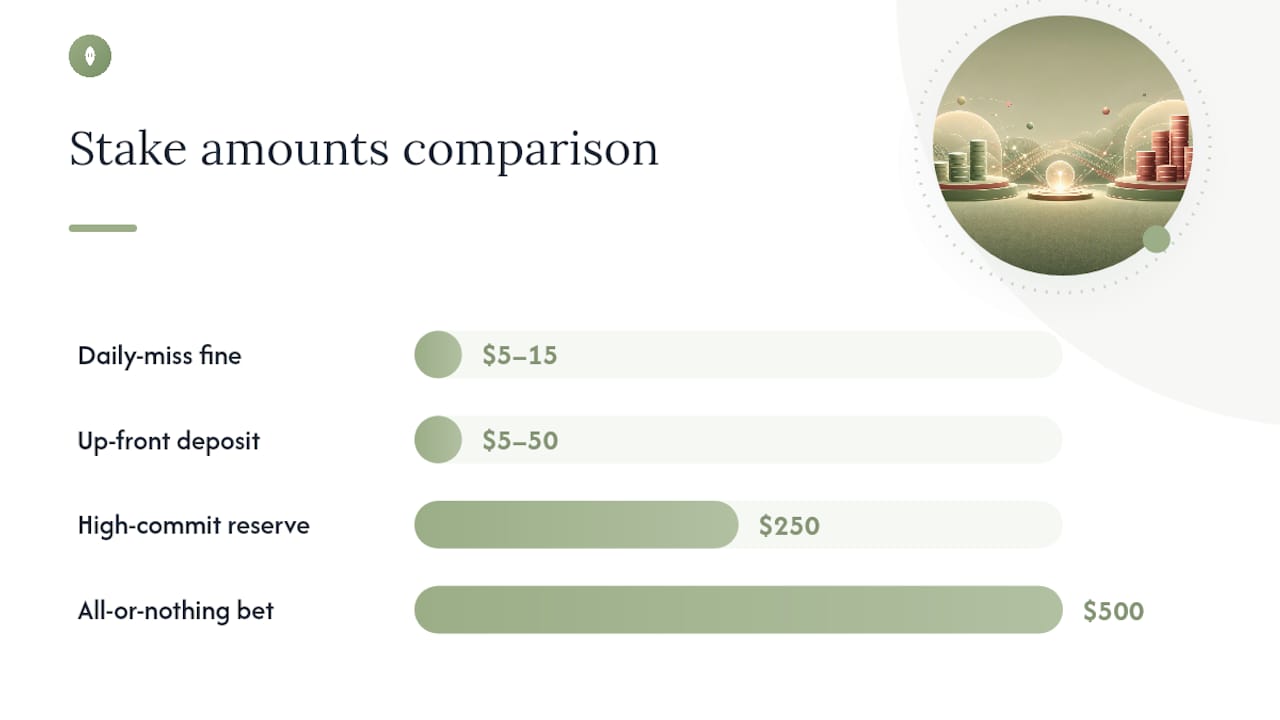
- For daily-miss fines, $5 to $15 per missed day is the sweet spot for most first-time challengers.
- For a single up-front deposit, $5 to $50 covers most habit-building goals; reserve amounts closer to $250 for high-commitment users tackling something they've failed at repeatedly.
- Choose 7 days when you're testing a script or unsure the habit fits your routine.
- Choose 21 days as your default. It matches the commonly cited habit-formation window and gives incentives enough time to work before effects taper.
- Choose 30 days when you're stacking multiple routines or need a stronger discipline reset.
- Build in one mulligan per week on 21 and 30 day challenges so a single rough morning doesn't end the whole attempt.
Smaller, consistent penalties tend to beat one giant bet. A $500 all-or-nothing deposit creates so much anxiety that people either avoid starting or quit the moment they slip once. Frequent smaller stakes create repeated feedback loops instead.
Pro Tip: Start every new affirmation script at the lowest stake in your comfort range. You can always escalate in week two once you know the habit is realistic for your schedule.
Verification Rules That Keep the Stake Honest
The reason FlourishOrForfeit and similar setups require typed affirmations instead of a checkbox is simple: typing forces active engagement, while a checkbox can be tapped in two seconds without a thought behind it. A randomized field experiment on incentive design found that how a scheme is structured, not just whether it exists, shapes both compliance and whether the habit sticks after the incentive ends.
Layer your verification to match your stake:
- Under $10/day: typed, timestamped entry is enough on its own.
- $10 to $50/day or deposits over $50: add SMS confirmation or a dashboard log as a second check.
- High-stakes or shared challenges: add a referee who reviews entries weekly, not daily, to avoid burning them out.
Set clear rules before day one: entries must be typed within a fixed window (say, before noon), no copy-pasting previous entries, and any dispute gets resolved with a screenshot or timestamp log rather than a verbal appeal. More friction means more accuracy, but too much friction means you quit the tracking before you quit the drinking, the scrolling, or whatever the affirmation targets. Match the verification weight to the stake, not to how motivated you feel on day one.
Writing Affirmations That Are Actually Verifiable
Keep every script under 20 words, written in the present tense, and tied to a specific action rather than a feeling. "I am confident" is unverifiable. "I spoke up once in today's meeting" is not.
- Anchor each script to a cue: a time of day, a location, or a trigger event.
- Require exact phrasing every day. Small wording drift is often the first sign someone's disengaging.
- Chain it: cue, then affirmation, then one small physical action (closing the laptop, standing up, texting a friend) so the typing isn't the whole ritual.
Example for productivity: "I closed my inbox by 10 a.m. and worked on my priority task." Example for confidence: "I made eye contact and spoke clearly in today's conversation."
Pro Tip: If you catch yourself softening the wording after a bad day, that's a signal to lower the stake, not the standard.
Tapering Off the Money Once the Habit Sticks
The Annual Reviews narrative on financial incentives notes that incentive effects can hold for months but tend to fade once the money disappears entirely and suddenly. The fix is a taper, not a cliff.
- Weeks 1 to 3: full stake, daily typed verification.
- Weeks 4 to 6: cut the stake in half, or switch from daily fines to a single end-of-week deposit.
- Week 7 onward: drop the money and replace it with a visible streak counter or a public commitment to a friend.
- If the streak breaks for more than three days, run a short 7-day deposit challenge again rather than restarting a full 21-day cycle from zero.
Swap in reflection prompts and habit chaining during the taper. Attach the old affirmation to a new habit you're building, and the routine carries itself forward once the consistency mechanics matter more than the fear of losing $10.
Choosing a Referee Who Won't Let You Off the Hook
A referee only works if they're willing to actually enforce the rules, which is harder than it sounds when the referee is a friend who likes you. The best referees are people with some distance from the outcome: a coworker in a different department, an online accountability partner you don't see socially, or a paid moderator on a platform that automates the check for you.
Set the terms before the challenge starts, not after the first missed day. Decide together what counts as valid proof (a timestamp, a photo, a typed log) and what doesn't. Ambiguity here is where most disputes start, and disputes are where accountability quietly dies.
Rotate or replace a referee who consistently waves through weak evidence. Friendship makes people lenient, and leniency defeats the entire point of a financial stake. If you can't find a strict-enough human, an automated dashboard log that timestamps entries removes the social awkwardness of policing a friend entirely. That's part of why deposit-and-collection research on commitment contracts, including smoking cessation studies from Poverty Action Lab, found that consistent contact and structured collection mattered as much as the size of the stake itself.
For lower-stakes challenges, self-verification with a single spot-check referee once a week is usually enough. For anything over $50 in total stake, use a second human check, not just software.
Where These Challenges Go Wrong
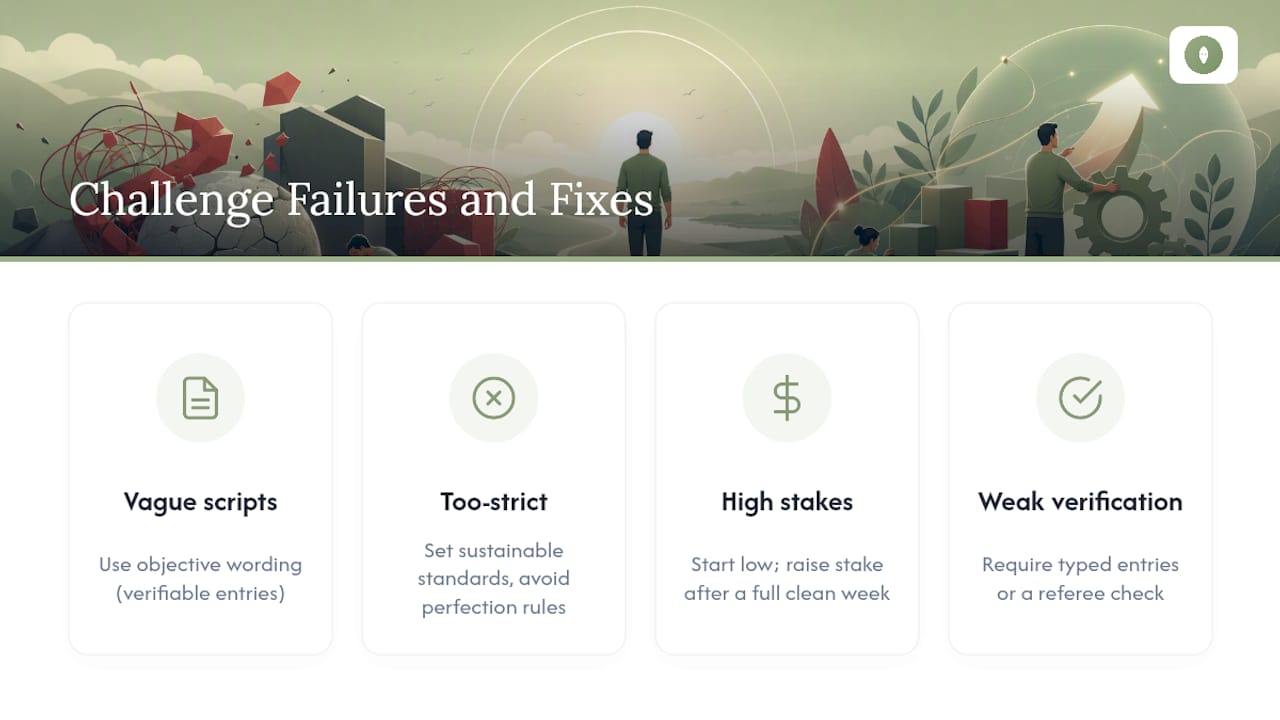
The most common failure isn't laziness. It's a script that's too vague to fail or too specific to sustain. "I am becoming a better person" can't be verified, so the typed entry becomes theater rather than accountability. On the other side, a script demanding perfection ("I will not check my phone once before noon") sets up an early break that tanks motivation for the whole month.
A second failure point: stakes set too high, too fast. Someone excited on day one commits $50 a day, misses day three, and quits the entire challenge rather than eating the loss. The fix is starting low and raising the stake only after a full week of clean entries.
Third, skipping the transition plan. People run a clean 21 days, the money disappears, and the habit disappears with it within two weeks. Meta-analytic research on incentive interventions shows effects can hold for months, but only when the design includes some kind of tapering rather than an abrupt stop.
Finally, weak or absent verification. A checkbox challenge without typed entries or a referee turns into an honor system, and honor systems fail exactly when discipline is weakest, which is the whole reason the stake existed in the first place.
What Actually Works: Real Patterns From Stake-Based Challenges
The clearest pattern across research on deposit contracts, including systematic reviews from UCL, is that short-term compliance jumps fast under a financial stake, and the people who keep the gains are the ones who paired the stake with objective tracking rather than a vague promise to themselves.
A writer who commits $10 per missed day toward a daily 300-word affirmation and word-count screenshot tends to outperform someone using the same affirmation with no stake at all, largely because the typed entry forces a moment of honest self-check every single day. Someone running a no-alcohol affirmation with a $20 per-miss stake and a referee reviewing entries weekly reports fewer relapses in month one than a no-stake control, mirroring the pattern found in commitment savings research on smoking cessation, where deposit collection and regular contact drove much of the effect.
The common thread in cases that hold past 30 days: the stake wasn't the whole plan. It was the ignition system for a routine that eventually ran on its own, backed by flexible incentive scheme research showing that how the reward structure tapers matters as much as how it starts.
Handling Money Stakes Legally and Ethically
Stake-based commitment contracts are private agreements between you and a platform, not gambling, since the outcome depends entirely on your own verified behavior rather than chance. Still, a few things matter before you put money on the line.
Use a platform with secure, Stripe-integrated payment processing so your stake is held and refunded through a regulated payment system rather than an informal peer-to-peer arrangement. Read the refund terms closely: a legitimate stake-based challenge refunds your full deposit on completion and only keeps the forfeited amount when you genuinely miss the verification requirement, not on a technicality.
There's an equity dimension too. A $50 deposit is a meaningful deterrent for one person and a rounding error for another, and a missed $250 stake could be a real financial strain for someone on a tight budget. Anyone stretching their budget to set a stake should start smaller. The mechanism works the same way at $5 as it does at $250. Only the risk changes.
Zack's Perspective: Where Stake-Based Challenges Break Down
The mistake I see most often is people treating the stake as the whole strategy instead of the ignition switch. A vague script, no referee, and a stake too big to sustain is a setup built to fail by day four. Deposit contracts can also be regressive: a $50 loss lands very differently depending on someone's paycheck, so I'd rather see someone on a tight budget try a $5 daily fine or a social commitment to a friend before they touch a bigger deposit. My rule of thumb is boring but it works: run a 7-day trial at the lowest stake that would still bother you if you lost it, then decide if 21 or 30 days is worth the bigger number.
— Zack
Start Your Own Stake-Based Affirmation Challenge
FlourishOrForfeit is built around exactly the setup this article recommends: pick a stake between $5 and $250, choose a duration of 7, 21, or 30 days, and type your affirmation word-for-word every day to keep the money you put down. Complete the challenge and you may get a refund; miss the verification and the stake is forfeited, with mulligan options built into longer challenges so one rough day doesn't end the run.
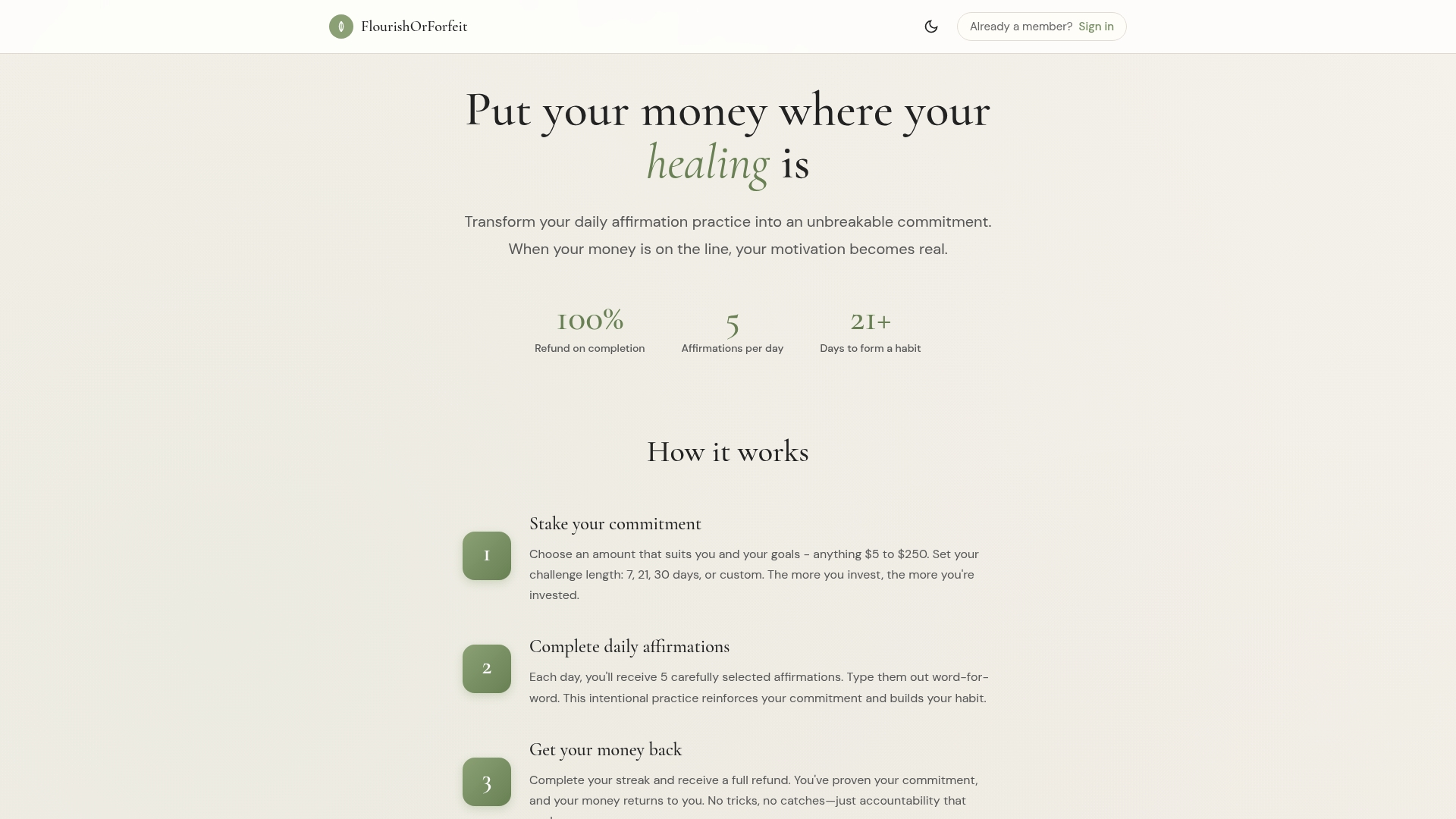
Getting started takes three steps: write your affirmation script, set your stake amount and duration, then choose typed verification with secure payment processing to hold the deposit. If you've read this far and already know which script you want to run, start a challenge on FlourishOrForfeit today and let the deposit do the work discipline alone hasn't.
Sources
- Spika et al., 2024 (commitment contract effects overview)
- Meta-analysis of incentive interventions (PubMed)
- Field experiment on incentive design and habit formation (PMC)
- Annual Reviews narrative on financial incentives for health behavior (2025)
FAQ
What Stake Amount Should Beginners Use?
Start with $5 to $15 per missed day, or a $5 to $50 refundable deposit, and raise it only after a full week of clean typed entries.
How Long Should a Challenge Last?
Use 7 days to test a new script, 21 days as the default habit-formation window, and 30 days for stacked routines or stronger discipline resets.
Why Does Typing the Affirmation Matter More Than Checking a Box?
Typing forces active engagement and creates a timestamped record, which makes self-deception far harder than tapping a passive checkbox.
What Happens if I Miss a Day on FlourishOrForfeit?
You forfeit the stake tied to that missed verification, though mulligan rules on longer challenges can forgive a limited number of missed days.
How Do I Keep the Habit After the Challenge Ends?
Taper the stake gradually over two to three weeks and replace it with a visible streak, a habit chain, or a public commitment before dropping the money entirely.