

A refundable deposit challenge is a prepaid stake, usually between $5 and $250, that gets returned in full if you complete a set run of daily habit actions and forfeited if you miss too many days. Research on deposit contracts shows this kind of financial commitment does boost short-to-medium-term follow-through, especially when the daily task is specific and someone else checks your work. Platforms like FlourishOrForfeit apply this exact structure to daily affirmations, pairing the stake with word-for-word typing and verification.
TL;DR:
- A stake of around $20 to $50 is usually enough to motivate behavior without causing excessive stress or anxiety.
- Short challenge periods of 7 to 21 days are most effective for establishing new habits, with longer durations offering diminishing returns.
- Verification methods like timestamped responses and designated referees are essential to prevent cheating and ensure fair tracking.
- The short-term effects of deposit contracts are proven, but habits often fade after the incentive ends unless reinforced with intrinsic motivation.
- Setting explicit, measurable daily goals and attaching them to existing routines greatly improves the chances of habit formation after the challenge concludes.
Table of Contents
- How Does a Refundable Deposit Challenge Actually Work?
- What Does the Research Say About Deposit Contracts?
- How Should You Pick Your Stake and Duration?
- How Do Platforms Prevent Cheating and Stay Fair?
- How Do You Keep the Habit After the Refund Comes Back?
- How FlourishOrForfeit Builds This Into a Real Challenge
- Ready to Start Your Own Challenge?
- Sources
How Does a Refundable Deposit Challenge Actually Work?
Signing up starts with two choices: how much to risk and how long to commit. Most platforms let you pick a stake within a common range and a duration of a few days to about a month, mirroring the timelines researchers use when they study deposit contracts. The three-week window shows up constantly in habit literature because it's long enough to build repetition but short enough to keep people engaged.
Once you're in, the daily requirement has to be unambiguous. On FlourishOrForfeit, that means typing an exact affirmation, word-for-word, rather than a vague "did I journal today" checkbox. Vague tasks are easy to fudge; verbatim typing isn't.
Verification is what separates a real commitment device from an honor system. Common methods include:
- SMS timestamp checks that log the exact moment you completed the task
- A designated referee or accountability partner who confirms completion
- Automated tracking through a dashboard that records daily activity
- Secure, Stripe-style payment processing that holds the stake until the challenge ends
Complete the full run and the stake comes back. Miss too many days and you forfeit it, though many programs build in a "mulligan," a limited number of skip days, especially on longer 21 or 30 day challenges where a single bad day shouldn't wreck the whole attempt.
What Does the Research Say About Deposit Contracts?
Deposit contracts work, but not indefinitely, and that distinction matters more than most habit apps let on. A National Institute for Health and Care Research review found financial incentives, including deposit-style contracts, produce a real short-term behavior shift, with pooled effects holding up for as long as 18 months in some cases (odds ratio 1.53). Past that window, the evidence gets thinner.
Statistic Callout: In a controlled experiment, households offered a financial commitment device increased their healthy grocery purchases by 3.5 percentage points compared to households given no such stake. That's a modest jump, but it happened purely because a stake was on the line.
A few patterns keep surfacing across the literature:
- Loss aversion, not the promise of a reward, is the engine. A behavioral-economics review points to the fear of losing money already committed as the core mechanism.
- Effects are strongest when the incentive is substantial enough to feel, delivered promptly, and tracked objectively, according to a 2025 narrative review of financial incentive studies.
- Persistence after the incentive disappears is inconsistent. Several field studies on exercise commitment contracts found gains often fade once the contract period ends unless something else keeps the habit alive.
None of that makes deposit challenges useless. It means they're a strong opening move, not a permanent fix.
How Should You Pick Your Stake and Duration?
Loss aversion doesn't require a huge number to work. A $20 stake can feel just as motivating as a $200 one if losing it would genuinely sting, and setting the amount too high risks turning a habit tool into a source of anxiety.
A few sizing rules help:
- Pick a stake that would annoy you to lose but wouldn't hurt your budget if it did.
- Start smaller ($5 to $25) if this is your first challenge, then raise the stake once you know your completion rate.
- Match duration to complexity: 7 days for a simple daily check-in, 21 days for building a genuine habit loop, 30 days for something you want to lock in before a specific date.
- Set explicit daily success criteria up front. "Type the affirmation before 9 a.m." beats "do it sometime today."
Pro Tip: If you're unsure which habit to anchor the challenge to, start with something you already do inconsistently, like a morning affirmation or a keystone habit, rather than inventing a brand-new routine from scratch.
People who seek out these challenges tend to already know they struggle with follow-through. Research on commitment devices shows demand clusters among people who recognize their own self-control gaps and go looking for external structure. If that sounds like you, the stake isn't a gimmick, it's doing exactly the job you need it to do.
How Do Platforms Prevent Cheating and Stay Fair?
Verification has to walk a line: strict enough to catch fakers, light enough that it doesn't feel like surveillance. The most workable systems tend to rely on methods that are hard to fake without being invasive, like time-stamped responses rather than a simple checkbox.
A short list of what a credible platform should offer:
- Timestamped logging. Every submission gets a timestamp so late or backdated entries are flagged automatically.
- A named verifier option. Some challenges let you designate a referee, a friend or family member who confirms completion through a text or email.
- Automated dashboard tracking. A running log of daily activity gives both the participant and the platform a clear record, reducing disputes about whether a day counted.
- Transparent forfeiture rules disclosed up front. You should know exactly what counts as a miss before you put money down, not after.
The trade-off is worth naming honestly: more verification means less friction for cheating but more visibility into your daily behavior. Read the fine print on what data a platform stores and for how long before you commit real money to a behavioral contract.
How Do You Keep the Habit After the Refund Comes Back?
The stake gets you started. Keeping the habit alive after your money comes back is a separate problem, and it's the one most challenges ignore.
Start with specificity. Write down the exact affirmation phrasing and the exact time of day you'll say it, and attach it to something you already do, brushing your teeth, making coffee, closing your laptop at night. Ambiguous timing is where most streaks quietly die.
During the challenge itself, a few tactics help completion rates:
- Set a daily reminder at the same time you complete the task, not a random hour.
- Tell one other person about the challenge. Social accountability adds a second layer of stakes beyond the money.
- Notice the pull of the goal-gradient effect: motivation tends to spike near the finish line, so plan your hardest days for the middle stretch, not the end.
Pro Tip: Before your challenge ends, decide in advance whether you'll run a second, lower-stake maintenance challenge or transition to no stake at all. Deciding on day 20 leaves you scrambling on day 21.
Once the refund lands, fade the financial scaffolding on purpose rather than letting it disappear by accident. Some people shift to intrinsic rewards. Others run a smaller follow-up challenge, at $5 or $10, just to bridge the gap. Either beats stopping cold, which is exactly when the research on habit slips suggests relapse risk climbs.
How FlourishOrForfeit Builds This Into a Real Challenge
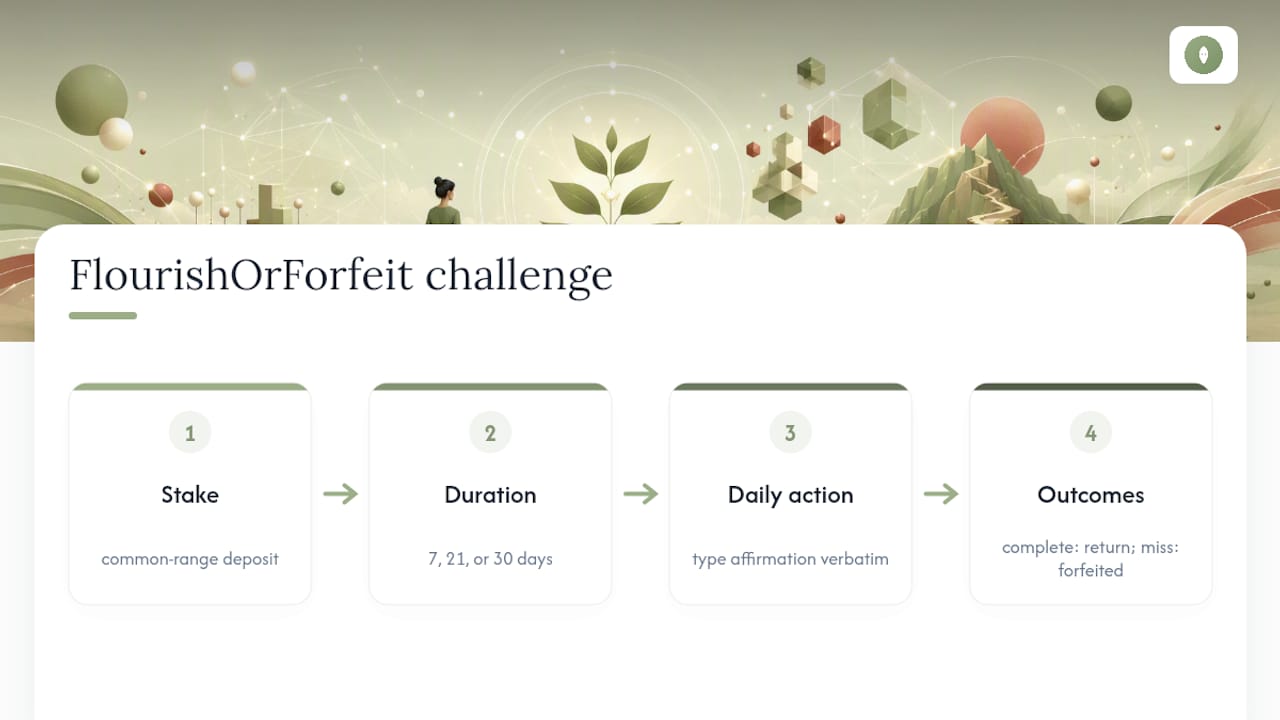
Some platforms run on a structure supported by evidence: a stake within a common range, a duration of 7, 21, or 30 days, and a daily requirement to type your affirmation word-for-word rather than just check a box. Complete the run and the full stake comes back; miss too many days and it's forfeited.
That maps directly onto what the research flags as effective design, measurable daily actions, objective tracking, and a stake substantial enough to matter. For readers who want to go deeper on the mechanics, the platform's posts on commitment deposits and end-of-challenge transitions cover the skip rules and the fade-out plan in more detail than a general overview can.
— Zack
Ready to Start Your Own Challenge?
Starting one is simple: pick a stake that would genuinely bother you to lose, choose a 7, 21, or 30 day window, and commit to typing your daily affirmation word-for-word. Verification happens automatically through the dashboard, and your full stake comes back the moment you finish.
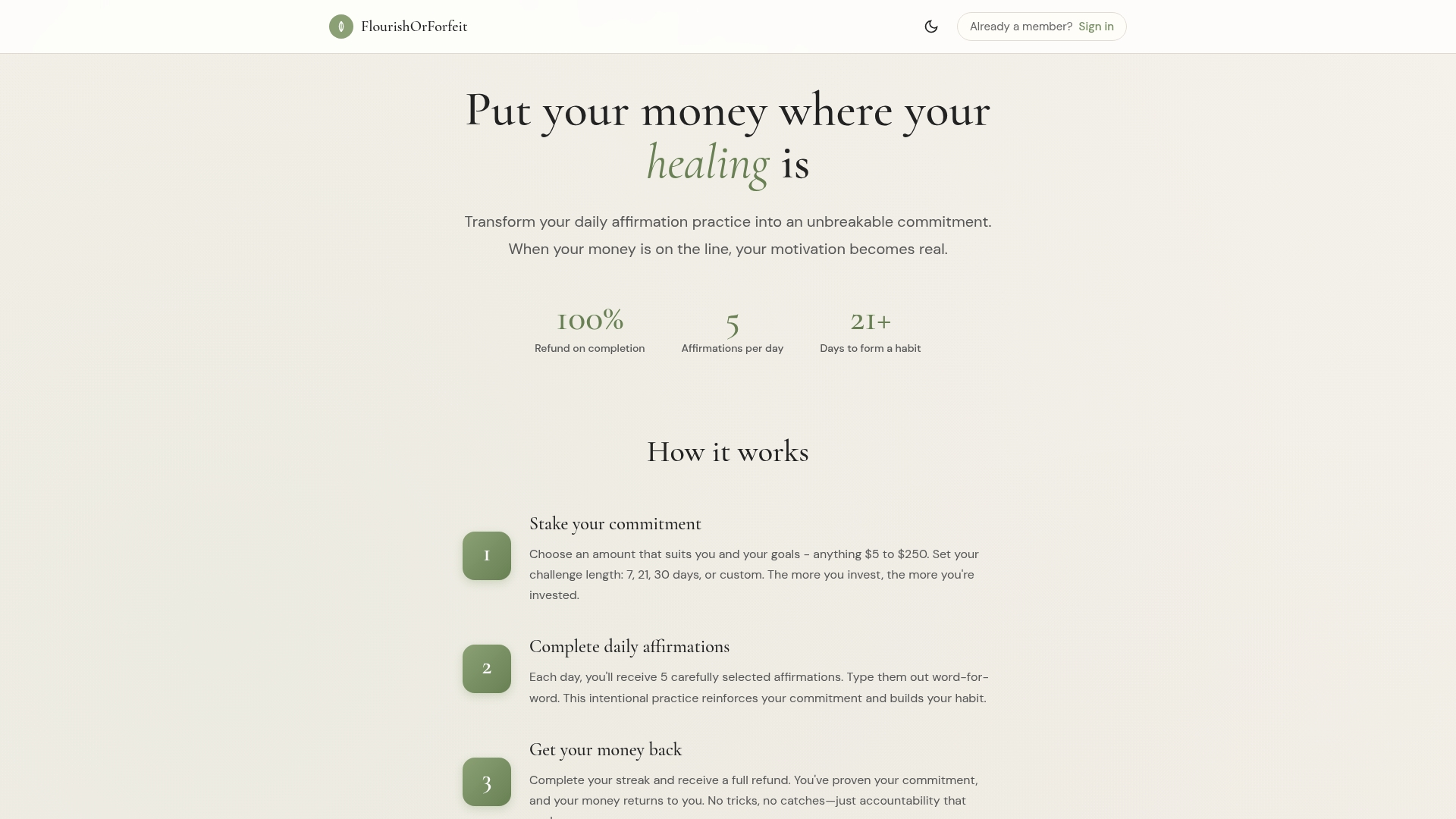
The one decision worth slowing down on is the stake itself. Too low and it won't register as a real loss; too high and you're adding stress instead of motivation. Somewhere in the $20 to $50 range works for most first-timers, based on the sizing logic covered earlier. If you want affirmation wording that's already built for a stake-based challenge, the growth mindset affirmation examples are a solid starting point.
When you're ready, start a challenge on FlourishOrForfeit and pick your stake and duration in a few minutes.
Sources
- NIHR alert: Financial incentives change health-related behaviour in the short term but effects may not be sustained
- Psychological Science study on commitment devices and healthy eating (2013)
- Changing health behaviors using financial incentives: a review from behavioral economics (2019)
- Effectiveness of financial incentives for health behavior change: narrative review and analysis (2025)
- People Don't Demand Commitment Devices Because... (Brandeis research output)