

The methods with the strongest track record are also the simplest: write if-then plans that pre-decide your response to obstacles, shrink your daily target until it's almost impossible to skip, track it with a visible streak, and add a partner, group, or short-term financial stake when you know you'll cut yourself slack alone. None of these require willpower reserves you don't have. They just remove the decision point where most people quit.
TL;DR:
- Setting small, daily behavioral units and tracking them consistently increases the likelihood of habit formation and reduces the chance of quitting.
- Implementation intentions are most effective for concrete, repeatable actions, especially for individuals with a high desire for self-control.
- Combining multiple methods, such as a plan, streak tracking, and an accountability partner, strengthens long-term commitment and prevents system failure.
- Public commitments and financial stakes can boost motivation but should be used primarily to initiate or reinforce specific short-term goals.
- Avoid common pitfalls like setting untrackable goals, punishing failure, overcomplicating systems, or interpreting a single missed day as failure.
Table of Contents
- What Self-Accountability Methods Are and Why They Work
- Practical Self-Accountability Methods You Can Start Today
- How to Choose the Right Setup for Your Goal
- What the Research Actually Supports
- Common Pitfalls That Sink Self-Accountability
- A Realistic Take on Timelines
- An Honest Alternative: Run a Commitment-Deposit Sprint
- Sources
What Self-Accountability Methods Are and Why They Work
Self-accountability means holding yourself to a commitment without anyone else checking in. External accountability puts that job on someone else, a boss, a coach, a deadline set by another person. The distinction matters because self-accountability fails in a specific way: you're both the one who sets the rule and the one who can break it without consequence, unless you build in structure that closes that gap.
That structure pays off in concrete ways. People who track their own follow-through tend to see:
- Better follow-through on tasks with no external deadline
- Faster habit formation because feedback is immediate instead of delayed
- Clearer priorities, since naming a commitment forces you to define it precisely
- Less procrastination, because vague intentions become specific triggers
- Improved well-being when accountability feels supportive instead of punishing
The research backing this isn't vague. Studies on self-concordant goals paired with implementation intentions found that people who set goals aligned with their real values, and then wrote specific if-then plans for pursuing them, showed significantly higher goal attainment than those who did either alone. The combination outperforms motivation by itself, which is a data point most goal-setting advice ignores entirely.
Practical Self-Accountability Methods You Can Start Today
Every method below is doable without an app, a coach, or a budget. Some work better solo. Others need another person or a bit of money on the line to bite. Here's the full toolkit, roughly ordered from lowest to highest structural intensity.
1. Implementation intentions (if-then plans)
An implementation intention is a sentence with a fixed structure: "When situation X happens, I will do behavior Y." Instead of "I'll exercise more," you write "When I finish my 9 a.m. call, I will put on running shoes before I check email." The specificity is the entire mechanism. It removes the split second where you'd normally negotiate with yourself.
This method helps almost everyone, but it helps one group most: people who score high on what researchers call Desire for Self-Control, meaning they want to control their impulses but often can't in the moment. Two experiments found implementation intentions boosted performance specifically for this group by pre-deciding the response to temptation, so there's nothing left to debate when the moment arrives.
The trade-off: if-then plans work best for concrete, repeatable actions. They're less useful for open-ended goals like "be more creative," where there's no clear trigger to attach the plan to.
2. Shrink the action, then track the streak
Pick the smallest version of the behavior that still counts. Not "write for an hour," but "open the document and write one sentence." Daily binary tracking, done or not done, beats vague weekly self-assessment because it removes the wiggle room that lets you round a half-effort up to a win. A streak counter, a wall calendar with X's, or a simple spreadsheet all work. The tool matters less than the rule: you check the box the same day, every day, with no retroactive editing.
Pair this with reflection habits that reinforce consistency over motivation, since the daily record is only useful if you actually look at it once a week and adjust.
3. Accountability partners
A partner works when the check-in has a fixed cadence and a fixed script. Vague "let's keep each other accountable" arrangements fade within two weeks because neither person knows what to report or when. A workable version: text your partner a single word, "done" or "missed," every night by 9 p.m. No explanations required unless you missed three days in a row, which triggers a five-minute call.
4. Small groups and habit huddles
A group of four to eight people, each posting a daily done/not-done update in a shared thread, tends to outperform private tracking for one reason: ambient visibility. You don't want to be the one name with three blank days next to it. Keep the group small enough that a missing post gets noticed, and set one rule: no judgment, just a "are you good?" nudge after a missed day.
5. Public commitments
Announcing a goal publicly, on social media, to your team, to family, can work as a one-time trigger for a big goal, but it has a documented downside: some people feel enough psychological relief from the announcement itself that follow-through drops. Use public commitments to kick off a specific sprint with a deadline, not as a substitute for a tracking system.
6. Commitment deposits and financial stakes
Putting money on the line works because it converts an abstract intention into a concrete cost. The research on commitment devices is consistent on one point: they work best as short, defined sprints with clear verification, not as permanent arrangements. A binary, easily verified behavior, did you show up, did you complete the task, holds up far better under a financial stake than a fuzzy goal like "eat healthier."
There's a secondary effect worth knowing about: stakes tend to push people toward more realistic goals rather than wildly ambitious ones, because nobody wants to lose money on a target they secretly knew was unreasonable. That recalibration, ironically, increases overall effort compared to setting an oversized goal with no consequence attached.
Platforms built around financial-stake behavioral contracts formalize this: you set the amount, the duration, and the verification method upfront, so there's no room to quietly lower the bar three days in.
7. Body doubling and environment design
Body doubling means working alongside another person, in person or on a video call, even if they're doing something unrelated. The presence alone reduces the friction of starting. Combine this with environment design: phone in another room, one tab open, a timer running. Neither method requires anyone's cooperation except your own willingness to remove obvious distractions before you start, not after you've already opened the fourth tab.
8. Layer two or three methods together
Single methods break under stress. The most durable setups combine layers: an if-then plan for when to start, a daily streak for tracking, and a partner or stake for the weeks motivation dips. Someone trying to write daily might pair "when I pour my morning coffee, I open my draft" with a streak tracker and a $25 stake on a 21-day sprint. Each layer catches what the others miss.
Pro Tip: Don't stack all three methods on day one. Start with an if-then plan and a streak for the first week, then add a partner or stake only once you've identified exactly where you tend to slip.
How to Choose the Right Setup for Your Goal
Start by being honest about which kind of person you are. Gretchen Rubin's Obliger framework is useful shorthand here: some people meet expectations easily when someone else is watching, but let their own deadlines slide. If that's you, skip straight to a partner, group, or stake. If you're self-directed and generally follow through on private commitments, a tracker and an if-then plan might be enough on their own.
From there, lock in three structural decisions before you start:
- Define the smallest daily unit of the behavior, small enough that skipping it feels obviously indefensible
- Pick one fixed place to report progress, a notes app, a shared doc, a partner text, and use it every day at the same time
- Schedule a five-minute weekly reflection to look at the full week's record, not just today
Decide in advance what a missed day means. Framing it as curiosity, "what got in the way today?" instead of punishment, improves persistence and reduces the shame response that usually causes people to quit entirely after one slip. A workable rule: after any miss, no judgment, just a same-day or next-day restart with no makeup attempts to erase the gap.
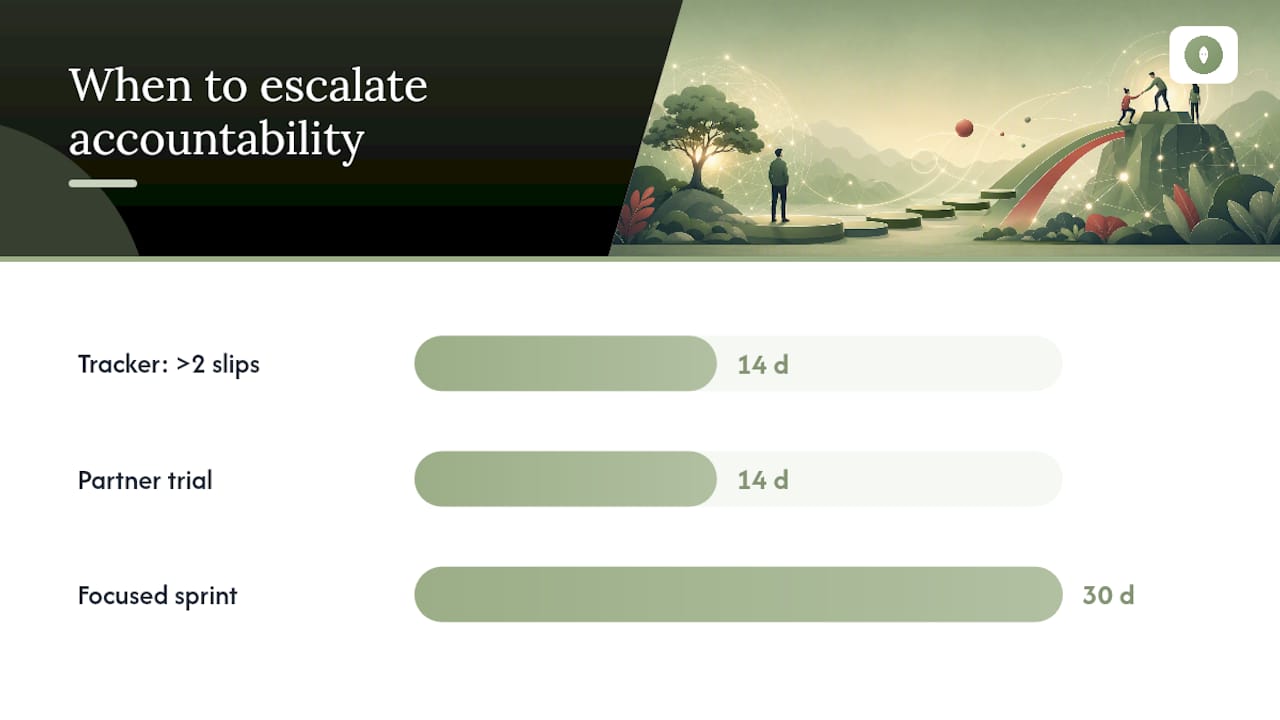
Escalate when the data tells you to, not when you feel guilty. If you've slipped more than twice in two weeks on a private tracker, add a partner. If two weeks with a partner still isn't sticking, run a focused 30-day sprint with a financial stake and daily verification, then reassess. Habit slip prevention works best as a specific re-entry plan you write down before the miss happens, not one you improvise in the moment.
What the Research Actually Supports
The strongest, most replicated finding in this space is the interaction between self-concordant goals and implementation intentions. Goals that reflect what you actually value, not what you think you should want, combined with a specific if-then plan for pursuing them, produced the highest short-term progress across multiple studies on personal goals, including New Year's resolutions.
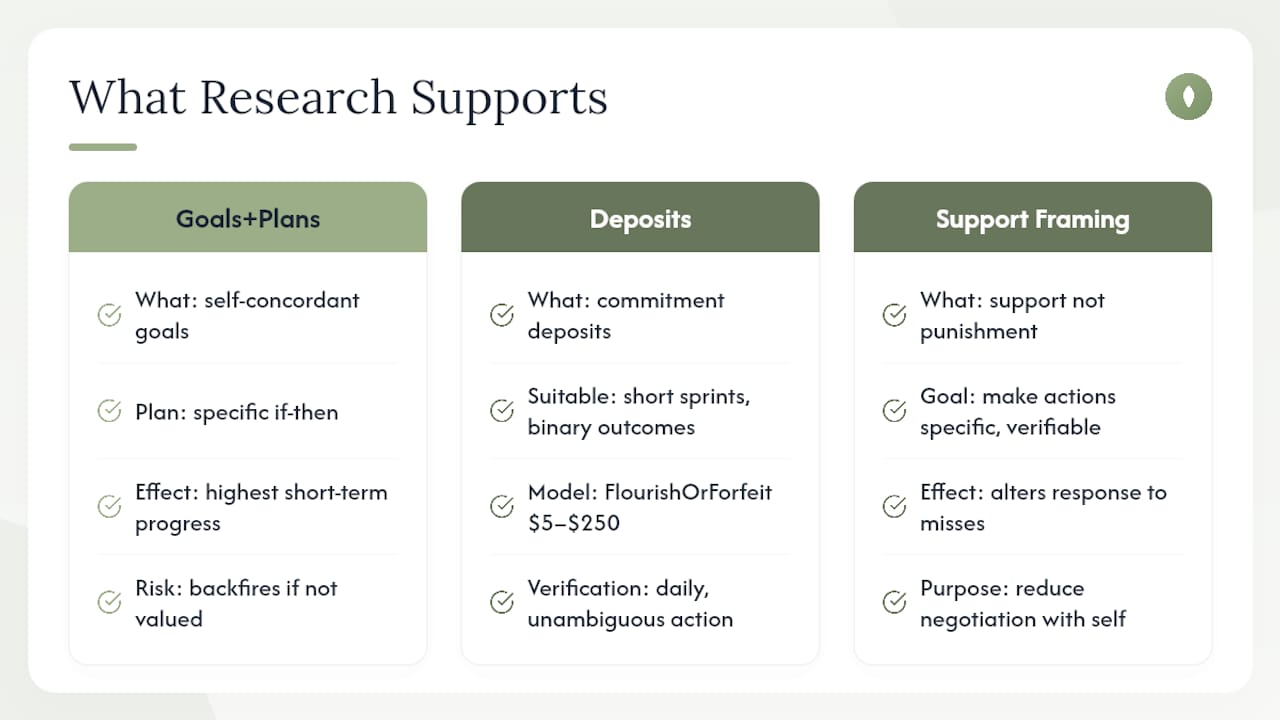
If-then plans help most when someone genuinely wants self-control but struggles to exercise it moment to moment. They can backfire when the goal itself isn't self-concordant, because a rigid plan attached to a goal you don't actually want just becomes another rule to resent.
Commitment deposits sit in a narrower but well-supported lane: short sprints, binary outcomes, real verification. FlourishOrForfeit's model, staking $5 to $250 on a 7, 21, or 30-day challenge with daily verification, is a direct real-world application of that research. It works because the behavior it verifies (typing an affirmation, word for word, every day) is unambiguous. There's no gray zone for "sort of did it."
Framing accountability as support rather than punishment changes how people respond to a missed day. The goal isn't to make failure expensive for its own sake. It's to make the daily action so specific and so verifiable that there's nothing left to negotiate with yourself about.
Common Pitfalls That Sink Self-Accountability
Most self-accountability systems don't fail because the method was wrong. They fail because of a handful of predictable mistakes.
The most common one is setting a goal too big to track daily. "Get healthier" gives you nothing to check off. Shrink it until the daily unit is embarrassingly small, then build up.
Second is treating a single miss as proof the system failed. One skipped day is data, not a verdict. Three consecutive skipped days without a re-entry plan is a genuine warning sign, and that's the actual threshold worth reacting to.
Third is choosing a tracking method that doesn't match your personality. Someone who thrives under social pressure but sets up a private spreadsheet will quietly abandon it within a month, then conclude "tracking doesn't work for me" instead of "I picked the wrong structure for who I am."
Fourth is stacking too many new systems at once, an app, a partner, a stake, a public post, all in week one. Complexity itself becomes the reason people quit, not the underlying habit.
Last is punitive self-talk after a miss, which research on welcoming accountability links to lower persistence, not higher. Curiosity about what went wrong keeps people in the game longer than guilt does.
A Realistic Take on Timelines
Most progress in self-accountability doesn't come from finding the perfect method on the first attempt. It comes from running a system for a couple of weeks, noticing exactly where it breaks, and adjusting one variable at a time. Treat your first 21 to 30 days as a test, not a verdict on your character.
Combine at least two methods from the start. An if-then plan without a way to track it fades from memory by day four. A streak without a trigger for when to act just becomes another guilt-inducing app icon. Iteration beats intensity every time.
— Zack
An Honest Alternative: Run a Commitment-Deposit Sprint
If you've tried a private tracker and a well-meaning partner text thread and still find yourself quietly letting the streak slide, a structured financial-commitment sprint closes the gap those looser methods leave open. Flourishorforfeit's model is straightforward: pick a stake between $5 and $250, choose a 7, 21, or 30-day challenge, and type five curated affirmations word-for-word each day, verified through the platform's tracking system. Finish the full run and you get a full refund. Miss days and forfeit the stake, with a mulligan built in for the longer challenges so one bad day doesn't sink a 30-day commitment.

This setup fits a specific situation best: a short-term push where procrastination has already beaten you a few times, or a stretch where you don't have a partner or group available to hold the social-accountability layer. It's blunt by design, which is exactly why it works for binary, verifiable actions. Pair it with the daily streak habits and reflection routine covered earlier for the best retention once your sprint ends. Set your stake and start your first challenge on FlourishOrForfeit today.
Sources
- Attaining Personal Goals: Self-Concordance Plus Implementation Intentions Equals Success
- Desire for self-control and task performance: A plan is a key
- 5 Habit Accountability Systems Compared: Which One Actually Works?
- Psychology research on welcoming accountability