

Set your stake at whatever dollar figure would genuinely bother you to lose, then match it to your challenge length: light stakes ($5–$25) for a 7-day test run, moderate ($25–$100) for 21 days, higher ($75–$250) only once you've already finished one challenge. FlourishOrForfeit refunds the full amount on completion and keeps it only if you forfeit, so the number you pick is a motivation lever, not a real financial risk if you follow through.
TL;DR:
- A stake between 1 and 3 percent of monthly income is a good starting point for a 21-day challenge, typically ranging from $40 to $120.
- The challenge's duration dictates the stake size, with 7 days requiring lighter stakes and 30 days demanding higher, more serious commitments.
- Refunds are full upon challenge completion, so the real financial risk usually only occurs if you miss days and forfeit the stake.
- Higher stakes can be adjusted upward after successful challenges, but should be scaled gradually to avoid discouragement or financial strain.
- Using skip-day allowances and setting reminders helps prevent accidental forfeits and supports habit consistency during the challenge.
Table of Contents
- How to Calibrate Your Stake by Duration and Budget
- Why Staking Money Actually Changes Behavior
- Three Stake Templates You Can Copy Today
- What Happens if You Miss a Day
- Adjusting Your Stake Between Challenges
- Why I Tell People to Start Smaller Than They Want To
- Start Your First Challenge on FlourishOrForfeit
- Sources
How to Calibrate Your Stake by Duration and Budget
The stake amount you choose has one job: make skipping a day feel expensive enough to avoid, without making the challenge itself feel like a gamble you can't afford to lose. That balance shifts depending on how long you're committing for and what your monthly budget actually looks like.
Here's a workflow that keeps the number honest instead of arbitrary:
- Start with your challenge length. A 7 day challenge is a trial run, so keep the stake small enough that losing it stings but doesn't disrupt your week. A 21 day challenge, the length tied to classic habit-formation research, deserves a stake that feels serious enough to carry you through the mid-challenge slump around day 10 to 14. A 30 day challenge is the highest commitment tier, so the stake should reflect real intent to finish, not just curiosity.
- Run the affordability checklist. Cover essentials and your emergency buffer before you touch a stake amount. Never fund a challenge with money earmarked for rent, debt payments, or savings goals you can't skip.
- Run the motivation checklist. Ask yourself what dollar loss would actually change your behavior tomorrow morning. If $10 wouldn't register, it's too low. If $150 kept you up at night, it's too high for a first attempt.
- Check the downside. Because FlourishOrForfeit refunds the full stake on completion, your real exposure is only the amount you'd forfeit by missing days, not the total pledged. That changes the math: you're pricing the cost of your own follow-through, not the cost of participating.
A useful heuristic from goal-design research: aim for roughly 1 to 3 percent of monthly income as a starting stake. It's rough, but it keeps the number tied to something real instead of a guess.
Why Staking Money Actually Changes Behavior
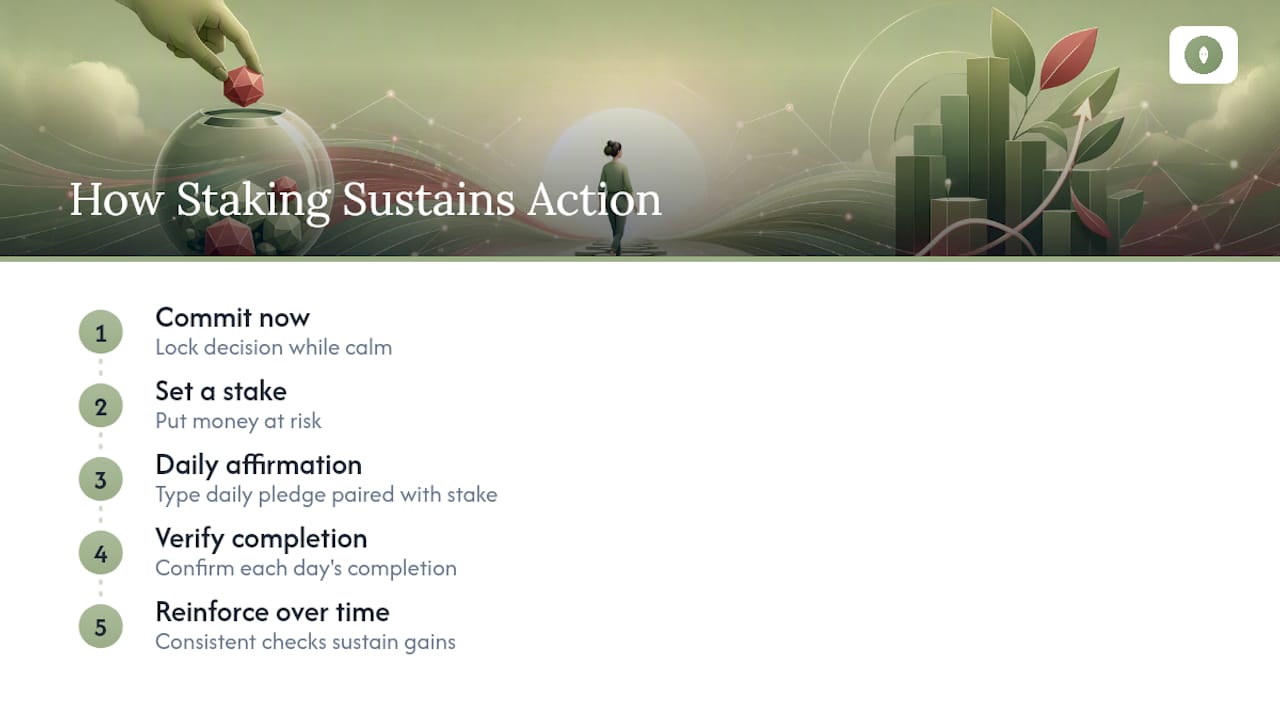
Commitment contracts work because they solve a timing problem, not a willpower problem. When you're calm and motivated today, you can lock in a decision that your tired, distracted future self would otherwise talk you out of. Researchers call this time inconsistency, and NBER's randomized trial on exercise commitment contracts found that nudges affecting contract length changed how long people committed for, without making them less likely to sign up in the first place.
The catch is durability. A systematic review in Preventive Medicine found financial incentives reliably boost short-term behavior change, but the effect often fades once the incentive disappears. What holds the gains in place afterward is design: how certain the penalty is, whether completion gets verified, and how often you're reinforced. A stake you check once a week does less than one you confirm daily, which is part of why daily typed affirmations paired with a stake outperform a vague "I'll try" pledge.
Three Stake Templates You Can Copy Today
Rather than guessing, start from one of these three templates and adjust based on your own affordability and motivation checklist.
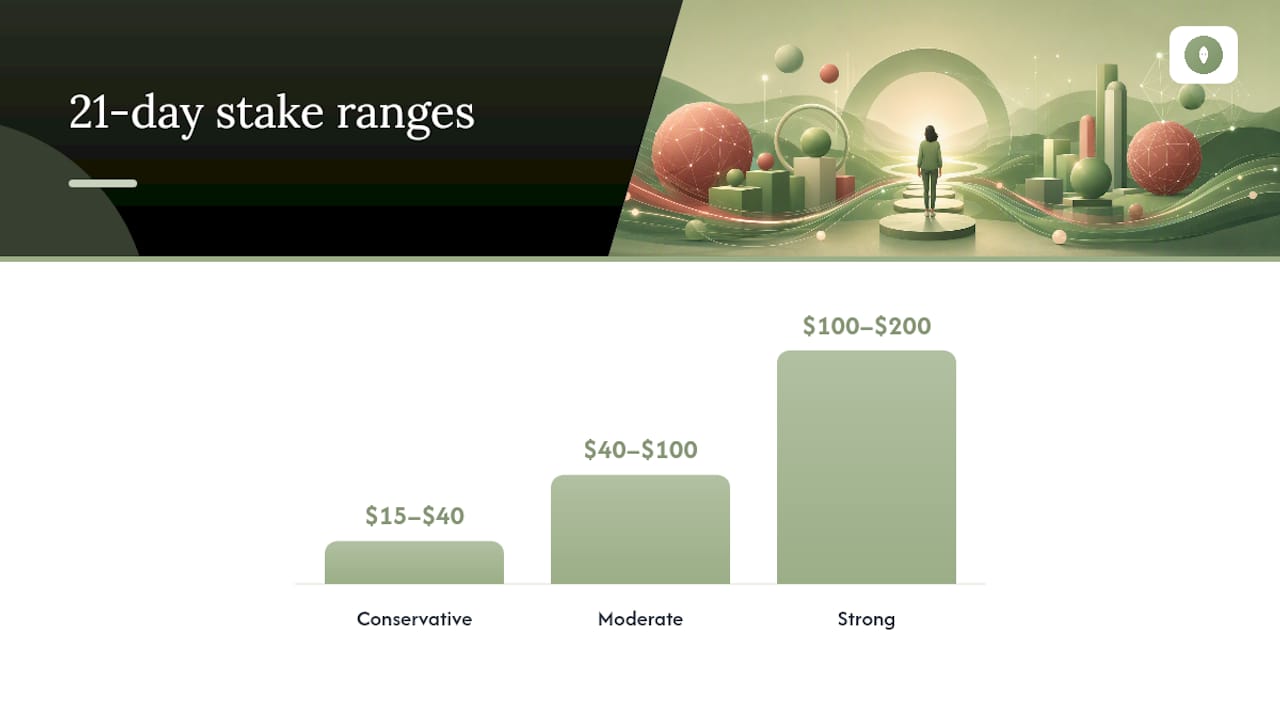
- Conservative: $5–$15 for 7 days, $15–$40 for 21 days, $40–$75 for 30 days. Good for a first challenge or a tight budget month.
- Moderate: $15–$30 for 7 days, $40–$100 for 21 days, $75–$150 for 30 days. Fits most people testing a new habit like daily affirmations or a meditation practice.
- Strong: $30–$75 for 7 days, $100–$200 for 21 days, $150–$250 for 30 days. Reserved for a second or third challenge, once you've already proven you can finish one.
Pro Tip: If your monthly take-home pay is $4,000, a 1 to 3 percent stake lands between $40 and $120, which slots neatly into the moderate template for a 21 day challenge.
A writer starting a 21 day affirmation habit around confidence scripts might pick $50. A busy professional stacking a meditation challenge onto an already full schedule might pick $75 for 30 days, since the higher stake compensates for the higher risk of a missed morning.
What Happens if You Miss a Day
Stake size should account for how forgiving the challenge structure is. FlourishOrForfeit's skip-day and streak-freeze options exist so one bad morning doesn't automatically cost you the entire stake, which means you can set a slightly higher amount than you would on an all-or-nothing system.
Still, plan for the slip before it happens:
- Check whether a skip-day allowance or mulligan applies before assuming you've forfeited anything.
- If you genuinely miss without an allowance left, treat it as data. Restart with a smaller stake next time rather than doubling down out of frustration.
- Watch for commitment fatigue. Stacking three high-stake challenges back to back tends to backfire; space them out.
Pro Tip: Set a calendar reminder 30 minutes before your usual affirmation time during the first week. Most missed days happen from forgetting, not from unwillingness.
Adjusting Your Stake Between Challenges
Treat your stake like a variable, not a fixed identity. Once you've completed a challenge, you have real evidence about what motivates you.
- Increase gradually after a completed challenge. Bump up by one template tier, not by maxing out to $250 immediately.
- Lower your stake if it's causing financial strain or if the habit already feels automatic. The stake's job is to build the habit, not to punish you once it's formed.
- Test higher amounts with a split trial. Run a short 7 day challenge at a higher stake before committing that amount to a full 30 day cycle.
Why I Tell People to Start Smaller Than They Want To
Most people want to prove something to themselves on the first try, so they pick a stake that's too aggressive. I'd rather see someone finish a $15, 7 day challenge and feel the refund hit their account than forfeit $150 because they overcommitted before they knew their own follow-through. FlourishOrForfeit's range, from $5 to $250 across 7, 21, or 30 days, exists precisely so you can scale up once you've earned the confidence, not before.
— Zack
Start Your First Challenge on FlourishOrForfeit
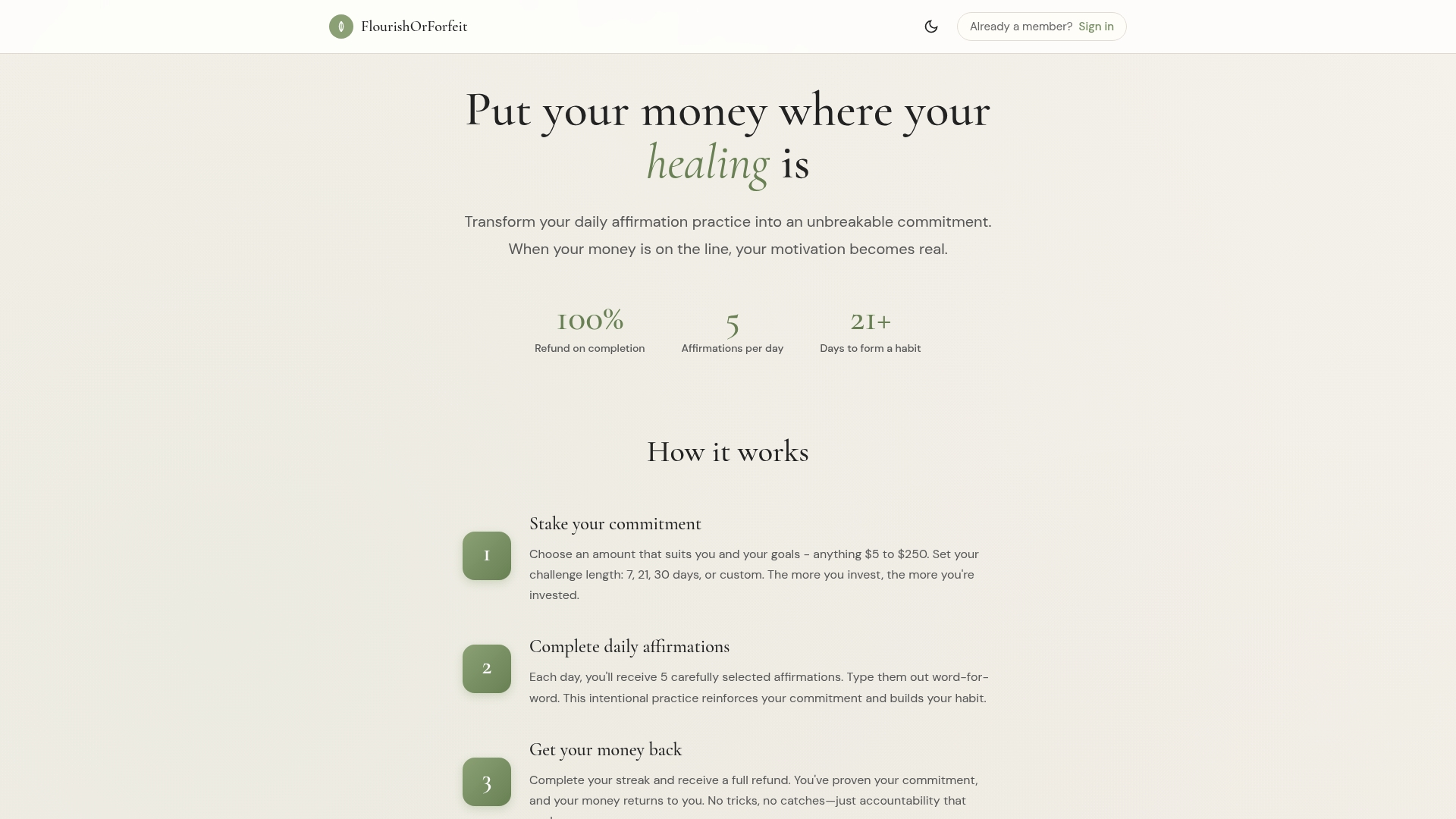
FlourishOrForfeit is the direct way to turn the calibration method above into an actual challenge, not just a plan. Pick a stake anywhere from $5 to $250, choose a 7, 21, or 30 day duration, and type your affirmations daily through secure, Stripe-backed payments. Finish, and you get a full refund. Miss too many days, and the forfeited stake becomes the cost of the lesson.
If you're still unsure where to start, the commitment deposit breakdown walks through the psychology behind why staking works, and the behavioral-contracts guide covers skip-day rules in more depth. When you're ready, start your first challenge with a conservative stake and see how it feels to get your money back for keeping a promise to yourself.
Sources
- Nudges in Exercise Commitment Contracts: A Randomized Trial (NBER working paper)
- Effects of financial incentives on behavior change: systematic review (Preventive Medicine, 2015)