

A keystone habit is a single routine that pulls a chain of other behaviors into place behind it. The strongest candidates on any keystone habits list are exercise, consistent sleep timing, short daily meditation, journaling, and making your bed. Each one is small enough to start today, and each tends to reorganize the habits around it. What follows is the list, a way to pick your one starting habit, and a method for installing it.
TL;DR:
- Exercise, sleep regularity, and meditation have the strongest evidence for triggering positive ripple effects across mood, behavior, and emotional regulation.
- Picking a habit with measurable, consistent execution and attaching it to existing routines increases the likelihood of long-term adoption.
- A 30-day minimum trial run is essential to determine whether the keystone habit creates noticeable behavioral improvements, given the median formation time of 66 days.
- Using stakes or accountability tools like money on the line significantly boosts consistency and reduces the risk of quitting early in habit formation.
- Habit formation timelines vary widely, with some individuals establishing automaticity in as little as 18 days and others taking over a year.
Table of Contents
- Keystone Habits List: 9 Options And Their Ripple Effects
- How Do You Choose Your Keystone Habit?
- How To Install A Keystone Habit In 4 Steps
- What Does The Research Actually Say About Habit Timelines?
- What I've Learned Watching People Try This
- Put A Real Stake Behind Your Trial
- Sources
Keystone Habits List: 9 Options And Their Ripple Effects
Not every habit on a generic list deserves your time. The ones below earn their spot because they're small, repeatable, and tend to drag other behaviors along with them.
- Exercise. Definition: any regular movement practice, from a 20-minute walk to a lifting session. Cascade effect: people who start exercising often see spontaneous drops in smoking and drinking, along with better emotional control. Try: lay out your workout clothes the night before so the first move requires zero decisions.
- Consistent sleep timing. Definition: going to bed and waking up within the same 30-minute window daily. Cascade effect: steadier energy reduces impulsive eating and improves focus during the day. Try: set a phone alarm labeled "wind down" 30 minutes before your target bedtime.
- Short daily meditation. Definition: 10 to 20 minutes of focused breathing or guided practice. Cascade effect: reliably improves attention and emotional regulation, which reduces impulsive reactions to cravings and stress. Try: sit in the same chair each morning before checking your phone.
- Journaling or planning your day. Definition: writing a short daily entry or listing your top three priorities. Cascade effect: clarifies decisions before the day gets noisy, which cuts down on reactive choices later. Try: keep the notebook open on your desk, not in a drawer.
- Making your bed. Definition: straightening your bedding within minutes of waking. Cascade effect: gives you one guaranteed win before 7 a.m., which tends to nudge follow-through on other small tasks. Try: pair it directly with turning off your alarm, no gap in between.
- Family dinners. Definition: eating one meal together, phone-free, most days of the week. Cascade effect: strengthens communication habits and often improves food choices for everyone at the table. Try: pick one recurring night, like Sunday, as the non-negotiable anchor.
- Daily reading. Definition: 15 to 30 minutes of reading, fiction or nonfiction. Cascade effect: builds a wind-down ritual that competes directly with late-night scrolling. Try: leave the book on your pillow so it's the last thing you see.
- Expense or financial check-in. Definition: a five-minute daily or weekly look at spending. Cascade effect: financial awareness tends to sharpen decision-making in other areas, since you're already practicing delayed gratification. Try: check your balance at the same time you check the weather.
- Planning or priming the day. Definition: a two-minute preview of your calendar and top task before you start work. Cascade effect: reduces the scramble that leads to skipped workouts or rushed meals. Try: do it with coffee in hand, before opening email.
Reviews of keystone habit research consistently point to exercise, sleep regularity, and meditation as the three with the strongest documented ripple effects on mood and behavior. That doesn't mean the others don't count. It means those three have the most evidence behind them.
How Do You Choose Your Keystone Habit?
Picking from a list is the easy part. Picking the right one for you takes a little more honesty. Ask yourself these four questions:
- Which behavior, when done, creates multiple downstream wins? Think about the one action that, on the days you do it, makes everything else easier.
- Which habit do you almost start but stop? That hesitation usually points to something you already know matters.
- Which habit aligns with the identity you want? Someone who sees themselves as disciplined gravitates toward different anchors than someone who values calm.
- Which habit is frequent and fits your daily rhythm? A habit you can only do on weekends won't build the same momentum as one that fits every day.
Run your answers through a short checklist: does it happen often enough to matter, does it touch more than one area of your life, can you measure it in a simple way, and is it low enough friction that you'll actually do it on a bad day?
Pro Tip: Pick the habit that's easiest to measure with a yes or no. "Did I go to the gym" beats "did I feel more productive" every time, because ambiguous wins are easy to talk yourself out of.

Once you've landed on one, commit to a 30 to 60 day trial before you touch anything else. Adding two or three new habits at once is the fastest way to abandon all of them by week two.

How To Install A Keystone Habit In 4 Steps
Choosing the habit is half the work. Installing it so it actually sticks is the other half, and this is where most people quietly fail.
- Anchor it with habit stacking. Attach the new habit to something you already do without thinking, like brushing your teeth or starting the coffee maker. The existing routine becomes the trigger for the new one.
- Redesign your environment to cut friction. Put the running shoes by the door, the journal on the pillow, the meditation app open on your home screen. Every extra step between you and the habit is a chance to skip it.
- Run a focused trial, minimum 30 days. Phillippa Lally's research found the median time for a behavior to become automatic was 66 days, with individual results ranging from 18 to 254 days depending on the person and the habit. Thirty days won't guarantee automaticity, but it's long enough to see whether the cascade effect is showing up.
- Only add a new habit after this one stabilizes. Stability means you do it without negotiating with yourself most days of the week.
For your trial plan, keep it simple: one daily micro-goal (10 minutes of meditation, not "meditate more"), one metric to track (a checkmark on a calendar), and a five-minute weekly review where you ask what worked and what didn't. Tracking ideas that actually hold up include a paper calendar with X's, a habit-tracking app, a one-line nightly journal entry, or an accountability partner who checks in. Some people track better with money on the line than with a calendar alone, since a financial stake changes how seriously the habit gets treated.
What Does The Research Actually Say About Habit Timelines?
The idea that habits form in 21 days is a myth that refuses to die. Lally and her colleagues tracked real participants building new routines and found a median of 66 days to reach automaticity, with a range stretching from 18 to 254 days. That spread matters: your keystone habit might click in three weeks or three months, and both are normal.
- The term "keystone habit" comes from Charles Duhigg's The Power of Habit, where he describes how small wins create momentum that spreads into unrelated areas of life.
- Exercise has shown correlations with reduced smoking and drinking in some studies of people who start a new fitness routine, alongside better emotional regulation.
- Consistent sleep timing and short daily meditation both show up repeatedly in reviews as reliable ripple-effect habits.
- Duhigg himself cautions that keystone effects are personal. The habit that transforms one person's routine might do nothing for someone else, so treat your first pick as a test, not a permanent verdict.
What I've Learned Watching People Try This
The people who succeed rarely pick the most impressive habit. They pick the one that's easiest to measure and hardest to fake, then they run a real trial instead of a vague intention. Someone might choose making the bed, track it for 30 days on a wall calendar, and notice by week three that they're also skipping fewer workouts. That's the cascade showing up in real time, not in theory. Tools like Flourishorforfeit work for people who need a stake in the outcome to stay honest with themselves. The habit you pick matters less than whether you actually finish the trial.
— Zack
Put A Real Stake Behind Your Trial
A calendar with checkmarks works until the week gets busy and the checkmarks stop. Flourishorforfeit gives your keystone habit trial something a calendar can't: real money on the line. You choose a stake between $5 and $250, pick a challenge length of 7, 21, or 30 days, and type five curated affirmations word-for-word each day to reinforce the identity shift behind your new habit.
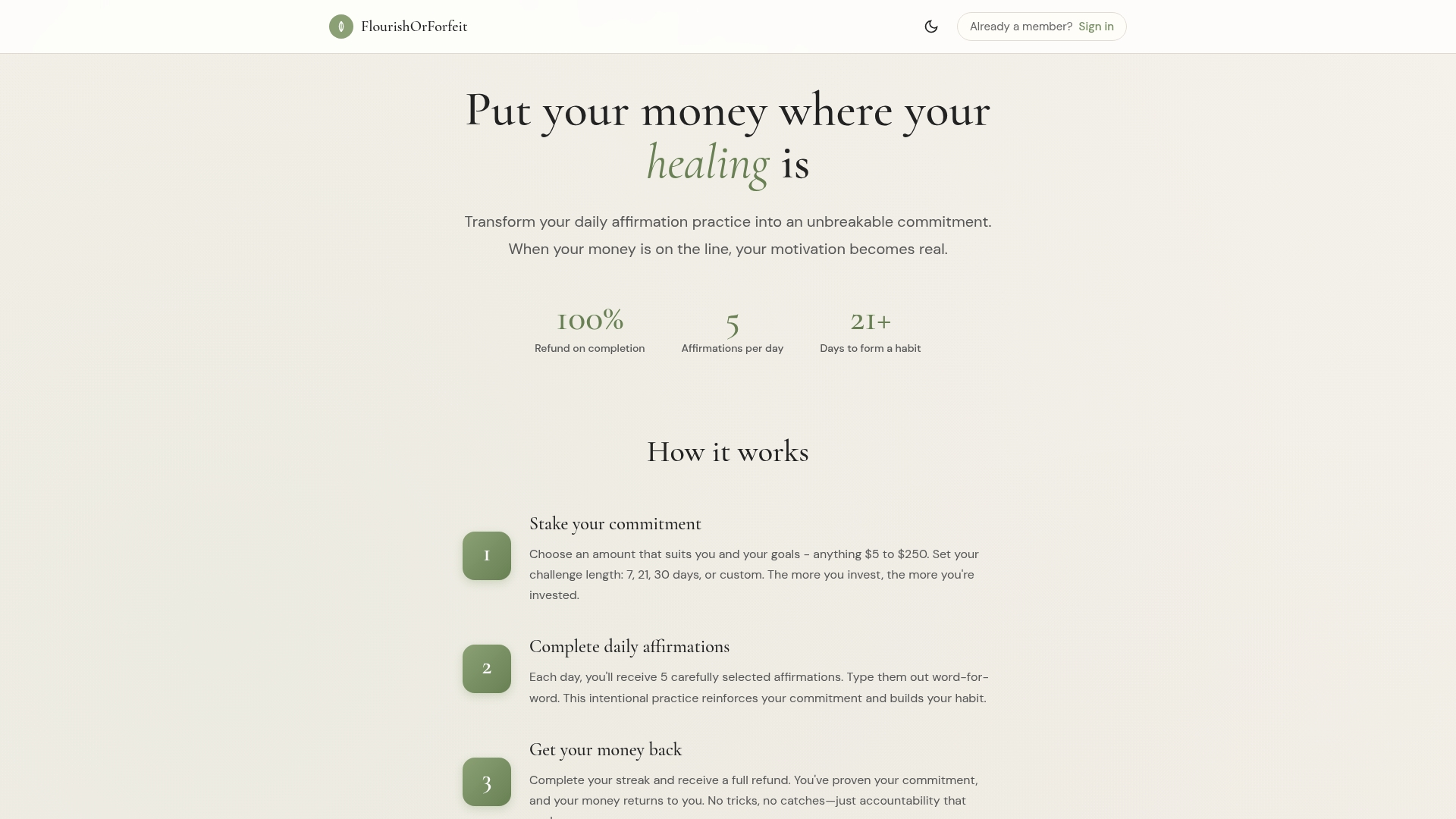
It maps directly onto the trial plan above. Pick your one habit, set a stake you'd actually feel losing, and run the challenge. Complete every day and you get a full refund; miss too many and you forfeit the stake, which is exactly the kind of friction that keeps a 30-day trial from quietly dying in week two. If you're ready to stop relying on willpower alone, start your challenge on Flourishorforfeit and put your first keystone habit to a real test.