

Short, present-tense affirmations paired with an immediate micro-action reliably increase the chance you start and finish tasks. Say the line, then trigger action with the 3-2-1 method, do one minute of work, and register the relief. That sequence, backed by fMRI research on self-affirmation and reinforced by stake-based tools like Flourishorforfeit, beats generic positive thinking on its own.
TL;DR:
- Specific, action-oriented affirmations linked to micro-actions significantly increase task initiation and completion.
- Pairing affirmations with a quick countdown and a 1-10 minute micro-task creates measurable momentum and relief.
- Reinforcing the routine with visible logging and timing cues boosts consistency and prevents affirmations from becoming hollow.
- Brain imaging shows that affirmations activate decision-related regions, but success depends on their connection to behavior, not just repetition.
- Using stakes or accountability platforms like Flourishorforfeit can help sustain habits longer than solo practice.
Table of Contents
- Affirmations for Procrastination, Sorted by What You Actually Need
- How to Practice Affirmations So They Overcome Procrastination
- What the Research Says About Affirmations and Action Triggers
- Common Mistakes That Make Affirmations Backfire
- Three Routines You Can Start Today
- Why I Think Accountability Beats Willpower Alone
- Turn Your Affirmation Practice Into a Funded Commitment
- Sources
Affirmations for Procrastination, Sorted by What You Actually Need
Vague "I am productive" lines rarely move you. What works is language specific enough that your brain can act on it in the next ten seconds. Here are 35 affirmations for procrastination grouped by function, not mood.
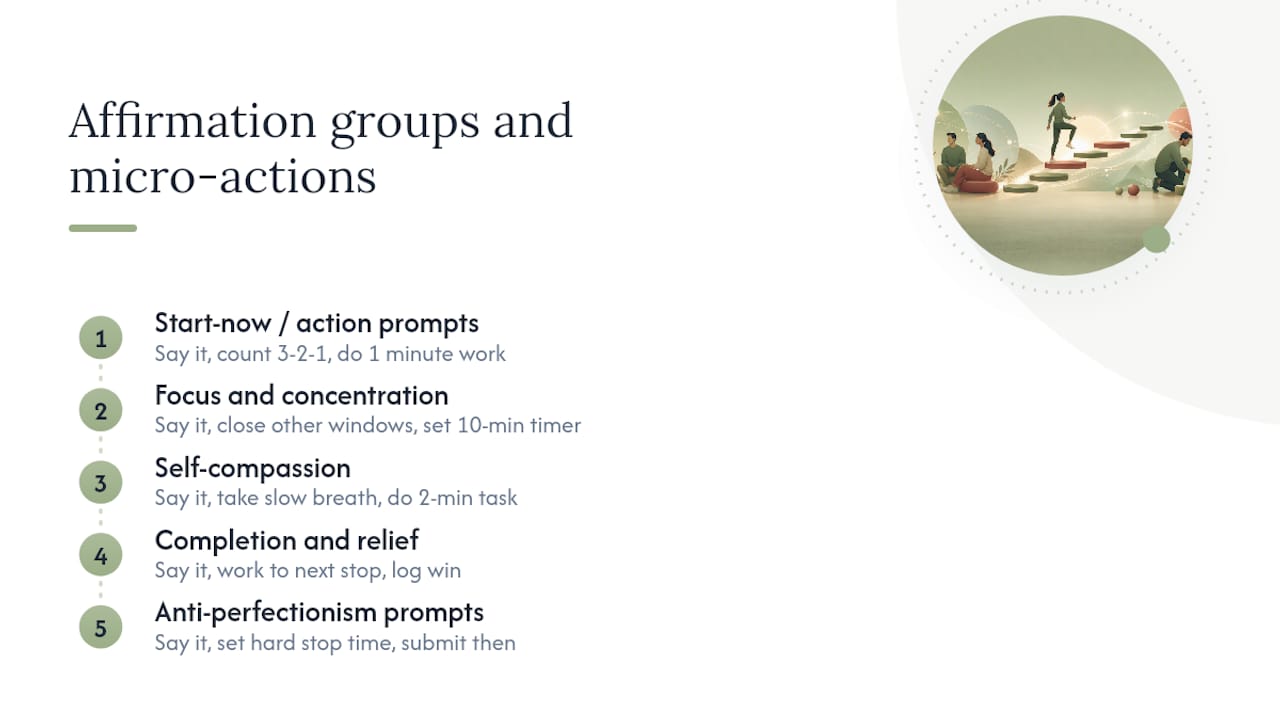
1. Start-now / action prompts — for when you're stalled at the edge of a task. "I do the first ugly step now." "I open the file and type one sentence." "I choose action over rehearsal." "Three, two, one, I begin." "I start before I feel ready." "One small move counts as progress." "I act now so I rest later." Micro-action: say it once, count 3-2-1, and do one minute of work before you're allowed to stop.
2. Focus and concentration — for when you're distracted mid-task. "I finish this thought before I check my phone." "My attention belongs to this task for the next ten minutes." "I return to the page, not the tab." "This is the only thing that matters right now." "I protect this block of time." Micro-action: say it, close every other window, and set a 10-minute timer before touching anything else.
3. Self-compassion (reduce shame) — for when guilt about delay is the real blocker. "Delaying doesn't erase my ability to finish." "I've recovered from a slow start before." "I'm allowed to begin imperfectly." "This task doesn't define my worth." "I treat myself like someone worth coaching, not punishing." Micro-action: say it, take one slow breath, then move straight into a two-minute task.
4. Completion and relief — for pushing through the final stretch. "I choose the relief of finishing over the comfort of avoiding." "One more push and this is off my list." "Future me is grateful I closed this today." "Finishing feels better than escaping ever did." "I'm closer to done than I was five minutes ago." Micro-action: say it, work until the next natural stopping point, then log the win immediately.
5. Anti-perfectionism prompts — for tasks you keep polishing instead of shipping. "Done is more valuable than perfect right now." "I can revise later; I can't revise anything." "Good enough moves me forward." "I release this version and improve the next one." "Progress beats a flawless draft that never ships." Micro-action: say it, set a hard stop time, and submit or send at that time no matter what.
How to Practice Affirmations So They Overcome Procrastination
Affirmations only work when they're wired to behavior, not repeated like a mantra in isolation. Here's the sequence that turns words into momentum:
- Pick one affirmation that matches your actual blocker (starting, focusing, shame, finishing, or perfectionism).
- Say or type it once, out loud or in a notes app, so it's deliberate rather than automatic.
- Trigger the 3-2-1 rule or a straight "start now" cue, then move your hands to the task within seconds.
- Complete a micro-task lasting 1 to 10 minutes, no longer. The goal is motion, not the whole project.
- Pause for a 5-second reward check, consciously noticing the relief of having acted, a step that helps your brain register that action produced relief instead of dread.
- Log the rep somewhere visible, whether a habit app, a notebook, or a Flourishorforfeit dashboard.
Anchor this routine to a specific timing cue, such as sitting down at your desk, finishing your coffee, or switching between meetings, rather than waiting for motivation to strike. Doing a few repetitions a day is realistic; more than that and the exercise can start feeling hollow.
Pro Tip: Pair your affirmation and micro-task with a Pomodoro timer set to 10 minutes instead of the standard 25. Shorter blocks lower the activation energy on days when procrastination is winning.

If solo repetition keeps slipping, external accountability changes the equation. Some people need a workout partner; others need money on the line, which is the entire premise behind financial-stake platforms.
What the Research Says About Affirmations and Action Triggers
Self-affirmation isn't just a mood trick. Brain-imaging research found that future-oriented affirmations activate the ventromedial prefrontal cortex and related valuation regions, and that activity predicted actual behavior change in participants afterward. That's the biological case for pairing a value-linked affirmation with an action step instead of just repeating a phrase and hoping.
The 3-2-1 method works by shrinking the window your prefrontal cortex has to negotiate with you. Counting backward and moving immediately short-circuits the overthinking loop that usually wins.
The Dennis Learning Center at Ohio State frames this as a deliberate interrupt, not a motivational gimmick. It works specifically because it removes the gap where hesitation lives.
Not every affirmation style helps, though. Overly positive or rigid lines can backfire, triggering defensive rejection when they feel dishonest. Research on the topic recommends flexible, compassionate phrasing over forced positivity, and pairing the words with a real action and a reward check rather than repeating them as a standalone ritual.
Common Mistakes That Make Affirmations Backfire
Most people don't fail because affirmations don't work. They fail because the affirmation never touches behavior.
- Passive or vague wording ("I am confident") instead of specific, action-linked lines ("I open the document now").
- Skipping the micro-action entirely, treating the affirmation as the whole practice instead of the trigger for one.
- Choosing unrealistic claims that your brain immediately rejects as false, which research ties directly to affirmation backfire.
- Ignoring the reward check, so the brain never learns that action led to relief.
- Relying on affirmations alone, with no system for logging, timing, or accountability.
Pro Tip: Run a quick self-audit each week: Did I pair the affirmation with an action? Did I pause to register the relief? Did I log it somewhere? Three "no" answers in a row means it's time to change your system, not your affirmations.
Three Routines You Can Start Today
Pick one based on how much resistance you're facing.
- Two-minute start script: Say your start-now affirmation, run the 3-2-1 count, then do exactly one minute of the task. Stop or continue, your choice, once the minute is up.
- Seven-minute focused session: Open with a focus affirmation, run a 10-minute Pomodoro on the task, then pause for a 5-second reward check before deciding whether to continue.
- 21-day scaffold: Days 1 through 6, use the two-minute script daily. Day 7, extend micro-actions to five minutes and start logging reps. Day 14, extend to ten minutes and add one accountability layer, whether that's telling a friend your daily target or starting a tracked challenge.
The scaffold works because it matches the well-known 21-day window often cited for habit formation, giving the affirmation practice enough repetition to stop feeling like an exercise and start feeling automatic.
Why I Think Accountability Beats Willpower Alone
Affirmations change how your brain values a task. They don't guarantee you'll act on that value at 4 p.m. when the couch is right there. That's the gap commitment devices exist to close, and it's the entire reasoning behind Flourishorforfeit's stake-based model: money on the line makes the cost of skipping a day concrete instead of abstract.
This isn't the only path to consistency, but for people who've tried solo affirmation practice and quietly let it slide, a financial stake tends to close the gap willpower leaves open.
— Zack
Turn Your Affirmation Practice Into a Funded Commitment
Flourishorforfeit is the option for people who've tried affirmations solo and watched the habit quietly disappear by day four. Instead of relying on memory or mood, you choose a stake between $5 and $250, commit to a 7, 21, or 30 day challenge, and type your affirmations word for word each day, tracked through secure payments and SMS verification.
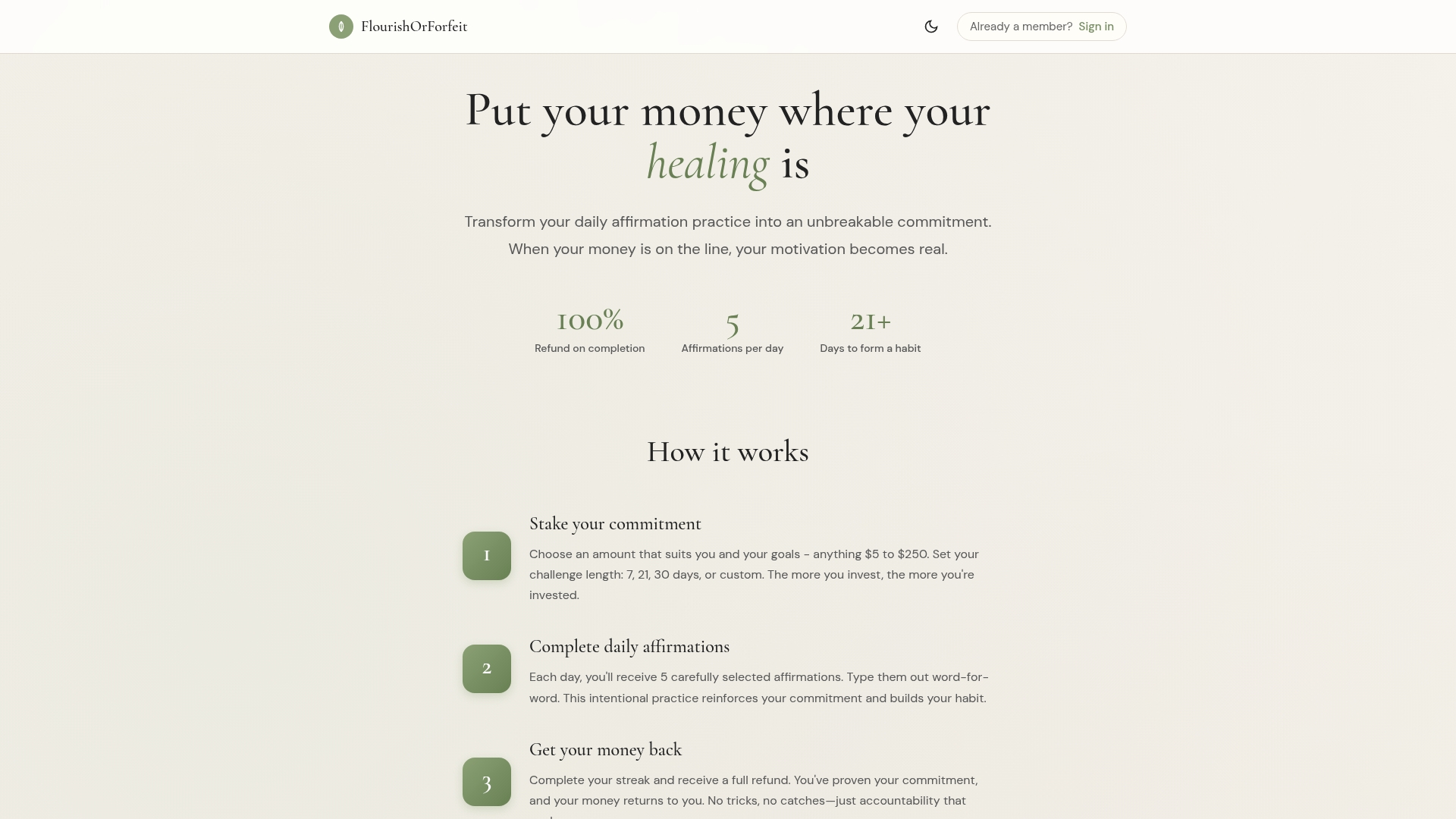
Complete every day and you get a full refund. Miss enough days and you forfeit the stake, which is exactly the kind of consequence that turns a nice idea into a kept habit. If you've read this far because solo repetition hasn't stuck, start a challenge on Flourishorforfeit and put a real deadline behind your next affirmation.