

A behavioral contract, in the sense that matters here, is a written agreement where you stake real money on completing a short daily task, usually typing out affirmations word for word, and either get a full refund for finishing or forfeit the stake for quitting. The design leans on a well-documented quirk of human psychology: losing money you already committed hurts more than gaining an equivalent reward feels good. That asymmetry, known as loss aversion, is why deposit contracts consistently outperform willpower alone in behavioral research. FlourishOrForfeit built its entire model around this idea, letting you stake $5 to $250 across a 7, 21, or 30-day challenge.
Here's the quick verdict before the mechanics:
- Financial-stake contracts work best for motivated adults who already want to change a habit but need external pressure to follow through.
- They are not a fix for deep-seated addiction or financial instability.
- A 21-day window lines up with the commonly cited habit-formation runway, though research treats that number as a rough anchor rather than a precise rule.
- Choosing the right stake, recipient, and verification method matters more than the app you use.
Key Takeaways
Financial-stake behavioral contracts work because losing a real deposit motivates follow-through more reliably than intention or willpower alone.
| Point | Details |
|---|---|
| Stake size matters | Pick an amount that stings enough to notice but won't strain your monthly budget. |
| 21 days is a useful anchor | Not a guarantee, but a psychologically meaningful middle ground between a 7-day trial and a 30-day deep habit push. |
| Specificity beats vague goals | Exact daily criteria, like typing five set affirmations, removes disputes over what counts as success. |
| Recipient choice changes outcomes | Anti-charity and referee setups tend to raise completion rates over neutral, self-only stakes. |
| FlourishOrForfeit implements this directly | Offers $5 to $250 stakes, 7/21/30-day challenges, SMS verification, and a full refund on completion. |
Table of Contents
- How Do Behavioral Contracts for Goals Actually Work?
- How Should You Choose Your Stake, Duration, and Recipient?
- What Are the Steps to Set Up a Behavioral Contract?
- What Tactics Actually Raise Your Success Rate?
- Who Should Avoid Financial-Stake Contracts?
- How Do Popular Behavioral Contract Tools Compare?
- What Pitfalls Derail Behavioral Contracts, and How Do You Avoid Them?
- What Do Real-World Results Show About These Contracts?
- Can You Adapt These Contracts Beyond Daily Affirmations?
- What Makes FlourishOrForfeit Different From Other Options?
- What's the Real Takeaway on Behavioral Contracts?
- Ready to Put a Stake on Your Own Habit?
- Sources
How Do Behavioral Contracts for Goals Actually Work?
Loss aversion is the engine, but it doesn't work alone. Pair it with hyperbolic discounting, the tendency to weigh a reward or punishment today far more heavily than one next week, and you get a powerful short-term lever. A $25 stake due tomorrow feels more urgent than a vague promise to "be better" someday. Add sunk cost, the money already committed, and quitting on day 12 of a 21-day challenge starts to feel like throwing away something you already own rather than simply skipping a task.
Verification tightens the loop further. When completion has to be reported, timestamped, or confirmed by a referee, the temptation to fudge the truth shrinks. Research on the mechanism is not purely theoretical, either.
The evidence in short: A peer-reviewed review of commitment contracts as a health tool found conceptual and empirical support for deposit-based agreements, while a field experiment on smoking cessation found participants in a deposit program were 3 to 5.8 percentage points more likely to pass a six-month biochemical test, with the effect still visible at 12 months.
- Loss aversion makes the cost of quitting feel immediate, not abstract.
- Hyperbolic discounting means near-term stakes beat distant rewards for changing daily choices.
- Sunk cost keeps you in the contract past the point where motivation alone would have faded.
How Should You Choose Your Stake, Duration, and Recipient?
Stake size should sting a little without threatening your rent. A common mistake is picking a token amount, $5 on a $200 monthly budget barely registers as a loss. Picking something that costs you real inconvenience, without risking hardship, is the sweet spot. Analysis of large commitment-contract datasets found that stake size, total commitment, and recipient choice are among the strongest predictors of whether someone actually finishes.
Duration works on a different axis. Seven days is a good trial run for skeptics. Thirty days builds deeper repetition. Twenty-one days sits in between, and it's the number most often cited as a rough marker for habit formation, useful less as science and more as a psychologically meaningful milestone that feels achievable but still demanding.
Recipient choice changes the emotional stakes:
- Charity: softer failure, money still does good, lower sting.
- Anti-charity: a cause you dislike, which research on stickK-style platforms found tends to increase completion rates because losing feels worse.
- Friend or referee: adds social accountability on top of the financial one.
Pro Tip: Start with a 7-day, low-stake contract to learn your own failure patterns before committing to a 30-day challenge with a higher amount.
What Are the Steps to Set Up a Behavioral Contract?
Setting one up is straightforward, but skipping a step is usually why people quit early.
- Define the exact daily task. For affirmation challenges, that means the precise wording you'll type each day, not a general intention like "stay positive."
- Pick your duration. Seven days to test the format, 21 for a real habit push, 30 if you want deep repetition.
- Set your stake. Somewhere between mildly annoying to lose and financially painless to pay if you fail.
- Choose your recipient. Self-refund on success, charity, anti-charity, or a friend acting as referee.
- Select a verification method. Self-report works for low-stakes tasks; SMS confirmation or photo proof adds friction against cheating.
- Turn on reminders. A daily nudge at the same time each day removes the "I forgot" excuse.
- Decide your missed-day policy up front. Will one missed day forfeit everything, or does a single mulligan apply?
Verification rigor should match the task. A five-affirmation typing challenge doesn't need biochemical testing, but it does benefit from a hard rule: type the exact five affirmations, not a paraphrase. That specificity removes ambiguity later, since vague criteria are what most disputes over "did I actually complete this" come down to.
Pro Tip: Write your missed-day policy into the contract before day one. Deciding mid-challenge whether a slip counts as a fail almost always favors letting yourself off the hook.
What Tactics Actually Raise Your Success Rate?
Three levers show up again and again in the literature: defaults, social pressure, and stake escalation.
Field experiments on deposit contracts for exercise found that when platforms suggested a slightly longer default duration, participants chose longer commitments without dropping their acceptance rate. In practice, that means picking the pre-selected challenge length rather than manually shortening it, since the default is usually calibrated to nudge you toward a duration that actually builds the habit.
Social accountability compounds the financial pressure. Adding a referee, someone who confirms your daily completion, has been shown to reduce cheating in commitment-contract research, and public visibility of a pending forfeit adds a second layer of discomfort beyond the money itself.
- Take the suggested default duration instead of shortening it.
- Add a referee or supporter who sees your daily progress.
- Consider an anti-charity recipient if a neutral one feels too easy to lose to.
- Start stakes modest, then raise them on your next challenge once you've proven you can finish one.
Anti-charity recipients deserve a specific mention. The same stickK analysis behind the recipient-effect finding also found that financial-only commitments with adversarial recipients outperformed neutral or social-only setups in raw completion numbers. That's not a universal rule, some people find the anti-charity mechanic too harsh, but it's a real lever if softer stakes haven't worked for you before.
Who Should Avoid Financial-Stake Contracts?
This approach isn't for everyone. If you're facing genuine financial hardship, a $50 forfeit isn't a motivating nudge, it's a real hardship, and the psychology stops working in your favor. The same caution applies if you're managing a compulsive spending or gambling pattern, since staking money on outcomes can reinforce the wrong instincts rather than build a healthy habit.
There's an emotional cost too. Losing a stake publicly, especially with a referee watching, can trigger shame that outweighs the behavioral benefit, and a review of commitment-contract research explicitly flags open questions about long-term efficacy and who these contracts actually help.
Sensible guardrails reduce the downside:
- Cap your stake at an amount you could lose without changing your month.
- Start with a smaller, staged stake before scaling up.
- Choose a charity recipient over an anti-charity if public failure feels too harsh.
- Build in one mulligan for genuine emergencies, not for convenience.
How Do Popular Behavioral Contract Tools Compare?
Most platforms in this category fall into two rough camps. The first is the general-purpose commitment app: broad goal categories, flexible recipients, and a "choose your own adventure" setup where you define both the task and the proof. These give you flexibility but put the burden of specificity on you, and vague self-defined goals are exactly what generates disputes over whether a day counted.
The second camp is the narrow, task-specific tool, built around one repeatable action rather than an open-ended goal. FlourishOrForfeit sits here: instead of asking you to define an arbitrary daily task from scratch, it structures the entire contract around typing five curated affirmations, with the duration (7, 21, or 30 days), stake ($5 to $250), and refund logic already built into the product.
The trade-off is straightforward. General-purpose tools give you more categories of goals to stake money on, but they also require more upfront design work, and a poorly specified goal is harder to verify fairly. Narrow, structured tools sacrifice flexibility for clarity: the daily criteria are fixed, the proof is unambiguous, and the reporting flow doesn't require you to invent your own verification rules. For a reader focused specifically on the daily-affirmation format, that structure removes the single biggest point of failure, ambiguous success criteria, before the challenge even starts.
What Pitfalls Derail Behavioral Contracts, and How Do You Avoid Them?
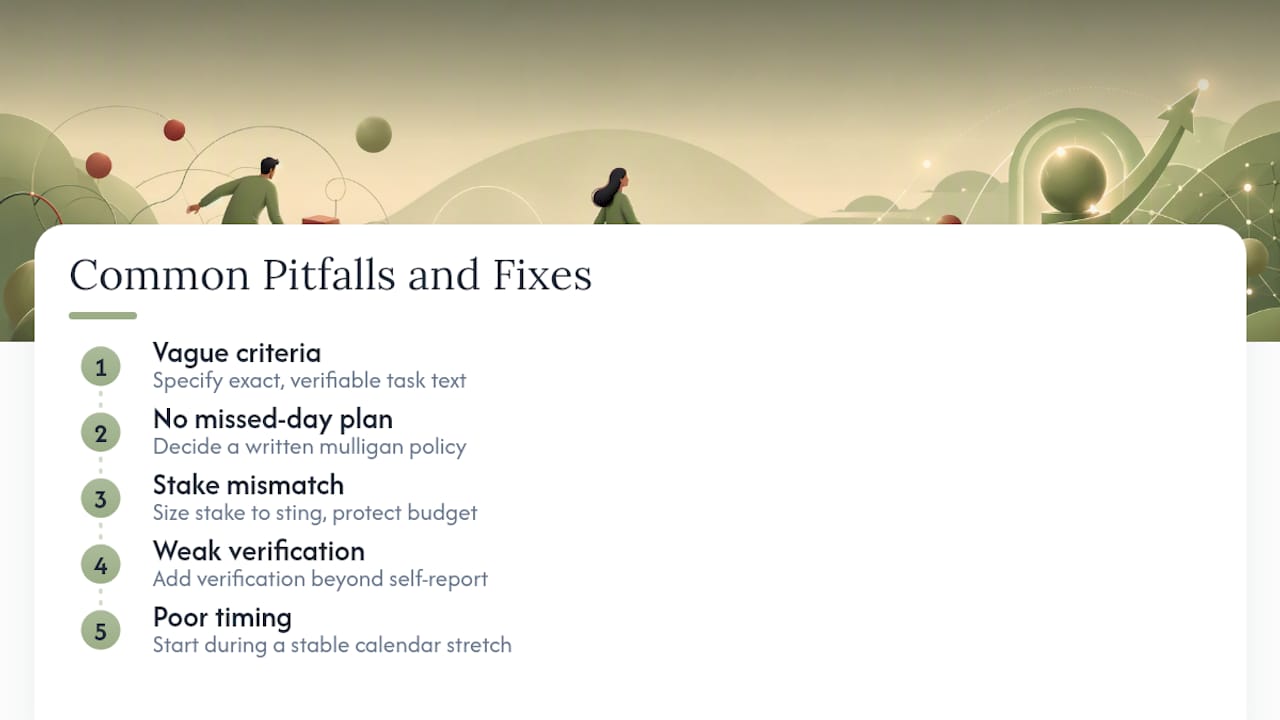
The most common failure point isn't lack of motivation on day one, it's ambiguity that surfaces on day nine. If your daily criteria weren't specific enough, you'll find yourself arguing with your own rules about whether a rushed, half-hearted attempt counts.
Vague success criteria. "Feel more positive today" isn't verifiable. Framing the task as "type these exact five affirmations" removes the debate entirely, since the proof is the text itself, not a subjective feeling.
No plan for a missed day. Without a pre-set mulligan policy, one bad day often triggers a full abandonment of the contract, sometimes called the "what the hell" effect, where a single slip turns into quitting altogether because the all-or-nothing framing feels broken.
Stake mismatch. Too low, and forfeiture doesn't sting enough to matter. Too high, and the fear of loss creates enough anxiety that people avoid starting at all, or quietly rationalize an early exit.
Weak verification. Self-report with no accountability layer invites the kind of quiet self-deception that undermines the entire mechanism, since the psychological effect depends on believing the stakes are real.
Poor timing. Starting a 30-day challenge during a chaotic week (a move, a big deadline) sets you up to fail on logistics, not motivation.
Each of these has a direct fix: tighten the criteria before day one, decide the mulligan policy in writing, size the stake to sting without threatening your budget, add a verification layer beyond self-report, and pick a start date during a stable stretch of your calendar.
What Do Real-World Results Show About These Contracts?
The strongest evidence for financial-stake contracts doesn't come from testimonials, it comes from field experiments that tracked real behavior change over months, not days. The CARES smoking-cessation program is the clearest example: a deposit-based contract requiring biochemical verification produced a 3 to 5.8 percentage point increase in six-month quit rates, and the effect held at the 12-month mark, well past the point where most willpower-only attempts have already failed.
Exercise research tells a similar story. Field experiments on gym attendance found that offering a voluntary deposit contract increased persistence, and when the platform suggested a longer default duration, participants chose to commit for longer without opting out at a higher rate. That's a meaningful finding: people didn't need to be talked into a longer commitment, they just needed the longer option to be the default.
The pattern across this research is consistent even though the behaviors differ wildly, quitting smoking, showing up to the gym, finishing a daily habit challenge. Real money staked against a verifiable action changes behavior more reliably than intention alone. That's the same mechanism FlourishOrForfeit applies to daily affirmations: a small, real stake, a clear daily task, and a refund waiting on the other side of consistency.
Can You Adapt These Contracts Beyond Daily Affirmations?
The five-affirmation format is a clean entry point because the verification is built in, but the same contract structure scales to other goals if you keep the criteria just as specific.

For fitness goals, define the exact action: "log a 20-minute walk in a tracking app" beats "exercise more." For writing or creative habits, "submit 300 words to a shared document" beats "work on my book." For financial habits, "transfer $20 to savings" beats "save more money." In every case, the fix for ambiguity is the same one that makes the affirmation format work: specificity over intention.
Duration and stake logic carry over directly. A new habit you're testing gets a 7-day trial run. A habit you're serious about building gets the 21-day window. A deep behavior change, quitting a substance, establishing a fitness routine, benefits from the full 30 days or longer.
Recipient and verification choices scale with the stakes involved. A low-effort daily check-in might only need self-report. A goal tied to health or money benefits from a referee or an automated verification step, the same principle researchers behind commitment-contract platforms have found reduces both cheating and the temptation to quietly let yourself off the hook. The lesson from the affirmation model applies everywhere: the tighter the definition of success, the fewer arguments you'll have with yourself at 11 p.m. on day 14.
What Makes FlourishOrForfeit Different From Other Options?
FlourishOrForfeit strips the setup process most commitment-contract platforms leave to you and replaces it with a fixed, low-friction structure. You choose a stake between $5 and $250, pick a challenge length of 7, 21, or 30 days, and commit to typing five curated affirmations exactly as written, every day, for the duration you selected.
The mechanics are simple by design. Complete every day and you get a full refund. Miss the requirement and you forfeit your stake, which is how the platform earns its revenue: not from subscription fees, but from stakes tied to unmet daily commitments. Payments run through Stripe-integrated processing, and completion is tracked through SMS verification and a dashboard that shows your daily status at a glance. Longer challenges include a mulligan, a single built-in allowance for a missed day, which mirrors the staged-stakes and mulligan approach that reduces early dropouts while still preserving the accountability the entire model depends on.
What separates this from a general-purpose commitment app is the removal of setup decisions that tend to derail people before day one. You're not writing your own affirmations, defining your own proof standard, or guessing at what counts as "done." The task, the verification, and the refund logic are already fixed, which leaves you with exactly one job: show up and type the five affirmations, every day, until the stake either comes back or doesn't.
What's the Real Takeaway on Behavioral Contracts?
Most advice on habit formation treats motivation as the variable to fix, more willpower, more discipline, a better morning routine. The research on commitment contracts says something less flattering: motivation isn't the bottleneck, specificity and consequence are. A vague goal with no cost for quitting fails regardless of how motivated you feel on day one.
Where conventional advice falls short is in treating all financial stakes as interchangeable. They're not. A $5 stake with no verification is closer to a suggestion than a contract. The design details, exact criteria, a real verification method, a recipient that makes losing sting a little, are what separate a contract that changes behavior from one that just gets ignored after day four.
If you're going to try this, prioritize the boring parts first: write the exact daily criteria before you touch the stake amount, decide your missed-day policy in writing, and pick a duration that matches how serious the habit actually is to you. The stake is what gets people's attention. The specificity is what actually makes them finish.
— Zack
Ready to Put a Stake on Your Own Habit?
Everything covered here, the stake ranges, the duration choices, the verification logic, is exactly what FlourishOrForfeit already runs on. Instead of building your own contract from scratch and guessing at fair verification rules, you get a fixed structure: pick $5 to $250, choose 7, 21, or 30 days, and commit to typing five curated affirmations exactly as written each day.
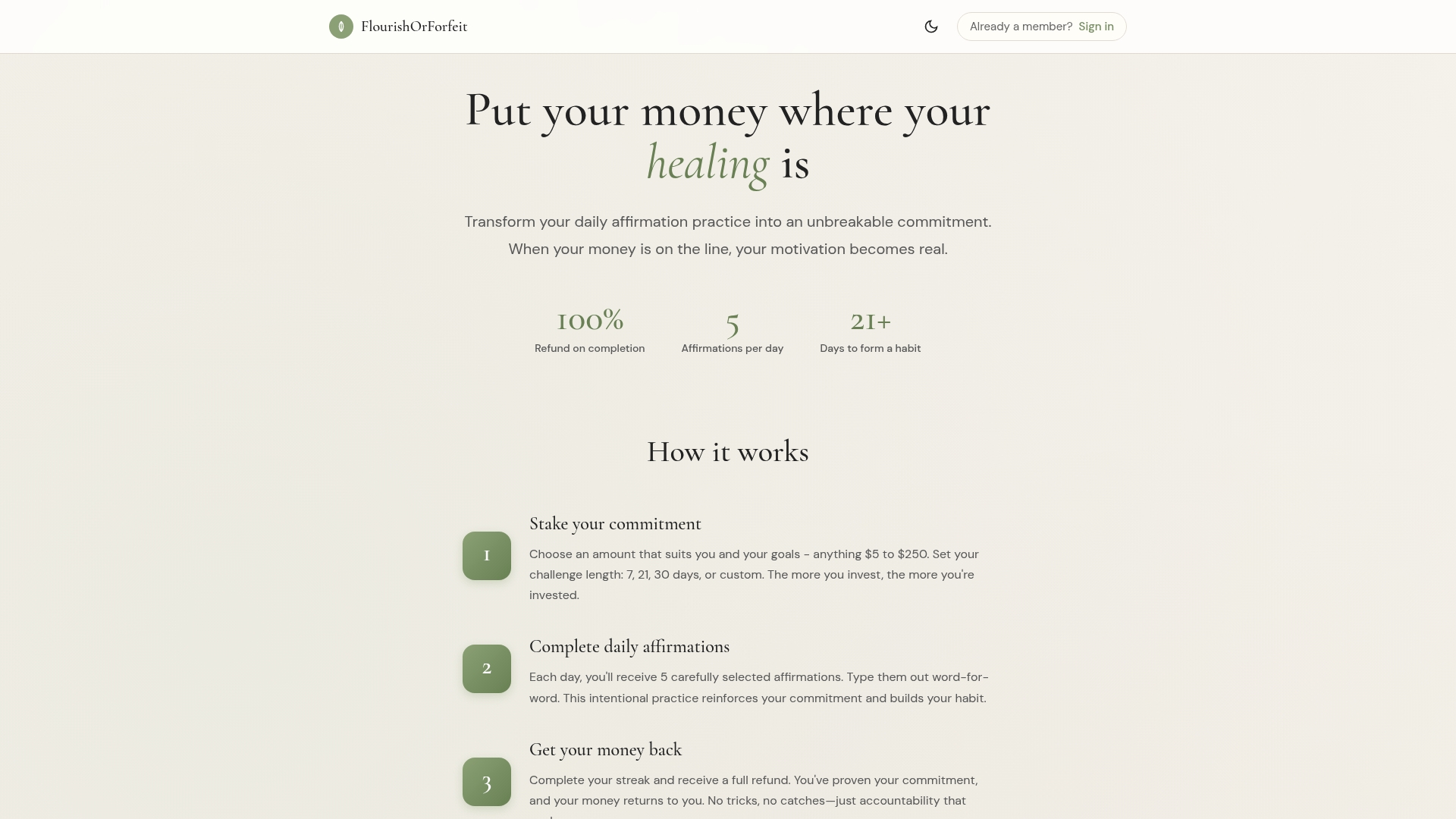
Payments run through Stripe-integrated secure processing, progress is tracked through SMS verification and a dashboard, and longer challenges include a built-in mulligan so one rough day doesn't sink the whole commitment. Finish the challenge and your full stake comes back. Miss it, and the forfeited amount is what funds the model, which is exactly the loss-aversion mechanism the research behind this article keeps pointing to. If you've read this far because you're ready to back a goal with real money instead of another willpower promise, visit the FlourishOrForfeit landing page and pick your first challenge length.
Sources
- Commitment contracts as a way to health (Halpern, Asch, Volpp — PMC)
- Sticky Goals: Understanding Goal Commitments for Behavioral Changes in the Wild (ACM)
- Nudges, Defaults, and Commitment Contracts (NBER)
- Put Your Money Where Your Butt Is: A Commitment Contract for Smoking Cessation (J-PAL / Poverty Action Lab)
- Does Loss Aversion Beat Procrastination? (Behavioral intervention report)