

Consistency beats motivation for lasting change because repeated actions performed in the same context become automatic, while motivation fades once the novelty wears off. Two things drive this: repetition wires behavior into cue-response loops that need less willpower over time, and stable contexts (same time, same place, same trigger) make those loops reliable. Your next move: pick one tiny behavior and tie it to a cue you already hit every day.
- Repetition builds automaticity, not intensity.
- Stable cues (a specific time or place) anchor the habit better than sheer willpower.
- Start today with one two-minute action linked to something you already do.
Key Takeaways
Consistency outperforms motivation because repeated behavior in a stable context becomes automatic, while motivation depends on a feeling that inevitably fades.
| Point | Details |
|---|---|
| Automaticity beats willpower | Repeated actions tied to the same cue require less conscious effort over time. |
| Intrinsic motivation predicts adherence | Long-term goal follow-through tracked with intrinsic motivation, not extrinsic rewards, in year-long research. |
| Incentives are double-edged | They help you start but can disrupt habits once those habits run on autopilot. |
| Track repetitions, not days | Frequency and context stability matter more than counting calendar days. |
| Financial stakes can help initiation | Flourishorforfeit's refund-or-forfeit model front-loads commitment the way research suggests works best. |
Table of Contents
- Why Consistency Beats Motivation, According to the Science
- What Does Consistency Actually Look Like Day to Day?
- How Do You Actually Build Consistency?
- When Does Motivation Still Help?
- Building Consistency With ADHD or Limited Executive Function
- How Long Does It Actually Take to Build a Habit?
- Try This 7-Day Micro-Challenge
- What the Strongest Evidence Says About Sticking With It
- How I Think About Setbacks and Iteration
- Want More Accountability? Put Something on the Line
- Frequently Asked Questions
- Sources
Why Consistency Beats Motivation, According to the Science
Automaticity is the mechanism that makes consistency win. When you repeat a behavior in the same setting enough times, your brain starts triggering it from the cue alone, before you've consciously decided to act. That's why brushing your teeth doesn't require a pep talk. Behavioral performance and context stability are two of the strongest predictors of habit strength in nutrition and physical activity research, which found that a consistent time or place mattered as much as how often people repeated the behavior.
Motivation runs on a different, less reliable circuit. It's tied to how you feel in the moment, and feelings move. Intrinsic motivation, wanting to do something because it satisfies you, held up better than extrinsic motivation in a year-long study of resolution adherence across U.S. and Chinese samples: intrinsic motivation predicted who stuck with their goals, while extrinsic motivation didn't show the same staying power.
Context cues can also override your intentions entirely, for better or worse. Habits can fire independently of what you consciously want, activated by memory associations tied to place and routine rather than by willpower in the moment.
Repetition in a stable context, not the strength of your desire to change, is what turns a behavior into something your brain does on autopilot.
Fast fact: completing one initial health screening raised the odds of completing later screenings by 32 to 36 percentage points, with effects barely fading over two years. One well-designed repetition can outlast years of good intentions.
What Does Consistency Actually Look Like Day to Day?
Consistency isn't grand. It's small, boring, and tied to something that already happens in your day.
- Morning journaling: Write three sentences right after you pour your coffee. The coffee is the cue.
- Midday walk: Ten minutes outside the second you close your laptop for lunch.
- Study habit: Review five flashcards during the break between classes, every time, same spot.
Take Maria, a nursing student who wanted to read more. She didn't overhaul her schedule. She just read two pages every night after brushing her teeth. By day five, she noticed she reached for the book before she'd even finished putting the toothbrush down. That's the cue-response link forming in real time.
How Do You Actually Build Consistency?
Willpower isn't a strategy. These are.
- Shrink the start. Make the first step so small it feels silly to skip, like two push-ups instead of twenty.
- Stack the habit. Attach the new behavior to one you already do automatically, like flossing right after you brush.
- Use implementation intentions. Decide the exact time and place in advance: "I'll stretch at 7 a.m. in the living room," not "I'll stretch more."
- Build identity-based rules. Say "I'm someone who shows up," not "I'm trying to exercise more."
- Design your context. Leave the running shoes by the door. Delete the app that derails you.
- Track and protect streaks. A visible chain of checkmarks makes the habit feel real and worth defending.
- Add accountability. Tell someone your plan, or put something on the line so quitting has a cost.
Each tactic works because it lowers the friction between deciding and doing. Habit-tracking apps that give immediate feedback speed this up considerably: an event-sampling study of 91 students logging 2,574 habit repetitions found that automaticity climbed with repetition, and as it climbed, motivational slumps mattered less.
Pro Tip: On a chaotic day, don't skip the habit, shrink it. If your rule is "write for 20 minutes," write for two instead. Keeping the streak alive matters more than hitting your usual volume.

When Does Motivation Still Help?
Motivation isn't useless, it's just a poor daily engine. It's a decent tool for three specific jobs: starting something new, planning your next stretch of effort, and injecting variety when a routine goes stale.
- Use a motivated burst to design next month's implementation intentions, not to power today's action.
- Set rewards around milestones, not every single rep, so you don't train your brain to expect a payoff for showing up.
- Front-load big incentives at the start of a challenge rather than repeating them daily.
Building Consistency With ADHD or Limited Executive Function
Standard habit advice often assumes a level of planning capacity that not everyone has. If cues slip past you or a missed day spirals into a missed month, the fix isn't more discipline. It's smaller cues and more scaffolding.
- Use external reminders (phone alarms, sticky notes on the door) instead of relying on memory.
- Pair the habit with something already high-reward, like your favorite podcast.
- Automate what you can: a recurring calendar block, a pre-set coffee maker, a standing SMS reminder.
- When you miss a day, forgive it in the moment and restart the very next opportunity. One skipped rep is data, not failure.
- On low-capacity days, delegate or shrink the task rather than skip it entirely, focusing on systems over willpower is more effective than trying harder.
How Long Does It Actually Take to Build a Habit?
Forget the fixed number of days. Frequency matters more than the calendar. A behavior repeated multiple times a day automates faster than one you do weekly, since your brain gets more repetitions to strengthen the same cue-response link.
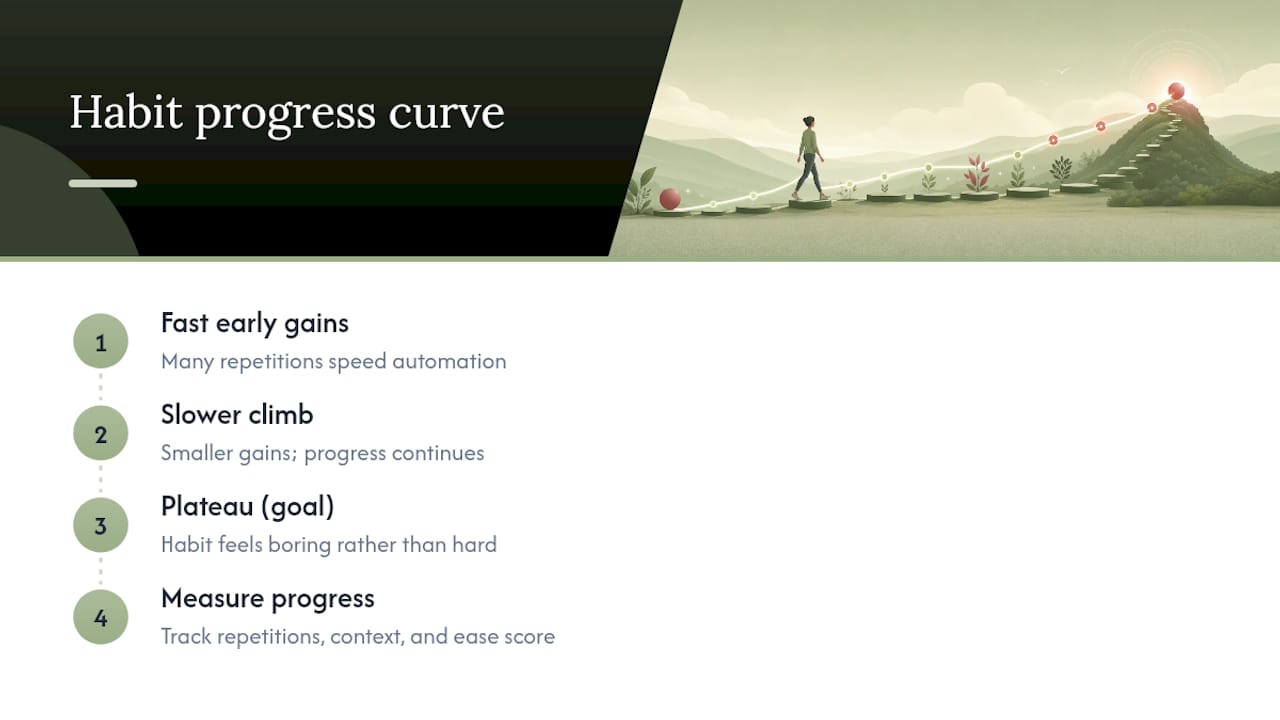
Track repetitions and how stable your context stays, not just whether you "succeeded" that day. An ease score, how much conscious effort the action took, tells you more about progress than a simple checkmark. Expect a curve: fast gains early, then a slower climb, then a plateau where the habit finally feels boring rather than hard. That plateau is the goal, not a warning sign.
Try This 7-Day Micro-Challenge
Pick one tiny, measurable behavior tied to a cue that already happens daily, then run this:
- Day 1: Choose the behavior (under two minutes) and the exact cue and location.
- Days 2 to 3: Execute right after the cue, log it immediately, no exceptions.
- Day 4: If you miss it, restart the next cue without penalty or extra makeup reps.
- Days 5 to 6: Keep the window identical each day; resist the urge to expand it yet.
- Day 7: Review your ease score. If it dropped, extend the challenge another week before scaling up.
Missed a day? Don't double up tomorrow. Just resume at the next scheduled cue.
What the Strongest Evidence Says About Sticking With It
An iterative mindset, assess, adjust, keep practicing, correlates with stronger habit automaticity and better outcomes in areas like weight management and work productivity. Treating setbacks as feedback rather than failure keeps people in the game long enough for repetition to do its work.
- Apps with immediate feedback loops speed up automaticity, per the student study cited earlier.
- Incentives are genuinely double-edged: they help you start, but repeated incentives can push you into a deliberative mindset that actually interferes with habits you've already automated.
- A commitment-stake model, like putting money behind a challenge, front-loads the incentive at the start rather than repeating it daily, which sidesteps that interference problem.
Incentives that front-load at the beginning of a challenge help initiation without competing against the habit you're trying to build.
How I Think About Setbacks and Iteration
Treat every missed day as a data point, not a verdict on your character. The iterative posture, assess what broke, adjust one variable, get back to practicing, holds up better over months than any single burst of resolve. Missed Tuesday's walk? Note why, shrink Wednesday's version, and go again.
Want More Accountability? Put Something on the Line
Systems and cues get you most of the way there, but some people need one more lever: a real cost for quitting. Flourishorforfeit turns your daily affirmation habit into a financial commitment. You choose a stake between $5 and $250 and a challenge length of 7, 21, or 30 days, then type five curated affirmations word-for-word each day, tracked through secure payments and SMS verification.
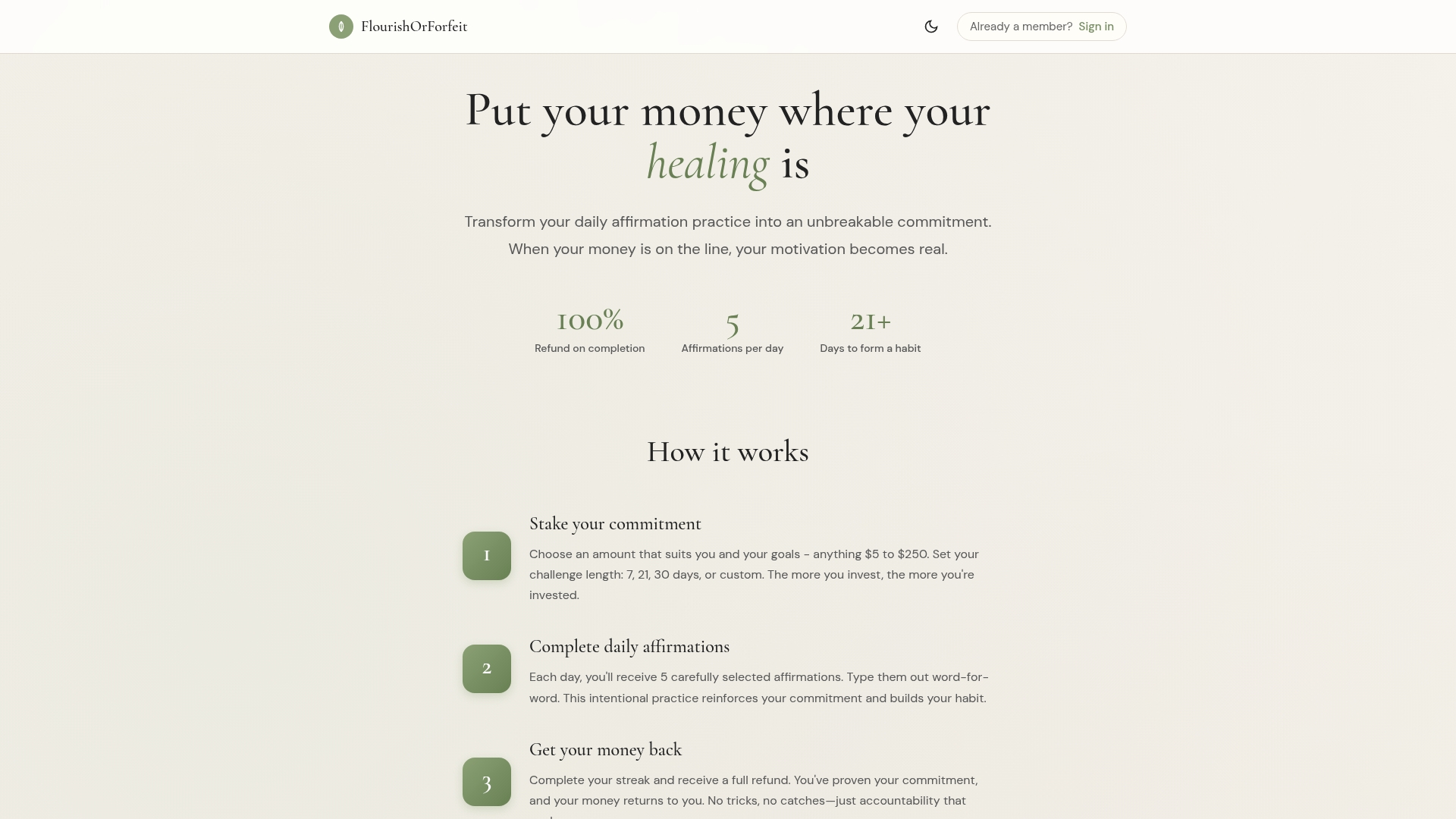
The logic tracks directly with the incentive research above: front-loading a stake at the start of a challenge raises the cost of quitting without the daily reward loop that can interfere with habit performance later on. Complete the challenge and you get a full refund. Miss too many days and you forfeit your stake, which is the whole point, it makes consistency the cheaper option. Longer challenges include a mulligan for one off day. If you want your affirmation habit to survive past week one, start a challenge on Flourishorforfeit and pick a stake that actually feels like something.
Frequently Asked Questions
What does "consistency over motivation" actually mean? It means relying on repeated, scheduled action tied to a fixed cue rather than waiting to feel inspired. Motivation might get you started, but consistency is what carries the behavior once the initial excitement wears off.
Is consistency harder for people with ADHD? It can be, since executive-function differences make planning and memory-based cues less reliable. Smaller behaviors, external reminders, and automated prompts tend to work better than relying on willpower alone.
What's a simple framework for staying consistent? Three C's work well: Cue (a fixed trigger), Consistency (same time and place), and Compassion (forgive a missed day and restart at the next cue instead of waiting for Monday).
How many days does it really take to build a habit? It depends more on how often you repeat the behavior than on a fixed number of days. Frequent, small repetitions in a stable context tend to automate faster than infrequent ones.
Can motivation and consistency work together? Yes. Use motivated bursts to plan and set up your systems, then let consistency and stable cues carry the daily execution.
Sources
- Woolley, Kaitlin, Giurge, Laura M. & Fishbach, Ayelet (2025) Adherence to personal resolutions across time, culture, and goal domains. Psychological Science, 36(8), 607 - 621. https://doi.org/10.1177/09567976251350960
- Incentives Activate a Control Mind-Set: Good for Deliberate Behaviors, Bad for Habit Performance
- Habit formation evidence from repeated health screenings (Jones_Habit.pdf)
- App-Based Habit Building Reduces Motivational Impairments During Studying – An Event Sampling Study
- Effects of behavioral performance, intrinsic reward value, and context stability on habit strength (nutrition habit study)