

Here are ready-to-use growth mindset affirmations you can start saying today, organized by moment (morning, before a challenge, after a setback) for both adults and kids, plus the habit-design steps that make the words stick. Repeating a phrase alone rarely rewires anything. Pairing it with a small action, and sometimes with real accountability like the stake-based model behind Flourishorforfeit, is what turns a slogan into a skill.
TL;DR:
- Effective growth mindset affirmations should be paired with small actions or accountability to produce real behavioral change.
- Timing and wording matter, with process-focused phrases working best in mornings, before challenges, or after setbacks, tailored to each situation.
- Attaching affirmations to existing routines and tracking progress through external accountability systems increases the likelihood of habit formation.
- Affirmations that highlight effort and strategy support resilience, but grand trait-based statements can backfire for people with low self-esteem.
- A challenge model with stakes and verification helps overcome the tendency to skip or dismiss affirmations over time.
Table of Contents
- Growth Mindset Affirmations For Every Part Of Your Day
- How To Practice Affirmations So They Actually Stick
- What The Research Actually Says About Affirmations
- Why Accountability Changes What Affirmations Can Do
- Turn Your Affirmations Into A Habit You Can't Quietly Skip
- Sources
Growth Mindset Affirmations For Every Part Of Your Day
Not every affirmation fits every moment. A line that works at 7 a.m. can feel hollow after a rough meeting. The categories below match the phrase to the moment, so you're not reciting generic positive mindset quotes that don't connect to what you're actually facing.
Morning routine affirmations work best short and process-focused, said while your coffee brews or your commute starts:
- "I'm building skill today, one attempt at a time."
- "I don't need to feel ready. I just need to start."
- "Today I'll try one thing I haven't tried before."
- "My effort today counts, even if the result doesn't show yet."
Before a challenge, resilience mindset affirmations that lean on "yet" language reduce the urge to bail before you've started:
- "I haven't mastered this yet, and that's a normal part of the learning process."
- "Difficulty is information, not a verdict on my ability."
- "I can find a strategy for this, even if I can't see it yet."
After a setback, the goal is to shift from judgment to data collection:
- "This result tells me what to adjust, not who I am."
- "What's the next smallest step, given what just happened?"
- "Failing here means I now know one thing that doesn't work."
Learning and skill-building affirmations should name the strategy, not just the outcome: "I'm testing a new approach because the old one plateaued" beats "I'm smart" every time, since it points at something repeatable.
For kids, the wording matters more than adults often realize. Swap "You're so smart" for phrasing that praises the process:
- "You kept trying different ways until one worked. That's how your brain builds new connections."
- "That was a hard problem, and you stuck with it."
- "Mistakes are the part where your brain is doing the most work."
Parents get more mileage from a 10-word process comment delivered right after a mistake than from a longer pep talk delivered later.
How To Practice Affirmations So They Actually Stick
Saying a phrase in the mirror for 30 seconds and moving on rarely produces change. What works is attaching the affirmation to something you already do and following it with a tiny, measurable action.
- Anchor it to an existing cue. Say your affirmation while brushing your teeth, waiting for coffee, or opening your laptop. Piggybacking on a habit you already have removes the "remember to do this" problem entirely.
- Follow it with 60 seconds of practice. Say "I'm getting better at hard conversations," then immediately rehearse one line you'll actually use that day. The APA's guidance on self-affirmation points to action-oriented affirmations paired with a concrete next step as the combination that produces real behavior change, not just a mood lift.
- Log one line about what happened. A single sentence in a notes app closes the loop between intention and evidence.
- Build in outside accountability if you're the type who quietly skips day four. A habit partner, a shared tracker, or a stake-based system like Flourishorforfeit's challenge model gives the affirmation a consequence beyond your own willpower.
- Adjust the wording if "I am" feels too big. Swap to third person ("Sam can figure this out") or to process language ("I'm learning to handle this") if first-person declarations trigger resistance instead of confidence.
Pro Tip: If a phrase makes you flinch or feel like you're lying to yourself, that's a signal to change the wording, not to push through it. Swap "I am confident" for "I'm practicing confidence" and see if the resistance drops.
What The Research Actually Says About Affirmations
Growth mindset isn't fixed at birth, but the phrasing you use to build it matters more than most people assume. Praise that highlights effort and strategy supports a growth mindset, while praise built around fixed traits ("you're a natural") can make people less willing to take on the next hard thing, according to research tied to Carol Dweck's work. The OECD's synthesis on growth mindset backs this up: interventions that pair effort-based feedback with strategy language improve resilience and how people respond to criticism.
But affirmations aren't universally helpful. A widely cited study found that simple positive self-statements can backfire for people with low self-esteem:
Participants low in self-esteem who repeated statements like "I am a lovable person" actually felt worse afterward than those who didn't repeat anything at all.
That finding, from research on positive self-statements, is why blanket "just say it and believe it" advice falls apart for a real chunk of people. The fix isn't abandoning affirmations. It's adjusting them: acknowledge the difficulty first, use process language instead of grand identity claims, and treat the affirmation as a strategy prompt rather than a fact you have to force yourself to believe. Reviews of the broader evidence consistently find that affirmations show small but real effects, and those effects grow when the words are tied to an actual routine rather than left to float on their own.
Why Accountability Changes What Affirmations Can Do

I keep coming back to one gap in most affirmation advice: it treats the words as the whole intervention. They're not. The evidence above is consistent on this point. Effort-focused language and self-compassionate phrasing help, but they help more when something outside your own motivation is tracking whether you showed up.
That's the case for combining affirmations with a commitment device instead of leaving them as a solo mental exercise. Flourishorforfeit's model, where you type out your affirmations daily and put real money on the line for a 7, 21, or 30 day stretch, isn't a gimmick bolted onto self-help. It's a direct answer to the fact that most people know what to say to themselves and still skip it by day four. The 21-day window lines up with how long habit formation research generally says it takes for a new routine to start feeling automatic.
— Zack
Turn Your Affirmations Into A Habit You Can't Quietly Skip
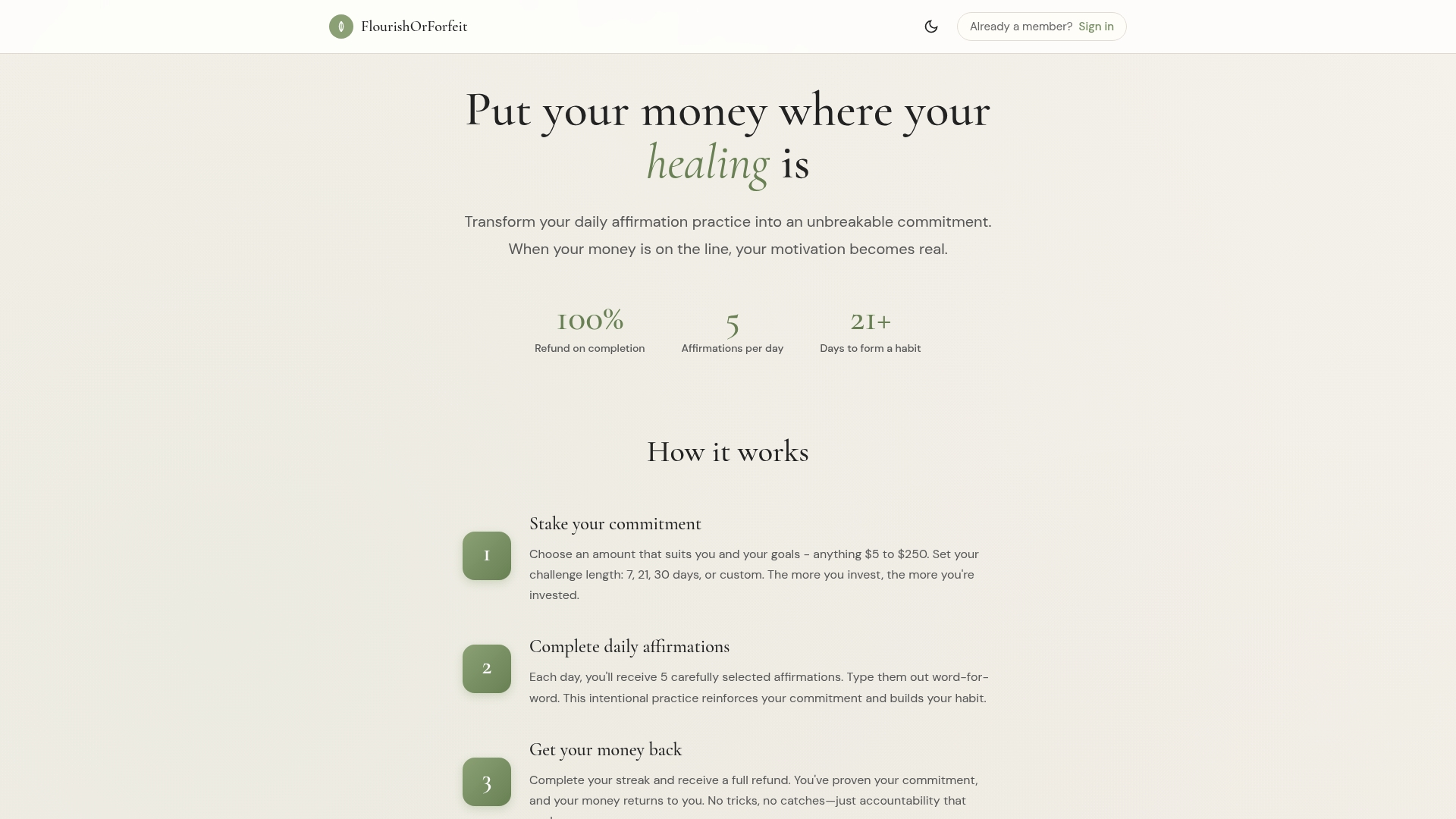
Flourishorforfeit is built for the exact gap this article just described: knowing which affirmations to say and actually saying them every single day. You pick a stake between $5 and $250, choose a 7, 21, or 30 day challenge, and type your five affirmations word-for-word each day, verified through the platform's secure tracking. Complete the challenge and you get a full refund. Miss enough days and you forfeit the stake, which is the entire point.
This fits a specific kind of person, so check whether you're it:
- You've tried affirmation apps or journals before and quietly stopped using them within two weeks.
- You respond better to a real consequence than to a reminder notification.
- You want a fixed, defined window (a week, three weeks, a month) rather than an open-ended "someday" habit.
If that sounds like you, start a challenge on Flourishorforfeit and pick the affirmation set and stake that fits where you're starting from.