

The goal-gradient effect is the tendency to work harder and faster as a goal gets closer, whether that goal is a coffee stamp card or day 21 of a habit streak. For habit builders, the practical takeaway is simple: keep the next finish line visible and keep milestones short, because distance to the goal, not the goal's size, drives effort. Decades of research back this up, from Clark Hull's animal experiments to modern loyalty-card studies.
TL;DR:
- Short, visible milestones and honest head starts significantly boost motivation by making progress feel closer, increasing effort near the goal.
- The effect is stronger for people with a present bias or a strong belief in personal control, especially when monetary stakes are involved.
- The goal-gradient effect primarily accelerates short-term completion, but chaining multiple goals is necessary to maintain long-term habit formation.
- Design flaws like hidden finish lines or artificial progress resets can undermine motivation and lead to dropout.
- Combining clear progress markers with real financial stakes, like deposits, optimizes habit-building by leveraging the proximity effect effectively.
Table of Contents
- What Is the Goal-Gradient Effect in Habit Formation?
- Why Proximity to a Goal Increases Effort
- Where You've Already Seen This Effect at Work
- How to Apply the Goal-Gradient Effect to Your Habits
- What the Research Actually Shows (and Doesn't)
- Do Some People Respond More to Near Finish Lines Than Others?
- How the Goal-Gradient Effect Differs From Goal-Setting Theory
- Does the Effect Build Lasting Habits or Just Short-Term Pushes?
- How Flourishorforfeit Puts the Goal-Gradient Effect Into Practice
- Put Your Own Habit on a Visible Finish Line
- Sources
What Is the Goal-Gradient Effect in Habit Formation?
The pattern traces back to psychologist Clark Hull, who ran maze experiments with rats in the 1930s and noticed something odd: the animals ran faster the closer they got to the food at the end of the maze. Hull called this acceleration the goal-gradient hypothesis, and for decades it stayed mostly in academic journals about animal behavior.
That changed in 2006, when marketing researcher Ran Kivetz and colleagues tested whether humans show the same acceleration with a loyalty card experiment. Customers got a 10-stamp coffee card, but one group received two "bonus" stamps already filled in, meaning both groups needed the same number of additional purchases to earn a free coffee. The endowed group finished noticeably faster.
- Customers with the head start completed their purchases in a median of about 12.7 days.
- The control group, starting from zero, took about 15.6 days.
- That gap works out to roughly 20% faster completion for the group that felt closer to the reward, even though the real distance was identical.
What makes the Kivetz study matter for habits isn't the coffee. It's proof that perceived proximity, not actual proximity, is what triggers acceleration. Lab rats and coffee drinkers behave the same way when a reward feels near, and later field experiments have replicated the pattern across different reward types.
Why Proximity to a Goal Increases Effort
Four overlapping mechanisms explain why people push harder as they close in on a goal, and understanding them helps you design habits that exploit the pattern honestly.
- Proportional distance beats absolute distance. Going from 8 of 10 days to 9 of 10 feels like a bigger leap than going from 1 of 30 to 2 of 30, even though both represent one day of progress. The brain tracks percentage remaining, not raw numbers.
- Endowed progress shrinks perceived distance. Give someone a head start, even a small one, and the goal feels closer than the math says it is. This is the same mechanism behind the coffee-card illusionary progress effect.
- The Zeigarnik effect adds mental tension. Unfinished tasks occupy working memory more than finished ones, which is part of why near-complete tasks pull at attention until they're closed out.
- Loss aversion kicks in near the end. Once you've banked 18 of 21 days, quitting suddenly feels like losing something you already own, not just failing to gain something new.
The gradient isn't a straight line. Recent research on non-monotonic motivation found what researchers call a "middle slump," a dip in drive that shows up after the initial excitement fades but before the finish line is close enough to pull hard. That same research on motivational dips also documents post-reward resetting: once a goal is achieved, motivation for the next one often drops back to baseline instead of carrying forward. Both patterns matter more for habit design than the acceleration itself, because they're where most people actually quit.
Where You've Already Seen This Effect at Work
You've encountered the goal-gradient effect dozens of times without naming it. Product designers rely on it constantly, and some habit tools use it well while others abuse it.
- Onboarding progress bars that start at 30% instead of 0% the moment you sign up, nudging you toward completion before you've done anything.
- Loyalty punch cards, the same format Kivetz tested, still used by coffee shops and gyms because a visible near-finish outperforms a flat discount.
- Streak counters and calendar chains, where an unbroken visual row of checkmarks creates the same loss-aversion pull as a nearly full punch card.
- Fitness app rings that close at the end of the day, converting an abstract calorie goal into a satisfying, visible near-completion state.
Pro Tip: If you're tracking a habit on paper or in a spreadsheet, don't start your tracker at zero. Give yourself credit for a genuine first action, like reading about the habit or setting up your materials, so the very first glance at your tracker shows real progress instead of an empty grid.
The same mechanics get misused. Some apps quietly move the finish line once you're close, adding another tier just as you reach the reward, or design endless leveling systems where completion never actually arrives. That's the line between using progress framing to help someone and using it to keep them on a treadmill. Endowed progress works ethically when the head start is honest and the goal genuinely benefits the person chasing it.
How to Apply the Goal-Gradient Effect to Your Habits
Turning the research into a daily practice takes five concrete moves, not vague motivation advice.
- Chunk long goals into short, visible milestones. A 30-day habit is abstract; "day 5 of a 7-day week" is not. Weekly or even daily sub-goals keep you on the steep part of the gradient instead of staring down a distant, flat-feeling target.
- Take an honest head start. If you've already been journaling casually for two weeks, count those days. A truthful quick win moves you further up the curve immediately, the same effect Kivetz's bonus stamps produced.
- Switch your framing on purpose. Early on, count what's "remaining" to create urgency about the gap. Near the end, switch to "completed", since research on progress framing in gamification shows "8 of 10 done" motivates a stronger final push than "2 days left."
- Line up your next goal before this one closes. The post-reward slump documented in recent motivation research hits hardest when there's a gap between finishing one goal and starting the next. Have day one of the next challenge already scheduled before day 30 of the current one ends.
- Track progress somewhere you'll actually see it. A sticky note on a monitor, a habit-tracking app, or a physical chain calendar all work. What matters is that the visual gives you proportional distance at a glance, not just a raw day count.
A simple version of this in practice: instead of committing to "meditate daily for a year," commit to four consecutive 7-day windows. Each window gives you a near, visible finish line, and each completion resets the gradient rather than leaving you staring at day 40 of 365 with no sense of progress. This is close to how structured commitment challenges are typically built, and it's worth pairing with strategies for staying consistent when motivation dips partway through.
Pro Tip: Write your milestone dates on a calendar you check daily, not in an app you have to open. The habit-gradient effect only works if the "distance remaining" is something you see without effort.
What the Research Actually Shows (and Doesn't)
The evidence for the goal-gradient effect is stronger than most psychology findings you'll encounter online, mainly because it has been tested in the field, not just in surveys. Kivetz's team didn't ask people how motivated they felt; they measured actual purchase timing across real customers, and the roughly 20% acceleration in completion time held up under scrutiny designed to rule out simple explanations like habitual buying patterns.
- The mechanism is illusionary or endowed progress: a head start shrinks perceived distance to the goal even when actual distance hasn't changed.
- The effect generalizes beyond coffee cards to any tracked sequence with a visible milestone structure.
- It has real limits: the middle slump and post-reward reset both show the gradient isn't a guarantee against dropout, just a lever that works best near the start and end of a goal.
The goal-gradient effect explains acceleration near a finish line, but it doesn't explain what happens in the middle or right after. Design for those two moments separately, or the gradient alone won't carry a habit to 30 days.
Flourishorforfeit builds its challenge structure directly around these findings, using short, fixed windows and visible day-by-day tracking so users stay on the steep part of the curve rather than the flat middle.
Do Some People Respond More to Near Finish Lines Than Others?
Not everyone feels the pull equally, and that's worth knowing before you design a habit system around it. People with strong present bias, the tendency to overweight immediate outcomes over future ones, tend to show a sharper goal-gradient response because a near reward already lines up with how they naturally value time. If you're someone who struggles to care about a reward six months out but gets genuinely energized by "two days left," you're a good candidate for short-window habit structures.
Personality and past experience matter too. People with a strong internal locus of control, who believe their actions directly cause outcomes, often need less external scaffolding since they already track their own progress mentally. People who've experienced repeated failure with long-term goals sometimes show a blunted response: the near finish line stops feeling motivating because they've learned not to trust that they'll actually reach it. For that group, an honest early win matters more than a distant milestone ever could.
Financial stakes appear to sharpen the effect for people who respond weakly to abstract progress alone. When money is attached to a deadline, the "distance remaining" becomes concrete in a way a checkmark on an app never quite achieves. This is likely why commitment-deposit models resonate differently across users. Someone highly motivated by streaks alone may not need one; someone who's watched a dozen streaks quietly die by day 12 often does.
How the Goal-Gradient Effect Differs From Goal-Setting Theory
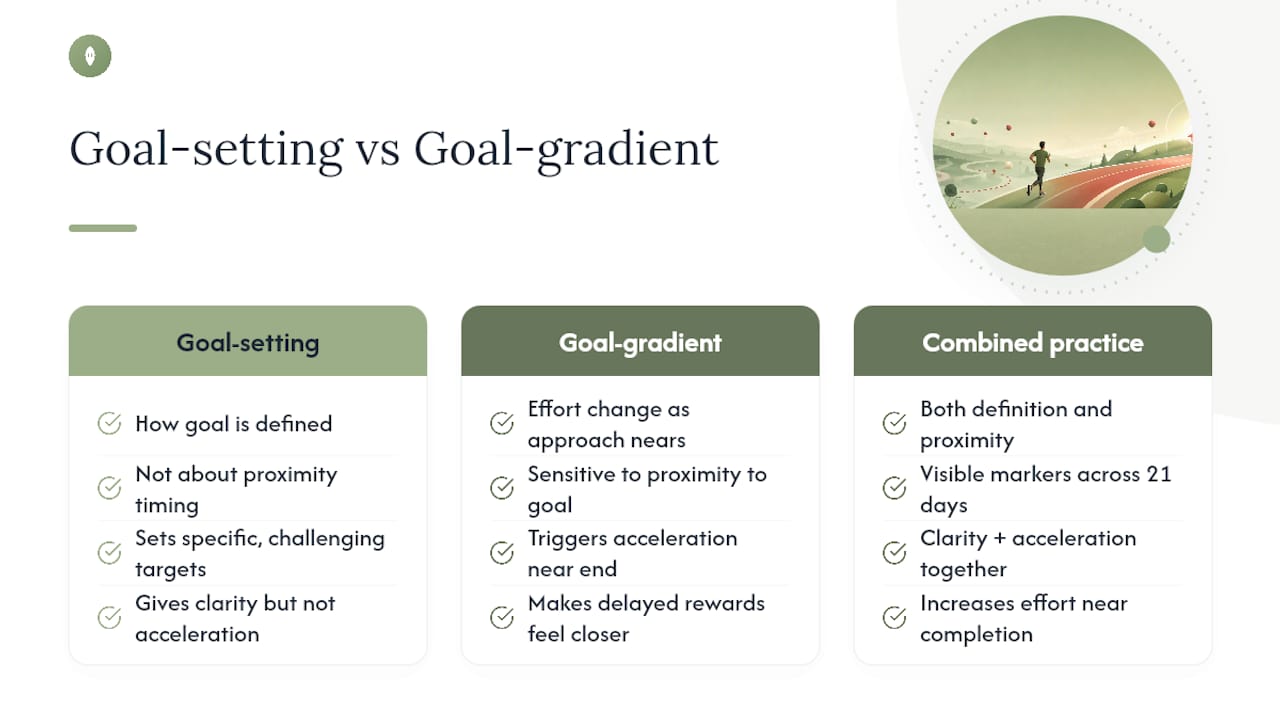
Goal-setting theory, most associated with the work of Edwin Locke and Gary Latham, focuses on how a goal is defined: specific and challenging targets outperform vague ones like "do better." The goal-gradient effect is a different layer entirely. It doesn't care how the goal was set; it describes what happens to effort as someone approaches whatever goal they already have.
The two ideas work together rather than compete. A specific, well-defined 21-day habit goal (goal-setting theory doing its job) still needs visible proximity markers to trigger the acceleration effect near the end (the goal-gradient effect doing its job). One without the other tends to underperform: a specific goal with no visible progress tracker gives you clarity but no acceleration, while a visible tracker attached to a vague goal gives you a countdown toward nothing meaningful.
The gradient effect also has a complicated relationship with immediate versus delayed rewards. Delayed rewards, like a payout at day 30, generally motivate less than immediate ones, because human motivation discounts the future. But the goal-gradient effect partially compensates for that discount by making the delayed reward feel psychologically closer as the deadline approaches. That's the whole mechanism in a sentence: a 30-day reward feels distant on day 1 and immediate on day 28, even though the actual reward hasn't moved at all.
Does the Effect Build Lasting Habits or Just Short-Term Pushes?
The honest answer is that the goal-gradient effect is better documented for finishing things than for making things stick. Kivetz's loyalty-card customers completed their purchases faster, but that study measured completion speed, not whether those customers kept buying coffee at the same rate a year later. That distinction matters for anyone using the effect to build a habit meant to last beyond one 30-day cycle.
Short-term behavior change and long-term habit formation respond to different parts of the gradient. The acceleration near a finish line is excellent for getting someone through days 25 through 30 of a challenge they might otherwise abandon. It does very little, on its own, for what happens on day 31, when there's no visible milestone left and the old behavior has to survive without a countdown.
The practical fix, and the one supported by research on post-reward resetting, is to chain gradients together rather than treat one as the finish. A habit that survives long term usually looks like a series of short, visible goals stacked back to back, each one re-triggering the acceleration effect right as the last one fades. Someone who treats day 30 as "done" often loses the behavior within weeks; someone who treats day 30 as "the start of the next 21-day window" tends to keep it. The gradient effect is a powerful tool for crossing finish lines. Whether it builds a lasting habit depends entirely on whether you keep drawing new finish lines instead of stopping at the first one.

How Flourishorforfeit Puts the Goal-Gradient Effect Into Practice
We built Flourishorforfeit's challenge windows at 7, 21, and 30 days on purpose, because each length gives users a near, visible finish line instead of an open-ended commitment that never feels close. A refundable stake tied to a short window recreates the same proximity pressure Kivetz measured with coffee stamps, except the "stamp" here is a day of typed affirmations and the reward is getting your own money back. Pairing that deposit with a visible daily dashboard is what keeps people from stalling in the middle, a pattern we also cover in our piece on staying consistent when motivation dips.
— Zack
Put Your Own Habit on a Visible Finish Line
Most habit apps ask you to trust willpower alone, which is exactly the part of habit-building the goal-gradient research says is weakest without a visible near-term goal. Flourishorforfeit adds the piece that's missing: a real financial stake, from $5 to $250, attached to a fixed 7, 21, or 30-day window, so every day you complete moves you visibly closer to a full refund instead of an abstract future benefit.

Because the challenge length is fixed and short, you're working with a genuine near finish line from day one, not a vague year-long resolution that never feels close enough to accelerate toward. Typing five affirmations word-for-word each day gives you an active, trackable milestone, the dashboard shows exactly how close you are, and a missed day carries a real cost instead of a silent shrug. If you've tried streak apps that quietly died in week two, pick a stake and a duration that matches your current habit, and start your challenge with a deadline close enough to actually pull you toward it.
Sources
The research behind the goal-gradient effect spans nearly a century, from lab animals to loyalty cards, and these are the core studies worth reading directly:
- The Goal-Gradient Hypothesis Resurrected: Purchase Acceleration, Illusionary Goal Progress, and Customer Retention - Kivetz et al.
- Goal-Gradient: Illusionary goal progress (University of Chicago extract)
- Review linking task-completion effects and memory/drive (NCBI PMC)
- Non-monotonic motivational patterns and the middle slump - Hwang & Choi (2026)