

Yes, affirmations work, but modestly and not for everyone in the same way. A 2025 APA meta-analysis of 129 studies and 17,748 participants found small but statistically significant improvements in general well-being (d = 0.29), self-perception (d = 0.32), and social well-being (d = 0.26). That's a real effect, not a rounding error, but it's also not the overnight mindset flip the self-help industry sells you.
The catch is in the fine print. Benefits in that meta-analysis lasted on a short-term timescale, and results depended heavily on how the affirmation was written and who was saying it. People with lower baseline self-esteem sometimes got less out of generic positive statements, or felt worse.
- The verdict: small, real, time-limited effects.
- The catch: phrasing and personal baseline change the outcome substantially.
- The fix: start with values-based reflection, not "I am amazing" slogans.
Pro Tip: Before you write a single affirmation, spend two minutes listing what actually matters to you (family, craft, integrity, curiosity). Values-based prompts outperform generic positivity almost every time.
Key Takeaways
Affirmations produce small, statistically significant improvements in well-being and self-perception, but the effect depends heavily on phrasing, timing, and baseline self-esteem.
| Point | Details |
|---|---|
| Effects are real but modest | The 2025 APA meta-analysis found effect sizes of 0.26 to 0.32 across well-being measures, persisting about two weeks. |
| Values beat slogans | Values-based statements outperform generic "I am" affirmations because they broaden self-concept instead of forcing false positivity. |
| Self-esteem changes the outcome | Low self-esteem paired with unbelievable statements can backfire and worsen mood. |
| Specificity and timing matter | Concrete, believable statements tied to implementation intentions work better than vague daily mantras. |
| Consistency is the real bottleneck | Flourishorforfeit adds a financial stake to daily affirmation practice, refunding on completion and forfeiting the stake on missed days to support follow-through. |
Where to Read the Original Research
For readers who want the primary sources instead of secondhand summaries:
- The 2025 APA meta-analysis press release for effect sizes and sample details.
- The Frontiers in Psychiatry RCT for moderator findings in a clinical population.
- The Annual Review of Psychology synthesis for the theoretical foundation of self-affirmation.
- The fMRI study on VMPFC activation for the neuroscience angle.
Prioritize meta-analyses and peer-reviewed RCTs over blog summaries when you want to judge how strong a claim about effectiveness really is.
Table of Contents
- How Do Affirmations Work in the Brain and Mind?
- What Does the Research Say About Affirmations Actually Working?
- When Do Affirmations Backfire?
- How Do You Make Affirmations More Effective?
- How Long Until Affirmations Start Working?
- Should You Write, Say, or Listen to Affirmations?
- Frequently Asked Questions
- Sources
How Do Affirmations Work in the Brain and Mind?
The leading explanation comes from self-affirmation theory, built out by researchers including Cohen and Sherman. Their framework argues that affirming your core values, not your ego, is what does the heavy lifting. When you write about what matters to you, your sense of self broadens beyond whatever threat or failure you're currently facing. A bad performance review stings less if your identity isn't riding entirely on your job title.
Neuroscience backs up part of this story. fMRI research links self-affirmation to activation in the ventromedial prefrontal cortex (VMPFC), a region tied to self-related processing and reward valuation. When that region lights up during an affirmation exercise, people tend to show reduced defensiveness afterward, meaning they're more willing to sit with uncomfortable information instead of dismissing it.
That matters because defensiveness is usually the thing standing between you and behavior change. If you're not defensive, you're more open to feedback, more willing to take a health warning seriously, more likely to actually try the harder thing.
Values-affirmation exercises can catalyze what researchers call a "cycle of adaptive potential," where a brief intervention triggers small shifts that compound into larger downstream benefits over weeks and months, according to a review in the Annual Review of Psychology.
Here's the rough causal chain researchers propose:
- Input: a short reflection on personal values, written or spoken.
- Neural response: VMPFC activation tied to self-relevance and reward.
- Psychological shift: lower threat response, higher sense of efficacy.
- Behavioral output: better follow-through on health, academic, or social goals in the weeks that follow.
None of this means affirmations rewrite your personality. It means a well-timed, values-based reflection can lower your guard enough to let real change happen. Separate research on stress-buffering and cortisol responses tied to values-affirmation exercises adds a physiological angle to the same story: less threat response, measured in the body, not just self-reported mood.
What Does the Research Say About Affirmations Actually Working?
The strongest current evidence is the 2025 APA meta-analysis. Pooling 129 studies and nearly 18,000 participants, it found consistent, small positive effects across three domains: general well-being, self-perception, and social well-being, with the self-perception effect (d = 0.32) the largest of the three. Benefits persisted for about two weeks on average, which tells you affirmations function more like a recurring habit than a one-time inoculation.
Randomized controlled trials tell a messier but still informative story. A pre-registered RCT in Frontiers in Psychiatry tested implementation-intention-based self-affirmation in 222 adults with psoriasis, tracking them at baseline, two weeks, and one month. The modified intervention conditions didn't beat the control group overall. But age and baseline self-esteem significantly moderated who benefited, which is a more useful finding than a flat "it works" headline. It tells you the effect is real for some people under some conditions, not universal.
A "small but significant" effect size in practical terms means you shouldn't expect a dramatic before-and-after. Think of it as similar to the effect of a modest exercise habit on mood: noticeable if you're tracking it carefully, easy to miss if you're not.
Here's how the key evidence stacks up:
| Study Type | Population | Main Result |
|---|---|---|
| Meta-analysis (129 studies) | 17,748 adults, mixed settings | Small positive effects on well-being, self-perception, social well-being |
| fMRI study | Adults undergoing values-affirmation tasks | VMPFC activation linked to reduced defensiveness |
| RCT (psoriasis patients) | 222 adults | No overall group advantage; strong moderation by age and self-esteem |
| Older experimental work | Adults grouped by self-esteem level | Positive statements helped high self-esteem, sometimes hurt low self-esteem |
The pattern across all four rows is the same: affirmations aren't a coin flip, but they're not a guarantee either. Whether they land depends on the person and the phrasing more than the mere act of repeating something positive.
When Do Affirmations Backfire?
Baseline self-esteem is the biggest known moderator. Experimental work published in Psychological Science found that repeating positive self-statements benefited people who already felt reasonably good about themselves, but made people with low self-esteem feel worse. The mechanism is straightforward: if a statement feels wildly discrepant from what you actually believe, your brain treats it as false, and the mismatch itself becomes a stressor.
Specificity matters too. "I am a successful person" invites your brain to argue back with counterexamples. "I handled that client call better than I expected" is harder to dispute because it's concrete and already happened.
- Baseline self-esteem: low self-esteem plus generic, unbelievable statements is a bad combination.
- Timing: affirming values right before a threat (a hard conversation, a test) works better than affirming after you're already spiraling.
- Specificity: vague, sweeping claims are easier to reject than small, factual wins.
- Age: some trials, including the psoriasis RCT, found age shaped who responded.
There's also the toxic-positivity trap. Forcing an upbeat statement over a genuinely difficult situation can shade into avoidance, where you're papering over a problem instead of solving it. Science journalism covering this research points out that compassionate self-talk, acknowledging that something is hard, often outperforms forced positivity, especially under acute stress.
If an affirmation practice leaves you feeling worse, more anxious, or like you're lying to yourself, that's a signal to stop and reassess, not push harder. Affirmations are a low-cost tool, not a treatment for depression or anxiety disorders. If low mood or self-esteem issues persist, a therapist or behavioral intervention belongs in the picture.
How Do You Make Affirmations More Effective?
Skip the mirror-pep-talk approach. Start with values, not adjectives.
- Identify two or three core values. Health, honesty, creativity, family, growth. Write a sentence about why one of them matters to you right now.
- Draft one to three short statements tied to those values. Keep them specific and believable, something you'd nod along to, not roll your eyes at.
- Add an implementation intention. Pair the statement with a concrete trigger: "When I sit down at my desk, I'll remind myself that consistency matters more than perfection."
- Schedule the practice daily, at a fixed time. Same slot every day beats sporadic bursts of motivation.
- Pair it with an action, not just words. Say the affirmation, then immediately do the small task it points to.
Sample statements that hold up better than generic slogans:
- "I'm the kind of person who follows through, even on hard days." (identity-based, specific)
- "When I feel like skipping my workout, I'll do five minutes instead of zero." (implementation intention)
- "Being honest with my team matters more to me than looking perfect." (values-based)
Implementation intentions, the "if-then" structure tested in several Frontiers in Psychiatry trials, give affirmations a job to do instead of leaving them as abstract mantras. The trials on booster sessions showed mixed results, but the underlying if-then structure is one of the more consistently useful behavior-change techniques in the broader psychology literature.
Pro Tip: Willpower fades by day four or five for most people. Pairing your affirmation practice with a commitment device, something with a real cost attached to skipping, tends to keep people showing up longer than motivation alone.

How Long Until Affirmations Start Working?
Some people notice a subjective lift the same day, a slightly calmer mind before a hard conversation. Measurable change, the kind researchers can actually detect in mood, behavior, or self-perception scores, tends to show up between two weeks and one month of consistent practice, which lines up with the timeframes used in the psoriasis RCT and the APA meta-analysis.
A simple way to track it yourself:
- Baseline: rate your mood, confidence, and one target behavior (1 to 10) before you start.
- Daily: jot one sentence on how the affirmation practice went and how you felt.
- Weekly: average your daily notes into a rough weekly score.
- Checkpoints: compare your baseline to your scores at the two week and four week marks.
Pro Tip: Run it like a short experiment, not a lifestyle. Two to four weeks, pre and post ratings, one specific behavior you're tracking. That beats vague impressions every time.
Should You Write, Say, or Listen to Affirmations?
All three formats show up in the research, and none is definitively superior for every person.
- Writing (values-affirmation essays) is the format most meta-analytic and RCT evidence is built on, and it forces more specificity than speaking off the cuff.
- Speaking aloud works well for pre-event nerves, a presentation, a hard conversation, because it's fast and portable.
- Listening to recordings, sometimes paired with music, shows small mood improvements in some clinical samples, though the evidence base here is thinner than for writing.
Tools matter less than consistency. A notes app, a $3 notebook, or a habit tracker all work equally well as long as you actually open them daily. What tends to fail is switching formats every few days out of boredom before any one approach gets a fair test.
Pro Tip: Pick one format and commit to a one-month trial before you decide it "doesn't work." Format-hopping is the most common reason people conclude affirmations are useless when the real problem was inconsistency.
A Balanced Way to Actually Use This
I'd treat affirmations the way I'd treat a multivitamin: cheap, low-risk, worth trying, but not a substitute for the harder stuff, sleep, exercise, therapy when needed. Write values-based statements, track results honestly, and drop anything that leaves you feeling worse instead of steadier.
A Low-Cost Way to Actually Stick With It
Knowing the right way to write an affirmation and actually doing it every day for a month are two different problems. Most people who try affirmations quit within the first week, not because the technique failed, but because there was nothing keeping them accountable on the days motivation didn't show up.
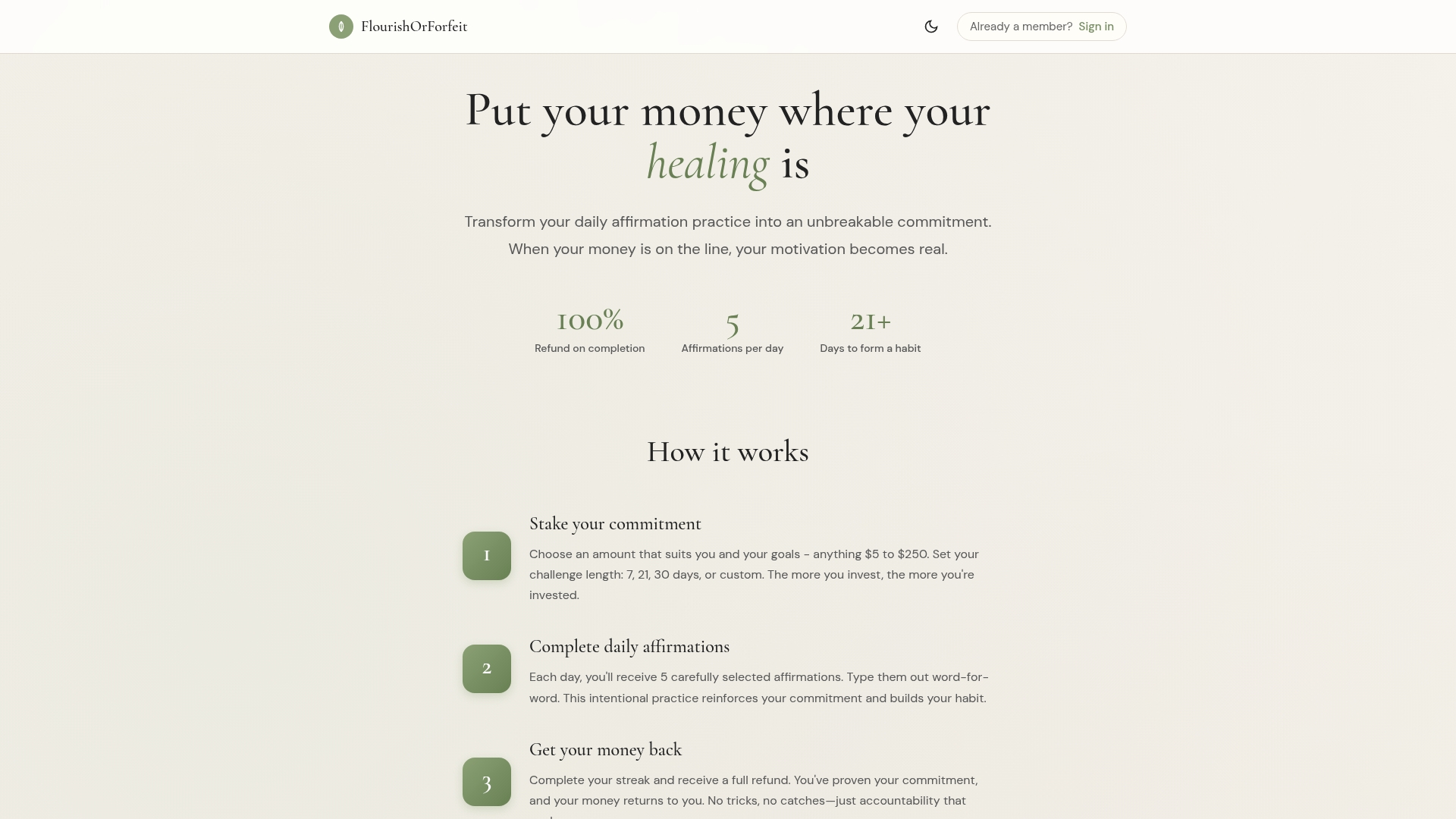
Flourishorforfeit turns that gap into a financial commitment. You choose a stake between $5 and $250, pick a challenge length of 7, 21, or 30 days, and type five curated affirmations word-for-word each day, verified through secure payments and SMS tracking. Finish the challenge and you get a full refund. Miss enough days and you forfeit your stake. It's not a replacement for therapy or deeper mental health support, but for readers who already know affirmations help and just need a reason to show up daily, the money on the line does what willpower alone often can't. Check the challenge options at Flourishorforfeit and pick a stake and duration that fits your goal.
Frequently Asked Questions
Do affirmations work for anxiety or depression? They can offer modest relief for everyday stress and self-doubt, but affirmations aren't a clinical treatment. Persistent anxiety or depression calls for therapy or a licensed provider, not a daily statement practice alone.
Why aren't my affirmations working? The most common reasons are vague phrasing, statements that feel too far from what you actually believe, and inconsistency. Switching to values-based, specific statements paired with an implementation intention usually helps more than repeating a slogan louder.
Can affirmations change your mindset long-term? Evidence suggests short-term shifts in self-perception and reduced defensiveness, lasting roughly two weeks per session in meta-analytic data. Lasting mindset change likely requires repeated practice over months, not a single burst of effort.
Are affirmations evidence-based or just a self-help trend? Both, depending on how they're used. Peer-reviewed meta-analyses and RCTs support small, real effects for values-based affirmations, while generic positivity slogans have weaker and sometimes negative evidence behind them.
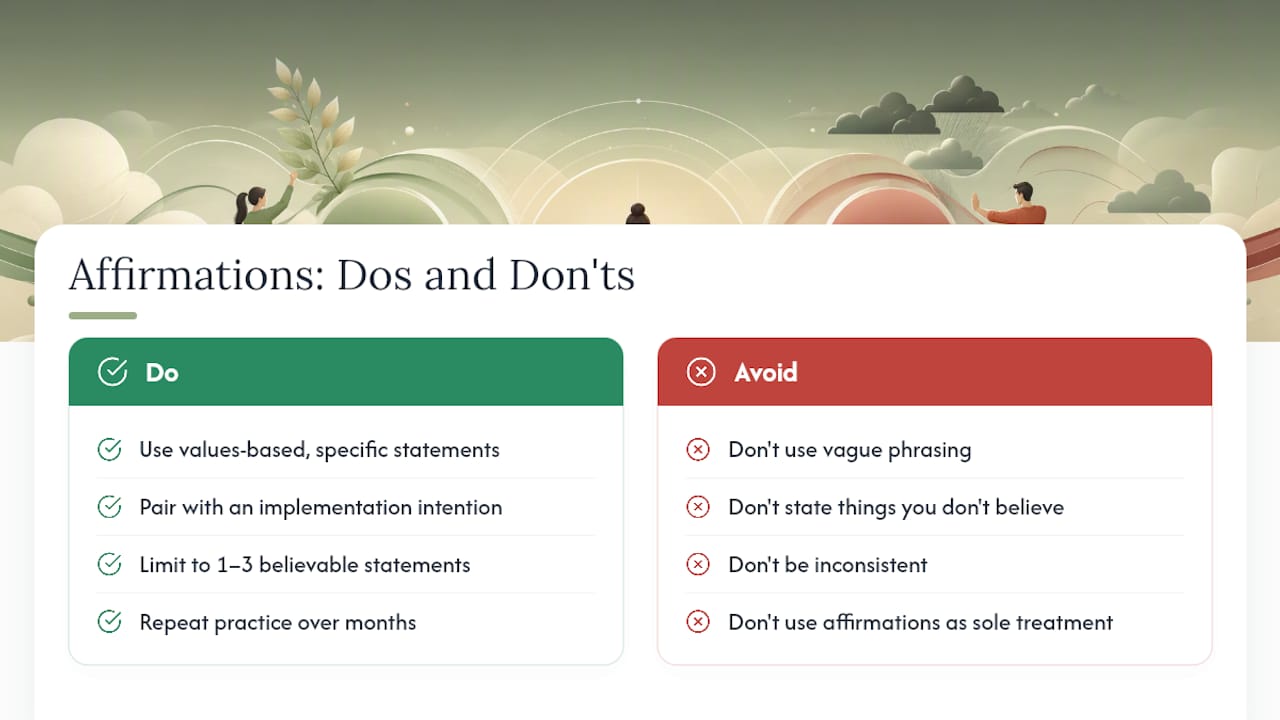
How many affirmations should I say per day? Research doesn't point to a magic number. One to three specific, believable statements tied to your actual values tend to outperform a long list of generic phrases you don't fully believe.
Sources
- American Psychological Association press release: self-affirmations and well-being (2025)
- PubMed entry on fMRI evidence linking self-affirmation to VMPFC activation
- Frontiers in Psychiatry: Implementation-intention-based self-affirmation RCT (2022)
- ScienceAlert: Do positive affirmations really work? A psychologist explains the science (2026)
- Annual Review of Psychology: Self-affirmation theory and intervention effects (2014)