

Prevent most habit slips by reengineering the cue and adding a small, consistent accountability system, not by trying to will yourself harder. Willpower fades by evening; environmental design and monitoring don't. If you want fewer missed days, focus your energy on three things:
- Piggyback the habit onto something you already do without fail, like brushing your teeth or starting your car.
- Write an implementation intention: a specific "if X happens, then I do Y" plan for your most common failure point.
- Run a 10-second monitoring check each night: did the cue fire, and did you respond?
Some people need one more layer: real stakes. A platform like FlourishOrForfeit turns "I should" into "I paid to."
Key Takeaways
Habit slip prevention works best when cue redesign and small accountability systems replace reliance on willpower alone.
| Point | Details |
|---|---|
| Fix the environment first | Piggyback new habits onto routines you already do automatically every day. |
| Plan for failure points | Write a specific if-then implementation intention for your most common slip trigger. |
| Recover without overcorrecting | After a slip, return to the minimum effective dose instead of trying to make up missed time. |
| Track weekly, not just daily | Review cue consistency and automaticity on a weekly or monthly rhythm as habits mature. |
| Add real stakes when needed | FlourishOrForfeit lets you stake $5 to $250 over a 7, 21, or 30 day challenge, refunded on completion. |
Table of Contents
- What Causes Habit Slip Prevention to Fail in the First Place?
- Actionable Prevention Toolkit for Stopping Habit Slips Before They Start
- How Do You Recover Right After a Habit Slip?
- Why a Financial Stake Can Strengthen Habit Slip Prevention
- How Stress and Emotion Trigger Habit Slip Prevention Breakdowns
- Does Self-Compassion Actually Help You Stick to Habits?
- What's the Best Way to Track Habits Over Months, Not Days?
- Who Should You Recruit for Habit Support Beyond Money?
- An Editorial Take on Why Most Habit Advice Skips the Hard Part
- Ready to Put Real Stakes Behind Your Next Habit?
- Selected Research and Reading
- Sources
What Causes Habit Slip Prevention to Fail in the First Place?
Habits aren't decisions. They're automatic responses your brain fires the instant a familiar cue appears, whether that cue is a location, a time of day, or an emotional state. Once a behavior gets repeated enough in a stable context, the cue and the response fuse into what researchers call a habit memory trace, and that trace doesn't care about your motivation level.
Neuroscience reviews describe this as a tug-of-war between habit circuits in the striatum and the cortical systems responsible for goal-directed control. When the environment stays constant, habits run smoothly. When it doesn't, the system stumbles.
Habit slips are rarely about weak character. They're context failures: the cue moved, disappeared, or got buried under a new routine, and the automatic response never fired.
Think about what happens on a business trip. Your morning gym habit was tied to walking past your gym bag by the door. No bag, no cue, no workout. Or picture a stressful week at work: your usual 3 p.m. walk gets cannibalized by a meeting, and by day three the habit has quietly disappeared. Vigilant monitoring, a cognitive strategy where you consciously watch for the moment a cue appears, is one of the few tactics shown to interrupt this automatic drift before it becomes a pattern.
Actionable Prevention Toolkit for Stopping Habit Slips Before They Start
Willpower is a bad long-term strategy because it depletes. Environment design doesn't. Here's the order to work through these tactics, starting with the highest-leverage one first.
- Piggyback on an unmovable routine. Attach your new habit to something that already happens every day no matter what. Template: "After I [existing habit], I will [new habit]." Coffee brewing, phone charging, and locking the front door are all reliable anchors because integrating a new behavior into an existing routine measurably reduces slips.
- Write an implementation intention. These "if-then" plans work partly because they make the cue itself more noticeable to your brain, which builds an almost automatic bridge between the trigger and the substitute action. Example: "If I feel the urge to skip my affirmation reading, then I will read just one line out loud before deciding."
- Add friction to the behavior you're trying to avoid, and remove it from the one you want. If late-night scrolling derails your wind-down routine, charge your phone in another room. If your habit is journaling, leave the notebook open on your pillow.
- Run a nightly two-minute check. Ask: did the cue show up today, and did I respond? Substitution and reduced cue exposure are both viable strategies for changing entrenched habits, but you can't apply them if you don't notice the pattern breaking.
- Use a reward system, but keep the dose small. A sticker chart, a checkmark, or a five-dollar stake all work the same way: they close the loop fast enough for your brain to register progress.
Pro Tip: Pick the smallest version of your habit that still counts as a "yes" on hard days. A one-minute meditation beats a skipped ten-minute session every time, because the streak matters more than the volume.
How Do You Recover Right After a Habit Slip?
The instinct to "make up" a missed day, doubling your workout or reading double the pages, is exactly backward. The better move is to return to the minimum effective dose and rebuild momentum from there instead of trying to prove something.
Use a simple 72-hour reset:
- Day 1: Diagnose what broke. Was the cue missing, did stress crowd it out, or did logistics get in the way?
- Day 2: Reinstate your piggyback anchor, even in a smaller form than before.
- Day 3: Restart your nightly monitoring check so you catch the next wobble early.
Match the fix to the actual cause instead of guessing:
- Cue disruption (travel, new schedule): rebuild a portable version of the cue, like a phone alarm tied to a routine you still do anywhere.
- Stress overload: shrink the habit to its smallest form for a few days rather than skipping entirely.
- Logistics failure (lost materials, broken routine): fix the physical setup before worrying about motivation at all.
Treat the slip as diagnostic information, not a verdict on your character. A missed day tells you which part of the system needs adjusting, nothing more.
Why a Financial Stake Can Strengthen Habit Slip Prevention
Not every habit needs money on the line, but some genuinely do. If you've already tried piggybacking, if-then plans, and monitoring checks and you're still slipping, adding a real cost to failure changes the calculation.
FlourishOrForfeit works on that principle directly. Users pick a stake between $5 and $250, choose a challenge length of 7, 21, or 30 days, and type five curated affirmations word-for-word every day. Complete the challenge and you get a full refund. Miss too many days and you forfeit the stake. Secure payments and SMS verification keep the process accountable without adding friction to the daily task itself.
- The stake functions as a commitment device, the same mechanism behind vigilant monitoring, just with real consequences attached.
- Typing the affirmation daily forces active engagement instead of passive intention.
- The 7 to 21 day windows work as short experiments, structured around the idea that a few consistent weeks builds a durable habit.
| Situation | Suggested approach |
|---|---|
| First time building the habit | Start with piggybacking and monitoring |
| Low-cost tactics keep failing | Add a small financial stake |
| High-value or high-stakes habit | Use a larger stake and shorter challenge window |
How Stress and Emotion Trigger Habit Slip Prevention Breakdowns
Stress doesn't just make habits harder. It actively reroutes your brain toward automatic, low-effort responses, which is exactly why a stressful week is when old habits resurface and new ones collapse. The cortical control that normally overrides automatic habits gets outcompeted when your attention is consumed by a deadline, a fight, or a bad night's sleep.
Emotional triggers work the same way as environmental ones. Boredom, loneliness, and frustration all function as cues, just internal ones instead of external. If you've ever noticed that you only skip your evening walk on days you feel anxious, that's not a coincidence. Anxiety is the cue.
The fix isn't to eliminate stress, which isn't realistic. It's to build a stress-specific contingency plan in advance. Decide now what your habit looks like on a bad day: a five-minute version, a one-line version, a "just show up" version. Pair this with a quick physiological reset, like a short walk or a few minutes of slow breathing, before returning to the habit itself. That sequence interrupts the automatic stress response long enough for the cortical control mentioned earlier to reassert itself.
Journaling which emotions precede your slips for two weeks often reveals a pattern you didn't know existed. Once you can name the trigger, you can build a specific if-then plan around it instead of a generic one.
Does Self-Compassion Actually Help You Stick to Habits?
Yes, and it's not just a feel-good idea. Shame after a slip tends to trigger avoidance, which turns one missed day into a five-day gap because facing the habit now means facing the failure too. Treating a slip as neutral data rather than a moral failing removes that avoidance loop entirely.
This doesn't mean lowering your standards. It means separating your identity from a single missed day. "I'm someone who is rebuilding a habit" is a very different internal sentence than "I failed again," and it changes whether you show up tomorrow.
Self-compassion also protects the accuracy of your diagnosis. If you're busy punishing yourself, you're not asking the more useful question: was this a cue problem, a stress problem, or a logistics problem? Harsh self-judgment skips straight past that analysis and jumps to "I'm bad at this," which gives you nothing to act on.
Mindset also shapes how you interpret setbacks going forward. People who view a slip as evidence the whole system is broken tend to quit outright. People who view it as one data point in an ongoing experiment tend to adjust and continue. The habit itself hasn't changed. The story attached to the slip has.
What's the Best Way to Track Habits Over Months, Not Days?
Daily tracking works for the first few weeks. Long-term consistency needs a different rhythm, because a habit that's been running for four months has different failure points than one you started last Tuesday.
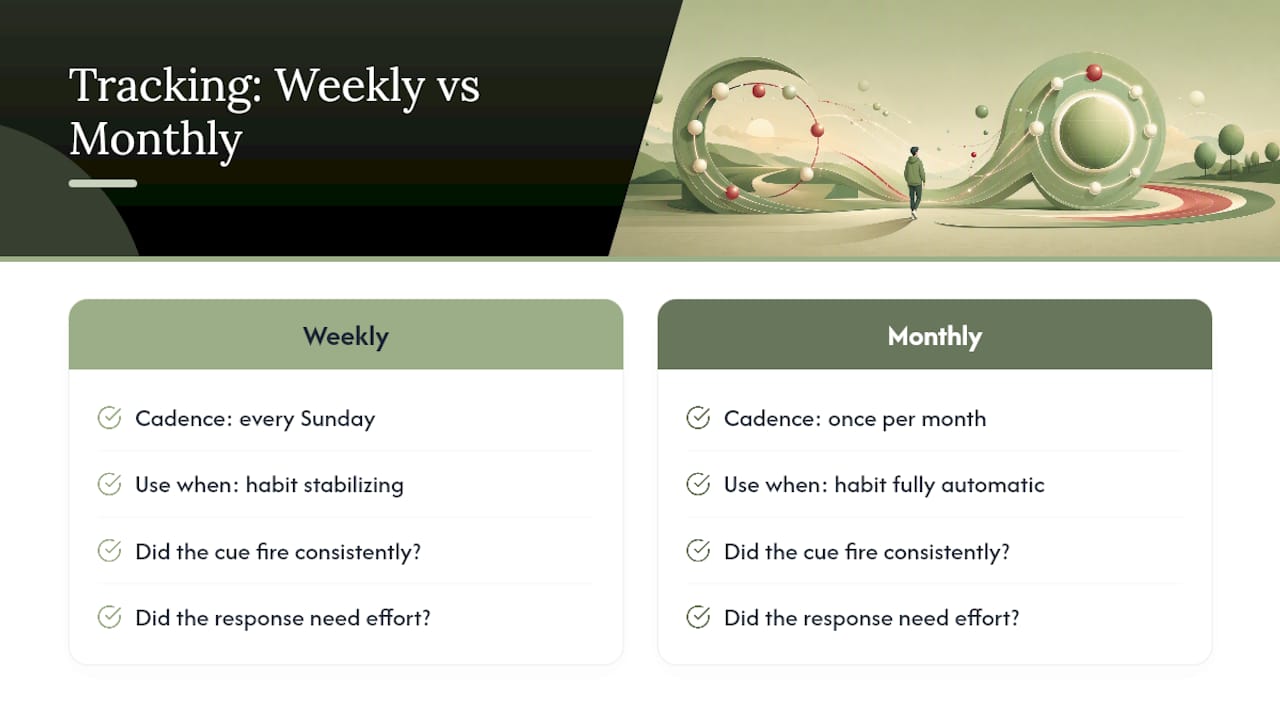
Weekly reviews work better than daily ones once a habit stabilizes. Ask three questions every Sunday: Did the cue fire consistently? Did the response follow automatically, or did it still require effort? Has anything in the environment shifted? A habit that's gone fully automatic needs a monthly check instead of a weekly one, freeing up attention for whatever habit you're building next.
Adjustment matters as much as tracking. A habit that worked in summer might not survive a schedule change in fall. Rather than treating a broken habit as a failure, treat it as outdated design that needs an update, usually a new cue, a new time, or a smaller version of the same behavior.
Simple tools work fine here: a paper calendar with X marks, a habit-tracking app, or a shared spreadsheet. The format matters less than the consistency of the review. What matters most is catching drift early, before three missed days becomes a month of silence.
Who Should You Recruit for Habit Support Beyond Money?
Financial stakes work well for some people, but they're not the only accountability lever, and they're not always the right one to start with. Social accountability often costs nothing and works through a completely different mechanism: you don't want to disappoint someone who's watching.

A simple accountability partner, someone who checks in twice a week by text, adds enough social pressure to close the gap on days when motivation alone wouldn't cut it. Public commitment works similarly. Telling a friend or posting your goal somewhere visible activates a mild social cost for quitting that many people respond to even more strongly than a small financial one.
Group challenges add a third layer: shared momentum. When other people are visibly working on the same habit, your own slips feel more noticeable, and your own progress feels more rewarding. This is different from financial stakes, but not mutually exclusive with them. Some people combine a small stake with a check-in partner for two overlapping layers of pressure.
The right level of accountability depends on the habit's value and your personal relapse risk. A low-stakes habit might only need a shared spreadsheet with a friend. A habit tied to a real goal, like a health change or a career shift, might justify combining social support with a financial commitment for the strongest possible structure.
An Editorial Take on Why Most Habit Advice Skips the Hard Part
Most habit content stops at "just be consistent," which is advice with no mechanism behind it. The research points somewhere more useful: slips are logistics failures, not character failures, and the fix is redesigning cues and adding real consequences, not gritting your teeth harder.
...
If you're skeptical, don't take my word for it. Pick one habit, write a single if-then plan for your most common failure point, and track it for seven days. See what actually breaks.
— Zack
Ready to Put Real Stakes Behind Your Next Habit?
If you've tried piggybacking, if-then plans, and nightly check-ins and you're still watching streaks fall apart, a financial stake closes the gap that willpower alone can't. FlourishOrForfeit gives you a concrete reason to show up on the days motivation goes quiet, because the money only comes back if the habit does too.
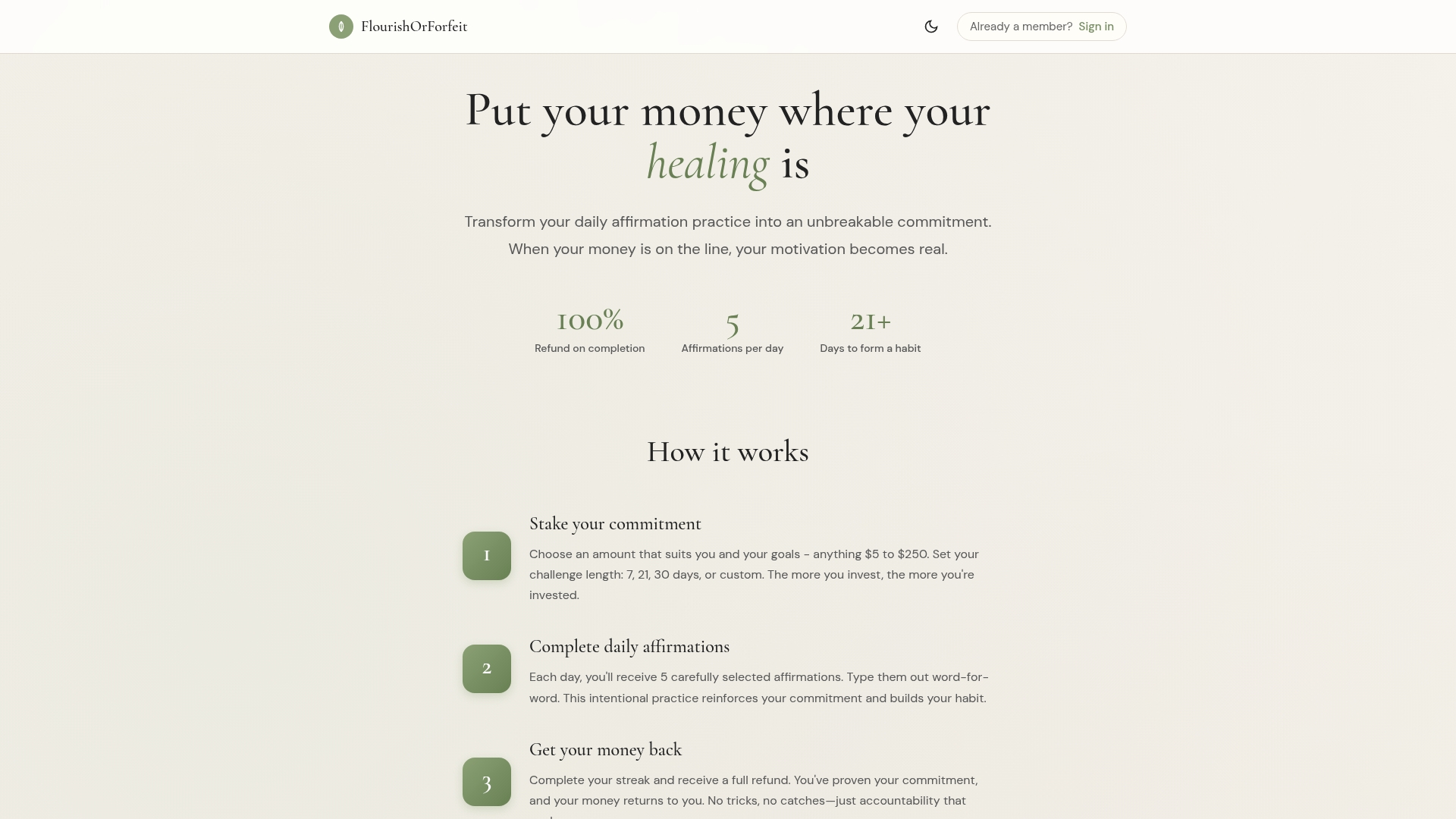
The platform fits people who already know accountability works for them but need something stronger than a checklist. You choose a stake between $5 and $250, pick a 7, 21, or 30 day challenge, and type five affirmations word-for-word each day. Finish and you get a full refund. Miss too many days and you forfeit the stake. Start your first challenge at FlourishOrForfeit and decide how much accountability your next habit actually deserves.
Selected Research and Reading
- Vigilant monitoring as a habit inhibition strategy: peer-reviewed research on interrupting automatic responses.
- Wendy Wood's research on habit slips and piggybacking: field studies on routine integration.
- The neuroscience of habit and purposeful behavior: review of habit versus goal-directed brain circuits.
- Strategies for resuming a habit after a slip: practical restart guidance.
- Recent research on habit degradation strategies: implementation intentions and substitution.
Sources
- Journal of Personality and Social Psychology (habit inhibition research)
- Habit slips and product adoption (Wendy Wood et al.)
- Creatures of habit: the neuroscience of habit and purposeful behavior (PMC)
- Psychology Today: 7 strategies for resuming a good habit after a slip