

If you just finished a stake-based affirmation challenge, do three things in order: confirm your refund status in your dashboard, take a planned 48-hour pause before committing to anything new, and pick one small daily action you can keep doing forever. That's the entire end-of-challenge transition in a sentence. Everything else is detail.
The reason this sequence matters is simple. Commitment contracts work by putting your money at risk, and that pressure disappears the moment the challenge closes. Without a plan for what replaces it, momentum often collapses within days.
- Log into your dashboard and check for a refund confirmation email.
- Skip signing up for a new high-stakes challenge for at least 48 hours.
- Choose a daily floor, something as small as typing one affirmation, and attach it to a habit you already have.
Pro Tip: Write your Day 31 plan on Day 1, not Day 30. Deciding what "maintenance mode" looks like before the pressure is off keeps you from making that decision emotionally.
Key Takeaways
Post-challenge success depends on confirming your refund within your dashboard, taking a 48-hour pause, and locking in a small sustainable floor habit before momentum fades.
| Point | Details |
|---|---|
| Confirm refund status first | Check your dashboard and email for completion confirmation before assuming anything went wrong. |
| Take a 48-hour pause | Avoid re-enrolling or quitting entirely; use the window to audit and plan. |
| Shrink the habit, don't drop it | Reduce from five affirmations to one or two, anchored to an existing routine. |
| Use the restart-for-three rule | Three consecutive floor days rebuilds momentum after any missed day. |
| Choose your path deliberately | Relaunch, low-stakes maintenance, or intentional release, decided from evidence, not drift. |
Table of Contents
- How Do Refunds and Forfeitures Actually Work?
- Why the First 48 Hours Matter More Than You Think
- Habit Shrinkage, Floors, and Anchoring That Actually Last
- What's the Rule When You Miss a Day After the Challenge?
- Should You Restart, Maintain, or Let It Go?
- Where FlourishOrForfeit Fits Into Your Next Move
- How Do You Handle the Emotional Letdown After Finishing?
- What Keeps Motivation Going Once the Stakes Are Gone?
- What Trips People Up Most in the Transition Phase?
- Does a Support Group Help After the Challenge Ends?
- Why Setting a New Goal Matters More Than Maintaining the Old One
- Why Most Transition Advice Misses the Point
- Sources
How Do Refunds and Forfeitures Actually Work?
Refund timelines and forfeiture rules are where most confusion lands, so get familiar with the mechanics before you assume anything went wrong. On FlourishOrForfeit, successful completion of your chosen 7, 21, or 30-day run triggers a refund of your full stake, processed through Stripe's secure payment infrastructure. Forfeiture kicks in when a day is missed and not made up through an available mulligan, and the forfeited amount is what funds the platform's incentive model.
If you think a day was marked incomplete in error, here's how to sort it out:
- Open your dashboard and pull up the daily log for the disputed day, including timestamp and SMS verification status.
- Screenshot the typed affirmation entry if it's still visible, since that's your primary evidence.
- Contact support with the specific date and what you believe should have counted as complete.
- Ask about mulligan eligibility if you're mid-challenge and know you'll miss a day for something unavoidable, like travel or illness.
Pro Tip: Longer challenges (21 or 30 days) tend to include more mulligan flexibility than the 7-day option, so if you know your schedule is unpredictable, factor that into which duration you pick next time.
Refund processing generally follows the platform's standard payment window once completion is confirmed. If it's taking longer than expected, your dashboard status is the first place to check before assuming an issue.
Why the First 48 Hours Matter More Than You Think
Practitioners who study behavior change consistently point to the first two days after a structured challenge ends as the highest-risk window for what's sometimes called the "permission to quit" effect. The accountability that kept you typing affirmations every day just vanished, and your brain notices immediately.
An integration pause is not laziness. It's a deliberate 48-hour buffer where you resist two urges: re-enrolling in another high-stakes challenge out of anxiety, or abandoning the habit entirely out of relief.
Use the pause for three things:
- Acknowledge what you did. Finishing a money-backed commitment is not nothing.
- Audit your performance. Did you rely on the floor days, or did five affirmations feel easy by the end?
- Set your Day 31 floor and anchor before the accountability structure fully disappears.
Habit Shrinkage, Floors, and Anchoring That Actually Last
The habit rarely dies from lack of willpower. It dies from an all-or-nothing standard that's impossible to sustain without a financial penalty attached. The fix is habit shrinkage: deliberately reducing the ask so the behavior survives without stakes.
Here's how that looks in practice:
- Shrink the volume. If you typed five affirmations daily during the challenge, drop to one or two for ongoing maintenance. The identity behavior matters more than the count.
- Fix an anchor. Attach your affirmation to something you already do without thinking, like brewing coffee or brushing your teeth. A floating habit with no cue gets skipped; an anchored one gets remembered.
- Track loosely, not obsessively. A visible weekly log works better long-term than a daily streak counter, because a single missed day in a streak system can trigger total abandonment. That's the same collapse risk seen in commitment savings research on deposit-based programs, where structured follow-through outperforms unstructured intention.
- Reduce formal tracking gradually. Once the anchor has held for a few weeks without conscious effort, you can step back from daily logging altogether.
Pro Tip: Use a three-tier ladder: Minimum (the floor), Normal (your challenge-era routine), and Bonus (extra affirmations on a good day). Any rung counts as a win, which keeps the habit flexible instead of brittle.
One matched-bet study found participants increased target behavior by roughly 38% during the incentive period. That's a strong short-term signal, but it also confirms the core problem: the lift is tied to the bet window, not the behavior itself. Your job now is converting that borrowed motivation into a routine that doesn't need a stake to survive.
What's the Rule When You Miss a Day After the Challenge?
Missing a day post-challenge is not the same emergency it was when money was on the line, but treating every slip as a diagnostic event instead of a failure keeps you from spiraling. The simplest fix: restart for three. Complete your daily floor for three consecutive days, and consider momentum rebuilt.
For travel or illness, use a micro-version rather than skipping entirely:
- Type one affirmation from memory instead of your full list.
- Do it verbally if typing isn't practical, just to preserve the identity behavior.
- Resume full tracking once you're back to a normal routine.
When a slip happens, run through this quick diagnostic:
- Cue check: Did your anchor habit happen, but the affirmation didn't follow?
- Environment check: Was your phone, journal, or app inaccessible?
- Load check: Were you simply overwhelmed that day?
The answer tells you whether to shrink the habit further, fix a broken anchor, or relaunch with fresh structure.
Should You Restart, Maintain, or Let It Go?
Not every affirmation habit deserves to continue forever, and deciding that consciously beats letting it fade by accident. Three paths make sense depending on what your challenge actually revealed.
Relaunch a stakes-based challenge if you noticed clear gaps in motivation rather than gaps in technique. If stakes were doing the heavy lifting and the habit itself never became automatic, another round on FlourishOrForfeit with a fresh 21 or 30-day window can rebuild that structure.
Move to low-stakes maintenance if the behavior mostly stuck. A weekly review, a simple self-tracking sheet, or an accountability partner who checks in asymmetrically (they ask, you don't have to report unprompted) can sustain a habit without financial friction.
Intentionally release the habit if it's served its purpose. Not every practice needs to run indefinitely. Closing it out deliberately, acknowledging what it gave you, and framing the ending as completion rather than failure keeps the experience positive.
- Set a specific "review date" 2 to 4 weeks out to reassess which path is working.
- Don't let indecision become the default; drift is its own kind of failure.
Pro Tip: If you're unsure which path fits, default to low-stakes maintenance for two weeks. It's reversible in either direction, toward relaunch or toward release, and buys you real data instead of a guess.
Where FlourishOrForfeit Fits Into Your Next Move
FlourishOrForfeit's structure gives you concrete evidence to work with during this transition. Stakes range from $5 to $250, challenge durations run 7, 21, or 30 days, and every transaction moves through Stripe's secure payment system. Completion triggers a full refund; missed days without an available mulligan result in forfeiture.
- Your dashboard holds the daily log, SMS verification records, and typed affirmation history, which is exactly what you'd need if disputing a result.
- Mulligans and longer durations interact directly: a 30-day challenge typically carries more flexibility for an occasional miss than a 7-day sprint.
- Support channels are listed directly on the platform for refund questions or verification disputes.
The affirmation habit-formation research behind the platform points to a consistent pattern: financial stakes correct for procrastination, not for skill. Once the behavior is automatic, the money was never the point.
How Do You Handle the Emotional Letdown After Finishing?
Finishing a money-backed challenge produces a strange mix of relief and unease, and both are normal. The relief is obvious: no more daily pressure. The unease is less discussed but just as common. It comes from losing a structure that gave your day a fixed point of accountability.

Some people also feel a quiet anticlimax. Thirty days of consistent effort, and then... nothing changes visibly. That flat feeling isn't a sign the challenge failed. It's a sign you're comparing an internal shift, confidence, self-talk patterns, discipline, against an external marker that was never going to announce itself.
Give yourself permission to notice both feelings without acting on either immediately. If the relief tempts you to drop the habit entirely, that's the 48-hour pause doing its job by slowing you down. If the unease tempts you to immediately re-stake money out of anxiety, that's worth sitting with too. Neither impulse needs an instant answer.
What actually helps is naming the shift out loud or in writing: "The challenge is over. The habit is now mine to keep without a deadline." That reframing moves you from being challenge-dependent to being self-directed, which is the entire point of the exercise in the first place.
What Keeps Motivation Going Once the Stakes Are Gone?
Long-term motivation after a stakes-based challenge rarely comes from willpower alone. It comes from redesigning what triggers the behavior and what rewards it.
Three things tend to matter most. First, visible progress beats invisible progress. A simple log you can glance at, even a paper checklist on your mirror, does more for sustained motivation than a mental tally. Second, social visibility helps some people and hurts others. If sharing your streak with a friend energizes you, use it. If it creates performance anxiety, skip it and track privately instead.
Third, and most overlooked: rotate your "why" periodically. The reason you started an affirmation practice at Day 1 might not be the reason you keep it at Day 90. Revisiting and rewriting your personal reason every few weeks keeps the habit from feeling stale or disconnected from your actual life.
A weekly review is one of the lowest-effort, highest-value maintenance tools available here. Five minutes, once a week, asking "did I hit my floor, and does the anchor still work?" catches decay before it compounds into a multi-week lapse. Motivation that depends on a single big decision made once tends to fade. Motivation reinforced by a small recurring check-in tends to hold.
What Trips People Up Most in the Transition Phase?
A handful of patterns show up again and again once the challenge structure disappears, and most are avoidable if you know to watch for them.
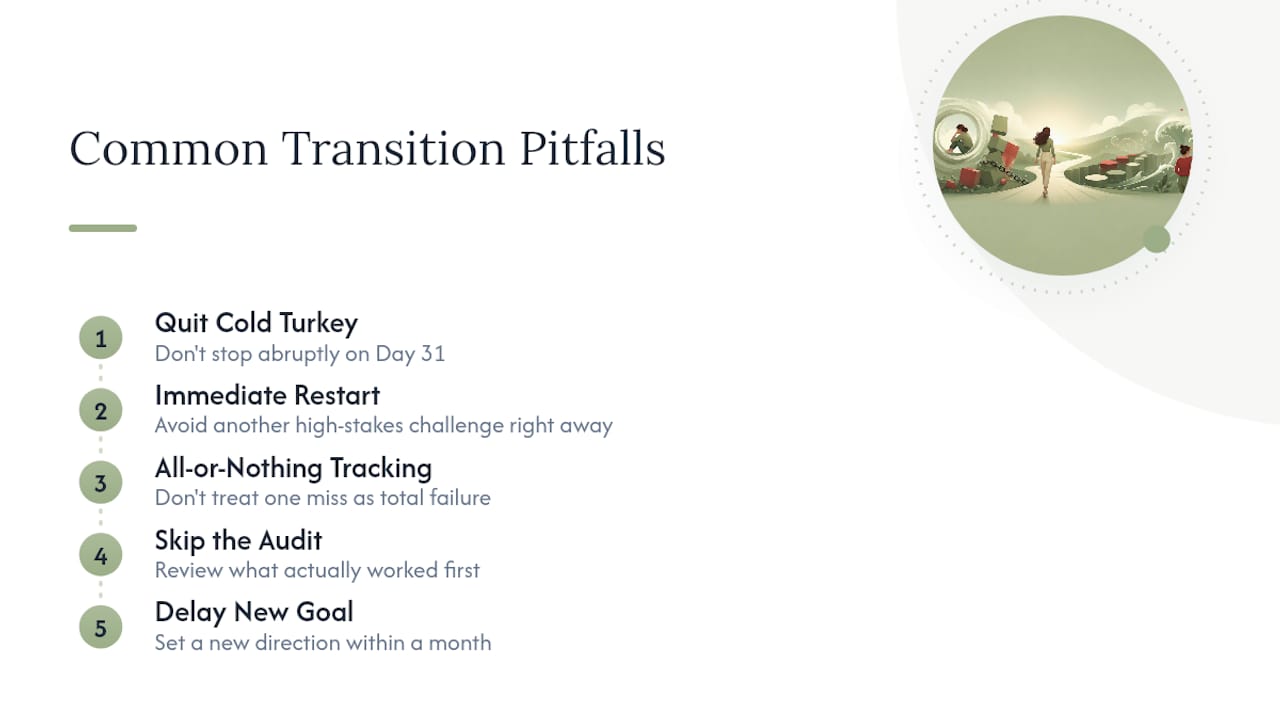
The most common mistake is treating Day 31 like Day 1 in reverse, meaning quitting cold instead of shrinking gradually. The habit didn't get easier because the challenge ended; it just lost its external enforcement. Dropping it abruptly wastes the internal progress you actually made.
The second mistake is overcorrecting into another high-stakes challenge immediately, often within the same week. This usually stems from anxiety about losing the habit rather than a genuine assessment of what's needed. Give the 48-hour pause room to work before deciding.
The third mistake is all-or-nothing tracking. If your only measure of success is a perfect streak, one missed day feels like total failure, which triggers abandonment. Avoiding an all-or-nothing streak tracker and building in explicit restart rules from the start prevents this collapse.
The fourth mistake is skipping the audit step entirely. Without reviewing what actually worked, whether the floor days felt sustainable, whether the anchor held, you're guessing at your next move instead of deciding from evidence.
The fifth: waiting too long to set a new goal. An affirmation habit with no forward direction tends to go stale within a month, even if the mechanics are solid.
Does a Support Group Help After the Challenge Ends?
Community involvement after a stakes-based challenge ends can extend the accountability effect well past the incentive window, but it works differently than the financial mechanism did.
A pooled or matched-bet structure raises participation during the incentive period because everyone's stake is visible and collective. Post-challenge, you can borrow that same social pressure without the money by joining or forming a small group of people doing similar habit work. The key is asymmetry: someone who checks in on you without requiring you to report back every time removes friction while keeping a light layer of accountability.
Online communities built around habit tracking or affirmation practice can serve this role, as can something as simple as a two-person check-in with a friend who's also maintaining a daily practice. What matters isn't the size of the group. It's whether the interaction feels supportive rather than another obligation stacked on top of your floor habit.
If community involvement starts to feel like pressure rather than support, that's worth noticing. The whole point of moving past a stakes-based system is reducing external pressure, not replacing one form of it with another.
Why Setting a New Goal Matters More Than Maintaining the Old One
A habit without a forward-facing goal tends to plateau, and plateaued habits are the ones most likely to quietly disappear. The affirmation practice you built during the challenge was in service of something, confidence, a mindset shift, a specific outcome you were working toward. Once the challenge ends, that "something" needs its own next chapter.
This doesn't mean escalating back into a new high-stakes challenge automatically. It means asking a direct question: what am I actually trying to build now that the 30 days are done? Maybe it's expanding beyond affirmations into a broader morning routine. Maybe it's applying the same discipline to a completely different habit. Maybe it's simply maintaining what you have while directing your energy elsewhere.
Whatever the answer, write it down. A vague intention to "keep it up" rarely survives contact with a busy week. A specific goal, tied to a floor and an anchor you've already tested, gives the habit somewhere to go instead of just somewhere it's been.
Why Most Transition Advice Misses the Point
The conventional advice after finishing a habit challenge is almost always some version of "keep going." That's not wrong, but it's incomplete. The research on commitment contracts is pretty clear that stakes correct for procrastination, not for skill or identity. That means the real work of the end-of-challenge transition isn't willpower management. It's redesign.
Most people treat Day 31 like a cliff edge instead of a fork. They either quit because the pressure's gone or they immediately re-stake because they don't trust themselves without it. Both reactions skip the actual decision: does this habit need to shrink, get anchored differently, or graduate into something with a new goal attached?
If I had to prioritize one thing, it's the audit during the 48-hour pause. Skip everything else in this guide if you must, but don't skip asking honestly whether the floor days felt sustainable. That answer tells you more about your next move than any amount of motivation ever will.
— Zack
Sources
- Commitment contracts and loss aversion (ICWSM article)
- CollegeBetter study on parimutuel commitment mechanisms (2017)
- Matched-bet mechanism experiments (SSRN, 2021)
- Commitment savings to stop smoking (Poverty Action Lab paper)