

Nudges for habit change built on financial stakes work when the contract is designed correctly: a small deposit, a binary daily task, and real verification. In practice, that means staking money on a fixed-length challenge (commonly 21 days) where you type a daily affirmation word-for-word and either get your money back or forfeit it. The rest of this guide covers the mechanics, the research behind it, and how to set one up without sabotaging yourself.
TL;DR:
- Depositing $10 to $25 weekly is optimal for habit formation without triggering avoidance or procrastination.
- A 21-day challenge is standard for establishing habits, but durations vary based on individual progress and confidence.
- Consistent enforcement of penalties, clear rules, and upfront planning prevent contract failure modes and behavior reversal.
- Loss aversion drives deposit-based challenges to outperform reward-only incentives and can lead to stronger habit adherence.
- Verification methods like typed affirmations with timestamps are essential for honesty, with upfront mulligan rules avoiding future disputes.
Table of Contents
- What Are Nudges for Habit Change, and How Do Commitment Contracts Work?
- Does the Research Actually Support Staking Money on Habits?
- How Do You Set Up an Affirmation Stake Challenge?
- Where Do These Challenges Go Wrong?
- Why Loss Aversion Makes This Work Better Than It Should
- How Flourishorforfeit Puts These Principles Into Practice
- Sources
What Are Nudges for Habit Change, and How Do Commitment Contracts Work?
A financial-stake commitment contract is a straightforward deal you make with yourself: put money down, commit to a specific daily action, and only get that money back if you actually do it. This is the version of "nudges for habit change" this guide covers. Unlike softer nudge tactics such as reminder emails or default settings, this one has teeth. You lose real money if you skip a day, which is the entire point.
The mechanics follow a simple loop. You place a stake for a set challenge length. Each day, you complete a defined task, typing a daily affirmation exactly as written, with a timestamp attached. Miss a day and something happens to your money: full forfeiture, partial loss, or a locked "mulligan" depending on the platform's rules. Finish every day and the stake comes back.
Verification is what keeps the whole system honest, and it typically works one of three ways:
- A human referee, usually a friend, who confirms whether you did the task.
- Automated data pulls, like step counts from a fitness tracker.
- Typed, timestamped entries, where the act of typing itself is the proof.
Typed affirmations solve a verification problem that step counts and photos don't: they require active engagement, not just passive data syncing. You cannot type a sentence in your sleep. Some platforms add variants on this core model, like anti-charity stakes (where forfeited money goes to a cause you dislike) or automated tracking that removes the need for a human referee entirely. The core mechanism stays the same across all of them: a binary daily test, a stake attached to the outcome, and a rule that decides what happens when you fail.
Does the Research Actually Support Staking Money on Habits?
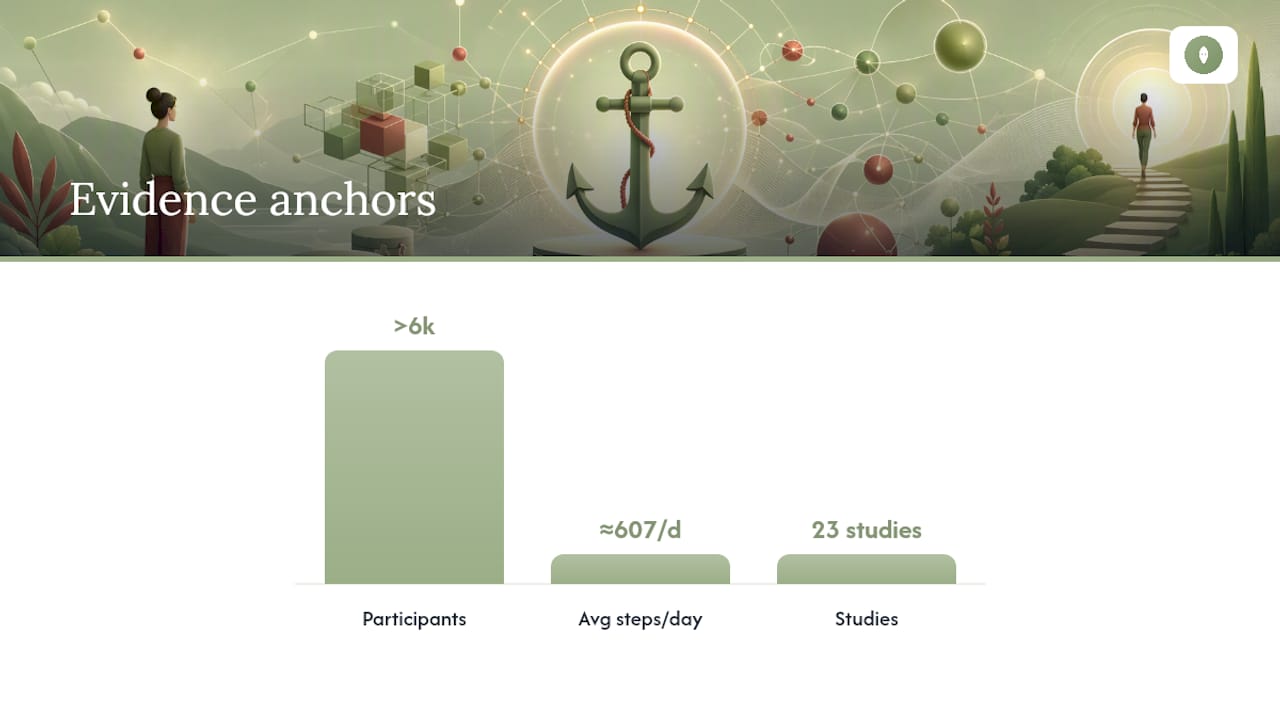
Yes, with real numbers behind it, though the effect size depends heavily on how the contract is built. A meta-analysis of 23 studies covering more than 6,000 participants found that financial incentives for physical activity raised daily step counts by a pooled average of roughly 607 steps per day during the intervention period. That is not a marginal bump. It is the kind of change that shows up in a Fitbit history without anyone needing to squint.
The stake structure itself matters more than most people assume. A 2024 randomized study of 1,629 gym members compared "hard" contracts, where participants risked their own money, against softer commitments with no real financial skin in the game. Soft commitments barely moved the needle.
The effect isn't limited to fitness. A deposit-based program called CARES, aimed at smoking cessation, raised six-month nicotine test pass rates by a few percentage points compared to a control group, and some of that gain held up in surprise tests conducted a year later.
The catch: most reviews also find that gains soften once the money stops being at risk. That's not a reason to skip the approach. It's a reason to treat the stake period as the on-ramp, not the whole road.
- Pooled step-count gains during intervention: about 607 steps/day
- Gym visit increase from hard contracts: 21%
- Smoking cessation gain from deposit contracts: several percentage points, with partial persistence at 12 months
How Do You Set Up an Affirmation Stake Challenge?
Building your own challenge comes down to five decisions, made in order.
- Define the daily task as binary. Either you typed the affirmation, word-for-word, with a timestamp, or you didn't. No partial credit, no "I meant to."
- Set a stake that stings a little, not one that terrifies you. Practitioner guidance points to a starting range around $10 to $25 per week as enough to matter without triggering avoidance. On platforms that allow a wider range, anywhere from $5 to $250 works, but start low and raise it only after you've proven you'll follow through.
- Pick 21 days as your default. It's the most commonly cited threshold for habit formation, and it's long enough to show a real pattern without demanding a huge upfront commitment. Use 7 days if you're testing whether the habit fits your life at all, and reserve 30 days for a habit you're already fairly confident about.
- Choose your verification method and set one clear mulligan policy before you start. Deciding mid-challenge whether a missed day "counts" is how contracts fall apart. Decide the rule on day zero.
- Add light supports around the core mechanic. Reminders, small in-challenge checkpoints, and even the goal gradient effect (people push harder as they near a finish line) all help keep momentum through the middle days, which is usually where people quit.
Pro Tip: Write your affirmation and your mulligan rule down before you fund the stake. If you can't state your own rules clearly, your future self will find the loophole for you.
Where Do These Challenges Go Wrong?
Three failure modes account for most of the money lost to bad contract design, and all three are avoidable.
The first is the "switch-off" effect. Research on time-varying financial penalties shows that inconsistent enforcement, letting a missed day slide sometimes but not others, can cause behavior to fall below where it started once the penalty structure gets removed or relaxed. The fix is boring but effective: enforce the same rule every single day, with no exceptions you didn't define in advance.
The second failure mode is stake size. Too low, and you adapt to losing it, treating forfeiture as a rounding error. Too high, and the fear of losing it makes you avoid starting at all, which defeats the entire purpose.
- Stakes too small: no real behavior change, easy to write off
- Stakes too high: avoidance, procrastination, or outright refusal to commit
- Inconsistent enforcement: behavioral reversal once penalties loosen
The third issue is pairing an impossible goal with real money. Staking $100 on a daily affirmation is reasonable. Staking $100 on quitting a substance cold with no other support in place is not the same category of risk, and it deserves the same caution any serious behavior change deserves; pair it with proper support, not just a penalty. For everyday habit slips, tools like a habit slip prevention plan can catch a single bad day before it becomes a pattern.
Why Loss Aversion Makes This Work Better Than It Should
Here's what surprises people the first time they try a stake-based challenge: losing $20 feels worse than the pleasure of earning $20 back. That's not a personal failing. It's documented behavioral economics, and it's the entire reason deposit contracts outperform reward-based systems built on the exact same dollar amount. A gift card for finishing a challenge does less to your behavior than a stake you're at risk of losing, even when the numbers on paper are identical.

What the research doesn't fully settle is how much of the effect comes from the money itself versus the structure around it. The StepBet observational data showing winners increasing daily steps by 44% is genuinely impressive, but it's a program that combines deposits with gamification and social visibility. Strip those supports away and the deposit alone probably does less work. I'd argue that's not a weakness of the model. It's a design instruction: a stake by itself is a decent nudge; a stake plus daily proof plus a hard deadline is a considerably stronger one.
The other thing conventional advice gets backwards is duration. Plenty of guides treat 21 days as gospel, as some magic number where a habit clicks into place permanently. Treat it instead as the minimum length needed to generate enough repetitions that you can honestly judge whether the habit fits your life. Some people need 30. Some people know by day 10 that a task isn't sustainable and would rather redesign it than force it. The stake's job isn't to manufacture a permanent habit in three weeks. It's to make sure you actually show up long enough to find out if the habit is worth keeping.
— Zack
How Flourishorforfeit Puts These Principles Into Practice
The platform is built around mechanics supported by research: users pick a stake, choose a challenge length, and type daily affirmations word-for-word so each entry is verified, not just logged.
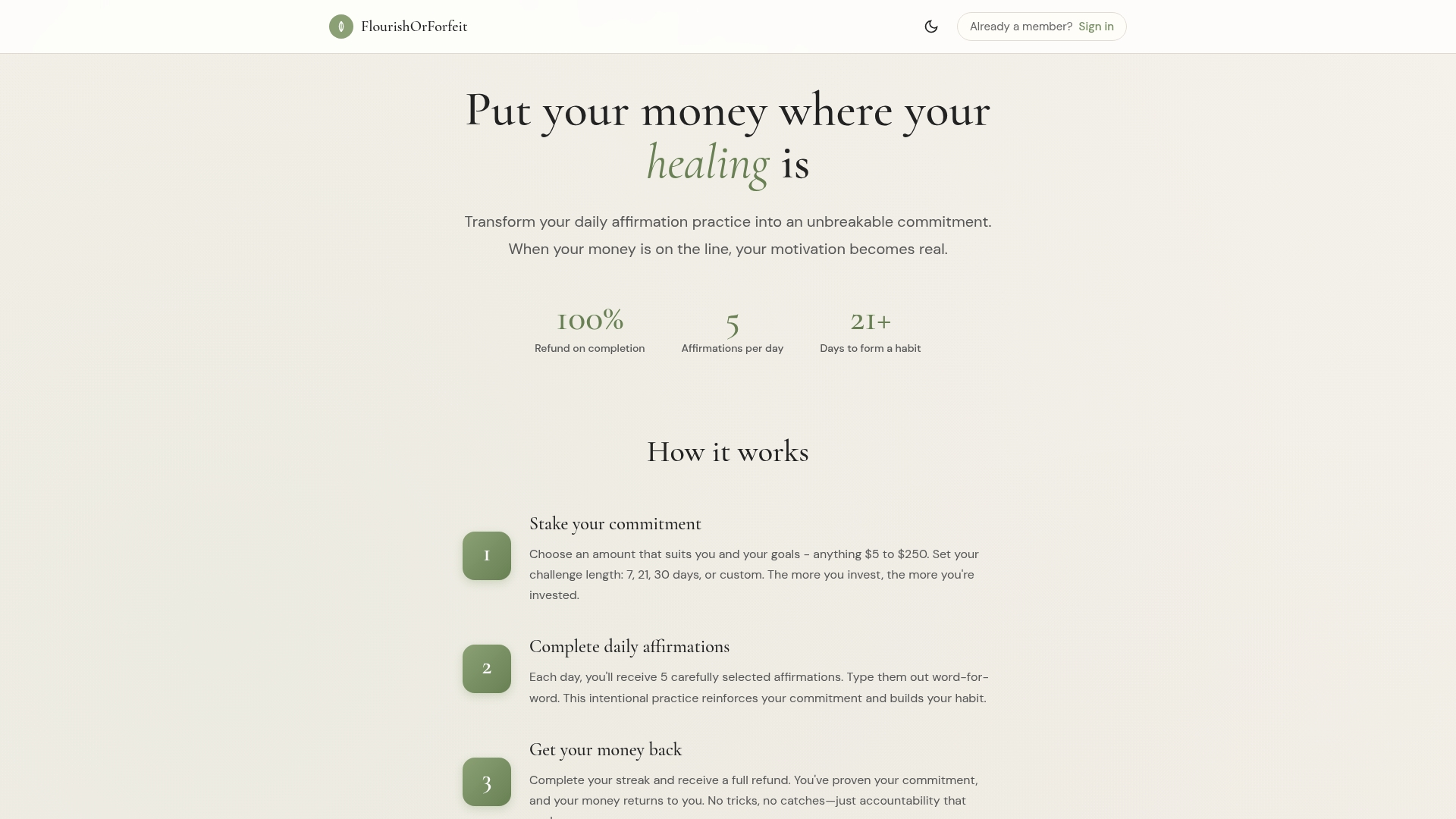
Complete the challenge to receive a refund of the stake; missing enough days results in forfeiture, with a mulligan option available for longer challenges. Payments are handled securely through an integrated system.
If you're evaluating any commitment platform, check for the same three things this guide has covered: a clear refund policy, real verification (not an honor system), and a mulligan rule that's stated upfront instead of decided after you've already missed a day. Ready to test whether a real stake changes your follow-through? Start a challenge on Flourishorforfeit and pick your stake, duration, and daily affirmation to get going.
Sources
- Financial incentives for physical activity in adults: systematic review and meta-analysis | British Journal of Sports Medicine
- Put a bet on it: Can self-funded commitment contracts curb fitness procrastination?
- Put Your Money Where Your Butt Is: A Commitment Contract For Smoking Cessation