

A 7-day challenge works as a momentum builder and a low-stakes test, not a habit-formation machine on its own. It proves you can show up for something small every day, which matters more than the challenge itself. This guide gives you a full bank of ideas across wellness, fitness, creativity, and productivity, sample day-by-day templates for the four most popular categories, and evidence-backed advice on picking rules that stick, plus what to do once your seven days are up.
TL;DR:
- Most 7-day challenges are effective because they focus on very small, routine cues that are hard to skip rather than the challenge itself.
- Structuring daily tasks to be embarrassingly easy and linking them to existing habits significantly increases the likelihood of completing the challenge.
- Tracking progress visibly and reflecting briefly each day improves consistency and helps identify whether the task remains manageable.
- A financial stake or accountability platform can reinforce commitment, but the challenge should be viewed as an opening step rather than a habit finished in a week.
- Failing a challenge provides valuable data for adjusting the cue or task, and starting with the smallest version helps prevent discouragement and builds proof of consistency.
Table of Contents
- 7 Day Challenge Ideas Sorted by Category
- How to Choose a 7-Day Challenge That You'll Actually Finish
- Four Sample 7-Day Plans You Can Copy Today
- What Actually Keeps People Going for the Full Seven Days
- Where FlourishOrForfeit Fits Into a 7-Day Challenge
- Starting Small Beats Starting Big, Every Time
- Turn Your Seven Days Into a Real Commitment
- Sources
- FAQ
7 Day Challenge Ideas Sorted by Category
The trick to picking a good 7-day challenge isn't finding the most impressive one. It's finding one small enough that skipping it feels obviously worse than doing it. Below, each idea includes a one-line instruction, a rough time estimate, and a quick note on where people tend to overreach.
Wellness challenges
- Sleep hygiene reset: Same lights-out time for seven nights. (5 minutes to set an alarm reminder.) Realism tip: pick a time you can hit even on your busiest night, not your ideal night.
- Hydration check-in: Drink a full glass of water within 10 minutes of waking. (2 minutes.) Realism tip: keep the glass by your bed, not in the kitchen.
- Morning stretch: Five minutes of stretching before you check your phone. (5 minutes.) Realism tip: do it on the floor next to your bed so you can't skip the step of getting up first.
- No screens after 9 p.m.: Phone goes in another room. (0 minutes of effort, high friction to break.) Realism tip: charge your phone in the kitchen, not your nightstand.
- Posture reset: Set three phone alarms a day to check and correct posture. (1 minute each.) Realism tip: silence the alarm the instant it goes off or you'll start ignoring it by day three.
- Cold shower finish: End your regular shower with 30 seconds of cold water. (30 seconds.) Realism tip: count out loud. Silence makes the 30 seconds feel like five minutes.
- Sunlight walk: Ten minutes outside within an hour of waking. (10 minutes.) Realism tip: keep shoes by the door so getting outside doesn't require a decision.
Fitness challenge themes
- Daily walk streak: 20 minutes, any pace, rain or not. (20 minutes.) Realism tip: define "walk" loosely. A loop around the block counts.
- 7-minute bodyweight circuit: Squats, pushups, planks, lunges, repeat. (7 minutes.) Realism tip: do it before you shower, not after work when energy is lowest.
- Stair challenge: Take the stairs instead of the elevator every time, all week. (Adds 2 to 5 minutes a day.) Realism tip: only works if stairs are actually on your daily path. Don't force a detour.
- 50 pushups a day: Broken into sets of 10 if needed. (5 minutes total.) Realism tip: start at whatever number you can do without straining. Ten real pushups beat five sloppy ones.
- Plank progression: Add 10 seconds to your plank hold each day. (Under 2 minutes.) Realism tip: log the number somewhere visible so day 5 isn't a guess.
- Mobility minute: One minute of hip or shoulder mobility work daily. (1 minute.) Realism tip: pair it with brushing your teeth so you never have to remember it separately.
Mental health and mindfulness
- Gratitude journal: Write three things you're grateful for before bed. (3 minutes.) Realism tip: keep the notebook on your pillow. If it's in a drawer, it won't happen.
- Digital sunset: No social media for the last hour before sleep. (0 minutes, just avoidance.) Realism tip: delete the app icon from your home screen for the week rather than relying on willpower.
- 5-minute mindfulness: One short guided meditation, any app or a free YouTube track. (5 minutes.) Realism tip: same time every day beats "whenever I remember."
- Worry dump: Two minutes writing down whatever is stressing you, no editing. (2 minutes.) Realism tip: do this before bed, not first thing in the morning, or it colors your whole day.
- One kind word to yourself: Say one specific thing you did well that day, out loud or written. (1 minute.) Realism tip: be specific ("I finished that email I'd been avoiding"), not generic ("I did good").
Creative 7 day tasks
- Daily sketch: One drawing, any subject, any skill level. (10 minutes.) Realism tip: use a small sketchbook, not a blank page. Small pages lower the bar.
- Photo-a-day: One intentional photo, themed or not. (5 minutes.) Realism tip: pick a loose theme like "texture" or "shadows" so you're not stuck deciding what to shoot.
- Micro-writing: 100 words of anything, fiction, journal, or a half-formed idea. (10 minutes.) Realism tip: write badly on purpose for the first three days to kill perfectionism early.
- One new recipe: Try one unfamiliar dish, doesn't need to be elaborate. (30 to 45 minutes, once during the week.) Realism tip: pick recipes with five ingredients or fewer.
- Doodle during calls: Sketch instead of scrolling during meetings or calls. (No extra time.) Realism tip: keep a dedicated notebook by your laptop so it's the default option.
Productivity and focus
- Inbox zero: Clear your inbox to zero once a day, even if it refills. (15 to 20 minutes.) Realism tip: set a hard stop timer. Perfectionist sorting eats the whole benefit.
- Single-task focus block: One 25-minute block with your phone in another room, one task only. (25 minutes.) Realism tip: pick the task before you sit down, not after.
- 25-minute learning sprint: 25 minutes on a skill you've been meaning to learn. (25 minutes.) Realism tip: keep the materials open and ready the night before.
- Two-minute rule cleanup: Any task under two minutes gets done the moment it appears, all week. (Variable, usually under 10 minutes total.) Realism tip: this only works if you actually notice the small tasks, so check your task list twice a day.
- One deep-work hour: 60 minutes of your hardest task first thing, before email. (60 minutes.) Realism tip: schedule it before you check your phone, not after.
Home and daily life
- 10-minute declutter: One drawer, shelf, or surface a day. (10 minutes.) Realism tip: set a timer. Decluttering without a timer turns into a two-hour project.
- Meal prep basics: Prep one component (rice, chopped vegetables, protein) each evening for the next day. (15 minutes.) Realism tip: prep the same thing every day for the week rather than reinventing the plan daily.
- Make the bed: Every morning, no exceptions. (2 minutes.) Realism tip: do it the instant you get up, before your feet hit the floor and momentum is lost.
- One email unsubscribe a day: Cut one recurring notification or newsletter daily. (2 minutes.) Realism tip: do this while your coffee brews so it's tied to an existing cue.
Social and kindness challenges
- One compliment a day: Give a genuine, specific compliment to someone daily. (1 minute.) Realism tip: specific beats generic. "That report was clear" lands better than "good job."
- Reach out to one person: Text or call someone you haven't spoken to in a while. (5 minutes.) Realism tip: pick the person before the day starts so you're not scrambling at 9 p.m.
- Say thank you specifically: Thank one person a day for something concrete they did. (1 minute.) Realism tip: name the specific action, not just "thanks for everything."
Learning and micro-habits
- 15 minutes of language practice: Duolingo, a workbook, or a podcast in the target language. (15 minutes.) Realism tip: same time slot every day, ideally tied to a commute or a meal.
- Glass of water after breakfast: One extra glass, tied directly to a meal you already eat. (1 minute.) Realism tip: keep the glass on the breakfast table, not in a cabinet.
- Read 10 pages: Any book, no genre restrictions. (15 to 20 minutes.) Realism tip: keep the book somewhere visible, not on a shelf across the room.
That's roughly 35 concrete options, and none of them require special equipment, an app subscription, or a Monday start date. Pick one that solves a real annoyance in your week, not one that sounds impressive on social media.
How to Choose a 7-Day Challenge That You'll Actually Finish
Most 7-day challenges fail for the same reason: the daily task is too big, too vague, or disconnected from anything already happening in the person's routine. Fix those three things and your odds improve dramatically.
- Match the challenge to a specific goal, not a general one. "Get healthier" produces a bad challenge. "Reduce afternoon energy crashes" produces a good one, because it points you toward a concrete daily action like a short walk after lunch.
- Make the daily task embarrassingly small. Five pushups beats a full workout for a first week, because the goal of week one isn't fitness. It's proving to yourself that you show up. Habit stacking research suggests keeping the action tiny and consistent, then scaling only once it feels automatic.
- Anchor the behavior to something you already do. "After I pour my coffee, I write three gratitudes" works better than "I'll journal sometime in the morning." This is an if-then plan, and the randomized controlled trial on routine versus time-based cue planning found that both routine cues and clock-time cues increase how often people actually follow through, as long as the cue is consistent.
- Set one clear completion rule per day, and build in a fallback. Decide upfront: does "doing the pushups" mean 20, or does 5 also count on a bad day? A pre-approved mulligan, one skip day that doesn't break the streak, keeps a rough Tuesday from turning into a quitting point.
- Add outside accountability. Tell a friend, post publicly, use a tracking app, or put money on the line. Each raises the cost of quitting just enough to get you through the wobble that usually hits around day 3 or 4.
Pro Tip: Write your if-then plan on a sticky note and put it where the trigger happens, not where you'll remember later. "After breakfast, glass of water" taped to the coffee maker outperforms the same sentence saved in your phone.
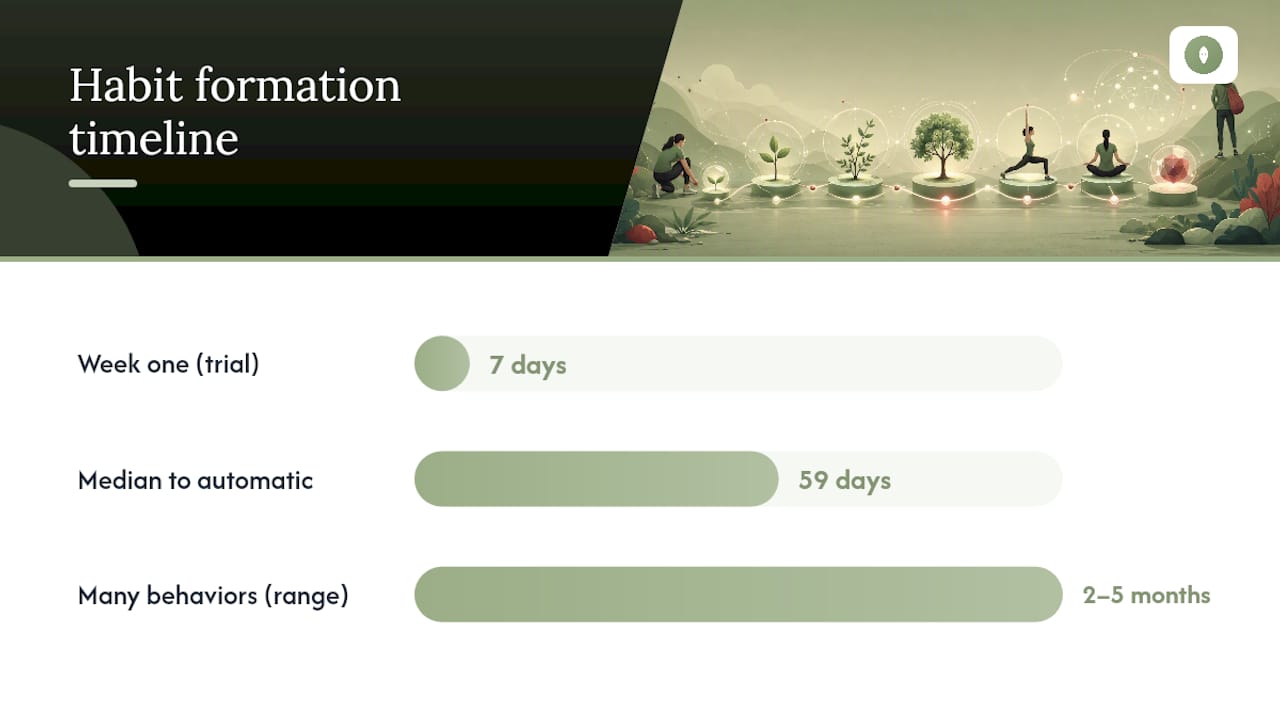
Here's the honest caveat worth sitting with: a systematic review and meta-analysis of health behavior habit formation found the median time to automatic habit formation is around 59 days, with many behaviors taking two to five months. Seven days will not make a behavior automatic. But a 2026 randomized controlled trial found that structured short interventions can produce real, measurable gains in habit strength in the very first week. Week one isn't the finish line. It's proof of concept.
Four Sample 7-Day Plans You Can Copy Today
Each plan below has a tiny version (for a genuinely packed week) and a full version (for when you have a bit more room). Both use the same daily trigger so the habit has a fixed home in your day.
Fitness: the 7-minute circuit
- Day 1: After you brush your teeth, 5 squats, 5 pushups, 20-second plank. Tiny version: 5 squats only.
- Day 2: Same sequence, add 2 reps to squats and pushups.
- Day 3: Same trigger, same sequence. Consistency matters more than progression this early.
- Day 4: Add lunges, 5 per side.
- Day 5: Full circuit, aim for smoother transitions between moves.
- Day 6: Repeat Day 5. Notice how it feels compared to Day 1.
- Day 7: Full circuit plus 30 seconds added to the plank. Decide whether to extend to 21 days.
If you miss a day, don't restart the count. Just do the tiny version the next morning and move on.
Mindfulness: 5-minute daily reset
- Day 1: After your first coffee, 5 minutes of guided breathing.
- Day 2: Same trigger, try a body-scan track instead.
- Day 3: Same time, no guided audio, just silent counting of breaths.
- Day 4: Add a one-line journal note about how the sitting felt.
- Day 5: Repeat Day 4.
- Day 6: Try sitting two minutes longer if it feels natural.
- Day 7: Reflect in writing on which version (guided, silent, journaled) felt easiest to repeat.
Tiny version: 60 seconds of breathing, same trigger, every day. Scaling note: most people extend this into a 21-day version once the morning slot feels claimed.
Creativity: the daily sketch
- Day 1: After dinner, sketch anything in the room for 10 minutes.
- Day 2: Sketch an object from a different angle.
- Day 3: Try a new medium (pen instead of pencil).
- Day 4: Sketch from memory instead of a real object.
- Day 5: Sketch the same object as Day 1. Compare.
- Day 6: Sketch something you'd normally avoid (hands, faces).
- Day 7: Pick your favorite sketch of the week and note why.
Tiny version: three minutes, one shape. Troubleshooting: if you skip a day, sketch twice the next day instead of trying to "catch up" perfectly, one skipped day rarely matters if the trigger stays intact.
Declutter: 10-minute daily clearing
- Day 1: Right after work, clear one drawer.
- Day 2: Clear one shelf.
- Day 3: Clear your phone's home screen and unused apps.
- Day 4: Clear one surface, kitchen counter or desk.
- Day 5: Clear one digital folder (downloads, photos).
- Day 6: Revisit Day 1's drawer. It usually needs a second pass.
- Day 7: Pick the messiest remaining zone and give it the full 10 minutes.
Tiny version: set a 3-minute timer instead of 10. Scaling note: extend into a 30-day room-by-room challenge once the daily habit of "just 10 minutes" feels normal rather than forced.
What Actually Keeps People Going for the Full Seven Days
The single biggest predictor of finishing isn't willpower. It's whether you built in a way to notice you're on track. A large behavioral study testing habit-formation techniques found that Habit Reflection, briefly reviewing what worked and what didn't the day before, was one of the strongest simple techniques for sticking with a new behavior. Mini-Habits, a fallback version of the task so small it takes less than a minute, ranked close behind.
A few things worth building into any 7-day challenge:
- Pick a cue tied to an existing routine (after coffee, after brushing teeth, right when you sit at your desk), not a vague time of day.
- Track completion somewhere visible, a paper calendar with X's, a habit-tracking app, or even a daily photo. Self-accountability methods that involve visible tracking consistently outperform mental tracking alone.
- Reflect for 30 seconds each evening on whether the day's version was too easy, too hard, or about right, and adjust tomorrow's version accordingly.
- If you miss a day, don't treat it as a failure. Missing a day doesn't undo a habit in progress, what matters is that you pick the plan back up the next day rather than abandoning it.
Pro Tip: If you're the type who needs a harder consequence than "I'll feel bad," add a real cost to skipping. A financial-stake behavioral contract works because losing money you already committed hurts more than never having the money in the first place.
By the numbers: The median time for a new behavior to become automatic is about 59 days, roughly eight and a half weeks. A 7-day challenge covers about 12% of that runway. Treat it as the opening lap, not the whole race.
Where FlourishOrForfeit Fits Into a 7-Day Challenge
If part of what's held you back before is that a plain checklist doesn't feel like enough pressure, a refundable-stake model addresses that directly. The platform lets you commit a chosen amount to a challenge lasting 7, 21, or 30 days, then type affirmations each day, verified through the app. Complete every day to get a full refund of your stake, or forfeit it if the challenge is not completed.
This mirrors what the behavioral contract research points to: putting real money on the line raises the personal cost of quitting in a way a plain to-do list never does. A 7-day affirmation run through the platform works like this: pick your stake, commit to the daily typing task, and let the system handle tracking to support your commitment. Successful completion returns the full deposit, no partial credit, no fine print.
Starting Small Beats Starting Big, Every Time
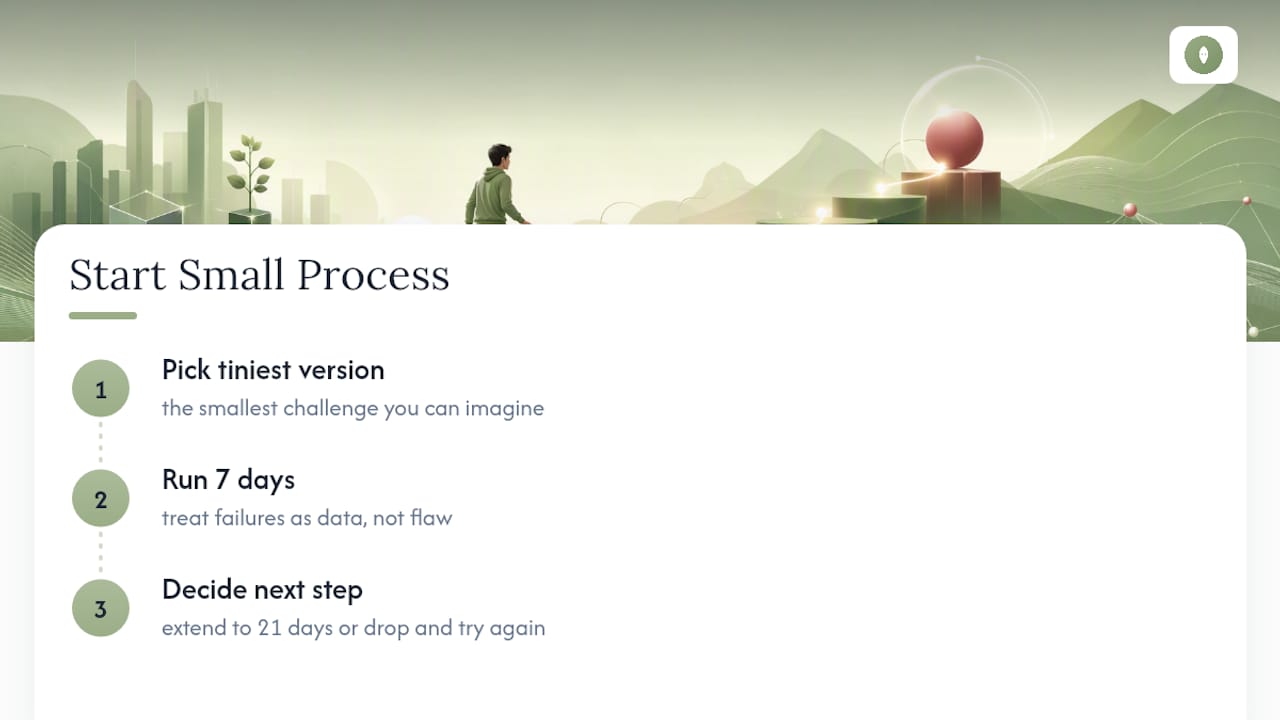
The biggest mistake I see in challenge culture is people treating the seven days as a test of character instead of a test of design. If you fail a well-designed tiny challenge, that's data, not a personal flaw. It tells you the cue was wrong, the task was too big, or the trigger didn't exist yet in your day.
My honest recommendation: pick the smallest version of whatever challenge tempted you most on this page. Run it for seven days. Then decide, based on how those seven days actually felt, whether to extend it into a 21-day plan or drop it entirely and try something else. That decision is worth more than any amount of motivation you could muster on day one.
— Zack
Turn Your Seven Days Into a Real Commitment
A plain checklist or a habit-tracking app can absolutely get you through seven days, but neither one costs you anything if you quit on day four. Flourishorforfeit changes that math. Instead of relying on willpower alone, you put a real stake behind your daily affirmation practice and get a full refund upon successful completion of the challenge.
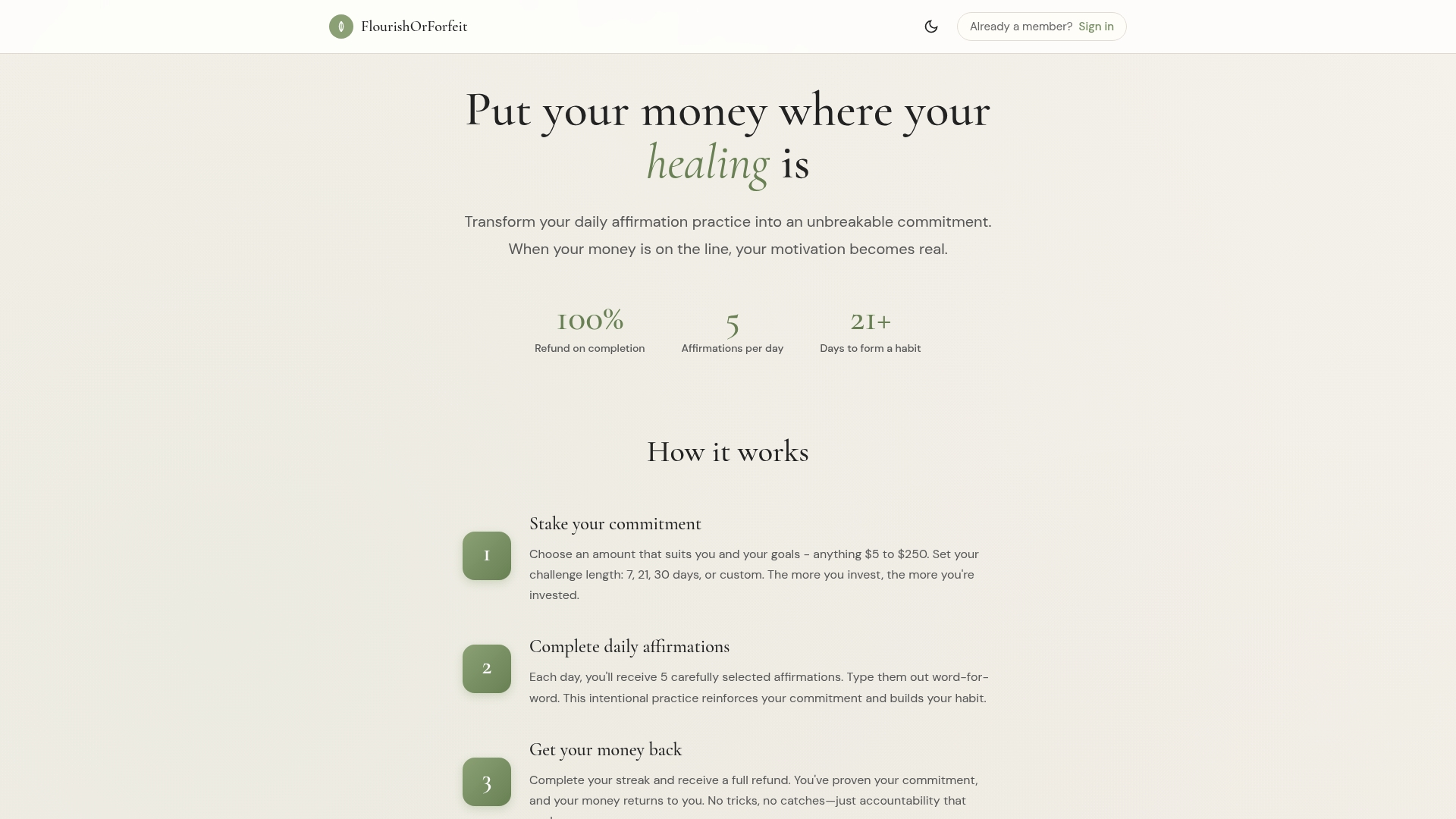
The platform handles the tracking side for you with secure payments, SMS verification, and a dashboard that shows your progress each day. For a 7-day trial run, this structure removes the guesswork of self-monitoring while adding a strong incentive not to skip. If you're ready to test whether a financial stake gets you further than your last five attempts at a New Year's resolution, start a 7-day challenge and pick your stake today.
Sources
- Time to Form a Habit: A Systematic Review and Meta-Analysis of Health Behaviour Habit Formation and Its Determinants
- How long to form a habit (behavioral scientist overview of recent RCT findings)
- Want to form some new daily habits? We ran a massive study to explore which techniques work
FAQ
Can you give me some examples of weekly challenges?
Popular examples include a daily walk streak, a gratitude journal, a digital sunset an hour before bed, a 10-minute daily declutter, and a 7-minute bodyweight circuit. Pick one tied to a routine you already have, like right after breakfast, so it has a fixed home in your day.
What are 7 exercises I can do every day?
A workable daily circuit is squats, pushups, lunges, a plank hold, glute bridges, calf raises, and standing knee lifts, done in short sets that take under 10 minutes total. Keep the numbers low the first few days (5 to 10 reps each) and add reps only once the sequence feels routine.
What are some good challenge ideas?
The strongest challenge ideas are tiny, specific, and tied to an existing cue rather than broad goals like "get fit" or "be more productive." A daily sketch, a 15-minute language sprint, a compliment-a-day habit, or a refundable-stake affirmation challenge through a platform like Flourishorforfeit all fit that pattern.
What are some daily challenges?
Daily challenges range from wellness tasks (a consistent sleep time, a morning glass of water) to productivity habits (a single 25-minute focus block, inbox zero) to kindness practices (one specific compliment a day). The common thread is a task small enough to complete even on a bad day.
What happens if I miss a day during a 7-day challenge?
Missing one day rarely derails the process as long as you resume the next day rather than quitting entirely. Research on habit consistency suggests that returning to the plan matters more than a perfect streak.