

Hyperbolic discounting is the mental habit of valuing an immediate reward far more than an equally sized reward that's even slightly delayed, and it's a leading driver of procrastination and habit failure. The bias isn't a character flaw. It's a predictable, well-documented pattern in how the brain values time, and it can be countered with specific tactics like precommitment and commitment stacking, which this article covers in detail.
TL;DR:
- People with steeper personal discount rates tend to procrastinate more, especially on tasks with long-term rewards like savings or health care.
- Precommitment devices and environmental redesign significantly reduce present bias by removing temptations and increasing friction for undesired behaviors.
- Hot states such as stress or hunger intensify impulsiveness, making structural interventions more effective than relying solely on willpower.
- Age, personality traits, and cultural context influence individual discount rates, requiring tailored commitment strategies for different people.
- Self-assessment methods, like delay-discounting questionnaires or tracking real-world decisions, help identify personal weak points in present bias.
Table of Contents
- What Is Hyperbolic Discounting, and How Does It Differ From Steady Impatience?
- Classic Experiments and Everyday Examples of Present Bias
- Why Discounting Predicts Procrastination, According to the Research
- Research-Backed Tactics to Reduce Present Bias
- Build Your Own Commitment Stack in Four Steps
- How a Financial-Stake Model Puts These Tactics Into Practice
- What's Actually Happening in the Brain
- Beyond Habits: How Present Bias Shapes Money and Health Decisions
- Who Discounts More? Age, Culture, and Personality Differences
- How to Measure Your Own Discounting Curve
- Where Present Bias Models Fall Short
- What Actually Works, and Where People Get It Wrong
- Start Your Own Commitment Stack Today
- Sources
What Is Hyperbolic Discounting, and How Does It Differ From Steady Impatience?
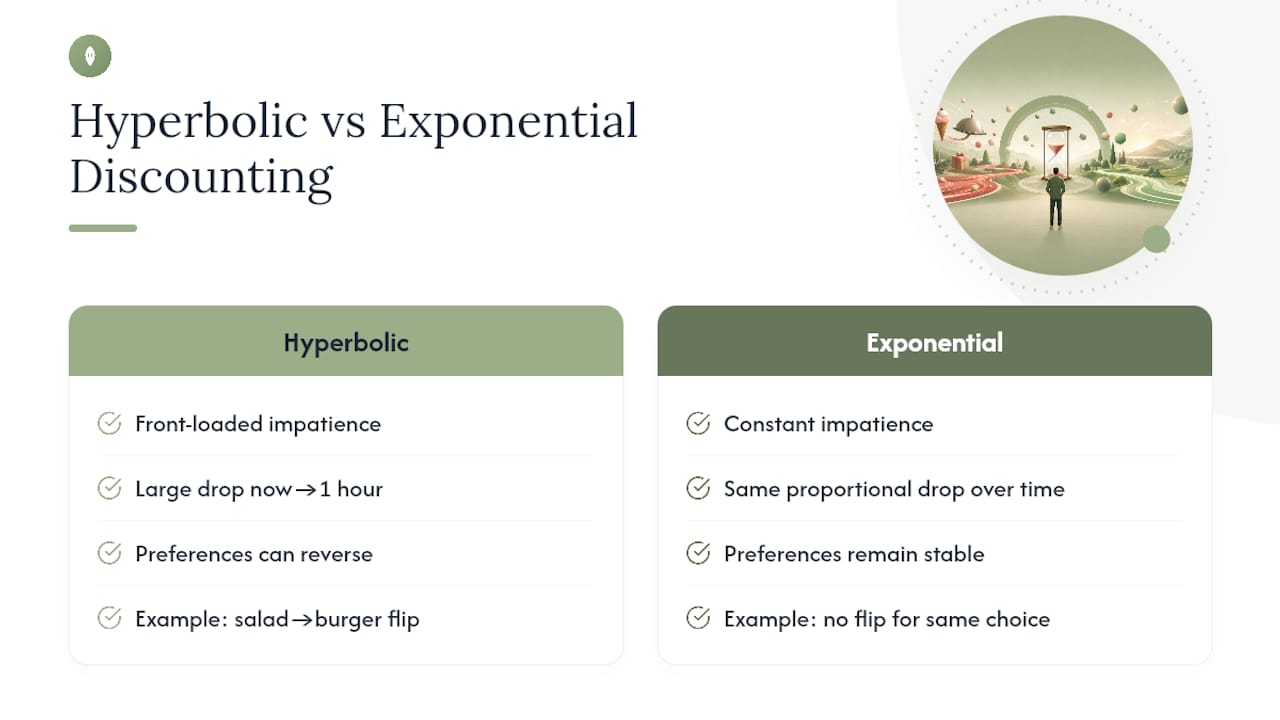
Hyperbolic discounting describes a very specific pattern: your impatience isn't constant, it's front-loaded. The drop in value between "right now" and "in one hour" feels enormous. The drop between "in one year" and "in one year plus one hour" feels like nothing. Economists call this "declining impatience," and it's the reason a $50 bonus today can feel more exciting than a $75 bonus in three months, even though the math clearly favors waiting.
Compare that to exponential discounting, the tidier model classical economics prefers, where your patience decreases at a fixed rate no matter when the choice happens. Under that model, your preference between two future rewards should never flip depending on when you're asked. Under hyperbolic discounting, it flips constantly. Ask someone in January if they'd rather have a healthy dinner on June 1 or a burger on June 2, and they'll pick the salad. Ask them on the morning of June 1, and the burger suddenly wins. Nothing about the actual reward changed. Only the distance to "now" did, and that's the entire mechanism behind present bias and habit failure.
Classic Experiments and Everyday Examples of Present Bias
The Stanford marshmallow experiments, run by Walter Mischel in the late 1960s, offered kids one marshmallow now or two if they waited about 15 minutes. The kids who waited tended to do better on later life measures, but the more interesting finding for adults is what the task revealed about strategy, not willpower. The children who succeeded weren't grinding through raw self-control. They looked away, sang songs, or physically turned their chair around. They changed their environment instead of fighting their impulse head-on.
Money-choice experiments in adults show the identical pattern. Offer someone $100 today or $110 in a month, and a lot of people take the $100. Offer that same person $100 in twelve months or $110 in thirteen months, and most switch to waiting for the bigger number, because neither option feels urgent. The delay is identical (one month), but the discounting curve isn't flat across time. It's steep near "now" and nearly flat further out.
You've lived this dozens of times without naming it:
- Adding one more item to an online cart at 11 p.m. that you'd never buy at noon
- Starting "just one more episode" when you'd promised yourself lights out
- Skipping a workout because today feels like an exception, again
- Pushing a report deadline because tomorrow-you will supposedly have more energy
Stress, hunger, and fatigue, so-called "hot states," steepen the discounting curve even further. That's not an excuse. It's a mechanism, and it's why willpower alone underperforms against structural fixes.
Why Discounting Predicts Procrastination, According to the Research
Hyperbolic discounting isn't just a lab curiosity. It shows up directly in how much people procrastinate outside the lab. A 2024 study in Scientific Reports tracked a long-term, real-world task and found a meaningful positive correlation between an individual's personal discount rate and how much they procrastinated (a statistically significant positive correlation).
The correlation, in plain terms: the steeper someone's personal discount rate, meaning the more they undervalue future payoffs relative to immediate ones, the more they tend to put off real tasks with real deadlines. The study also found wide variation across participants, which tracks with everyday experience: some people are chronically last-minute, others rarely are, and the gap traces back to how sharply they discount time.
This connects directly to a classic quirk economists call time inconsistency: the same person who happily commits to a future obligation resists that obligation once it arrives. Workers who delay cashing a check they've already received, then eventually cash a similar one weeks late, are exhibiting the same preference reversal pattern documented in economic studies of impatience. The practical implication is straightforward: you can't argue your way out of a steep discount curve. You have to change the incentives sitting on either side of the delay.
Research-Backed Tactics to Reduce Present Bias
The good news: present bias responds well to deliberate design, not more self-discipline. Here's what the evidence actually supports.
- Precommitment and commitment devices. Removing the tempting option before the hot state hits works better than resisting it in the moment. Lab research on precommitment shows people choose larger, delayed, effort-requiring rewards far more often once the easy option is pre-eliminated. Automatic transfers, website blockers, and financial stakes all operate on this same principle.
- Episodic future thinking. Vividly imagining a specific future scene, not a vague "future you," makes delayed outcomes feel more emotionally real, which narrows the discounting gap.
- Chunking and goal-gradient framing. Big distant goals get discounted hard. Breaking them into near-term milestones exploits the goal-gradient effect, where effort and motivation both increase as a reward gets closer.
- Environmental design. Add friction to the tempting behavior (log out, delete the app, hide the credit card) and strip friction from the desired one (pre-pack the gym bag, queue the healthy meal).
- Mindfulness and attention-control training. Several studies point to mindfulness-based practice as a genuine lever for reducing procrastination, distinct from willpower training.
Pro Tip: Stack two tactics at once, like an automatic transfer plus a specific future scene ("Saturday morning, coffee in hand, checking my savings goal"). A single device is a speed bump. Two devices working on different failure points is a wall.
Build Your Own Commitment Stack in Four Steps
Theory is cheap. Here's how to turn it into a plan you can start today.
- Pick one habit and a fixed window. Choose a single behavior, not five, and commit to a 7, 21, or 30-day trial rather than "forever." Shorter windows lower the perceived cost of starting.
- Match the commitment device to your actual failure mode. If you cave under social pressure, use a public pledge. If you cave alone at night, a financial stake or an automated rule works better, because it doesn't rely on anyone watching.
- Redesign the environment on both sides. Add friction to the temptation, remove friction from the target behavior. Small setup work here does more than motivation ever will, a point covered in depth in consistency over motivation.
- Set a tracking method and a recovery rule before you start. Decide in advance what happens after a missed day, whether that's a mulligan, a reset, or a smaller stake, so a single slip doesn't collapse the whole attempt. See habit slip prevention for concrete recovery templates.
Day zero checklist: name the habit, pick the window, choose the stake or pledge, remove one specific temptation from your environment, and write down your recovery rule. All five in the first 24 hours, before motivation fades.
How a Financial-Stake Model Puts These Tactics Into Practice
A commitment deposit turns the abstract idea of "precommitment" into something concrete: money on the line, a fixed timeline, and a clear outcome.
- The stake ranges from a small chosen amount, determined by the person making the commitment.
- Daily engagement requires typing out affirmations word-for-word, which forces active attention rather than passive scrolling past a reminder.
- Complete the full run and the stake comes back in full; miss too many days and the stake is forfeited, which is the actual teeth behind the commitment.
- Challenge lengths run 7, 21, or 30 days, with 21 days tracking the commonly cited rule-of-thumb window for habit formation.
- A mulligan option on longer challenges builds in the same recovery-rule logic recommended above, so one bad day doesn't sink a 30-day run.
For deeper templates on structuring the stake itself, see behavioral contracts for daily goals.
What's Actually Happening in the Brain
Hyperbolic discounting isn't a single brain circuit misfiring. It's competition between two systems that don't weigh time the same way. Regions associated with immediate reward processing, closely tied to the brain's dopamine pathways, respond strongly to rewards available right now. Regions involved in deliberate planning and abstract reasoning, concentrated in the prefrontal cortex, handle rewards that are distant or hypothetical. When a reward is available immediately, the limbic, reward-driven system tends to dominate the decision. When every option is delayed, the deliberate system gets more say, because nothing is urgent enough to hijack attention.
This is also why "hot states," meaning stress, hunger, sleep deprivation, or acute craving, make discounting so much worse. Under a hot state, the reward-driven system gets louder and the deliberate system gets quieter, almost like the volume knobs move in opposite directions. People routinely underestimate how differently they'll behave in a hot state compared to how they predict they'll behave while calm and rested, a gap researchers studying self-control across emotional states have documented repeatedly.
The practical takeaway isn't "try harder in the moment." It's that awareness alone rarely changes outcomes once a hot state hits. The decision has effectively already been made by the time you're standing in front of the vending machine at 3 p.m. That's precisely why structural interventions, removing the choice before the hot state arrives, consistently outperform in-the-moment willpower.
Beyond Habits: How Present Bias Shapes Money and Health Decisions
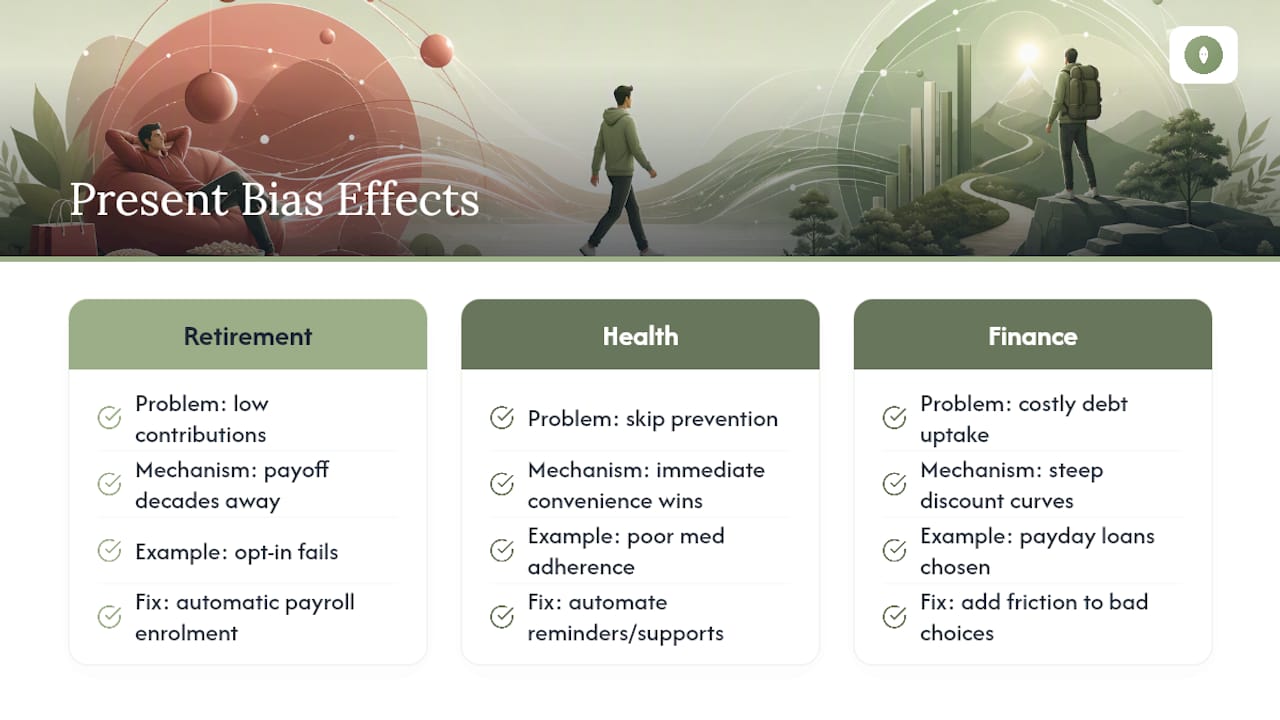
Hyperbolic discounting doesn't stop at daily habits. It's a major reason retirement savings rates stay stubbornly low even among people who know, intellectually, that they should be saving more. A contribution today has a real, felt cost. The payoff sits decades away, discounted almost to nothing by the same curve that makes a burger beat a bonus. This is precisely why automatic payroll enrollment in retirement accounts works so much better than asking people to opt in manually: it removes the moment where present bias gets a vote.
Health behaviors follow the identical script. Smoking, skipping preventive screenings, and ignoring early symptoms all trade a distant, uncertain cost (disease years from now) for an immediate convenience (skipping an unpleasant appointment today). Medication adherence for chronic conditions shows the same pattern: people are far more consistent with drugs that produce an immediate felt effect than with ones that quietly prevent a problem down the line.
The financial planning implications run deep too. People with steeper discount curves are more likely to carry high-interest credit card debt, more likely to take payday loans despite terrible terms, and more likely to underinsure against future risk. None of that is a knowledge problem. Financial literacy campaigns rarely move the needle much on their own, because the issue isn't understanding compound interest. It's that compound interest lives in a part of the timeline your brain barely prices in. The fix looks the same as it does for habits: automate the good behavior, add friction to the bad one, and stop relying on future motivation that the discounting curve guarantees will underperform.
Who Discounts More? Age, Culture, and Personality Differences
Discount rates aren't fixed traits, and they don't distribute evenly across people. Adolescents and young adults, on average, show steeper discounting curves than older adults, tracking with ongoing prefrontal cortex development that continues into the mid-twenties. That's part of why financial and health habits formed in your teens and twenties often need more external scaffolding, not less, even though that's exactly the life stage with the fewest guardrails in place.
Personality matters too. Traits linked to low conscientiousness and high impulsivity correlate with steeper discounting, which lines up neatly with the Scientific Reports procrastination findings showing wide variation in individual discount rates. Some people are simply working with a steeper curve than others, through no particular fault of their own, and pretending everyone starts from the same baseline is part of why generic productivity advice fails so often.
Cultural context adds another layer. Populations with historically higher economic volatility or shorter life expectancy show, on average, steeper discounting in behavioral economics research, which makes sense as a rational adaptation: if the future is genuinely less certain, discounting it more heavily isn't irrational at all. This matters practically because it means a "one-size-fits-all" commitment device is never going to work equally well for everyone. Someone with a naturally steep discount curve likely needs a stronger commitment device than someone whose curve is closer to flat, not because they lack discipline, but because their starting math is different.
How to Measure Your Own Discounting Curve
You don't need a lab to get a rough read on your own present bias. The classic self-assessment is a delay-discounting questionnaire: a series of paired choices like "$50 today or $100 in six months," repeated across different amounts and time frames. Where your answers flip from choosing the immediate option to choosing the delayed one reveals your personal discount rate, and psychologists use exactly this method, often called the Monetary Choice Questionnaire, in formal research settings.
A simpler, less clinical version: track your own real-world flip points for a week. Notice the specific moments where you decide to skip a planned behavior, whether that's a workout, a task, or a spending decision. Write down what was true right before the flip, time of day, stress level, hunger, social setting. Most people find their present bias isn't random. It clusters hard around specific hours or specific emotional states, which is exactly the information you need to design a commitment device that targets your actual weak point instead of a generic one.
A third option is behavioral: look at your own history with past commitments. Do you tend to keep pledges better with money on the line, or with someone else watching? Do short deadlines work better for you than long ones? Your own track record, honestly reviewed, is a pretty reliable proxy for your discount curve, and it costs nothing to review.
Where Present Bias Models Fall Short
Hyperbolic discounting is a genuinely useful model, but it's not a complete theory of why habits fail, and treating it as one leads to overconfident advice. The math describes a pattern in choices. It doesn't fully explain why any individual person's curve looks the way it does on a given day, and it tends to flatten out other real contributors to habit failure, like skill gaps, unclear goals, competing obligations, or simple lack of resources.
Critics of present-bias-heavy explanations also point out that some behaviors that look like discounting are actually something else entirely: uncertainty about whether the future reward will even materialize, not impatience about time itself. A person who "discounts" a pension payout might not be impulsive. They might reasonably distrust that the money will still be there, or that they will be. Collapsing every delayed choice into a discounting curve risks missing that distinction.
There's also a measurement problem worth naming honestly. Discount rates estimated from hypothetical money choices in a survey don't always predict real behavior with the same task, and episodic future thinking as an intervention still needs more randomized controlled trials before anyone should call it a reliably proven fix, as opposed to a promising one. None of that undermines the core insight. It just means the tactics work best layered together, aimed at a specific failure mode, rather than treated as a single universal cure for procrastination.
What Actually Works, and Where People Get It Wrong
Financial stakes help most with repeated, high-temptation behaviors, not one-off decisions. The most common failure mode is setting the stake too high out of guilt, which breeds resentment instead of follow-through, or measuring success too vaguely to know if you actually did the habit. Design beats shame every time. Pair a small environmental tweak with a stake you'd genuinely mind losing, and add a person who knows about it.
— Zack
Start Your Own Commitment Stack Today
Reading about precommitment and actually putting money behind a habit are two different experiences. Flourishorforfeit turns the tactics covered above into a working stake: you commit an amount between $5 and $250, type out five affirmations word-for-word every day, and either get a full refund for finishing or forfeit the stake if you don't. No app subscription, no vague accountability partner who forgets to check in. Just a fixed timeline and real money doing the job willpower usually can't.
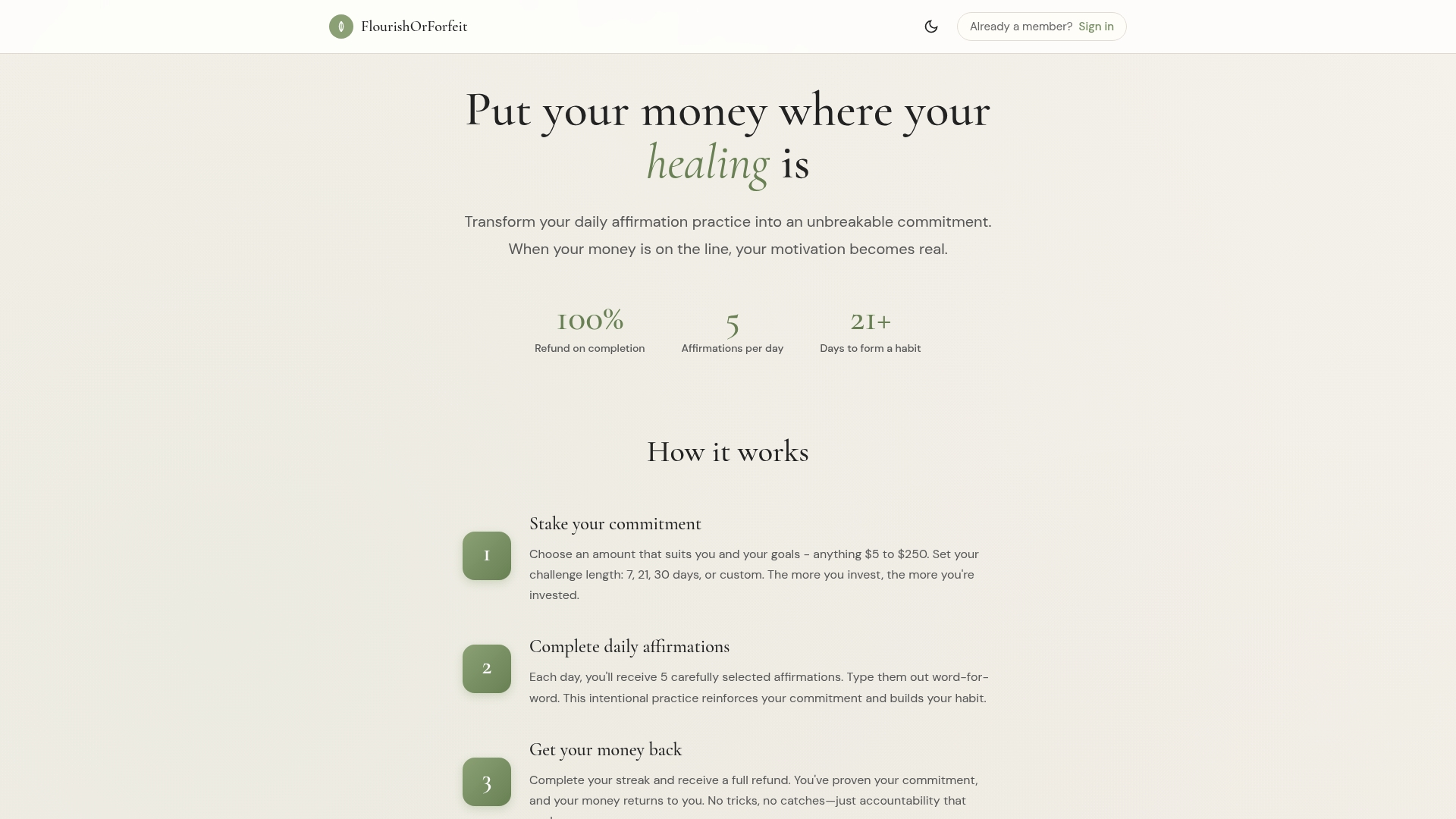
It's built for exactly the pattern this article covers: repeated behaviors where "I'll start tomorrow" keeps winning, whether that's a new morning routine, a consistency streak you keep breaking, or a goal you've abandoned more than once. Pick a 7, 21, or 30-day window depending on how ambitious you're feeling, set your stake at an amount that would actually sting to lose, and let the deadline do what motivation alone hasn't. Start a challenge and see whether your own discount curve holds up once real money is on the line.
Sources
- Temporal discounting predicts procrastination in the real world | Scientific Reports
- Conquering the inner couch potato: precommitment is an effective strategy to enhance motivation for effortful actions
- Procrastination and Impatience (Kellogg/Northwestern working paper)
- Hyperbolic discounting | The Decision Lab