

Present bias is why you skip the gym you swore you'd hit and why the credit card balance never quite shrinks: your brain values a reward available right now far more than the same reward tomorrow, so any habit whose payoff is delayed loses out to any temptation whose payoff is instant. The fix isn't more willpower. It's commitment devices, environment redesign, and vivid future thinking, tools that lower the cost of the present moment instead of trying to out-argue it.
TL;DR:
- Present bias causes people to overvalue immediate rewards, making habits like exercise or debt repayment harder to sustain over time.
- Startup costs and the weak hour of the day amplify habit failure because present bias inflates the effort and diminishes future benefits.
- People tend to overpredict their follow-through, with most forming only short-term habits and those with stronger present bias dropping out earlier.
- Using vivid future imagining, bundling rewards, reducing initial effort, and enforcing strict commitment devices can counteract present bias.
- Building flexibility into systems for high-stress times and setting small stakes enhances habit formation and long-term adherence.
Table of Contents
- What Present Bias and Habits Have to Do With Each Other
- How Present Bias Blocks Habit Formation and Causes Relapse
- Are You a Naive or Sophisticated Present-Biased Agent?
- What Field Experiments and Transaction Data Actually Show
- Evidence-Backed Tactics That Actually Beat Present Bias
- Designing Commitment Devices That Actually Hold
- How Present Bias Hijacks the Cue Routine Reward Loop
- Why Stress and Strong Emotions Make Present Bias Worse
- What Present Bias Costs You Over a Lifetime, Not Just a Week
- Does Present Bias Look the Same Across Cultures and Age Groups?
- Where the Research on Present Bias Still Falls Short
- An Honest Note on Testing Your Own Present Bias
- Ready to Put a Real Stake on Your Next Habit?
- Sources
What Present Bias and Habits Have to Do With Each Other
Economists describe present bias as a specific flaw in how people discount the future. A rational, exponential discounter values next week slightly less than today and next year slightly less than next week, in a smooth, consistent curve. A present-biased brain does something stranger: it applies a steep, extra discount to anything that isn't happening right now, then reverts to a shallower, more patient curve for everything further out. That's why you'll happily commit to a 6 a.m. workout schedule for next month while refusing to get out of bed for the one scheduled today.
The split roughly tracks a tug-of-war between brain systems: limbic and reward circuitry pushing hard for immediate payoff, prefrontal regions trying to hold the longer view. Neuroscience research on present bias links this to activation patterns in the ventromedial prefrontal cortex when people evaluate delayed rewards.
Three places this shows up constantly:
- Skipping a workout because the couch wins today, even though "future you" always plans to go.
- Buying something on impulse that blows the monthly budget, justified as a one-time exception every single time.
- Making the minimum payment on debt instead of the extra paydown you budgeted for, because that cash feels more useful spent now.
How Present Bias Blocks Habit Formation and Causes Relapse
Every new habit has a startup cost, the friction of changing clothes, driving to the gym, opening the app, before any reward shows up. Present bias inflates that cost far beyond its real size, because the brain weighs the effort happening now much more heavily than the benefit arriving later. That mismatch is the single biggest reason habits die in the first two weeks.
Three mechanics drive the collapse:
- The startup tax. The first action in any routine feels disproportionately expensive, so people delay it, and each delay makes the habit less automatic.
- The weak hour. Most people have a predictable daily window, late evening, mid-afternoon slump, right after a stressful meeting, when present bias spikes and self-control drops.
- Misprediction of future behavior. People plan as if their future self will show up reliably, then get surprised when that self bails.
Field experiments on gym attendance found something telling: participants consistently overpredicted how often they'd actually work out, while only about a third formed a lasting short-run habit, with that habit formation roughly equivalent to a small per-visit incentive. Retention data tell a similar story. Exercise trials show that people with stronger present bias tend to drop out earlier, meaning the bias doesn't just block the first attempt, it keeps eroding a habit after it's already underway.
Pro Tip: Identify your own weak hour before you design any habit. If you know 9 p.m. is when your discipline evaporates, build your system around never needing willpower at 9 p.m. in the first place.
Are You a Naive or Sophisticated Present-Biased Agent?
Behavioral economists split present-biased people into two camps, and knowing which one you are changes what actually works. A naive agent doesn't realize how present-biased their future self will be; they plan today assuming tomorrow's version of them will be reasonable, disciplined, and available. A sophisticated agent knows their future self will cave, and plans around that fact instead of hoping it won't happen.
Most people land somewhere in between, a state researchers call partial naivete. Signs you're leaning naive:
- You consistently predict you'll stick to a plan "this time" despite a pattern of not sticking to it before.
- You schedule tight, back-to-back commitments assuming future-you will have the same energy and clarity as today's you.
- You feel surprised, rather than expectant, when motivation fades.
Experimental estimates suggest people often expect their future self to be about two-thirds less present-biased than they actually turn out to be, which is a specific, measurable gap between forecast and reality. This gap matters practically: naive planners tend to underuse commitment devices because they don't think they'll need them, while sophisticated planners seek out binding structure precisely because they've stopped trusting their future self's follow-through. Projection bias compounds the problem, since people plan today's schedule and today's grocery list based on how they feel right now, not how the tired, distracted version of themselves will feel when the moment actually arrives.
What Field Experiments and Transaction Data Actually Show
The gap between what people intend and what people do isn't a theory, it's measurable in real transactions and real gym check-ins. Three findings stand out for anyone trying to build a habit that survives contact with real life.
- Gym-attendance experiments show people overpredict their future attendance by a wide margin, even when money is riding on the outcome.
- Transaction-level financial data show present bias directly explains why people fail to follow through on self-set debt-paydown plans and contribute less to retirement accounts than they intend to.
- Meta-analytic work on episodic future thinking finds that vivid mental simulation of a specific future event measurably flattens the discounting curve, meaning people place more real weight on delayed rewards after the exercise.
The debt-paydown research is the one that should make anyone with a credit card pay attention: it isn't that people don't know they should pay down debt faster. They plan to. Present bias intervenes at the moment of action, and the plan quietly slips, month after month, until the balance looks nothing like the schedule that was drawn up. That's the same mechanic sinking your gym plan and your savings plan. Different domain, identical failure point.
Evidence-Backed Tactics That Actually Beat Present Bias
None of these tactics require becoming a different person. They work by changing the environment around the decision so the present-biased brain has less to fight.
- Use episodic future thinking before the temptation window opens. Spend 60 seconds vividly imagining a specific future scene tied to the habit, what your Saturday looks like if you paid down the card this month, what next winter feels like if you kept training. Research on episodic future thinking shows this measurably reduces how steeply people discount delayed rewards.
- Shrink the startup cost until it's smaller than the excuse. Sleep in gym clothes. Pre-load the debt payment in your banking app so it needs one tap. Lowering the first step is often the single highest-leverage change available, because momentum is easier to sustain than to generate.
- Bundle temptation with the habit, not against it. Pair the treadmill with a show you only watch there. Pair the extra debt payment with a small, immediate, harmless reward, so the behavior pays off today instead of only in six months.
- Write if-then plans for your specific weak hour. "If it's 9 p.m. and I want to skip tomorrow's workout clothes prep, then I do it anyway before I sit down." Stack the new behavior onto an existing habit so it doesn't need its own willpower budget.
- Combine tactics into a short, enforceable block. A 21-day window works well because it's long enough to build real momentum and short enough that overpredicting adherence doesn't cost you months of failure before you notice.
A simple 21-day blueprint: week one, reduce every startup cost you can find and set one if-then rule for your weak hour. Week two, add a temptation bundle and check in daily on whether your prediction of success matches reality. Week three, layer in a small financial or social stake if adherence is still shaky, since by now you have real data on where you actually fail, not where you assumed you would.
Designing Commitment Devices That Actually Hold
A commitment device only works if breaking it costs something you'd genuinely rather not lose, and if that cost is enforced without exceptions you can talk yourself into. Vague accountability, telling a friend you'll try harder, rarely holds up against a present-biased brain that's very good at negotiating with itself in the moment.
What makes a stake effective:
- A meaningful but affordable amount. Too small and it's not a deterrent; too large and people avoid signing up at all or look for loopholes.
- A short enough window to learn fast. Seven to thirty days lets you see real adherence data instead of riding on optimism for months.
- Rigid enforcement. Commitment devices lose their power when there's a way to wriggle out of the cost, so ambiguity is the enemy.
- Social visibility. Stakes paired with someone else watching tend to outperform private, unverified promises.
Flourishorforfeit builds around exactly this logic: users stake $5 to $250 against a 7, 21, or 30 day challenge of typing five affirmations daily, verified and tracked, with a full refund on completion and forfeiture on failure. The range lets a naive planner start small and a sophisticated one raise the stake to match how much slippage they expect from themselves.
How Present Bias Hijacks the Cue Routine Reward Loop
Habits run on a loop: a cue triggers a routine, the routine delivers a reward, and repetition wires the loop into something closer to automatic. Present bias doesn't break this loop, it exploits it, by making sure the fastest, most available reward wins the competition for attention every single time a cue fires.

Here's where it gets interesting. A stressful email arrives (cue), and two routines compete for the response: opening a snack (reward in seconds) or going for a walk (reward in maybe twenty minutes, if at all today). Present bias doesn't just prefer the snack, it distorts the perceived size of each reward in real time, making the immediate one loom larger than it would look on paper. That's why the healthy routine so often loses even when the person genuinely wants the walk more, in the abstract, five minutes before the cue hits.
This is also why habit stacking works better than willpower. If you attach the new routine to an existing, well-worn cue, brushing your teeth, closing your laptop, you're not asking present bias to lose a fair fight. You're routing around the fight entirely, because the cue now triggers the desired routine before the temptation has a chance to present its own competing reward. The weak hour discussed earlier is really just the moment when your environment is stacked with cues that reliably trigger the wrong routine, over and over, until it feels like your default. Redesigning which cues you're exposed to, and what routine each one triggers, does more for long-term habit strength than any amount of resolve applied in the moment.
Why Stress and Strong Emotions Make Present Bias Worse
Present bias isn't a fixed setting, it flexes with your emotional state, and stress is the single biggest amplifier. Under pressure, the brain narrows its attention toward immediate threats and immediate relief, which is exactly the cognitive posture that favors instant gratification over delayed payoff. A hard day at work doesn't just make you tired, it temporarily raises the discount rate your brain applies to the future.
This explains a pattern almost everyone recognizes: the habit that felt easy to maintain during a calm week collapses the moment life gets stressful, a deadline, a fight, a bad night's sleep. It's not a coincidence or a character flaw. Stress hormones shift processing away from the more deliberative, patient evaluation of outcomes and toward faster, reflexive responses, and reflexive responses are where present bias operates most strongly.
Strong positive emotions can do something similar in the other direction, briefly, but the practical risk runs mostly one way: negative emotional states are far more common triggers for habit slippage than positive ones. Anxiety about money makes the impulse purchase feel more soothing. Frustration after a bad workout makes skipping tomorrow's session feel more justified. Loneliness makes the extra drink feel more necessary right now.
The practical takeaway is to build slack into any habit system for high-stress periods rather than assuming your discipline holds steady. A commitment device or if-then plan set up during a calm week should specifically account for the version of you that exists during a bad one, because that's precisely when the weak hour turns into a weak week, and when a system with zero flexibility tends to break instead of bend.
What Present Bias Costs You Over a Lifetime, Not Just a Week
A single skipped workout or one missed debt payment looks trivial in isolation. The research on present bias makes clear that the real damage compounds, because the same bias reliably shows up at every decision point, month after month, nudging outcomes in the same direction each time.
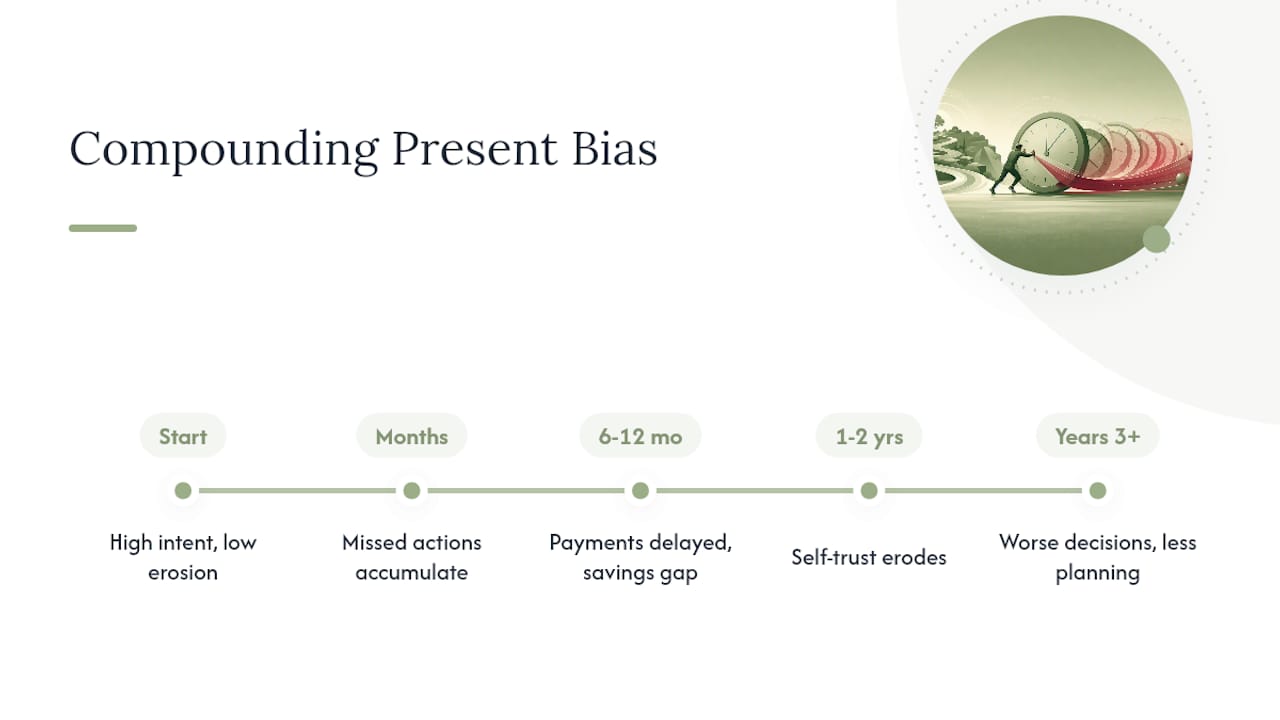
Transaction-level data on debt paydown shows this compounding effect directly: present bias doesn't just delay a single payment, it systematically erodes progress on self-set financial plans over months and years, and the same mechanism reduces how much people save for retirement relative to their own stated intentions. The gap between the plan and the outcome isn't random noise, it's a predictable tax that present bias levies on almost every long-horizon goal.
The well-being cost runs deeper than the financial one. Chronic present bias creates a specific, corrosive kind of dissatisfaction: the gap between who you intend to be and who your choices actually make you. People who consistently plan well and execute poorly don't just miss goals, they lose trust in their own commitments, which makes every future plan feel more futile before it even starts. That erosion of self-trust is arguably a bigger long-term cost than any single missed payment or skipped workout, because it changes how much effort a person is willing to invest in planning at all.
Decision quality suffers too. Once someone learns, correctly, that their future self tends to abandon plans, they start making worse near-term decisions to compensate, over-committing to rigid structures, avoiding ambitious goals altogether, or swinging to the opposite extreme of refusing to plan and just reacting to whatever feels urgent. Breaking that cycle usually requires external structure, not more internal resolve.
Does Present Bias Look the Same Across Cultures and Age Groups?
Present bias shows up in every population researchers have studied, but its intensity and expression aren't uniform. Age is one of the more consistent factors: younger adults, on average, tend to show steeper discounting of future rewards than older adults, a pattern that shows up repeatedly across different study designs and reward types, though the gap narrows for larger, more consequential decisions.
Income and financial security shape present bias in a way that's easy to misread as pure impatience. Someone living paycheck to paycheck has a rational reason to weight the present heavily, an unpredictable expense next month is a real threat, not a hypothetical, so discounting the future isn't always a cognitive error so much as an accurate response to genuine uncertainty about whether "later" will even be stable. That distinction matters for anyone designing a habit system: a commitment device that assumes stable future income will fail differently for someone facing real financial precarity than for someone with slack in their budget.
Cultural context also plays a role, though the research here is thinner and less conclusive than on age or income. Cultures with stronger norms around collective saving, extended family financial support, or long-term social obligation tend to show somewhat different discounting patterns in lab studies, though isolating culture from income, institutional trust, and measurement differences across countries remains genuinely difficult. The honest takeaway is that present bias is close to universal as a tendency, but the size of the bias, and which interventions land best, shift with a person's actual financial stability and social context, not just their willpower.
Where the Research on Present Bias Still Falls Short
Most of the strongest evidence on present bias comes from a narrow set of domains, gym attendance, debt paydown, retirement savings, which makes the findings solid within those areas but harder to generalize cleanly to every habit someone might want to build. A result about incentivized gym visits doesn't automatically transfer to, say, sleep habits or screen time, even though the underlying mechanism is probably similar.
Lab-based discounting tasks, the classic "$10 now or $12 in a week" choices, also draw a fair amount of skepticism, because a hypothetical small-stakes decision in a study doesn't always predict behavior with real money, real temptations, and real social pressure. Some researchers argue the parameter estimates for present bias, and for partial naivete specifically, vary enough across studies and populations that any single number should be treated as a rough signal rather than a fixed constant.
There's also a selection problem baked into a lot of commitment-device research: people who sign up for a study offering a savings or gym-attendance contract are already more likely to be somewhat sophisticated about their own present bias, which can inflate how effective these devices look compared to how they'd perform if imposed on a fully unselected population. And most field experiments run for weeks or months, not years, so the field genuinely doesn't have strong long-run data on whether habits built through commitment devices persist once the stake or the study period ends, or whether people relapse the moment the external structure disappears. That's a real gap, and anyone citing this research, including this article, should hold the long-term claims a little more loosely than the short-term ones.
An Honest Note on Testing Your Own Present Bias
Most people are partially naive about their own future self, this one included, so the honest move isn't assuming you've got it figured out, it's running small tests and paying attention to the results. Set a short window, a week or two, and watch where the plan actually breaks down rather than where you assumed it would.
That gap between prediction and reality is the most useful data you'll get. Combine a low-friction system, shorter startup steps, a stacked cue, with one small commitment device, and let the results tell you whether to raise the stakes or change the approach. Recalibrate every cycle instead of betting everything on one perfect plan.
— Zack
Ready to Put a Real Stake on Your Next Habit?
Environment design and if-then plans go a long way, but some habits need one more layer: a cost for skipping that you actually feel. Flourishorforfeit builds that layer around a simple daily affirmation challenge, stake between $5 and $250, commit to 7, 21, or 30 days, and type five affirmations word-for-word each day, tracked and verified.
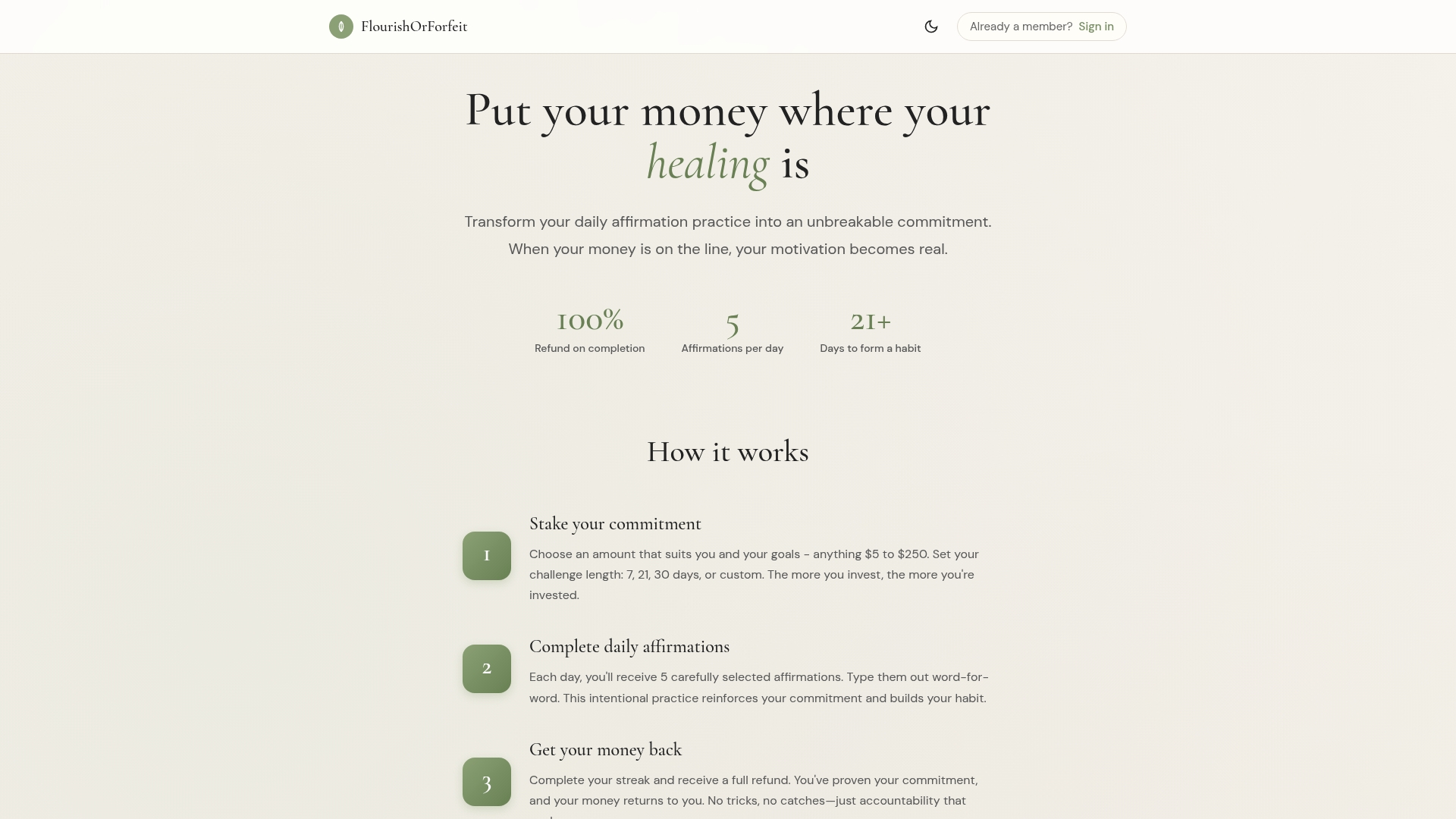
The financial-stake model fits best if you already know you're prone to overpredicting your own follow-through, the sophisticated-agent move is choosing a stake now precisely because future-you can't be fully trusted to show up without one. It's less useful as a standalone fix if your obstacle is purely logistical, no time, no access, rather than motivational, so pair it with the environment changes covered earlier rather than treating the stake as the whole solution. Pick a duration that matches how much runway you need to see the habit through the weak hour repeatedly, then start your first challenge and let the stake do the part of the job willpower keeps failing at.
Sources
- Naiveté, projection bias, and habit formation in gym attendance (Acland & Levy)
- Sticking to Your Plan? Present Bias and Debt Paydown (Kuchler & Pagel)
- Episodic future thinking and delay discounting (PMC article)
- Research on naive vs sophisticated present bias (PMC article)
- Present bias and exercise retention (Springer article, 2018)