

A commitment deposit is a refundable financial stake you lock up on a habit platform and get back only if you meet a verifiable goal, forfeiting it if you don't. The behavioral mechanism is loss aversion, and the evidence is stronger than most people expect: an analysis of the StickK dataset covering 397,456 commitments found that contracts built around six to eight weeks, weekly reporting, and an outside referee produced the highest success rates.
Here's what to do with that information right now:
- Start with a 21 to 30 day trial before committing to anything longer.
- Set a stake that would genuinely sting if lost, but wouldn't hurt your bills.
- Pick a goal you can verify objectively, not one that relies on your own honesty.
- If you want a ready-made structure instead of building your own contract, FlourishOrForfeit runs exactly this model for daily affirmation habits.
Key Takeaways
Commitment deposits work by converting an abstract future cost into a present, tangible loss, and the strongest results come from six to eight week contracts with weekly verification and a real financial stake.
| Point | Details |
|---|---|
| Start with a short trial | Try a 21 to 30 day challenge before committing to a longer six to eight week contract. |
| Size your stake honestly | Pick an amount that would sting if lost but wouldn't affect your ability to pay bills. |
| Verification beats trust | Use SMS check-ins, trackers, or app logs instead of relying on self-reported honesty. |
| Choose your recipient carefully | Sending forfeited funds to an anti-charity or the platform often raises adherence over sending it to a friend. |
| FlourishOrForfeit offers a ready structure | Its $5 to $250 stakes over 7, 21, or 30 days come with SMS verification and Stripe-backed refunds. |
Table of Contents
- Why Money Changes Behavior: The Science Behind Commitment Deposits
- What Makes a Commitment Deposit Actually Effective?
- How Much Should You Stake and For How Long?
- How Do You Set Up and Verify a Commitment Deposit?
- When Should You Avoid a Commitment Deposit?
- What Does the Research Actually Show?
- When I'd Actually Recommend a Commitment Deposit
- Try a Commitment Deposit With FlourishOrForfeit
- Frequently Asked Questions
- Sources
Why Money Changes Behavior: The Science Behind Commitment Deposits
The mechanism is simple: a deposit converts an abstract future cost into a present, tangible risk, which is exactly what counters present bias. Humans are wired to overvalue immediate comfort and undervalue future consequences. That's why "I'll start Monday" turns into six Mondays. A deposit short-circuits that pattern by making the cost of quitting arrive today, not eventually.
Loss aversion does the rest of the work. Behavioral research consistently shows people feel the pain of losing something more sharply than the pleasure of gaining an equivalent amount, and commitment contracts exploit that asymmetry on purpose. You're not gaining a reward for good behavior. You're avoiding a loss you already own, which is a much stronger motivator for most people.
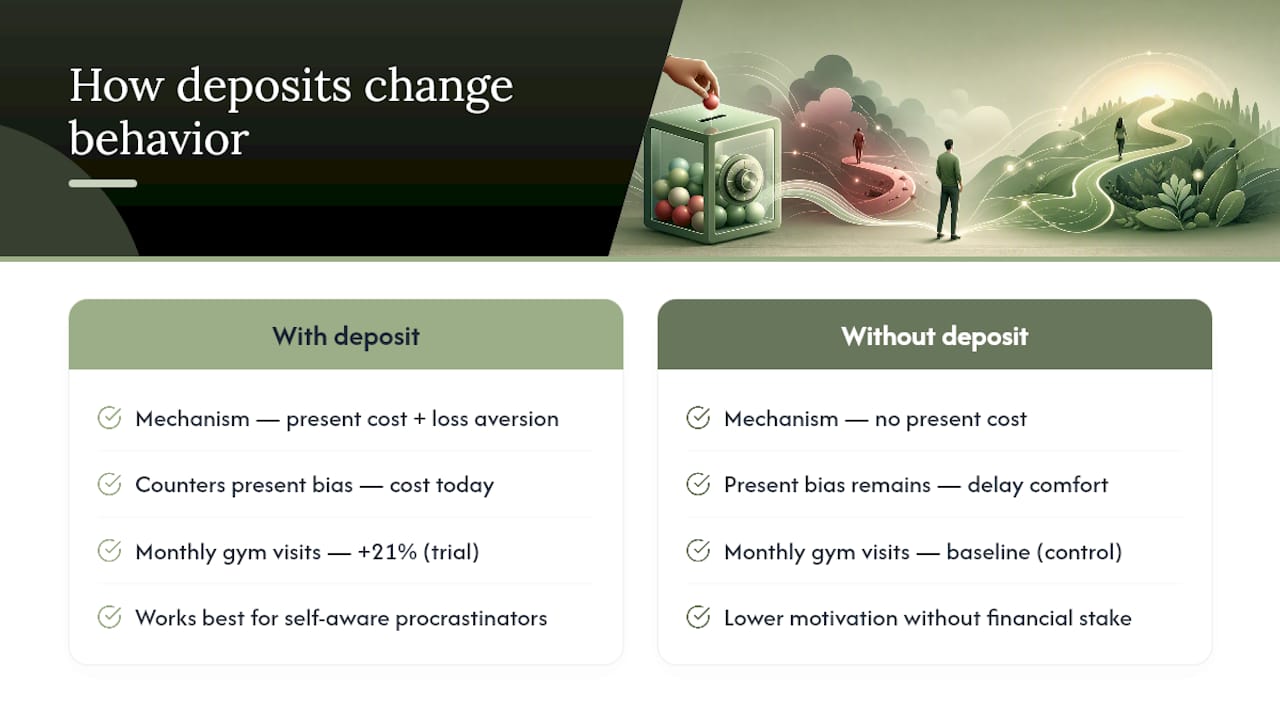
A randomized trial of gym members backs this up directly: offering a hard, incentivized commitment contract raised monthly gym visits by about 21% compared to a control group with no financial stake.
Pro Tip: Commitment deposits work best for people who already recognize their own procrastination pattern. If you know you're the type to skip day four of anything, that self-awareness is exactly what makes the stake effective. Ironically, fewer than a third of StickK users actually put money on the line, even though the ones who did saw better outcomes.
What Makes a Commitment Deposit Actually Effective?
Short, specific contracts beat vague ones almost every time. "Exercise more" fails as a commitment goal because nobody, including you, can verify it. "Log three 30-minute workouts per week for six weeks, tracked in an app" succeeds because it's measurable and impossible to fudge.
Build your contract around these elements:
- Goal specificity: a number, a frequency, and a deadline, not a vibe.
- Verification method: a fitness tracker, SMS check-in, photo proof, or app log, something outside your own memory.
- Reporting cadence: weekly reporting is the sweet spot found in large-scale commitment data.
- Contract length: six to eight weeks for most habits, based on the strongest dataset evidence.
- Stake structure: decide whether the deposit is charged once or per missed report.
- Recipient of forfeited funds: charity, anti-charity, a friend, or the platform itself.
- External referee: someone (or something) that confirms you actually did the thing.
- Default duration nudges: platforms that suggest longer windows tend to see users pick longer commitments, which correlates with better follow-through.
A couple of real-world shapes this takes: a six to eight week weight-loss plan with weekly weigh-ins and $5 to $50 stakes per missed week, or a 21-day affirmation challenge with daily check-ins and a single $20 deposit paid up front.
Pro Tip: An external referee, or a recipient you'd hate to fund, tends to raise adherence more than people expect. Data from the StickK dataset shows anti-charity recipients often produce better survival rates than sending forfeited money to a friend or a cause you don't mind supporting. Losing money to something you dislike stings more than losing it to something neutral.
How Much Should You Stake and For How Long?
Choose a stake that feels real but wouldn't wreck your week if you lost it. Adherence tends to rise with stake size, but very high required deposits scare people away before they even start, so there's a practical ceiling most platforms respect.
A workable rule: tie your stake to a slice of your weekly discretionary spending rather than picking a random number. Roughly:
- Low stakes ($5 to $20): good for a first attempt or a habit you're only somewhat sure you'll keep.
- Medium stakes ($25 to $75): for habits you've tried before and know you can do, but keep abandoning.
- High stakes ($100+): reserved for people who've already proven a habit works for them and just need a harder push.
If your contract charges per missed report rather than a single upfront deposit, multiply that weekly figure by your total reporting periods to see your real exposure before you commit.
On duration, the StickK analysis points to six to eight weeks as the range with the strongest success correlation. Shorter 21 to 30 day windows work fine as a starter, especially for a habit you've never attempted with money on the line. Longer 12 to 16 week commitments suit people who respond well to default nudges toward extended timelines.
A few sample setups: a daily affirmation challenge at $20 for 21 days with daily typing verification, a running goal of three runs per week for eight weeks at $15 per missed week, or a smoking-cessation savings deposit held for six months with biochemical verification at set checkpoints.

How Do You Set Up and Verify a Commitment Deposit?
The process follows the same basic shape everywhere: deposit money, agree to rules, report or get verified, then collect a refund or lose the stake. Here's the full sequence.
- Define the goal and rules. Write down exactly what counts as success, with no ambiguity.
- Choose your stake and recipient. Decide the dollar amount and where forfeited money goes.
- Set your reporting schedule. Weekly is standard; daily works for shorter challenges.
- Pick a referee or verification method. A person, an SMS check-in, or an app log that can't be faked.
- Deposit the funds. Most platforms hold this through a secure payment processor until the contract ends.
- Complete verification through each cycle. Submit proof on schedule, whether that's a photo, a tracker sync, or a typed check-in.
- Reach the timeline for refund or forfeiture. Successful completion typically triggers a refund within a few business days; missed goals trigger forfeiture at the point of failure or at contract end.
- Use dispute resolution if something goes wrong. Legitimate platforms offer a way to flag verification errors before funds move.
Expect the full cycle, from deposit to refund, to run the length of your chosen contract plus a short processing window, often just a few days after your final check-in.
FlourishOrForfeit runs this exact flow for affirmation-based habits. You choose a $5 to $250 stake and a 7, 21, or 30 day challenge, then type five curated affirmations daily. Verification happens through SMS, payments run through Stripe, and completing the challenge triggers a full refund. Missing a day forfeits that portion of your stake. FlourishOrForfeit operates this platform directly and keeps forfeited stakes as part of its business model, which is worth knowing upfront.
Pro Tip: Screenshot or save your contract terms the day you sign up. If a dispute ever comes up about a missed verification window, having your own record of the agreed rules speeds up resolution considerably.
When Should You Avoid a Commitment Deposit?
Commitment deposits are a behavioral tool, not an investment vehicle. Never stake money you can't afford to lose outright, because forfeiture is a real, intended outcome of the design, not an edge case.
Build in these safeguards before you deposit anything:
- Start with a small stake on your first attempt, regardless of how confident you feel.
- Confirm the platform uses a payment processor with clear refund timelines, like Stripe.
- Read the recipient rules so you know exactly where forfeited money goes.
- Get any referee agreement in writing, even if it's just a text thread.
- Check what personal data the platform collects and how it's stored.
Skip commitment deposits entirely if you're dealing with active financial instability, an untreated addiction or depressive episode where professional support matters more than a habit app, or a situation where losing money publicly could create real social or safety risk. Before you deposit, ask yourself three questions: do I have a financial buffer, is my goal actually measurable, and can I genuinely accept losing this money if I fail?
What Does the Research Actually Show?
Across multiple large datasets and randomized trials, deposit-based commitment contracts reliably increase short-term adherence, and some designs produce effects that outlast the money itself.
- The StickK dataset of 397,456 commitments found six to eight week contracts with weekly reporting and referees correlated with the strongest outcomes.
- A randomized gym trial found hard commitment contracts raised monthly visits by about 21% versus no-stake controls.
- The CARES savings-deposit program for smokers produced modest but statistically significant cessation increases at six months, with effects still showing up in surprise tests a year later.
- A flexible incentive structure sustained exercise habits better after the incentive ended than a rigid, routine-based structure did.
For one person designing their own deposit, the takeaway is straightforward: shorter isn't always better, verification matters more than trust, and a well-chosen recipient for forfeited funds can meaningfully change your odds.
When I'd Actually Recommend a Commitment Deposit
I recommend a commitment deposit when someone has a clear, measurable goal, a stake they can genuinely afford to lose, and enough self-awareness to admit their future self needs a push. That's a narrower group than the marketing around these platforms suggests.
Two things I'd tell anyone starting out: run a short trial-length deposit before scaling up your stake, and pair the money with a referee or accountability partner if you can.
Pro Tip: Try a 21 to 30 day affirmation challenge before touching a larger stake. It's a low-risk way to find out whether financial pressure actually motivates you, before you put real money behind something bigger.
Try a Commitment Deposit With FlourishOrForfeit
FlourishOrForfeit gives you a ready-made deposit structure instead of asking you to build your own contract from scratch. You skip the spreadsheet and the DIY verification headaches, choose your terms, and start the same day.
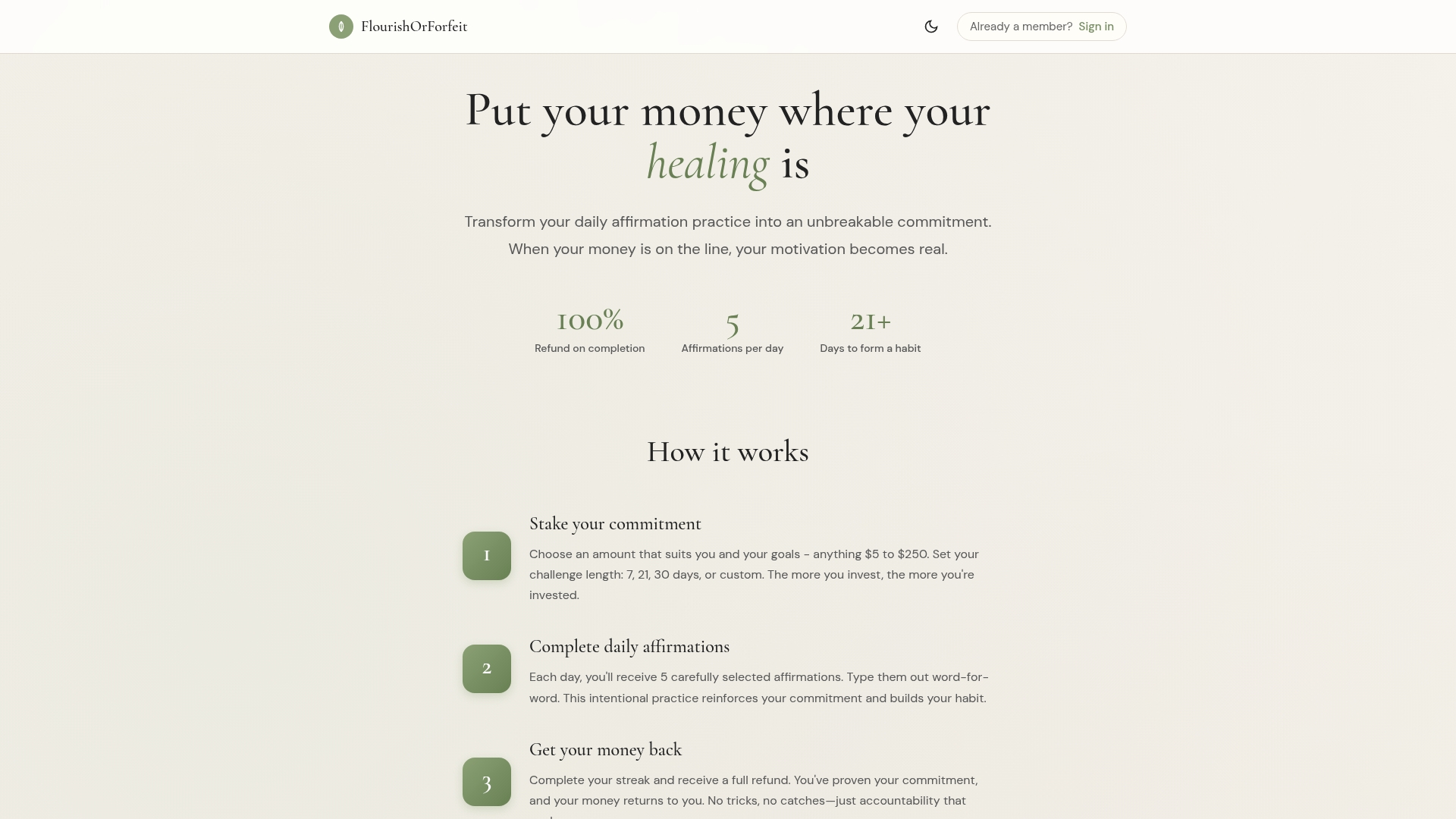
Here's what's on offer: stakes from $5 to $250, challenge lengths of 7, 21, or 30 days, and daily affirmation typing verified through SMS. Payments run securely through Stripe, refunds process automatically on successful completion, and longer challenges include a mulligan option if you slip once. FlourishOrForfeit operates this platform directly and earns revenue from stakes that get forfeited, which is disclosed here plainly because it matters to how the incentive is structured.
Getting started takes three steps: pick your challenge length and stake amount, sign up and deposit funds, then verify your daily check-ins and collect your full refund on completion. If you're ready to test whether a real stake changes your follow-through, start your first challenge today.
Frequently Asked Questions
How is a commitment deposit different from earnest money in real estate?
They're unrelated concepts that happen to share the word "deposit." Real estate deposit requirements involve a buyer putting down funds to signal serious intent on a property purchase, with the money applied toward closing costs or returned under specific contract terms. A commitment deposit, in the habit-formation sense used throughout this article, is a personal stake you place with yourself, refunded only if you hit a self-improvement goal you set and verified.
Is a commitment deposit the same as a commitment fee?
No. A commitment fee explained in lending or business contexts usually refers to a nonrefundable charge paid to secure access to funds or a service, regardless of outcome. A commitment deposit for habit formation is fully refundable when you succeed, which is the entire point of the design.
What's a reasonable amount for a commitment deposit if I've never tried one?
Somewhere in the $5 to $20 range for a first attempt, especially over a 21 to 30 day window. You're testing whether financial pressure actually changes your behavior before scaling the stake up on a habit you've already proven you can follow through on.
What happens to my money if I complete the challenge successfully?
On platforms like FlourishOrForfeit, successful completion triggers a full refund of your deposit, processed automatically through the same payment system you used to fund it, typically within a few business days.
Can I get my refundable commitment deposit back if I miss just one day?
That depends entirely on the platform's rules. Some, including FlourishOrForfeit for its longer challenges, offer a mulligan that forgives a single missed day without triggering full forfeiture. Others forfeit the stake tied to that specific reporting period. Read the contract terms before you deposit, not after you miss a day.