

Use present-tense, identity-focused affirmations, read them at a fixed daily anchor, and pair each one with a tiny, immediate action. Skip vague lines like "I am amazing." Say something believable, do something small right after, and repeat it consistently. That combination is what generally helps produce change, not just the words alone.
TL;DR:
- Effective affirmations should be specific, believable, and used in conjunction with immediate, small actions to reinforce desired behaviors.
- Reciting one or two affirmations daily, paired with physical actions, improves follow-through more than passive repetition of multiple lines.
- Most people fail with affirmations due to overclaiming, lack of associated actions, and focusing on outcomes rather than behaviors.
- Research shows self-affirmation modestly increases openness to change by reducing defensiveness and neural activity in key brain areas.
- Using stakes or financial commitments to track affirmation completion significantly enhances consistency and long-term habit formation.
Table of Contents
- Affirmations for Self-Discipline, Sorted by What You're Actually Trying to Fix
- How to Write Affirmations That Don't Feel Like a Lie
- When to Say Affirmations So They Actually Cue Action
- Why Most People Quit Affirmations Within a Week
- What the Research Says About Self-Affirmation and Behavior
- What Running Affirmation Challenges Taught Me About Follow-Through
- A Built-In Reason to Actually Finish: Staking Money on Your Affirmations
- Where This Article's Claims Come From
- Sources
Affirmations for Self-Discipline, Sorted by What You're Actually Trying to Fix
Different moments call for different lines. A morning affirmation about focus does nothing for you at 9 PM when you're staring at a bag of chips you promised yourself you'd skip. Pick the category that matches your actual struggle, then narrow it down to one or two lines.
Morning and daily anchor:
- "I follow through on what I decide the night before."
- "I am someone who keeps small promises to myself."
- "Today I do the hard task first."
- "I am learning to trust my own follow-through."
- "My morning actions set the tone for my day."
Focus and deep work:
- "I finish one task before starting another."
- "I protect my attention like it's worth something, because it is."
- "I am building the habit of staying with hard things."
- "Distraction is a choice, and I choose focus instead."
- "I work in short, complete bursts."
Consistency over time:
- "I show up even on the days I don't feel like it."
- "My consistency matters more than my motivation."
- "I am someone who keeps streaks, not excuses."
- "Small daily effort is how I build the life I want."
- "I am learning to trust the process, not just the mood."
Resisting urges and impulses:
- "I can feel an urge and not act on it."
- "I pause before I decide."
- "This craving will pass whether I feed it or not."
- "I am practicing the pause between wanting and doing."
- "I choose my future self over this moment's comfort."
Notice the "I am learning to" phrasing scattered through those lists. That's a bridge line for anyone whose brain immediately argues back against a flat "I am disciplined." Pro Tip: Pick one or two lines from a single category, not five lines across five categories. Read them at the same anchor point every day for two weeks before adding more.
How to Write Affirmations That Don't Feel Like a Lie
Affirmations fail for one main reason: they're too big, too vague, or too obviously untrue the moment you say them. Fix that with four rules.
- Use present tense. "I follow through" beats "I will follow through" because your brain treats future promises as optional.
- Name a specific behavior or identity, not a feeling. "I finish my morning workout" works better than "I feel strong."
- Keep it short. One sentence, ideally under ten words, that you could say out loud without wincing.
- Make it believable today, not someday. If "I am disciplined" feels false, that's a signal to adjust the phrasing, not abandon the practice.
Identity-focused lines ("I am someone who finishes what I start") tend to outperform pure outcome lines ("I will lose 20 pounds") because identity statements shape decisions across many situations, not just one goal. When a direct claim feels like a stretch, bridge phrasing softens it without losing the point: "I am learning to finish what I start" still points you the same direction, just without the internal eye-roll.
When to Say Affirmations So They Actually Cue Action
The best time for affirmations isn't some universal magic hour. It's whatever daily transition already exists in your life. Morning routines work well because they set the tone before the day's decisions pile up. Pre-task moments work because they put the line right next to the behavior you want. Even a phone-unlock trigger can work, since you already touch your phone dozens of times a day.
Morning versus evening affirmations serve different jobs: morning lines prime the day's intentions, while an evening line can reinforce identity after you've already followed through. What actually matters is what happens in the ten seconds after you say the line.
- Say the affirmation.
- Immediately do one small, related action (write the first task, drink the water, close the tab).
- Track only whether you did the action, not how you felt about it.
- Run this for 14 to 21 days before judging whether the phrasing works.
- Adjust the wording, not the whole practice, if follow-through stalls.
Why Most People Quit Affirmations Within a Week
Three mistakes account for almost every failed attempt at building self discipline with affirmations.
- Overclaiming. Lines that feel obviously false trigger internal resistance. Soften with bridge phrasing until the claim catches up to reality.
- Too many lines, no action. Reciting ten affirmations passively is habit theater, not habit building. Cut to one or two and attach a physical action to each.
- Chasing outcomes instead of behavior. Track whether you did the micro-action, not whether you hit the bigger goal yet. Outcomes lag; behavior doesn't.
Pro Tip: If a line still feels fake after two weeks of daily use, the fix is almost never "try harder." Rewrite the phrasing to match where you actually are.
What the Research Says About Self-Affirmation and Behavior
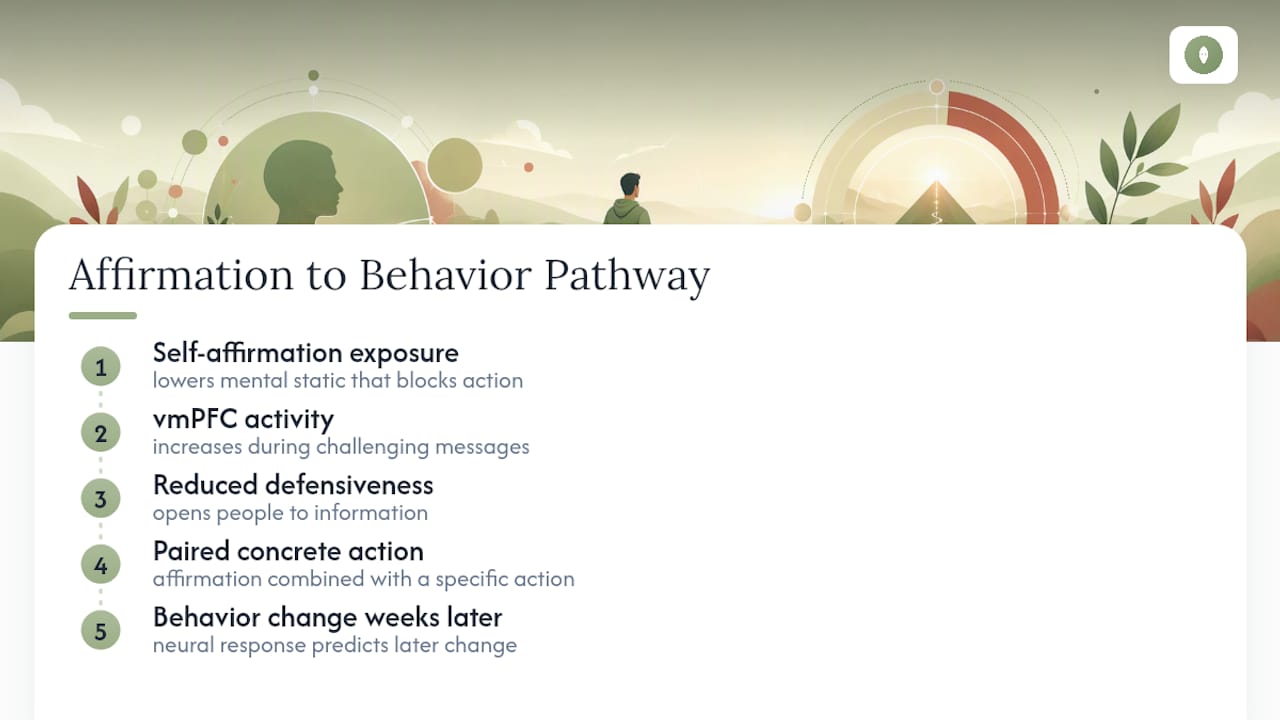
Self-affirmation doesn't rewire willpower overnight. It lowers the mental static that keeps people from acting on things they already know they should do.
A meta-analysis of self-affirmation interventions found a small but reliable effect on behavior, with an effect size around d+ = .32, alongside smaller effects on message acceptance (d+ = .17) and intentions (d+ = .14), a pattern confirmed in the published PubMed summary of the same review. That's not a dramatic transformation. It's a modest, consistent nudge.
fMRI research adds a mechanism: self-affirmation increases activity in the ventromedial prefrontal cortex during exposure to challenging messages, and that neural response predicts real behavior change weeks later. Related neural evidence points to the same pathway: affirmation lowers defensiveness and opens people up to acting on information they'd otherwise ignore. The takeaway is simple. Affirmations work best as a receptivity tool paired with a concrete action, not as a standalone fix.
What Running Affirmation Challenges Taught Me About Follow-Through
The completion patterns are consistent: people who type their affirmation word-for-word stick with it longer than people who just read it silently. Typing forces attention. A short accountability nudge, like a reminder tied to a real stake, closes more gaps than willpower ever does on its own.
— Zack
A Built-In Reason to Actually Finish: Staking Money on Your Affirmations
Reading about self-discipline is easy. Sticking with a daily affirmation for three straight weeks is the hard part, and that's exactly where most well-intentioned routines quietly fall apart. Flourishorforfeit adds a mechanism the lines above can't: a real financial stake tied to daily follow-through.
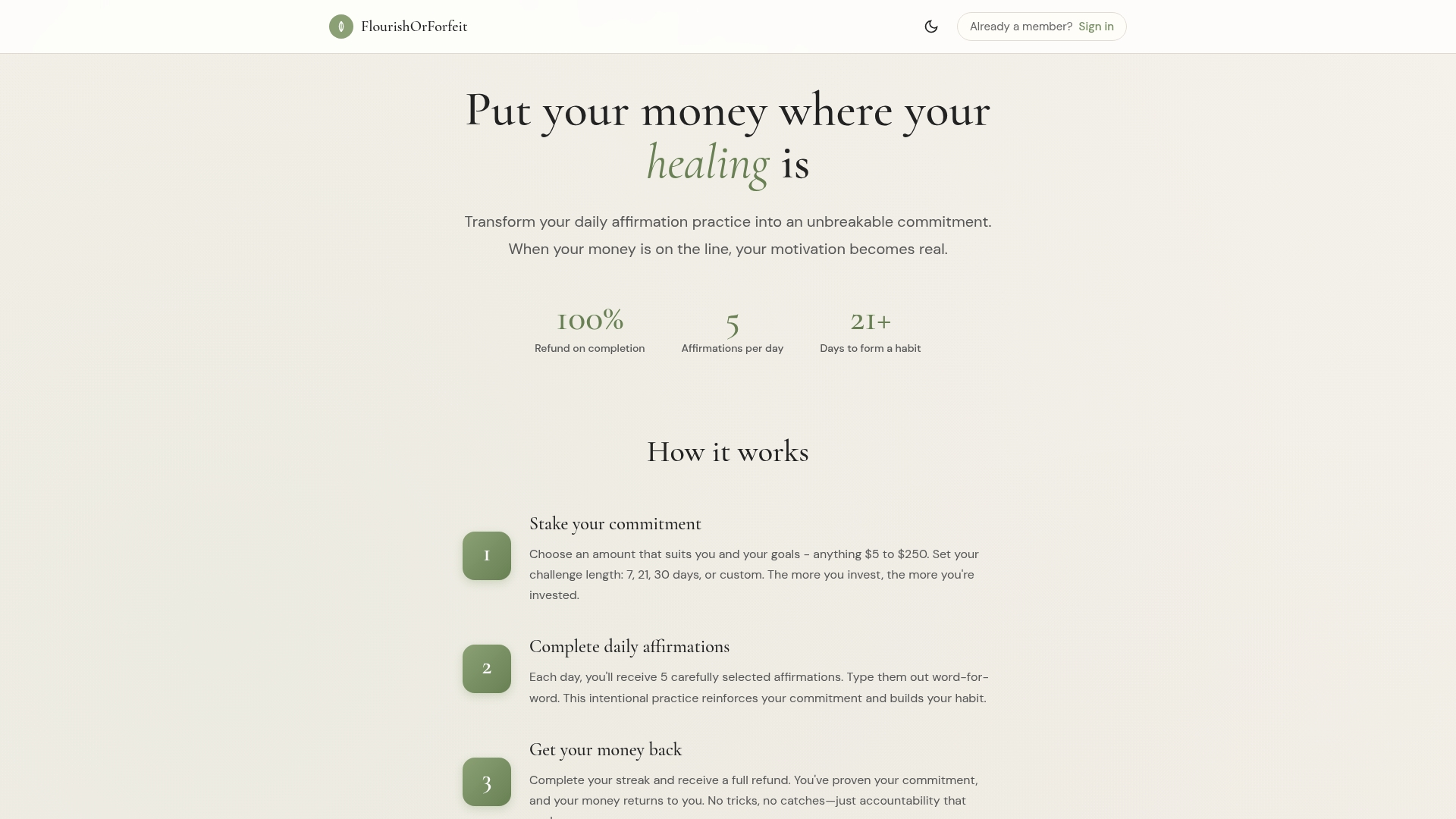
Here's how it works. You pick a stake and a challenge length, and type your affirmations word-for-word each day, verified through the platform's tracking. Finish the full challenge and you get a refund. Miss a day and you forfeit your stake. That structure suits people who already know what they should be doing but need something more binding than a sticky note on the mirror. If the mistakes described earlier sound familiar, missed days, passive repetition, no real consequence, a growth mindset affirmation challenge with money on the line is a straightforward way to test whether stakes close the gap your motivation hasn't. Set your stake and start your first challenge at Flourishorforfeit.
Where This Article's Claims Come From
- fMRI study on self-affirmation and VMPFC activity: the neural mechanism behind why affirmations reduce defensiveness.
- PNAS abstract on neural mechanisms of affirmation: supporting evidence for the same brain based pathway.
- Do Affirmations Work? What the Research Actually Shows: a plain-language breakdown of the same research for further reading.
Sources
- Neural evidence linking self-affirmation to increased VMPFC activity and subsequent behavior change
- The impact of self-affirmation on health-behaviour change: a meta-analysis (PubMed record)
- Neural mechanisms of affirmation effects (PNAS abstract)