

Yes, short, targeted affirmations can help you stay consistent, but only when you say them every day and pair them with a clear habit cue. The mechanism is three things: self-affirmation buffers you against the sting of a missed day, tying the words to your identity makes the habit feel like "who you are" instead of a chore, and stacking the phrase onto an existing routine gives it a trigger it can't skip. The scripts below are ready to copy.
TL;DR:
- Consistent daily affirmation routines work best when paired with a fixed cue, a specific action-focused phrase, and a tracking method to maintain streaks.
- Effective affirmations are time-insensitive but must be repeated at the same moment each day to reinforce the habit, whether in the morning or evening.
- Rephrasing affirmations to sound believable at tough moments and focusing on the behavior rather than vague goals increases their staying power.
- Habit stacking and adding small stakes, such as financial commitments, can significantly boost adherence when motivation wanes or past attempts fail.
- Refresh affirmations when they feel stale or when streaks break, keeping the language specific and connected to core personal values to maximize impact.
Table of Contents
- What Are Affirmations for Consistency, and Why Timing Matters
- How to Build a Daily Practice That Sticks
- Affirmations for Every Situation: Copy-Ready Scripts
- The Research Behind Why Affirmations Work (and Where They Fall Short)
- Turning Affirmations Into Automatic Behavior
- What to Do When Affirmations Feel Fake or You Miss a Day
- Matching Affirmations to Your Actual Goals and Personality
- How to Track Progress and Know When to Rewrite Your Affirmations
- A Practical Note on What Actually Moves the Needle
- When Willpower Isn't Enough, Add a Real Stake
- Sources
- FAQ
What Are Affirmations for Consistency, and Why Timing Matters
Affirmations for consistency are short, self-directed statements you repeat on a fixed schedule to reinforce a specific behavior you're trying to stick with. They differ from generic positive affirmations ("I am worthy") because they name the action ("I show up every morning") and tie it to a moment in your day. That distinction matters for anyone asking when to do affirmations or hunting for the best time for affirmations to actually stick.
The honest answer is that timing matters less than consistency of timing. A morning routine affirmation works because mornings tend to have fewer competing demands, not because sunrise carries some special power. If your schedule runs backward, evening works just as well, provided you anchor it to the same moment every single day.
How to Build a Daily Practice That Sticks
The format matters as much as the words. A weak affirmation is vague and passive ("I want to be better"). A strong one names the action, sits in the present tense, and reads like a promise you're already keeping: "I show up every morning and do one meaningful task before checking my phone."
Here's a simple routine to build daily affirmations into something that actually moves behavior, not just mood:
- Write one anchor affirmation for your morning routine, tied to your single biggest habit goal.
- Add two or three micro-affirmations for specific pressure points during the day (before a hard task, before a workout, before a difficult conversation).
- Say them out loud or type them, not just think them. Typing engages more of your attention than silent repetition.
- Pair each one with a fixed cue: right after coffee, right before opening your laptop, right after you sit in the car.
- Track completion daily with a streak counter, a paper checkmark, or a phone reminder that asks you to confirm you did it.
- Commit to a short window first, 7 to 21 days, then review what worked before extending.
The whole ritual should take under a minute. If it takes five minutes, you'll skip it on your busiest day, which is exactly the day you need it most.
Pro Tip: Write your affirmation as if a slightly annoyed future version of you is reading it back. If it sounds like something you'd actually believe at 7 a.m. on a bad Tuesday, it will survive longer than something that sounds like a poster.
Affirmations for Every Situation: Copy-Ready Scripts
Different moments call for different wording. A line that works when you're energized won't land when you're exhausted or recovering from a missed day. Pick the category that matches your current situation.
Short daily affirmations (say once, fast, no ceremony needed):
- "I do the next right thing, not the perfect thing."
- "Today counts, even if it's small."
Morning routine affirmations (energizing, commitment-focused):
- "I show up every morning and do one meaningful task before anything else."
- "My discipline today is proof I follow through."
Work and productivity affirmations (task-focused, built to survive interruption):
- "I finish what's in front of me before I open a new tab."
- "One task, fully done, beats five tasks half-started."
Health and self-care affirmations (permission-based, small-step framing):
- "I'm allowed to rest without losing my progress."
- "A ten-minute walk still counts as showing up."
Setback and restart affirmations (reframe failure without shame):
- "Missing a day doesn't erase the pattern I've built."
- "I restart today, not next Monday."
Long-term vision affirmations (identity and values-linked):
- "I'm becoming someone who finishes what they start."
- "Consistency is how I honor what matters to me."
That last category deserves extra attention. Research on habit-identity association shows that linking a habit to your values and sense of self strengthens the connection between the two, which is why "I'm becoming someone who…" phrasing tends to outlast "I want to…" phrasing over the long run.
The Research Behind Why Affirmations Work (and Where They Fall Short)
Self-affirmation theory, first laid out by psychologist Claude Steele, proposes that affirming your values buffers your sense of self against threats like failure or criticism, which lowers defensiveness and makes you more open to changing course. That's the psychological engine behind "missing a day doesn't erase the pattern" working better than pure willpower.
The evidence goes beyond theory. A brain-imaging study found that self-affirmation changed activity in the brain region tied to self-related processing, and that shift predicted actual behavior change a month later.
Affirmations reduce defensiveness and increase receptivity to change. They don't install a habit by themselves. They open the door; repetition and cues walk through it.
Habit researcher Wendy Wood's work makes the limit clear: habits are cue-driven and become automatic through repeated, context-stable performance, not motivation. Affirmations work best as a tool that reduces resistance and reinforces identity, paired with the mechanical cue-and-reward loop that actually builds the habit.
Turning Affirmations Into Automatic Behavior
An affirmation with no trigger is just a nice thought you'll forget by lunch. The fix is habit stacking, attaching the affirmation to something you already do without thinking.
- Anchor it to an existing habit: "After I brush my teeth, I say my morning affirmation and lay out my workout clothes."
- Keep the context identical every day, same chair, same time, same order of actions, so the cue becomes automatic instead of something you have to remember.
- Add a tiny reward right after the target behavior (checking a box, a five-minute break) and add friction to the competing behavior (leave your phone in another room during the ritual).
- Build in accountability through a tracking app, a friend who checks in, or a small financial stake tied to completion.
That last option isn't gimmicky. Committing real money to a challenge works because reflecting on progress and adjusting course beats relying on willpower alone once motivation dips, and a stake gives you a reason to reflect instead of quietly quitting.
Pro Tip: Stack your affirmation onto a habit you already do 100% of the time, like unlocking your phone or sitting down at your desk. If the anchor habit is inconsistent, the new one inherits that inconsistency.
What to Do When Affirmations Feel Fake or You Miss a Day
- If a line feels hollow, rewrite it smaller and more specific. "I'm a disciplined person" can feel like a lie; "I did one thing today that future me will thank me for" usually doesn't.
- If you skip a day, don't restart with guilt. Do a short resolution reflection: what got in the way, what you'll adjust, then say the affirmation again tomorrow.
- Avoid all-or-nothing thinking. One missed day is data, not proof the whole attempt failed.
- Scale gradually. Run a 7-day version before committing to 21 or 30, and adjust wording once you know which lines actually hold up under stress.
Matching Affirmations to Your Actual Goals and Personality
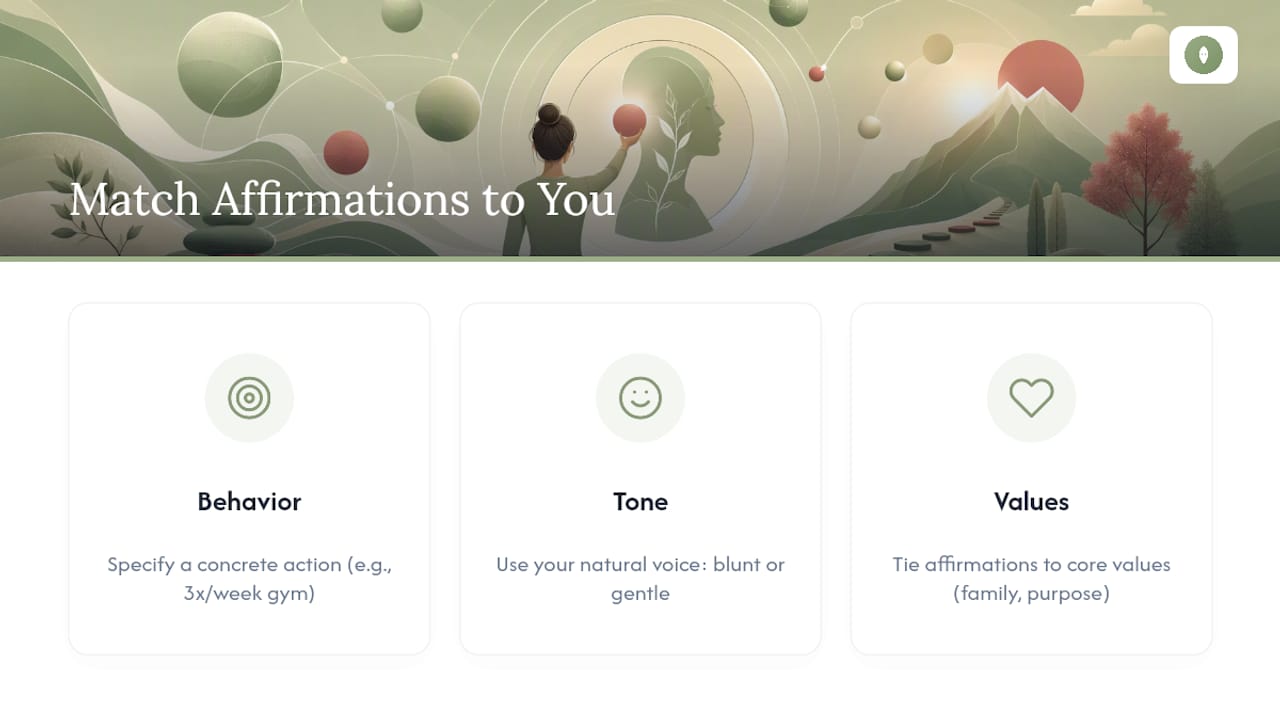
A script that works for a night-shift nurse won't necessarily work for a freelance designer, and a phrase that motivates a naturally competitive person can feel forced to someone who's motivated by calm and steadiness. Start by naming the exact behavior you're trying to build, not the vague outcome. "I get to the gym three mornings a week" beats "I want to be healthier" because it gives the affirmation something concrete to attach to.
Match the tone to how you actually talk. If you're naturally blunt, "I don't negotiate with myself before 8 a.m." will land harder than a softer, more encouraging line. If you respond better to warmth than pressure, keep the wording gentle: "I show myself the same patience I'd show a friend trying this."
Values matter more than most people expect here. Cohen and Sherman's review of self-affirmation research found that affirmations work best when they're self-generated and tied to core personal values, which is why a borrowed affirmation from a book rarely sticks as well as one you wrote yourself in your own words. If family matters more to you than career status, an affirmation like "I'm building a life my kids will remember as steady" will outperform a generic success affirmation every time.
How to Track Progress and Know When to Rewrite Your Affirmations
Consistency itself is the metric that matters most early on, not how you feel about the affirmation. A simple streak count, marked daily on a calendar or app, tells you more in week one than any mood check-in.
Around the two or three-week mark, look at your streak data honestly.
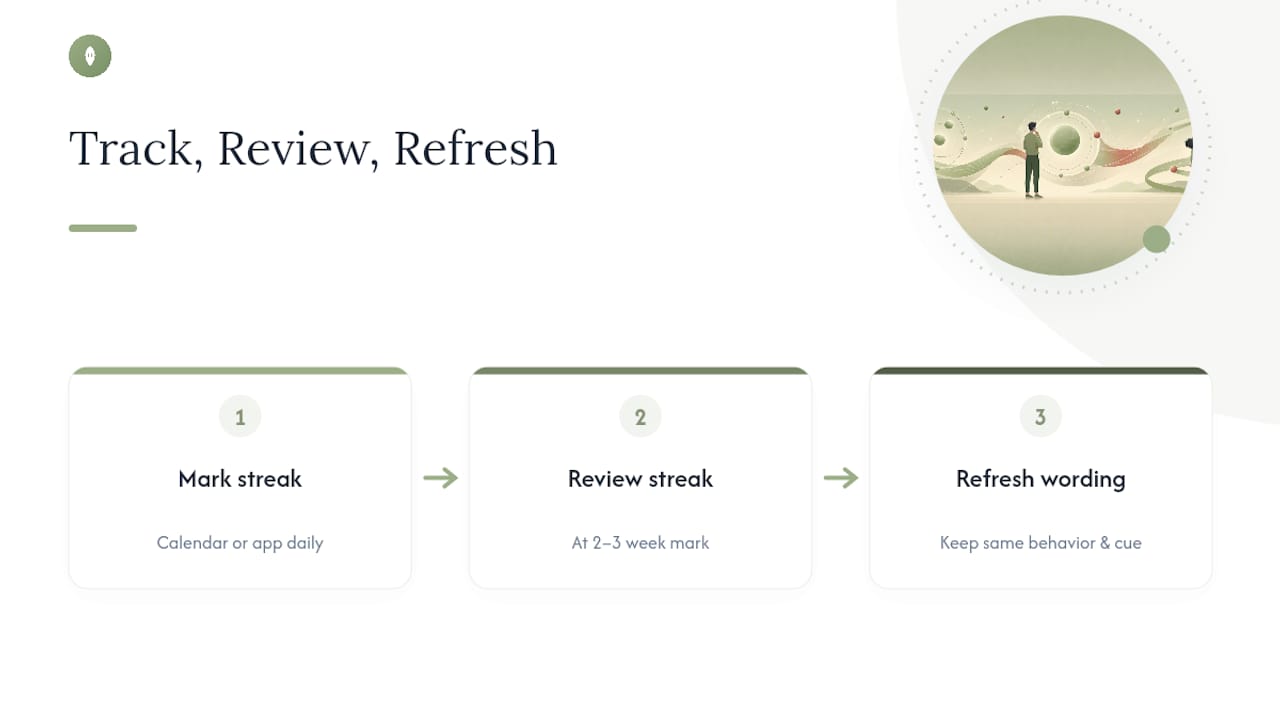
Rewrite when a line stops producing a reaction. Affirmations can go stale the same way a favorite song does after the hundredth repeat. When that happens, don't abandon the practice, just refresh the wording while keeping the same behavior and cue. Small language changes, from "I will" to "I am," or from a broad goal to a narrower one, can restore the sense of specificity that made the original affirmation work.
A Practical Note on What Actually Moves the Needle
Affirmations get dismissed as fluffy because most people use them the wrong way: vague wording, no fixed time, no follow-through when a day gets missed. Used properly, they're a small but real lever, one that lowers resistance and reinforces identity, exactly what the self-affirmation research and habit science both point to.... FlourishOrForfeit transforms daily affirmations into a committed practice by combining financial stakes with habit formation techniques (Flourishorforfeit).
— Zack
When Willpower Isn't Enough, Add a Real Stake
Affirmations reduce resistance and habit stacking builds automaticity, but some readers need one more layer: a reason it actually hurts to skip. That's the gap Flourishorforfeit is built for. You pick a stake within a certain range, choose a challenge length, and type daily affirmations that are tracked with secure payments and verification. Finish the challenge to receive a refund, or forfeit your stake if you miss enough days.
This isn't for everyone. If you're the type who follows through on a paper checklist, you probably don't need it. But if past attempts have quietly died around day 9 because there was no real cost to skipping, a financial commitment changes the calculation in a way a phone reminder never will. Pairing the stake model with habit-stacking routines or decision-fatigue scripts tends to work even better than either alone. Start by picking your stake amount and challenge length on FlourishOrForfeit and set your first daily affirmation today.
Sources
- Steele 1988 — The psychology of self-affirmation (selected topics reading)
- Habits, goals, and effective behavior change — Wendy Wood (2024)
- How to stay engaged and achieve goals when motivation fades — Psychology Today (2026)
FAQ
What is the strongest affirmation for staying consistent?
The strongest affirmation is specific, present-tense, and tied to an action you can actually complete that day, something like "I show up every morning and do one meaningful task," rather than a broad statement about who you want to become.
What are some motivational quotes about consistency?
Most useful ones boil down to the same idea: small repeated actions beat occasional big efforts, which lines up with habit research showing that context-stable, repeated behavior is what actually builds automaticity.
How do I motivate myself to stay consistent when I don't feel like it?
Rely on cues and small stakes rather than motivation, since motivation naturally fluctuates; anchoring your affirmation to a fixed daily trigger, and optionally adding a financial commitment through a platform like Flourishorforfeit, removes the need to feel motivated at all.
What are three affirmations to say every day?
A solid daily set covers action, identity, and recovery: "I do the next right thing, not the perfect thing," "I'm becoming someone who finishes what they start," and "Missing a day doesn't erase the pattern I've built."