

Do three short affirmations, spoken or typed, in under five minutes, every morning for 30 days, anchored to something you already do (coffee, brushing your teeth, sitting down at your desk). That's the whole challenge. Research on brief self-affirmation exercises links this kind of practice to small but real well-being gains, though full habit automaticity usually takes longer than a month. Thirty days won't rewire you. It will tell you whether the habit is worth keeping.
TL;DR:
- Performing three daily affirmations anchored to existing routines can produce small well-being improvements, especially with consistent repetition over 30 days.
- Short affirmations should focus on specific values or processes in present tense and avoid vague or grandiose statements that may be dismissed.
- Research indicates modest gains from 30 days of practice, with more repetitions leading to better adherence and progress toward habit formation.
- Stalling often results from too many affirmations, vague cues, or unrealistic lines, which can be mitigated by simplifying and attaching affirmations to routine behaviors.
- Incorporating accountability methods, like stakes or reminders, significantly improves motivation and consistency during a self-affirmation challenge.
Table of Contents
- How Does a 30-Day Affirmation Challenge Actually Work?
- A Ready-to-Use 30-Day Affirmation Plan You Can Copy Today
- What Does the Research Say Happens in 30 Days?
- What to Do When the Challenge Stalls
- How Flourishorforfeit Reinforces a 30-Day Affirmation Habit
- What I'd Actually Tell You After Day 30
- Start a Committed 30-Day Affirmation Challenge
- Sources
How Does a 30-Day Affirmation Challenge Actually Work?
The mechanics are simpler than most guides make them sound. Each day you pick 3 to 5 affirmations, repeat them 3 to 10 times, and deliver them one of three ways: spoken aloud, typed out, or handwritten. Timing matters less than consistency, but most people anchor the main session to a morning routine and use shorter versions as situational cues throughout the day (before a meeting, before a hard conversation, before bed).
If you're short on time or motivation, default to the minimal version:
- Speak it: One line, said out loud, twice, in under 30 seconds.
- Type it: One line, typed word for word, which forces active attention instead of passive skimming.
- Write it: One line by hand in a notebook, for people who process better on paper.
The line itself matters more than the delivery method. Good affirmations describe a value or process ("I follow through on commitments I make to myself") rather than an unearned outcome ("I am the best in my field"). Vague, grandiose lines tend to backfire because they're easy for your own brain to dismiss. A short checklist for phrasing helps: keep it present tense, keep it specific, and keep it something you can point to evidence for by the end of the day.
One caveat worth stating plainly: affirmations support mood and motivation, but they're not a substitute for therapy, medication, or professional care when you're dealing with clinical anxiety or depression.
A Ready-to-Use 30-Day Affirmation Plan You Can Copy Today
You don't need to write 30 new affirmations from scratch. A weekly-theme structure covers the ground that matters most while giving you room to personalize the wording.
- Week 1, identity: "I show up for myself, even on the days I don't feel like it." / "I am someone who follows through." / "My habits are building the person I want to become."
- Week 2, competence: "I am capable of figuring out hard problems." / "I've handled difficult things before, and I can handle this one." / "Progress, not perfection, is the goal today."
- Week 3, calm: "I can slow down and still get things done." / "My worth isn't tied to how busy I am." / "I choose calm over chaos when I have the choice."
- Week 4, gratitude and goals: "I notice at least one good thing about today." / "I'm allowed to want more and still appreciate what I have." / "Every small step toward my goal counts."
On a genuinely busy day, drop to the minimal option: one line, typed once, still counts as a completed day. Don't let a bad Tuesday turn into a skipped week.
For weekends, add a two-minute expanded version: read your line, then write one sentence answering "Where did I see evidence of this today?" That single sentence is your evidence bank, and it's the difference between an affirmation that feels hollow and one that starts to feel true, because you're pairing the statement with a real, small proof point instead of just repeating words into the void.
A few notes on maintenance:
- Rotate lines weekly if a theme stops resonating, but keep at least one fixed "anchor" affirmation for the full month so you have a consistent baseline to judge progress against.
- Retire an affirmation once it stops feeling aspirational and starts feeling simply true. That's a sign to write a new one, not a sign to quit.
- If a line consistently makes you skeptical or uncomfortable rather than motivated, it's probably not written specifically enough for your actual situation.
What Does the Research Say Happens in 30 Days?
The honest answer: measurable but modest gains, with the real payoff often landing after day 30, not during it.
A meta-analysis of 129 independent tests of self-affirmation interventions found small but statistically significant effect sizes, around .32 for self-perception and .29 for general well-being. Those aren't the "completely different person" numbers marketing copy implies, but they're consistent enough across dozens of studies to take seriously. The American Psychological Association's 2025 review reached a similar conclusion: brief self-affirmation exercises produced small, significant boosts to well-being and self-worth, with benefits holding up over an average follow-up window of nearly two weeks.
Dosage seems to matter. A 2018 mHealth trial that tracked 127 people over 28 days found that participants who did more affirmation repetitions stuck to their behavior-change goals better than those who did fewer (coefficient 1.42, P=.04). More reps, tracked daily, correlated with better follow-through.
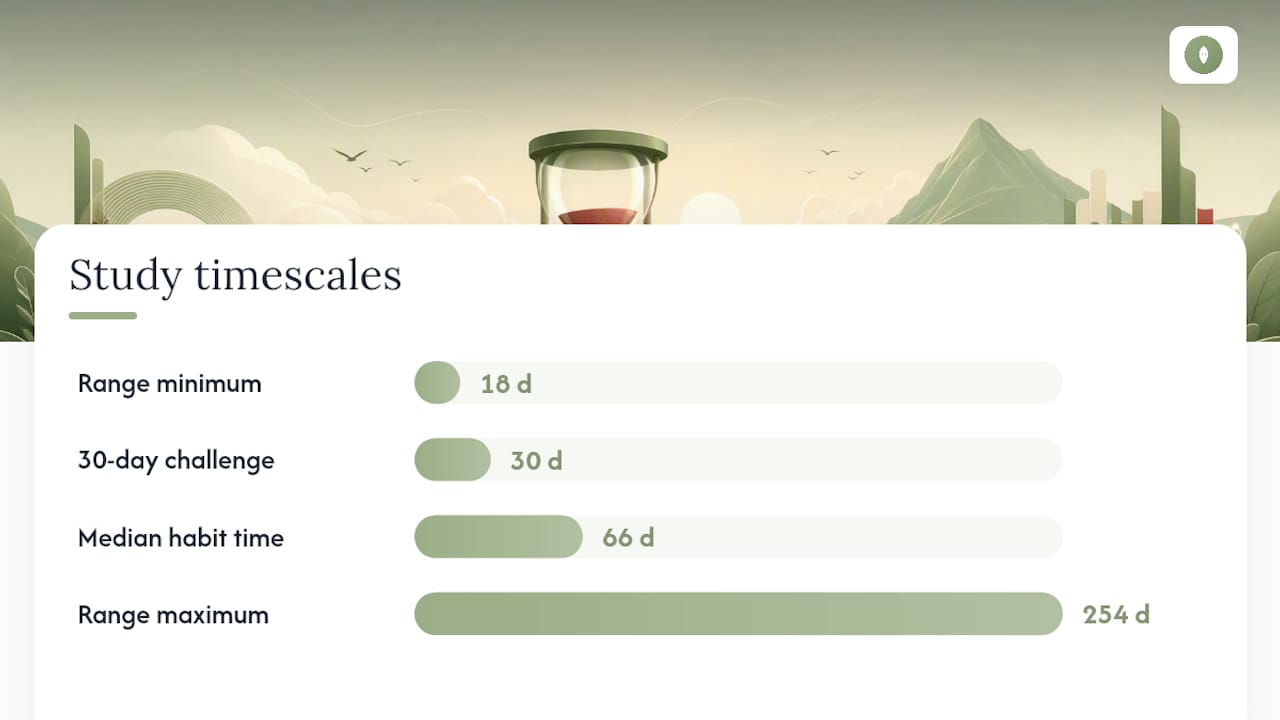
Habit-formation research from University College London put the median time to near-automatic behavior at about 66 days, with individual results ranging anywhere from 18 to 254 days.
That range comes from a longitudinal habit study tracking real behaviors, not affirmations specifically, but the takeaway transfers directly: 30 days is roughly the first half of the median habit-formation timeline. Treat it as a diagnostic trial, not a finish line.
Two things worth tracking daily during your 30 days:
- Mood or energy, rated quickly on a 1 to 5 scale so you have a trend line by day 30.
- Behavior frequency tied to your goal (did you actually follow through on the thing the affirmation points at?).
If both are trending up by day 20 or so, that's a real signal to keep going past the month.
What to Do When the Challenge Stalls
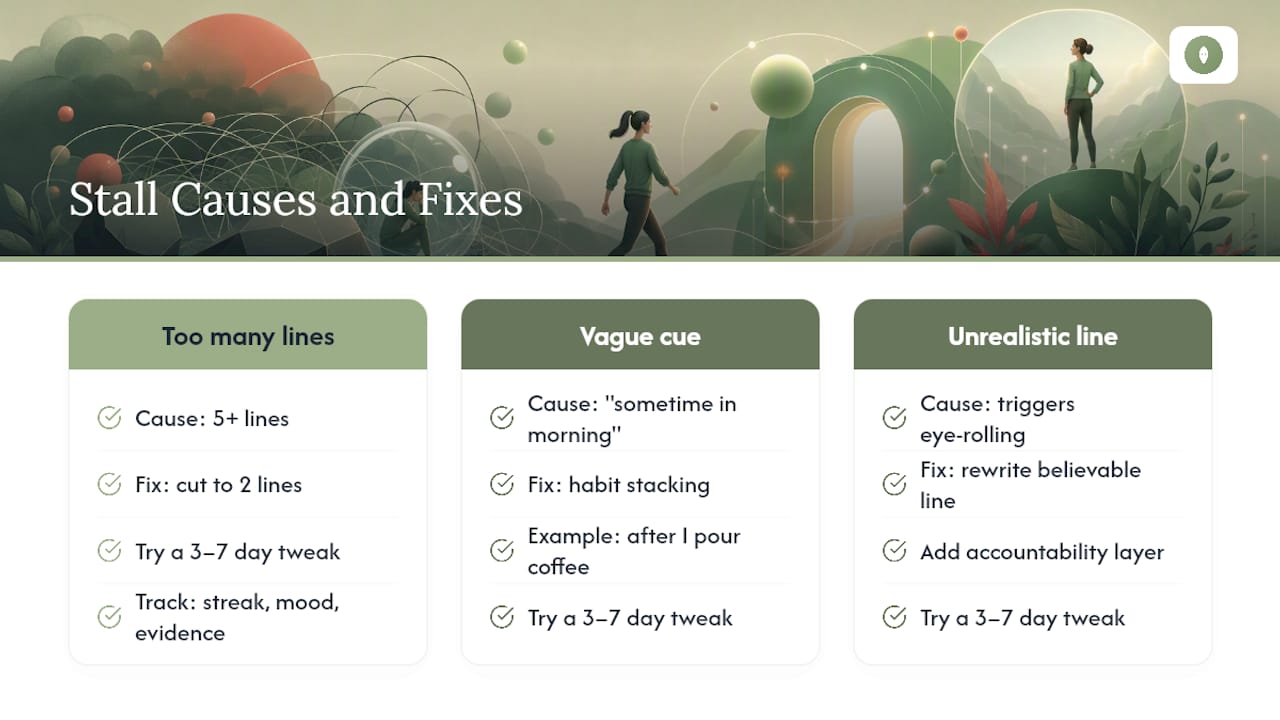
Most 30-day attempts don't fail because affirmations "don't work." They fail because of three predictable mistakes: too many lines at once, a cue that's too vague ("sometime in the morning"), or affirmations so unrealistic they trigger eye-rolling instead of buy-in.
Fixes are usually small. Cut your list from 5 lines to 2. Replace "in the morning" with "right after I pour coffee." Rewrite an inflated line into something you'd actually believe on a bad day.
Habit stacking solves most cue problems on its own: after brushing your teeth, after your first sip of coffee, before you close your laptop at night. Pick a routine you never skip, and attach the affirmation to it.
When you stall, run a short experiment instead of quitting outright. Try a 3 to 7 day tweak (new cue, fewer lines, a new delivery method) and watch your streak, your mood rating, and your evidence bank for signs of improvement. If nothing moves, pair the practice with an accountability layer: a buddy check-in, a small self-imposed stake, or a typed confirmation that forces active engagement instead of passive repetition.
Pro Tip: If you keep "forgetting," the problem usually isn't memory, it's that the cue lives in your head instead of your environment. Put a sticky note on your coffee maker or set a recurring phone alert at the exact minute your anchor habit happens.
How Flourishorforfeit Reinforces a 30-Day Affirmation Habit
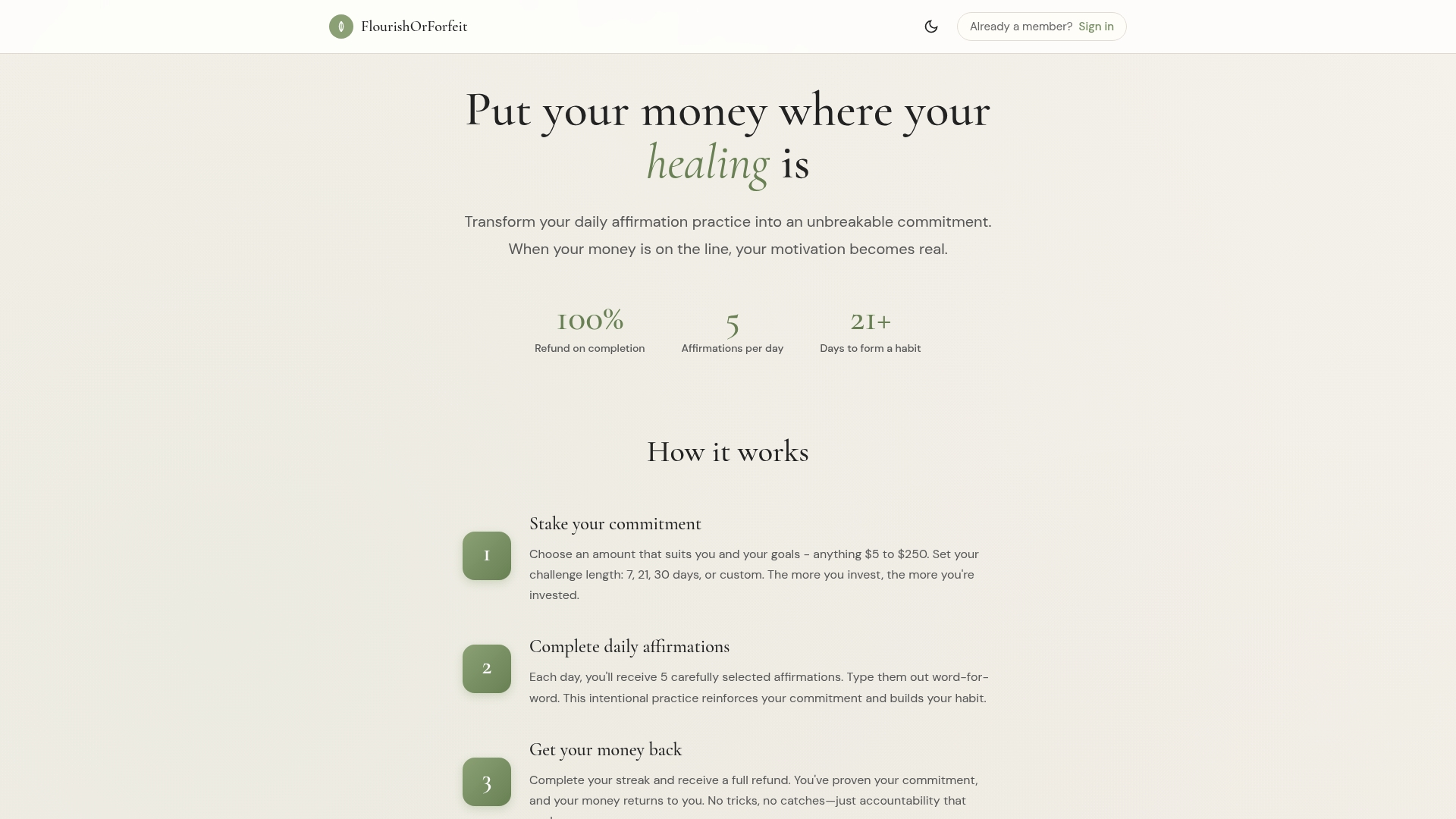
Willpower alone gets shaky by week two for most people, which is why active confirmation and small stakes measurably improve adherence compared to passive practice. Flourishorforfeit builds that principle directly into a 30-day affirmation challenge:
- You choose a stake amount and a challenge duration.
- Each day, you type your affirmations word for word, creating active engagement.
- Complete every day and your stake is refunded; miss the challenge and you forfeit it.
Think of the platform as an accountability layer, not a replacement for writing good affirmations. Pair Flourishorforfeit's typed daily confirmations with the weekly-theme template above, and you get both halves of what the research points to: well-written lines and a real reason to show up on day 17 when motivation alone would've let you skip.
What I'd Actually Tell You After Day 30
Thirty days of honest affirmation practice usually leaves you somewhere between "nothing changed" and "everything changed," and that middle ground is normal, not a failure. The research backs small, real gains, not a personality overhaul, and habit science says you're likely still short of full automaticity at day 30. Spend 10 minutes reviewing your evidence bank and mood trend, decide whether to continue as is, tweak your cue or wording, or extend into a longer commitment if the early signal looks good.
— Zack
Start a Committed 30-Day Affirmation Challenge
If you've read this far, you already know the plan works better with a reason to actually show up. The platform gives you that reason: pick your stake, choose a challenge window, and type your affirmations word for word each day to confirm you did the work.
Complete every day of the challenge and your stake comes back in full. Miss a day past your allowance and you forfeit it, which is exactly the kind of financial accountability that turns "I'll try to remember" into "I actually did it." It runs alongside the free 30-day template above rather than replacing it. You still need affirmations worth repeating; the platform just makes sure you repeat them. Start your 30-day challenge on Flourishorforfeit and put a real stake behind the habit you're trying to build.
Sources
- Self-affirmations can boost well-being, study finds — American Psychological Association
- Mobile health app trial showing adherence benefits from self-affirmation dosing
- Meta-analysis summarizing effect sizes of self-affirmation interventions
- Report on UCL habit-formation findings and the 66-day median