

A Ulysses contract is a precommitment device: you lock in a future decision now, while you're clearheaded, so a weaker future version of you can't undo it. It works best for recurring temptations or a single keystone habit, not a dozen goals at once. FlourishOrForfeit and stickk.com are two working models of this idea, both using money as the lock.
TL;DR:
- Overcommitting to multiple habits at once or creating overly large stakes can cause failure, so focus on one or two keystone behaviors and choose stakes that are uncomfortable but not overwhelming.
- Use clear measurement and verification methods, such as app logs or third-party checks, to prevent rationalization and self-deception from undermining the contract.
- Building in skip-day rules and limiting commitments to one goal enhances the pact's durability during tough days when quitting seems tempting.
- Legal and clinical uses of Ulysses contracts require professional oversight to ensure enforceability and safety, unlike informal personal contracts that rely solely on external consequences.
Table of Contents
- What Are Ulysses Contract Examples You Can Use Today?
- Clinical, Legal, and Tech Uses Worth Knowing About
- Does Precommitment Actually Work? What the Research Shows
- Build Your Own Pact: Template and Two Sample Contracts
- Where Ulysses Contracts Go Wrong (and How to Fix Them)
- Real-World Case Studies Worth Learning From
- Customizing a Ulysses Contract to Fit Your Life
- Staying Committed When the Contract Gets Hard
- A Publisher's View: FlourishOrForfeit as a Working Model
- Ready to Put a Financial Stake Behind Your Own Commitment?
- Sources
- FAQ
What Are Ulysses Contract Examples You Can Use Today?
You don't need a philosophy degree to build one of these. You need a decision you keep breaking, and a way to make breaking it expensive or inconvenient.
Some of the simplest examples are ones you've probably already half built without naming them:
- Automatic bill pay and recurring investments. Setting a 401(k) contribution or a savings transfer to auto-draft removes the daily choice entirely. You committed once; the system enforces it every month after.
- Prepaid bookings. Paying for a gym class, a flight, or a nonrefundable retreat before you feel like going forces the future version of you to either show up or eat the loss.
- Financial-stake contracts with third-party enforcement. Platforms like stickk.com let you put money on the line for a goal, sometimes routing forfeited funds to an "anti-charity," a cause you'd hate to fund if you fail.
- Digital lockouts. Apps like SelfControl block distracting sites or apps for a set window on Mac, and it can't be undone early, even by restarting the computer. Built-in phone screen-time locks work the same way.
- Environmental removal. Leaving your credit card at home, deleting a food delivery app, or physically locking your phone in a timed box removes the option instead of relying on willpower in the moment.
- Public commitments. Telling your team you'll ship a draft by Friday, or texting a friend your daily check-in, turns your reputation into the enforcement mechanism.
Each of these swaps a moment of willpower for a structure that acts on your behalf. The PMC review on precommitment models documents this exact range, from physically removing temptation to monetary penalties and site blocking, as the core toolkit behind precommitment psychology.
Clinical, Legal, and Tech Uses Worth Knowing About
Ulysses contracts show up outside personal productivity, too, and some of those uses carry real legal weight.
In psychiatric care, a Ulysses contract (sometimes called a psychiatric advance directive) lets a patient specify, while stable, how they want to be treated during a future crisis, including consenting in advance to medication or hospitalization they might resist in the moment. Gambling and drinking self-exclusion programs work similarly: you ask an institution to bar you before the urge hits, and that agreement holds even if you later show up asking to be let back in.
Technology extends the same logic:
- Encrypted, time-locked files or accounts that can't be reopened before a set date.
- Account-level app blockers and OS-level screen-time locks that require a second device or a waiting period to override.
- Automated forfeiture systems, where missing a check-in triggers a financial penalty without human review.
The catch is that enforceability and consent get complicated fast in clinical settings. A 2025 paper in Theory and Decision distinguishes external control commitments, which physically block a choice, from self-control commitments that merely raise the cost of breaking a promise. Psychiatric and legal applications usually need a professional involved, not a DIY pact.
Does Precommitment Actually Work? What the Research Shows
Precommitment isn't just a productivity trick; it shows up in brain activity. Imaging research on decision-making found that when people voluntarily restrict their own future choices, the lateral frontopolar cortex (LFPC) coordinates with the dorsolateral prefrontal cortex, and this pattern was strongest in people who scored higher on impulsivity measures.
The correlation between LFPC connectivity and impulsivity ran as high as r = 0.90 in that Neuron study on precommitment and the frontal polar cortex, one of the clearest signals that precommitment specifically targets the brain circuitry involved in self-control failures.
Behavioral data points the same direction. Public summaries of stickk.com outcomes reported in Wikipedia's overview of the Ulysses pact describe success rates climbing from roughly 42.7% with no stakes attached to around 82.8% when money and third-party verification were added. Treat that gap as directional rather than clinical proof, but it lines up with what impulsive and present-biased people report: a promise alone rarely beats a habit loop, but a promise plus a cost usually does.
Build Your Own Pact: Template and Two Sample Contracts
A Ulysses contract only works if it's specific enough that you can't argue with yourself about whether you kept it. Fill in these seven fields before you commit anything:
- Decision: the exact behavior you're locking in.
- Trigger: the situation where you're tempted to break it.
- Measurement: how success gets verified, not felt.
- Time window: the daily or weekly deadline.
- Enforcement mechanism: what happens if you fail (money, access loss, public notice).
- Verification: who or what checks that you did it.
- Exceptions: a built-in skip-day rule for legitimate emergencies.
Sample Pact A, phone distraction: Decision: no social apps before 9 a.m. Trigger: waking up and reaching for the phone. Measurement: SelfControl blocklist logs. Time window: daily, for 21 days. Enforcement: a friend gets a screenshot notification if the block is bypassed. Verification: the app's own tamper-proof timer. Exception: one skip day per week, logged in advance.
Sample Pact B, 21-day affirmation with financial stake: Decision: type five chosen affirmations word-for-word, once daily. Trigger: end-of-day routine. Measurement: text logged and time-stamped in a tracking dashboard. Time window: 21 consecutive days. Enforcement: a prepaid stake, refunded in full on completion, forfeited on a missed day. Verification: SMS confirmation. Exception: a single mulligan day built into the challenge length.
Pro Tip: Run through this quick checklist before you finalize any pact: Is it specific enough to measure without judgment calls? Does someone or something outside your own willpower enforce it? Can you actually sustain it for the full window without redesigning your whole life?
Where Ulysses Contracts Go Wrong (and How to Fix Them)
Most failed pacts share the same three mistakes.
- Overcommitting. Trying to lock in five habits at once splits your attention and guarantees you'll break at least one. Limit yourself to one or two keystone goals at a time.
- Perverse incentives. A stake so large it creates panic, or a punishment that damages a relationship, defeats the purpose. The pressure should motivate, not terrify.
- Clinical or legal misuse. Using an informal pact to manage a medication decision or a legal obligation without professional input can create real harm; that territory needs a doctor or lawyer, not a spreadsheet.
The fix is usually structural: gradate your stakes so month two costs more than week one, build in a skip-day rule so one bad day doesn't collapse the whole contract, and use a third party for verification instead of grading your own homework.
Real-World Case Studies Worth Learning From
The clearest evidence for Ulysses contracts doesn't come from theory. It comes from what happens when ordinary people put a cost behind a promise they'd otherwise break.
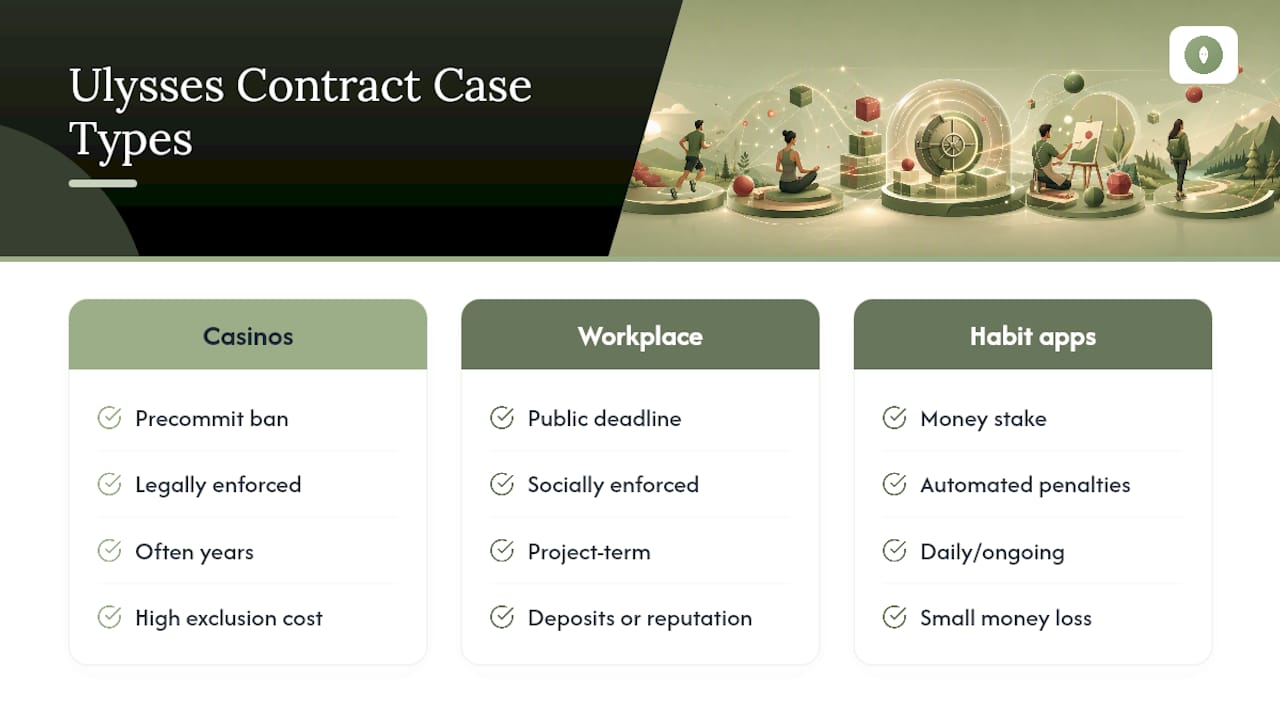
Self-exclusion programs at casinos and betting sites are one of the longest-running examples. A person signs an agreement barring themselves from the property or platform, sometimes for years, and the institution is legally bound to enforce it even when the person later shows up asking for an exception. That's a Ulysses contract functioning exactly as designed: the version of you who signed it protects everyone else from the version who wants back in.
Workplace deadlines tell a smaller but similar story. Writers who announce a public shipping date, or teams that pay a deposit for a conference booth before the project is finished, routinely report finishing work that would have slipped for months without the external pressure. The Atlassian guide to the Ulysses pact collects several of these workplace cases, including prepaid commitments and automatic payment systems that function as low-stakes but effective pacts.
Financial-stake habit platforms extend the same logic to daily behavior. Someone trying to build a consistent morning routine or stick to a reading habit puts money behind the promise instead of relying on motivation that fades by day four. The pattern across all three cases is the same: remove the decision from the moment, and let the earlier commitment do the work.
Customizing a Ulysses Contract to Fit Your Life
A pact copied word-for-word from a stranger's routine rarely survives contact with your actual schedule. The strongest ones get adjusted along three dimensions.
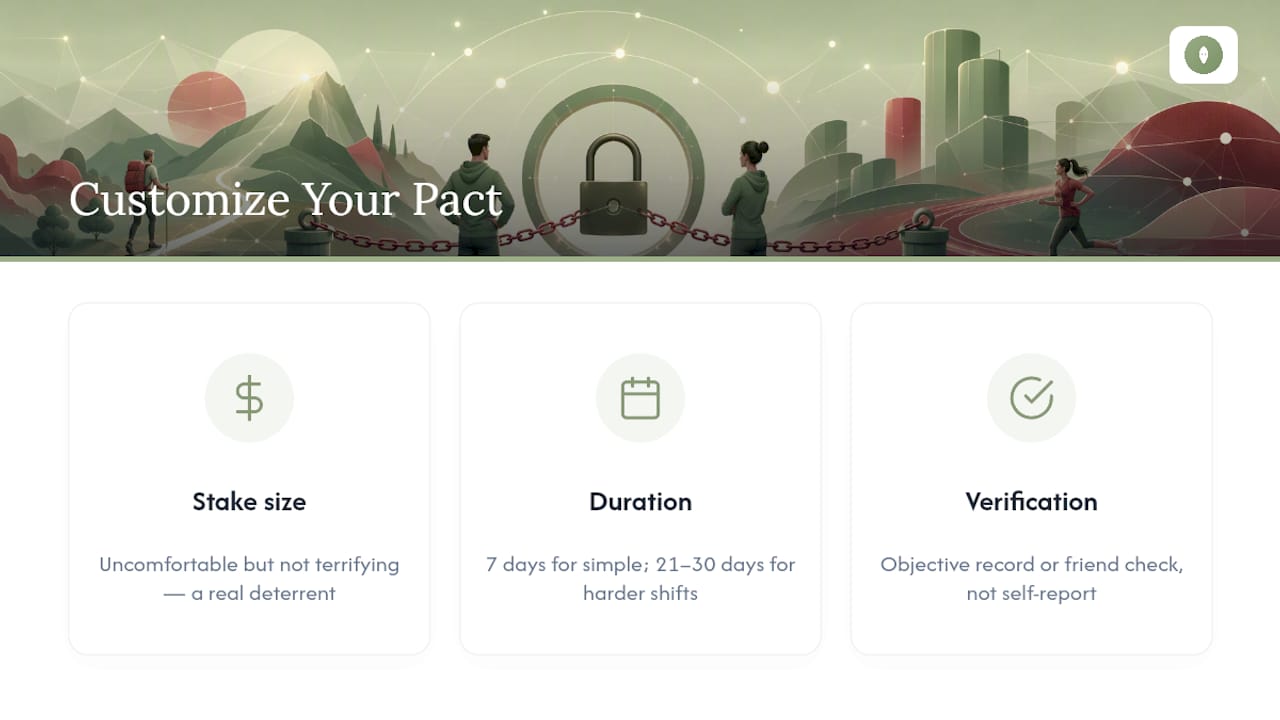
Stake size matters more than people expect. Too small and it's easy to shrug off a forfeited $5; too large and the fear of losing money starts crowding out the habit itself. Most people find the right number is uncomfortable but not frightening, somewhere they'd genuinely rather not lose but wouldn't lose sleep over.
Duration should match the habit's difficulty. A simple daily check-in might only need seven days to prove the loop works. A harder behavioral shift, like a new eating pattern or consistent affirmation practice, tends to need the fuller 21 or 30 day window, in line with the common benchmark that new habits take about three weeks to stabilize.
Verification method depends on how easily you can lie to yourself. If you'll rationalize a missed workout, use a wearable or gym check-in log instead of self-report. If you'll talk yourself out of a hard conversation, use a friend who texts you asking whether you had it, not a private journal entry only you can see.
The guide to picking a keystone habit is a useful starting point if you're not sure which single behavior deserves the pact in the first place, since stacking too many customized rules onto one contract usually backfires.
Staying Committed When the Contract Gets Hard
Every Ulysses contract eventually hits a day where quitting looks appealing, and the fix is rarely more willpower. It's better design.
A skip-day rule, built in before you start, prevents one bad day from turning into abandoning the whole thing. Knowing you have one legitimate pass removes the all-or-nothing thinking that makes people quit on day twelve instead of just missing day twelve. Guidance on preventing habit slips points to this exact mechanism as one of the more reliable ways to protect a streak without giving yourself unlimited outs.
Reducing the contract to a single keystone goal also helps more than most people expect. Competing commitments are one of the fastest ways a pact falls apart, since willpower and attention are shared resources across every promise you're juggling at once, according to the Atlassian breakdown of goal-setting pitfalls. Trying to run three pacts simultaneously usually means all three get less attention than one would.
Finally, external verification beats internal honesty almost every time. A comparison of commitment deposit models shows that contracts checked by a person, an app, or a payment system consistently outperform contracts that rely on self-reported completion, because the temptation to quietly let yourself off the hook disappears when someone else is watching the outcome.
A Publisher's View: FlourishOrForfeit as a Working Model
FlourishOrForfeit is a concrete example of the template above in action, not a hypothetical. Users choose a stake between $5 and $250, pick a 7, 21, or 30 day window, and type five chosen affirmations word-for-word each day. Complete the full run and the stake refunds in full; miss a day and the money is forfeited, with a mulligan built into the longer challenges as a skip-day safety valve.
That maps directly onto the seven-field template: the trigger and decision are fixed by the daily typing task, measurement is objective rather than self-reported, and enforcement is external because the money is already on the table. It's the financial-stake model in its simplest, most measurable form.
— Zack
Ready to Put a Financial Stake Behind Your Own Commitment?
Reading about precommitment is easy. The part that actually changes behavior is putting something real behind the decision, which is exactly what a financial-stake behavioral contract is built to do.
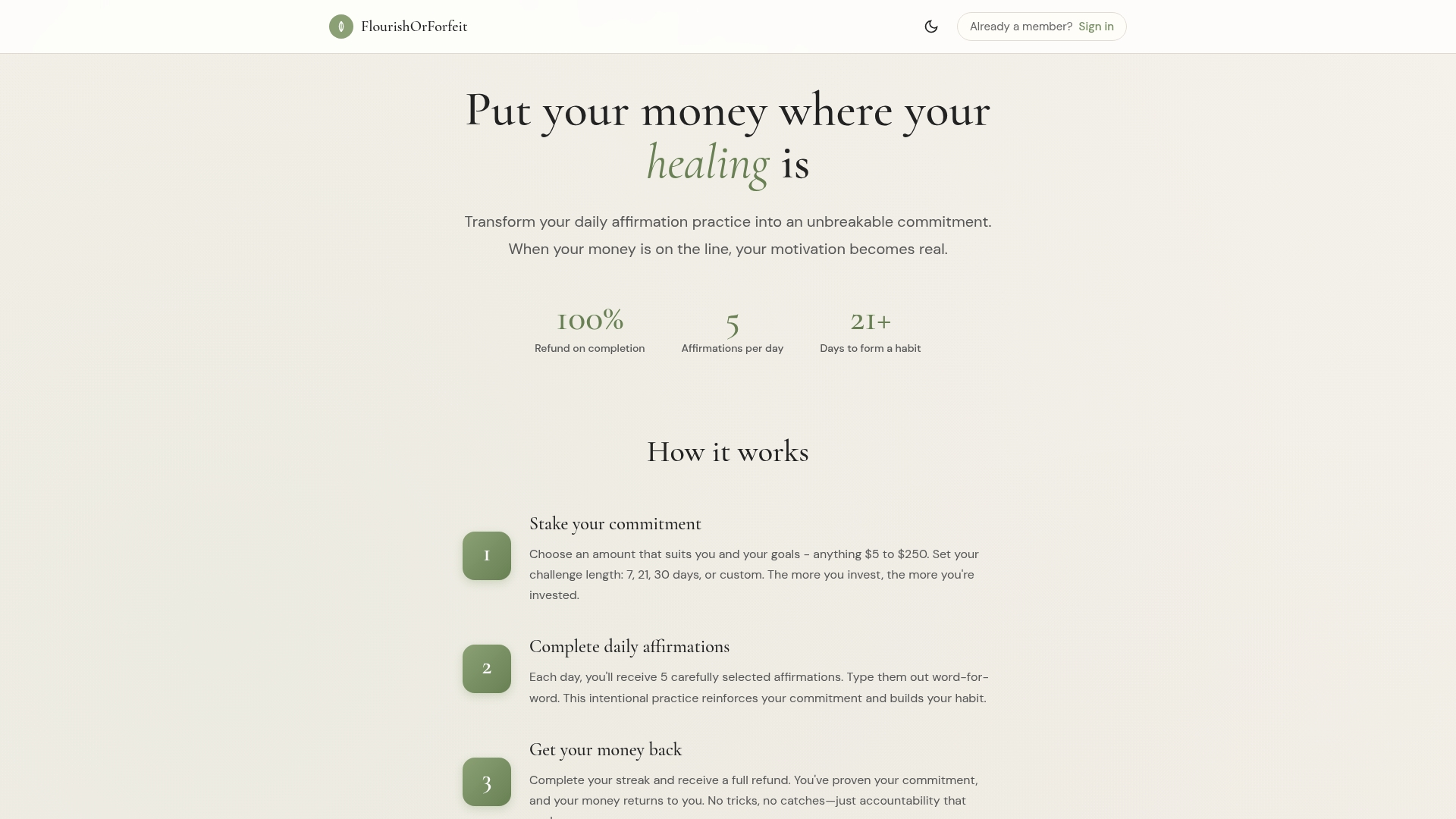
Some online platforms let you set up challenges where you commit money and track progress automatically by typing affirmations daily, with rules that refund your stake on completion or forfeit it if you miss days, enforcing commitment through a financial penalty. If you've got one keystone habit you keep meaning to lock in, start a challenge on FlourishOrForfeit and let the stake do the enforcing.
Sources
- Precommitment and the frontal polar cortex (Neuron, 2013)
- Don’t Let Me Do That! – Models of Precommitment (PMC review)
- Ulysses revisited: external control vs self-control (Theory and Decision, 2025)
- How to master your goals with the Ulysses pact (Atlassian blog)
FAQ
Why is it called a Ulysses contract?
The name comes from Homer's Odyssey, in which Ulysses has his crew bind him to the ship's mast and plug their own ears before sailing past the Sirens, locking in his safety before temptation could override his judgment.
How does a Ulysses contract work?
You make a binding decision while calm and clearheaded, then attach an external enforcement mechanism, money, a blocked account, a third-party check, so a future, more tempted version of you can't easily reverse it.
What are the pros of a Ulysses contract?
It removes in-the-moment decision-making, and platforms using financial stakes and verification have reported success rates rising sharply compared with no-stakes goals, according to public stickk-related summaries.
What is an Ulysses agreement?
It's another name for the same concept: a precommitment agreement, informal or financial, sometimes used clinically as a psychiatric advance directive specifying future treatment preferences in advance.