

Short, present-tense affirmations that feel roughly true and pair with a small daily action can genuinely support goal progress. They work best as a nudge, not magic. Start today: pick one statement, say it out loud once, then do a 60-second task that proves it. That combination, not repetition alone, is what makes the habit stick.
TL;DR:
- Affirmations are most effective when paired with a specific, small action that proves the statement, rather than relying on repetition alone.
- Using short-term affirmations tied to immediate behaviors boosts believability and makes progress measurable within days.
- Clarifying and attaching concrete behaviors to long-term affirmations helps maintain motivation over extended goal periods.
- Repeating affirmations with routine cues, such as morning or pre-task anchors, increases consistency and habit formation.
- When affirmations feel false or ineffective, scaling them back to more believable statements and tracking behavior shifts enhances results.
Table of Contents
- Affirmations for Goal Setting: 25 Ready-to-Use Lines by Category
- How to Write Your Own Effective Affirmations
- Daily Practice Routines That Make Affirmations Stick
- What the Research Actually Says About Affirmations
- Why Your Affirmations Might Be Falling Flat
- Short-Term vs. Long-Term Goal Affirmations
- The Psychology Behind Why Affirmations Move Goal Behavior
- Overcoming Skepticism: What to Do If Affirmations Feel Fake
- Pairing Affirmations With Visualization and Other Techniques
- Starting Small: One Line, One Anchor, One Week
- Accountability When Willpower Alone Isn't Cutting It
- Sources
Affirmations for Goal Setting: 25 Ready-to-Use Lines by Category
You don't need to write your own affirmations from scratch to start today. Below are 25 goal setting affirmations grouped by the areas people ask about most: career, productivity, confidence, money, and health. Each one is short, present tense, and built to feel believable rather than aspirational fluff. Where a goal is a stretch, you'll notice bridge phrasing ("I am learning to," "I am becoming") instead of a flat claim that might feel false on day one.
Career and career growth affirmations for success
- I am building skills that make me valuable at work.
- I speak up in meetings with clear, useful ideas.
- I am learning to negotiate for what I'm worth.
- My work today moves my career forward.
- I ask for feedback and use it well.
Productivity and daily discipline
- I finish what I start, one task at a time.
- I protect my focus during my most important hour.
- I am becoming someone who follows through.
- I choose progress over perfection today.
- I close my laptop knowing I did real work.
Confidence and mindset affirmations for goals
- I trust my ability to figure things out.
- I am capable of handling hard conversations.
- My past setbacks taught me something useful.
- I am learning to speak to myself with respect.
- I show up even when I feel unsure.
Money and financial goals
- I make spending choices that match my goals.
- I am building a habit of checking my finances weekly.
- I am learning to save before I spend.
- My money decisions today support my future self.
- I am becoming more comfortable talking about money.
Health and physical goals
- I move my body because I respect it.
- I am learning to choose food that fuels me.
- I rest without guilt when I need to.
- My habits today build the health I want later.
- I am becoming someone who keeps promises to myself.
Notice what's missing from all 25: negations like "I am not lazy" or "I never fail." Negation forces your brain to picture the very thing you're trying to avoid. Every line above states the outcome directly, one idea at a time, so there's nothing to argue with.
How to Write Your Own Effective Affirmations
The 25 above cover common goals, but personal ones hit harder. Use this formula: notice the specific negative thought, reframe it, put it in present tense, start with "I," and keep it to 5 to 12 words. That length and tense combination is what University Health Services' guidance on positive affirmations recommends, and it lines up with how autosuggestion research describes effective self-talk generally.
Run every draft through a believability check.
- Say it out loud. Does it feel roughly 30 to 40 percent true right now?
- If it feels completely false, add bridge language: "I am learning to" instead of "I am."
- If it feels totally true already, it's not stretching you. Sharpen it.
- Attach one tiny action that proves the statement, even slightly, today.
Pro Tip: If an affirmation makes you roll your eyes, it's too big. Shrink the claim until it feels almost boring. Boring and believable beats bold and hollow.
Daily Practice Routines That Make Affirmations Stick
Saying an affirmation once and forgetting about it does nothing. The habit needs a cue, a repetition, and a tiny action that generates proof.
- Morning anchor. Say your affirmation right after you make coffee or brush your teeth. Routine cues make repetition automatic, and morning timing tends to support consistency better than trying to remember at random points in the day.
- Pre-task anchor. Before the specific task tied to your goal (a hard email, a workout, a budget check), repeat the line once.
- The one-minute plus thirty-second rule. Say the affirmation for about a minute, then immediately do a 30-second aligned behavior, like writing one sentence or doing five pushups.
- Track it. Use a phone reminder, a journal, or a one-line daily checklist. Frame the first stretch as a 7, 21, or 30-day experiment, then review what actually shifted.
Habit stacking this onto something you already do daily removes the "did I remember" problem entirely.
What the Research Actually Says About Affirmations
Affirmations aren't just feel-good talk. Brain imaging shows self-affirmation activates the medial prefrontal cortex and posterior cingulate cortex, regions tied to self-processing and personal valuation. In one study, that activation predicted actual reductions in sedentary behavior weeks later, according to PNAS research on self-affirmation and behavior change.
A few other findings matter for how you use this practice:
- Self-affirmation appears to lower defensiveness, which makes people more open to health and behavior-change messages they'd otherwise dismiss.
- Pairing the affirmation with an actual behavior amplifies the effect. Belief plus action outperforms belief alone.
- A systematic review of self-talk research found that positive, instructional self-talk generally helps performance, though the size of the effect depends on the task and the person.
One underused variation: asking yourself "Will I?" instead of declaring "I will" increased intrinsic motivation in experimental tasks. Try swapping the question format into your routine occasionally, especially on days the statement feels flat.
Why Your Affirmations Might Be Falling Flat
If a month has passed and nothing feels different, the affirmation itself is usually the problem, not you.
- Too vague. "I am successful" gives your brain nothing to grab onto. Name the specific behavior or outcome instead.
- Too big a leap. Claiming "I am a confident public speaker" when you've never given a talk creates dissonance your brain rejects. Bridge it: "I am learning to speak with more confidence."
- No behavior attached. A statement with zero action behind it is just wishful talk. Add the 30-second anchor.
- Toxic positivity. Forcing positivity over a real problem (grief, burnout, a genuine setback) backfires. Acknowledge the reality, then affirm the response you're building.
Run a one-week test on a single affirmation before judging whether the whole practice works. One line, one week, one tracked behavior tells you more than a month of scattered statements.
Short-Term vs. Long-Term Goal Affirmations
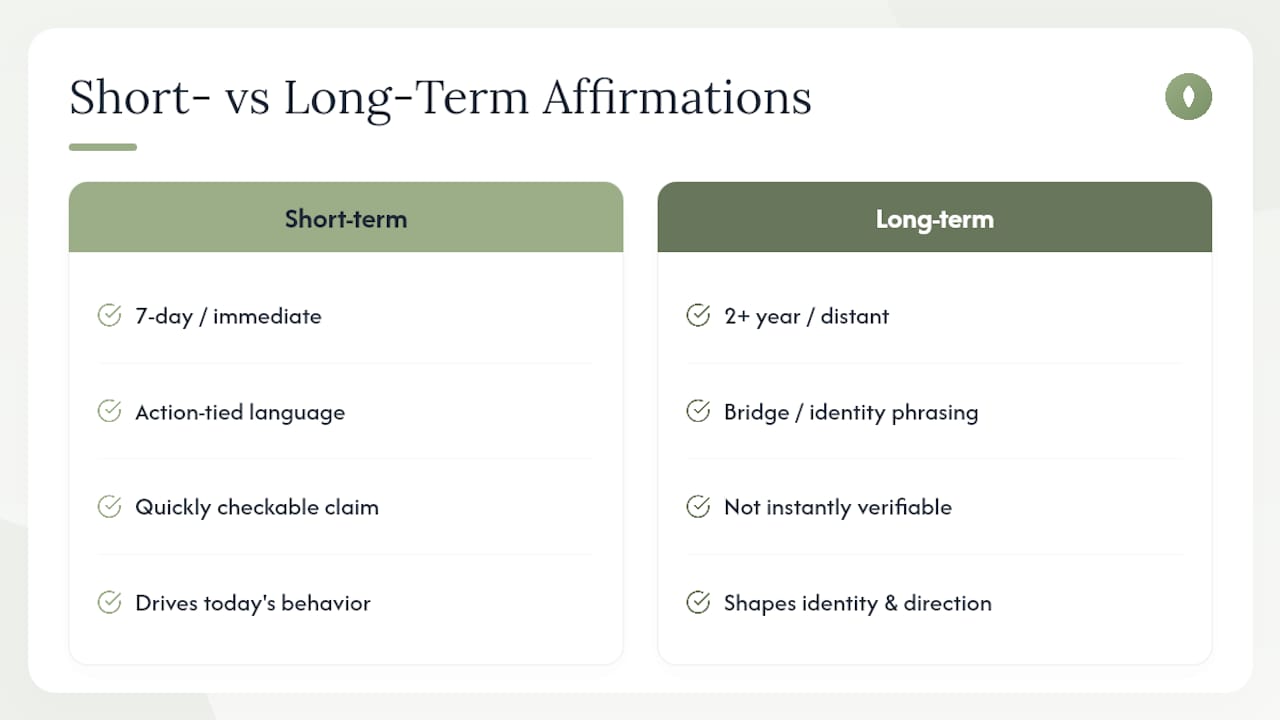
A 7-day goal and a 2-year goal need different language, and treating them the same is a quiet reason affirmations stop working.
Short-term goals benefit from affirmations tied to immediate, checkable actions: "I finish my workout today," "I send this email before noon," "I say no to one distraction right now." These work because the timeframe is close enough that your brain can verify the claim almost instantly, which builds the believability the practical guide on writing affirmations recommends.
Long-term goals need more bridge phrasing, since the outcome is far enough away that a flat present-tense claim can feel dishonest. "I am becoming the kind of person who saves consistently" works better over a year-long savings goal than "I am financially free," which nobody believes on day one. "I am building a career I'm proud of" holds up better across a multi-year path than "I am at my dream job."
A useful split: use short-term affirmations to drive today's behavior, and use long-term ones to shape identity and direction. Rotate them. On days when the big goal feels distant, lean on the short-term line that gets you through the next hour. On days when you need perspective, the identity-level line reminds you why the small task matters at all.
The Psychology Behind Why Affirmations Move Goal Behavior
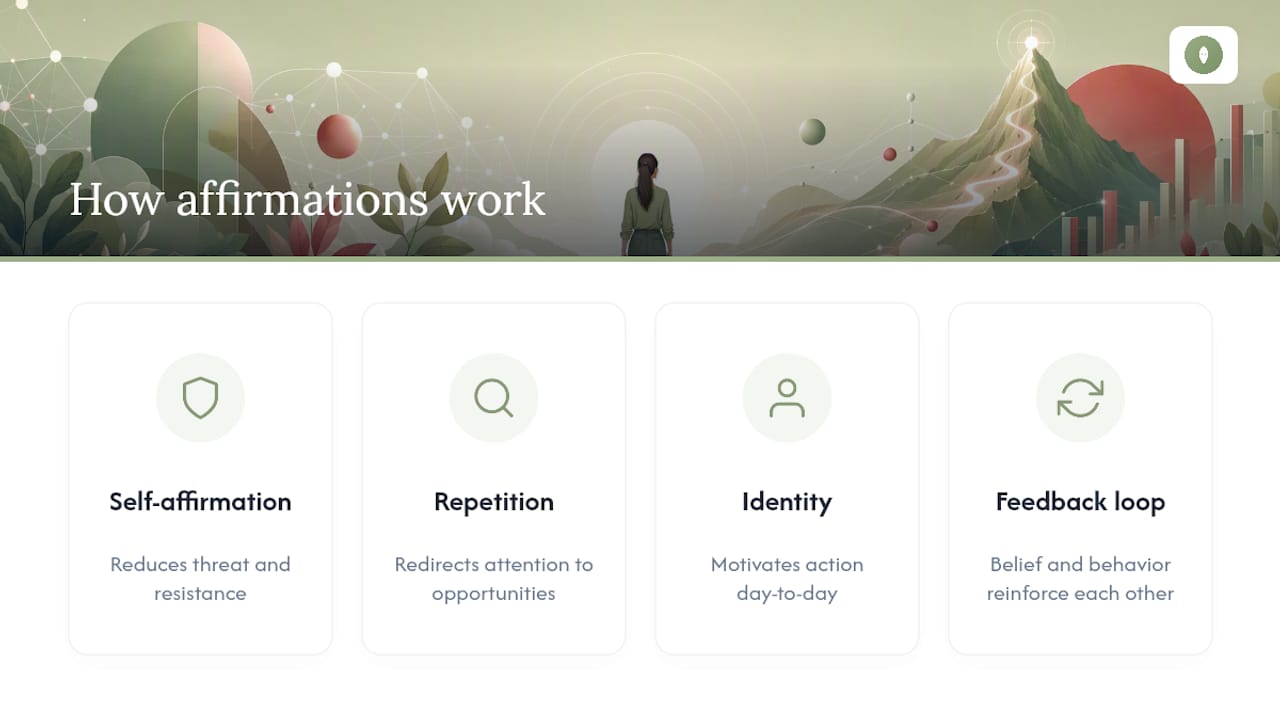
Affirmations work partly because they lower psychological defensiveness. When people feel their sense of self is under threat, whether from a scary diagnosis, criticism, or evidence they're falling short of a goal, they tend to reject the information rather than act on it. Self-affirmation reduces that threat response, which is part of why affirming your values or capabilities before facing a hard task makes you more receptive to doing something about it, per the PNAS neural imaging findings.
There's also a simpler mechanism at work: repetition shapes attention. What you say to yourself repeatedly becomes what your brain scans for. Someone repeating "I notice opportunities to save" starts actually noticing them in daily spending decisions, not because money magically appears, but because attention got redirected toward a category it used to ignore.
Identity plays a role too. Framing a goal-linked affirmation around who you're becoming ("I am someone who follows through") rather than what you'll achieve taps into identity-based motivation, which tends to outlast motivation tied purely to outcomes. Outcomes are inconsistent and slow. Identity statements give you something to act from every single day, regardless of that day's results.
None of this means affirmations override real constraints, skill gaps, or circumstances. They shift attention, lower resistance to acting, and build a small feedback loop between belief and behavior. That loop is the mechanism, not a promise.
Overcoming Skepticism: What to Do If Affirmations Feel Fake
Skepticism about affirmations usually comes from one bad experience: reciting an unbelievable statement, feeling nothing change, and writing off the whole practice. That reaction is reasonable, and the fix isn't more enthusiasm. It's better calibration.
Start by admitting the skepticism out loud rather than forcing positivity over it. If part of you thinks "this is silly," that resistance is data, not a failure. It usually means the affirmation you chose is too far from where you actually stand. Scale it back until it feels almost mundane.
Treat the whole thing as an experiment instead of a belief system. You're not being asked to convert. You're testing whether one sentence, repeated daily and paired with a tiny action, changes anything measurable over a set period. Frame it that way and the skepticism has less to grab onto, because you're not claiming certainty either.
Track a concrete behavior, not a feeling. Feelings are slippery and easy to dismiss as placebo. A specific action, like actually opening your savings app three times this week, is harder to argue with. When skeptics see their own behavior shift, even slightly, that tends to do more convincing than any amount of explanation ever could.
Pairing Affirmations With Visualization and Other Techniques
Affirmations work better as one piece of a small toolkit, not a standalone fix. Visualization pairs naturally: spend 20 seconds picturing yourself actually completing the behavior your affirmation names, then say the line. The mental rehearsal gives the words a concrete image to attach to instead of floating as an abstract claim.
Interrogative self-talk is worth mixing in occasionally. Instead of declaring "I finish my workout today," ask "Will I finish my workout today?" That question format has been shown to increase intrinsic motivation for goal-directed action in experimental settings, likely because a question invites a decision rather than a passive statement.
Classic goal-setting frameworks still apply underneath all of this. An affirmation like "I am becoming someone who finishes what I start" works best when it's backed by a specific, measurable target behind it, the kind SMART goal frameworks or simple weekly reviews already encourage. The affirmation carries the identity and motivation; the concrete goal structure carries the plan. Neither replaces the other.
If you're already journaling or doing weekly goal reviews, add one line at the top: your affirmation for the week, plus the single action that proved it true. That combination takes fifteen seconds and turns a vague mindset practice into something with a paper trail.
Starting Small: One Line, One Anchor, One Week
I picked one line to test: "I am building a habit of checking my finances weekly." Nothing dramatic. I attached it to my morning coffee, the one part of my day that never changes, and added a 60-second action right after saying it out loud: opening my banking app and glancing at one number.
By day four, the resistance I expected never showed up. Checking the number stopped feeling like a chore and started feeling like something I already did. By day seven, I noticed I'd made two small spending choices differently, without consciously deciding to. That's the signal worth watching for: not a mood shift, but a behavior shift you can point to.
— Zack
Accountability When Willpower Alone Isn't Cutting It
If you've tried the morning anchor, the tiny actions, and the tracked checklist and still keep skipping days, the problem usually isn't the affirmation. It's that nothing costs you anything when you skip it. A real financial stake can close that gap to the habit you're already trying to build.
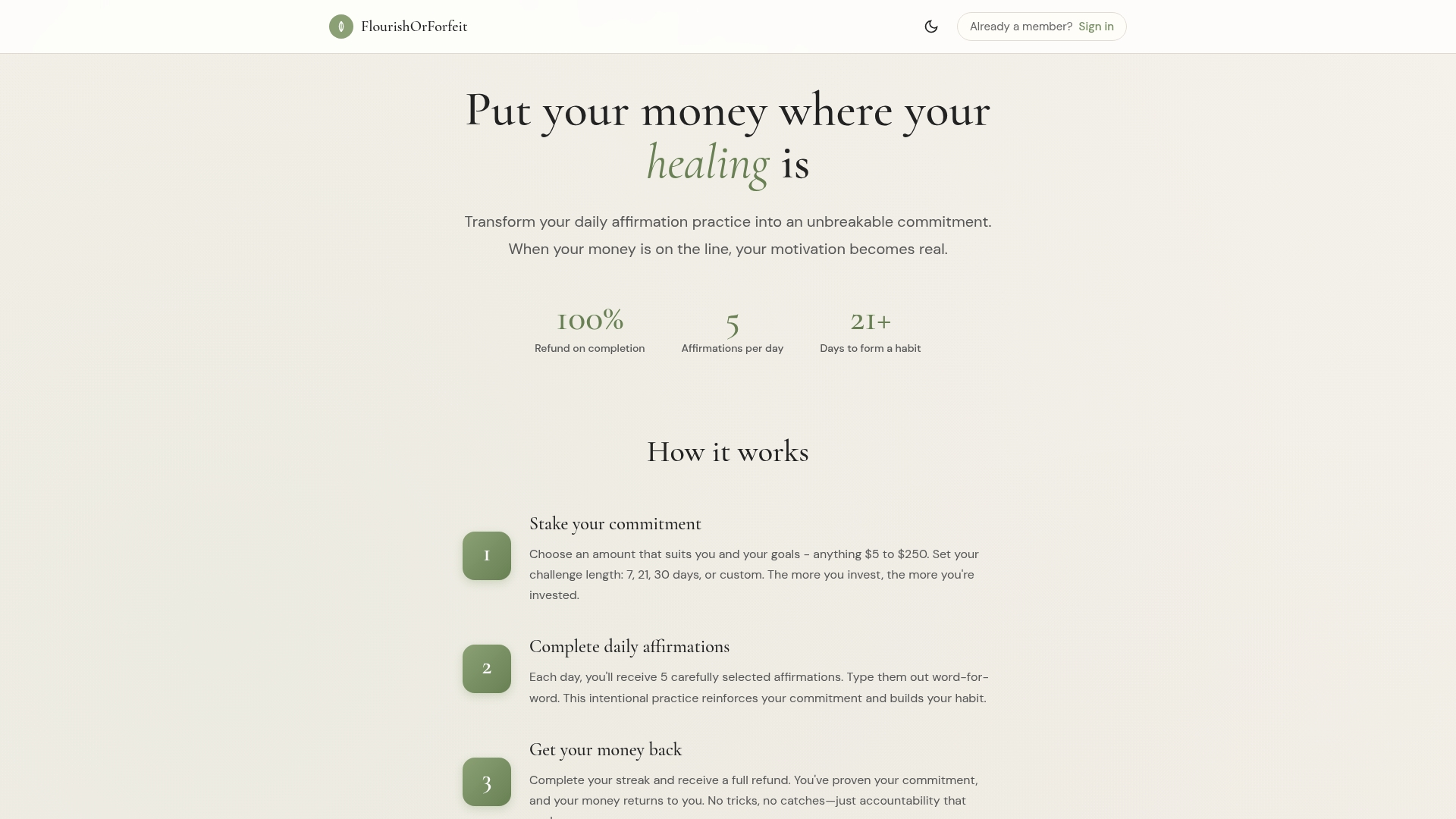
Here's how it generally works: choose a stake amount, pick a challenge length, and type your affirmations daily, verified through the platform. Finish the full challenge and you get a refund. Miss a day and you forfeit your stake, which makes the commitment tangible rather than aspirational. It's worth considering if you've tried habit stacking and reminders on your own and the consistency still hasn't held. If that sounds like where you're stuck, you can start a challenge on Flourishorforfeit and pick a stake and timeframe that actually makes skipping a day cost you something.
Sources
- University Health Services—Positive affirmations (practical guidance)
- How do you write an affirmation? (practical guide)