

Start saying these out loud today, once in the morning and once before any high-stakes moment at work:
- "I bring real value to every room I walk into."
- "I handle challenges with focus and calm."
- "My ideas are worth sharing and worth hearing."
- "I grow stronger with every difficult conversation."
- "I am prepared, capable, and ready for today."
- "I speak with clarity and confidence."
- "I belong in this role, and I earn my place every day."
- "I welcome feedback because it makes me better."
How to use them right now: Pick two or three that feel true, say them aloud while standing straight, and repeat them three times before you open your laptop or walk into a meeting. That's it. The research on why this works comes later in this article. First, just use them.
Table of Contents
- What are work confidence affirmations and why do they help?
- How do you build a daily affirmation routine at work?
- 30+ work confidence affirmations grouped by situation
- How do you write your own workplace affirmations?
- What should you say right before a meeting or presentation?
- What does the research actually say about self-affirmation at work?
- Key Takeaways
- Why accountability changes everything about affirmation practice
- Flourishorforfeit turns daily affirmations into a real commitment
- Useful sources
What are work confidence affirmations and why do they help?
Workplace affirmations are short, present-tense statements you repeat deliberately to reinforce a belief about your own competence, worth, or behavior at work. They fall into two broad types: values-based affirmations (connecting you to what you care about most) and performance-focused affirmations (targeting a specific skill or situation, like speaking up in meetings). Both types work, and the research behind them is more solid than most people expect.
The psychological mechanism comes down to what researchers call self-affirmation theory. When you reflect on your core values or strengths, you broaden your perspective and reduce defensiveness, which makes you less reactive to threats and more open to learning. Neuroimaging studies show this process activates reward-related brain regions, specifically the ventromedial prefrontal cortex (vmPFC) and ventral striatum. In plain terms: a brief affirmation shifts your brain from threat mode into a state where you can actually think clearly and perform.
Two findings stand out for anyone using affirmations in a professional context:
- Self-affirmation buffers the negative link between job insecurity and creative performance, helping employees stay creative even when they feel threatened at work.
- A brief self-affirmation improves problem-solving among people under chronic stress, which is exactly the condition most workplaces create.
A national survey also found that spontaneous self-affirmation is already common in the general population and is linked to greater optimism and health-related self-efficacy. Most people already do a version of this without realizing it. A structured daily practice just makes it deliberate and consistent.
How do you build a daily affirmation routine at work?
Consistency beats intensity. A 90-second daily practice done every day for 21 days will outperform a 20-minute session done twice a week. Three routines work well for most professionals:
Morning desk routine (3–5 minutes)
- Sit upright before opening email or any app.
- Take three slow breaths.
- Read or say your three chosen affirmations aloud, slowly.
- Write one of them by hand or type it in a notes app.
- Set a one-word intention for the day ("focused," "clear," "present").
Pre-meeting micro-routine (30–60 seconds)
- Step away from your screen or find a quiet corner.
- Take one deep breath, exhale fully.
- Say two affirmations quietly or in your head.
- Roll your shoulders back, lift your chin slightly.
- Walk in.
On-the-spot stress anchor (under 30 seconds)
- Press your feet flat on the floor.
- Breathe in for four counts, out for four counts.
- Repeat one affirmation once, firmly and silently.
For habit formation, the 21-day mark is where most people notice a shift in how automatic the routine feels. Flourishorforfeit's challenge structure is built around exactly this timeline, with 7, 21, and 30-day options. Research on values-based reflection producing real behavioral change supports the idea that brief, targeted practice done consistently can produce measurable outcomes faster than most people expect.
Pro Tip: Set a phone alarm labeled with your top affirmation. When it goes off, say the line once. That single repetition, done daily, builds the habit faster than longer sessions you skip.
30+ work confidence affirmations grouped by situation
Confidence at work
Use these at your desk each morning or any time self-doubt creeps in. Say them aloud when possible.
- "I am capable of handling whatever today brings."
- "I trust my judgment and my experience."
- "I add something no one else in this team adds."
- "I am growing more confident with every challenge I face."
- "I deserve my seat at this table."
- "I show up fully, even on hard days."
- "My work reflects my commitment and my skill."
Leadership and management
Say these before a team meeting or a one-on-one where you need to set direction.
- "I lead with clarity, honesty, and care."
- "My team trusts me because I show up consistently."
- "I make decisions with the information I have and adjust as I learn."
- "I create space for others to do their best work."
- "I am the kind of leader I would want to follow."
- "I hold my team accountable because I believe in them."
Before meetings
Quiet, quick, and effective. Use the pre-meeting micro-routine above with these lines.
- "I come to this meeting prepared and present."
- "My contributions move this conversation forward."
- "I listen well and speak when I have something worth saying."
- "I am calm, focused, and ready."
- "I handle unexpected questions with composure."
Presentations and public speaking
Say these in the 60 seconds before you start. Pair with a slow breath and upright posture.
- "I know this material and I share it clearly."
- "My voice is steady and my message is strong."
- "The audience wants me to succeed."
- "I have prepared for this and I am ready."
- "I speak with authority and warmth."
- "Nerves mean I care. I use that energy."
Teamwork and collaboration
Relational self-affirmation, reflecting on how your contributions help others, is particularly effective before joining a new team or a collaborative project. It increases perceived social worth and improves information sharing.
- "I bring out the best in the people I work with."
- "I contribute ideas and I support others' ideas equally."
- "My collaboration makes the whole team stronger."
- "I communicate openly and I listen without judgment."
- "I am a reliable teammate."
Handling conflict and difficult conversations
Write these down before a hard conversation. Seeing them on paper adds a layer of commitment.
- "I approach conflict with curiosity, not defensiveness."
- "I can disagree respectfully and still be heard."
- "I stay grounded when the conversation gets tense."
- "I speak my truth clearly and I listen to theirs."
- "Difficult conversations make working relationships stronger."
Career growth, raises, and interviews
Use these during job-search periods or before a performance review. A values-based reflection before an interview can shift your mindset from "I hope they like me" to "I know what I bring."
- "I am ready for the next level of responsibility."
- "I advocate for my own growth without apology."
- "I have earned the right to ask for what I want."
- "I bring skills and perspective that are genuinely valuable."
- "My career is moving in the direction I choose."
Calming anxiety at work
These work best as a stress anchor. One line, repeated once, with a breath.
- "I am safe. I am capable. I can handle this."
- "This feeling is temporary. My ability is not."
- "I breathe through pressure and come out clearer."
- "I have gotten through hard days before. I will again."
- "One step at a time is enough."
Short one-liners for busy days
When you have five seconds, not five minutes:
- "I've got this."
- "I am enough."
- "I show up."
- "I am ready."
- "I belong here."
Light and funny affirmations for levity
Humor lowers the stakes and makes a practice sustainable. These work well in a team setting or when you need to break tension with yourself.
- "I am a professional who occasionally has no idea what I'm doing, and that's fine."
- "I have survived 100% of my bad meetings so far."
- "I am caffeinated, capable, and mildly optimistic."
- "My imposter syndrome has terrible judgment."
- "I am doing my best, and my best is genuinely pretty good."
Positive affirmations for coworkers
Share these with a teammate who's struggling, or say them about someone before a collaboration.
- "My colleague brings real strengths to this project."
- "I see the effort my team puts in, and I appreciate it."
- "The people around me are capable and committed."
- "I trust my coworkers to do their part."
How do you write your own workplace affirmations?
The simplest formula: I am + [specific skill or quality] + [brief reason or evidence].
That third piece, the reason or evidence, is what separates a believable affirmation from an empty one. It gives your brain something to anchor to.
Fill-in-the-blank prompts to get you started:
- "I am skilled at _______ because I have done it successfully before."
- "I handle _______ with confidence because I prepare thoroughly."
- "I contribute _______ to my team, and that matters."
- "I am growing in _______, and I can see the progress."
Before and after example:
| Generic | Personalized |
|---|---|
| "I am confident at work." | "I am confident in client meetings because I know my product and I listen well." |
| "I am a good communicator." | "I communicate clearly under pressure because I pause before I respond." |
| "I handle stress well." | "I stay focused when deadlines are tight because I break problems into steps." |
The personalized version works because it connects the claim to a specific behavior you already do. That connection is what makes the statement feel true rather than aspirational.
Pro Tip: Write three affirmations on a sticky note and put it where you'll see it before your first meeting of the day. Visibility beats memory every time.
What should you say right before a meeting or presentation?
These micro-scripts are designed to be used privately, in a hallway, a bathroom, or a quiet corner, in 30–60 seconds flat.
Pre-meeting script (30 seconds)
- Inhale for four counts, exhale for four counts.
- Say quietly: "I am prepared and present. My contributions matter."
- Roll your shoulders back and lift your chin.
- Walk in with your eyes up.
Pre-presentation script (60 seconds)
- Two slow breaths.
- Visualize one moment where you explained something clearly and people responded well.
- Say: "I know this material. My voice is steady. The room is on my side."
- One final breath, then go.
For virtual meetings, the same routines apply. Close unnecessary tabs, mute notifications, and say your two lines before you click "Join." The physical cues still work on camera: sitting upright and looking directly at the lens changes how you come across and how you feel.
A few quick adjustments by situation:
- One-on-one with a manager: Swap "the room is on my side" for "this conversation moves me forward."
- Conflict conversation: Add "I stay grounded when the conversation gets tense" as your anchor line.
- Job interview: Use a values line: "I know what I bring and I'm here to show it."
What does the research actually say about self-affirmation at work?
The evidence base for self-affirmation is stronger than the wellness-industry version of it suggests. Here are the key findings that apply directly to workplace use:
- Stress and problem-solving: A randomized study found that self-affirmation improved problem-solving performance among chronically stressed individuals, buffering the performance decline that stress normally causes.
- Job insecurity and creativity: Self-affirmation weakened the negative link between job insecurity and creative performance, helping employees stay creative even under threat.
- Real-world behavioral change: In field experiments, a 15-minute values-based reflection increased reemployment probability by a factor of roughly 2.4–3.5 within four weeks. Brief and intentional beats long and generic.
- Brain mechanism: Neuroimaging links affirmation to vmPFC and ventral striatum activation, the regions tied to reward processing and self-related valuation, which explains why affirmation reduces defensive reactions to criticism and threat.
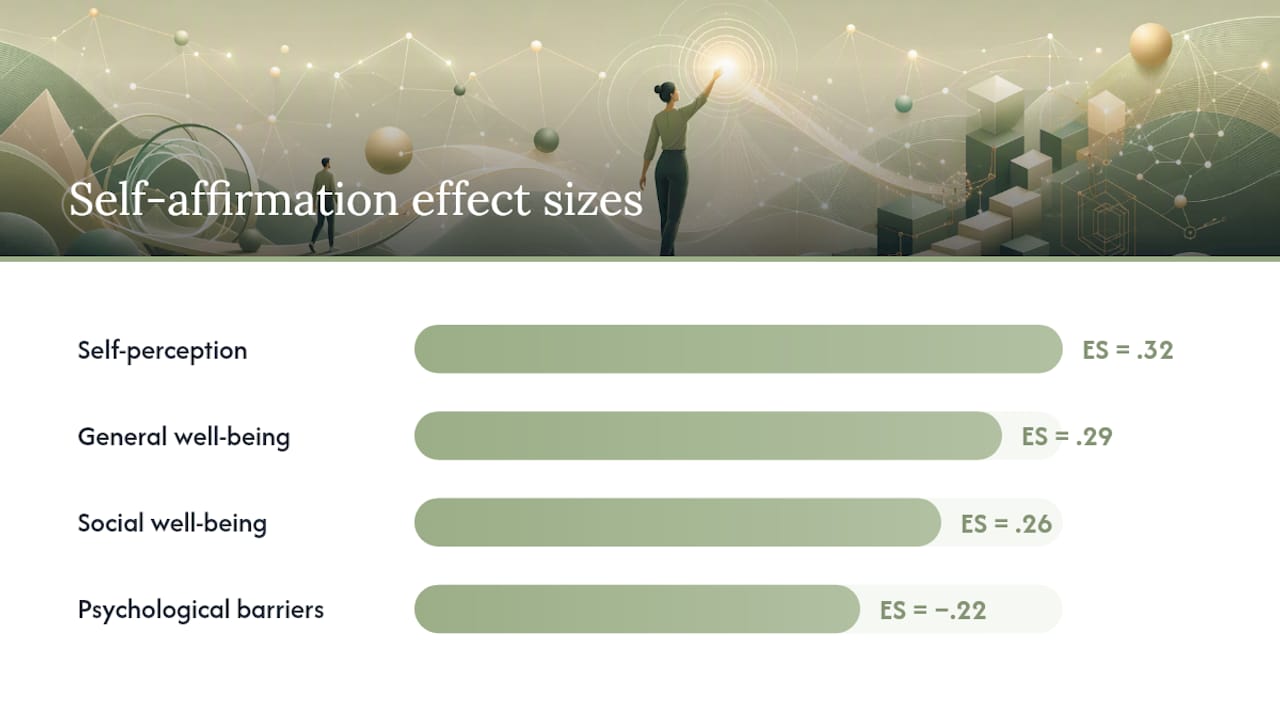
A meta-analysis of self-affirmation interventions found small but consistent positive effects across multiple outcomes, with effect sizes: self-perception ES = .32, general well-being ES = .29, social well-being ES = .26, reduction of psychological barriers ES = −.22.
Small effect sizes in psychology often translate to meaningful real-world differences, especially when a practice is low-cost and repeatable. The broader theoretical review by Steele and Cohen confirms that affirmation works best as a buffer under threat or chronic stress, which is precisely when most people reach for it at work.
Practical implication: Affirmations are most effective when you use them before a stressful event, not after. A 15-minute values reflection before a difficult week, or a 60-second routine before a hard meeting, will outperform a vague daily recitation done out of habit.
Key Takeaways
Work confidence affirmations are most effective when they are believable, present-tense, paired with a physical anchor, and practiced consistently for at least 21 days.
| Point | Details |
|---|---|
| Use present-tense, specific lines | "I handle client calls with calm and clarity" works better than "I will be confident someday." |
| Practice before stress, not after | Affirmations buffer threat most effectively when used before a hard meeting or difficult week. |
| 21 days builds the habit | Research and Flourishorforfeit's challenge structure both point to 21 days as the key consistency threshold. |
| Pair with breath and posture | A physical cue makes the statement feel more credible and reinforces the mental shift. |
| Flourishorforfeit enforces daily practice | Staking $5–$250 on a 7, 21, or 30-day challenge creates real accountability for showing up every day. |
Why accountability changes everything about affirmation practice
The gap between knowing affirmations work and actually doing them every day is where most people get stuck. It's not a knowledge problem. It's a commitment problem.
The research on values-based reflection is clear: brief, intentional practice done consistently produces real behavioral change. The reemployment study showed that a single 15-minute reflection shifted outcomes measurably. But "brief and intentional" requires showing up, and showing up requires more than good intentions on a Monday morning.
What I find genuinely interesting about the evidence is that the mechanism, activating reward circuitry and reducing defensiveness, works whether or not you feel motivated when you start. The practice creates the state; the state doesn't have to precede the practice. That's the argument for structure over willpower. When you've staked something real on completing a daily habit, the motivation to open the app and type your affirmations doesn't depend on how you feel that morning.
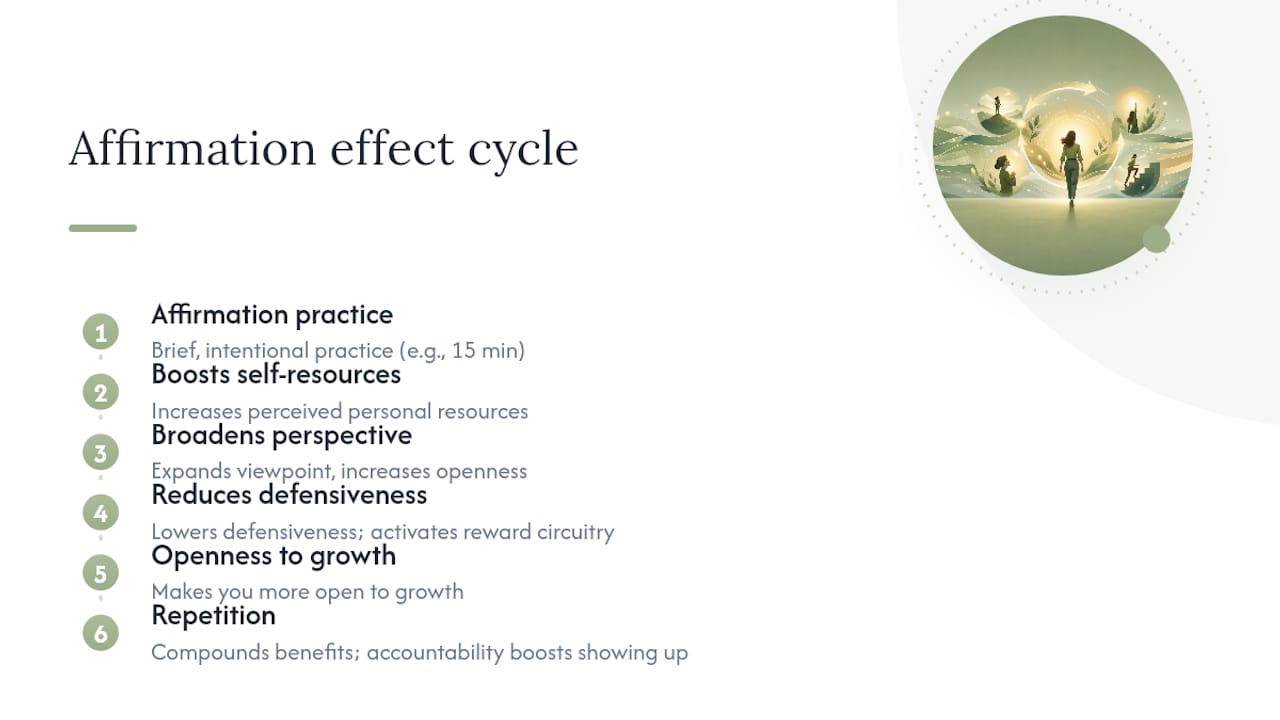
The Sherman synthesis on self-affirmation effects describes a cycle: affirmation boosts self-resources, which broadens perspective, which reduces defensiveness, which makes you more open to growth. That cycle needs repetition to compound. A financial stake doesn't make the affirmations more powerful on any given day. It makes the repetition more likely, and repetition is where the real effect lives.
Flourishorforfeit turns daily affirmations into a real commitment
Reading a list of affirmations is easy. Coming back to them every single day, especially when work is hard, is where most people fall short. Flourishorforfeit is built for exactly that gap.
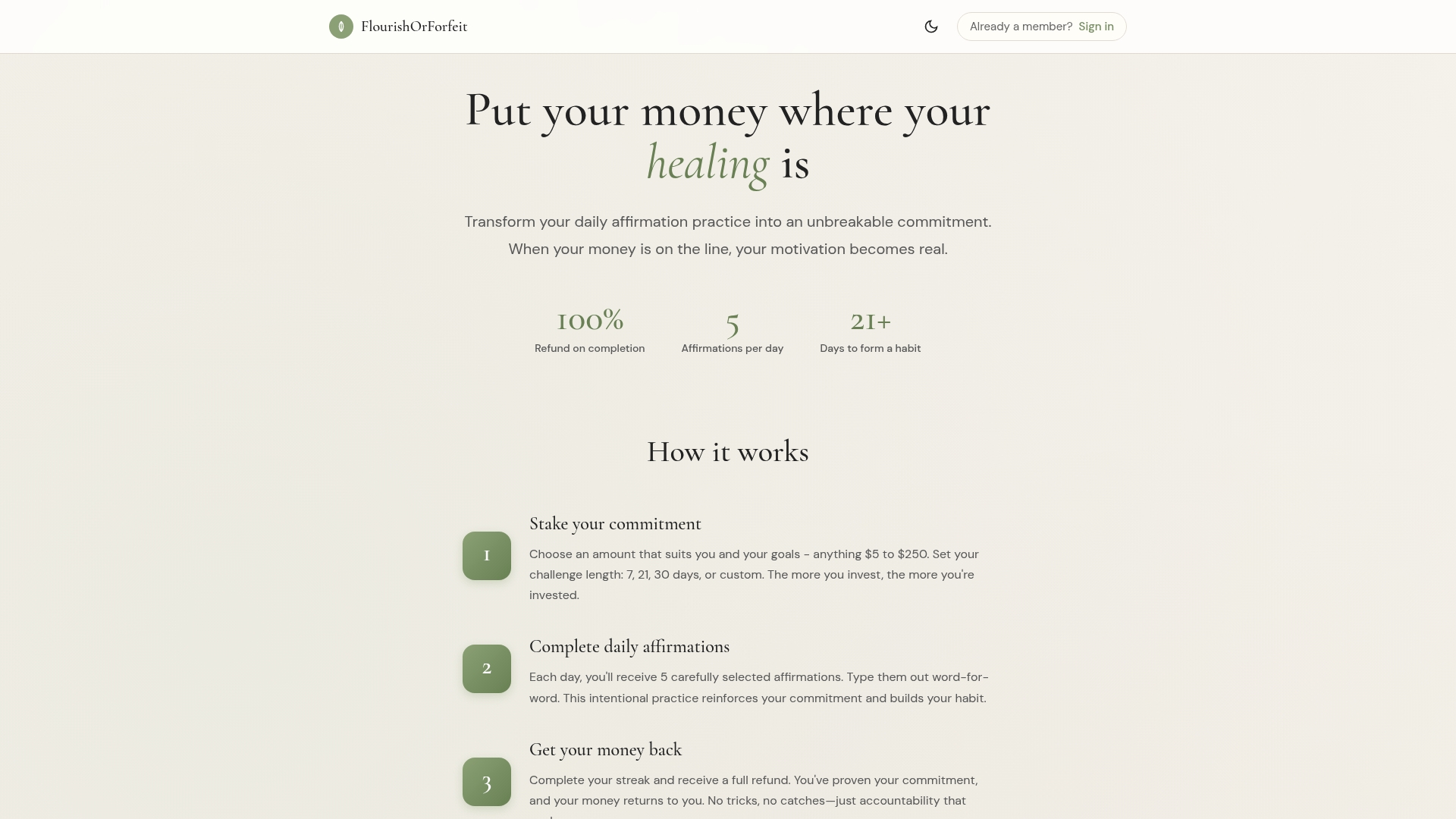
You pick a stake between $5 and $250, choose a challenge length of 7, 21, or 30 days, and type five curated affirmations word-for-word each day. Complete the challenge and you get a full refund. Miss a day and you forfeit your stake. The platform tracks your streak through a dashboard, uses SMS verification to confirm daily completion, and includes a mulligan option for longer challenges so one bad day doesn't end your run. Secure payments run through Stripe.
The financial stake isn't a gimmick. It's the mechanism that makes the habit stick when motivation dips, which it always does around day four and day twelve. Start your challenge at Flourishorforfeit and put something real behind the practice you've been meaning to build.
Useful sources
The following primary research sources back the claims in this article:
- Self-affirmation increases reemployment success for the unemployed - PMC
- https://journals.plos.org/plosone/article
- Cognitive, Social, Physiological, and Neural Mechanisms Underlying Self-affirmation: An Integrative Review
- Self-affirmation and social psychological intervention
- https://doi.org/10.1111/jasp.12519
- https://www.ovid.com/journals/ampsy/pdf/10.1037/amp0001591~the-impact-of-self-affirmation-interventions-on-well-being-a
- Self‐Affirmation: Understanding the Effects - Sherman - 2013 - Social and Personality Psychology Compass - Wiley Online Library
- https://journals.sagepub.com/doi/10.1177/1359105316643595