

Financial-stake daily-affirmation challenges are the most direct form of temptation bundling available today. You put real money on the line in a meaningful range, type five affirmations word-for-word every day for a week or longer, and get a full refund when you finish. Miss a day, and you forfeit the stake. That's the whole mechanism. If you're ready to start, Flourishorforfeit is where you set it up.
Key Takeaways
Financial-stake daily-affirmation challenges work because they make the cost of quitting immediate and the reward for finishing concrete, a structure backed by peer-reviewed commitment-contract research.
| Point | Details |
|---|---|
| Stake before you start | Depositing money upfront makes loss salient now, not as an abstract future consequence. |
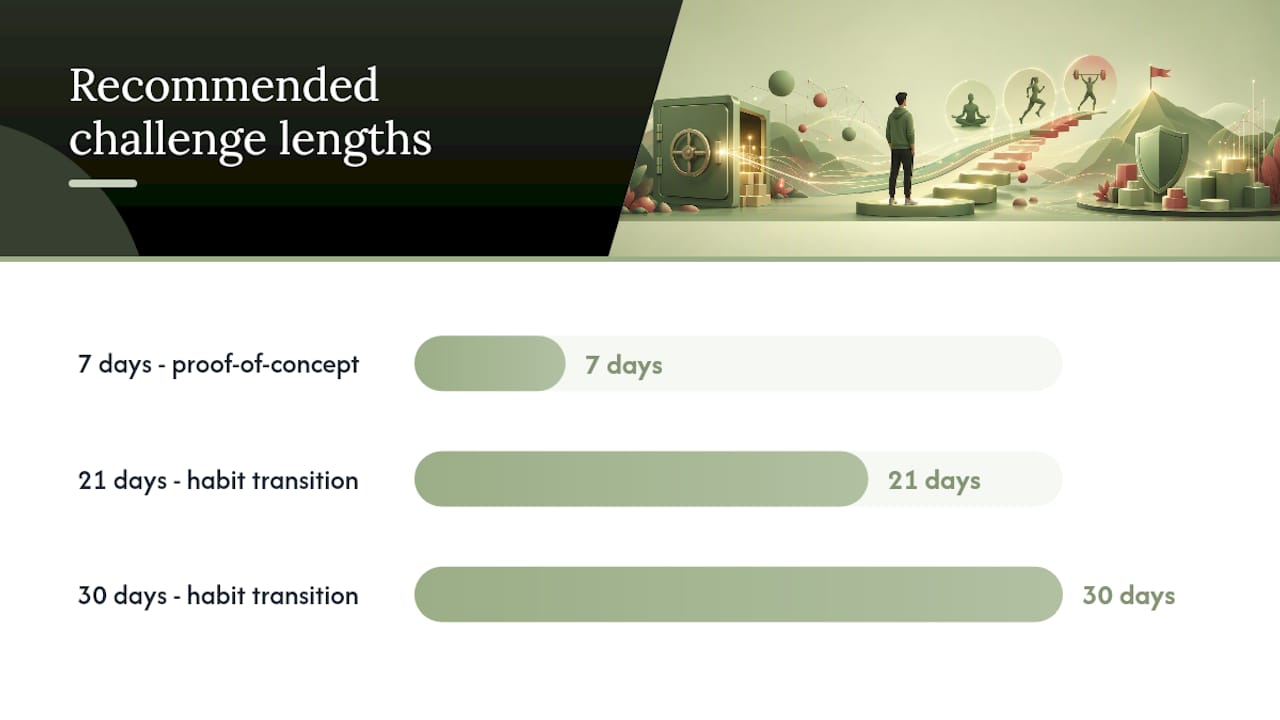
| Choose 21 or 30 days | NBER research supports longer commitments for habit transition; 7 days rarely produces lasting change. |
| Lock in your affirmations | Write specific, present-tense statements on day one and never edit them mid-challenge. |
| Use a fixed daily cue | Tying typing to an existing ritual removes the daily decision and reduces dropout. |
| Flourishorforfeit | Offers $5–$250 stakes, 7/21/30-day durations, Stripe payments, and a full refund on completion. |
Table of Contents
- How does a stake-based affirmation challenge actually work?
- Why do longer commitments produce better results?
- How do you start and complete a challenge?
- How do you pick the right stake amount and duration?
- What mistakes cause people to fail their challenges?
- What should you check about payments and privacy before staking?
- Who benefits most from this format, and what if it's not right for you?
- How do you stay motivated and handle lapses mid-challenge?
- What do successful challenges look like in practice?
- How do you track progress and measure success?
- A note on platform safeguards
- Ready to put your money where your habits are?
- Sources
How does a stake-based affirmation challenge actually work?
The process runs in three stages: deposit, verify, and resolve.
Stage 1: Deposit. Before the challenge begins, you choose a stake amount and a duration, then pay upfront through Stripe. The money is held against your commitment, not charged as a fee. This front-loaded structure matters because commitment contracts work by making the prospect of loss immediate and salient, not abstract. Paying now, before you've had a chance to rationalize skipping, is what gives the contract its teeth.
Stage 2: Daily verification. Each day, you log in and type your five curated affirmations word-for-word. The platform records the entry with a time stamp. SMS verification and a personal dashboard confirm completion. Typing matters here: passive reading lets your mind wander, while active, word-for-word entry forces genuine engagement with the text.
Stage 3: Resolution. Complete every day of the challenge and Flourishorforfeit issues a full refund. Miss a day without using a mulligan, and the stake is forfeited. The mulligan option, available on 21- and 30-day challenges, gives you one recovery day if life genuinely gets in the way. Use it wisely.
Key trust signals at a glance:
- Payments processed through Stripe (PCI-compliant)
- Full refund guaranteed on successful completion
- Forfeiture terms stated clearly before you commit
- Mulligan available on longer challenges only
Why do longer commitments produce better results?
The short answer: 7 days is rarely enough to shift a behavior from deliberate effort to automatic routine.
NBER research shows that nudging users toward longer commitments (21 or 30 days rather than short bursts) increases the total number of successful habit-building sessions. The same analysis finds that longer commitments help a habit transition from a conscious task to an established pattern, making the behavior more likely to persist after the challenge ends.
The mechanism is straightforward. When you deposit money before the challenge starts, the potential loss is real and present, not a vague future consequence. That immediacy is what separates a staked challenge from a simple resolution. A review of commitment devices documented a randomized trial in which deposit contracts raised quit rates for smokers by roughly 40%, a result that held because verification was reliable and the penalty was tangible. The same design logic applies to daily affirmation habits.
How do you start and complete a challenge?
Setup checklist
- Choose your duration: shorter for a quick test, several weeks for genuine habit formation, or about a month for a deeper commitment.
- Set your stake: pick an amount that stings a little if lost but won't cause real financial harm.
- Write your five affirmations: specific, present-tense, personally meaningful. Lock them in before day one.
- Schedule a daily cue: a fixed trigger (morning coffee, after brushing teeth) that fires the habit automatically.
- Complete payment through Stripe and confirm your start date.
Daily routine
- Open the platform at the same time each day, tied to your chosen cue.
- Type each affirmation word-for-word, no copy-paste shortcuts.
- Confirm via the dashboard or SMS verification.
- Log your mood or a one-line note alongside the entry. Tracking context helps you spot patterns over time.
Pro Tip: Tie your typing session to a ritual you already do without thinking, like making coffee. The existing habit carries the new one until it stands on its own.
The mulligan is a safety valve, not a free pass. On 21- and 30-day challenges, one missed day can be recovered. Save it for genuine emergencies, not a morning you simply slept in.
How do you pick the right stake amount and duration?
The core rule: never stake money you'd feel genuine financial stress losing. The goal is psychological salience, not financial risk.
| Tier | Range | Best for |
|---|---|---|
| Micro | A small, affordable amount | First challenge, testing the format |
| Medium | A moderate amount | Motivated users with a clear habit target |
| Committed | A larger amount meaningful to the user | High-accountability seekers, repeat challengers |
A few decision guidelines:
- Affordability first. The stake should feel meaningful, not threatening. If losing it would affect rent or groceries, it's too high.
- Motivation calibration. The stake should be enough to motivate without being trivial.
- Duration and stake together. Longer challenges spread the cost so daily commitment feels manageable. Framed that way, the commitment feels manageable.
Research consistently favors 21 or 30 days for habit transition. Seven-day challenges work as proof-of-concept runs but rarely produce lasting change on their own.
What mistakes cause people to fail their challenges?
Most failures trace back to a handful of predictable errors.
- Staking unaffordable amounts. Financial stress undermines the positive framing the challenge is built on. Reduce the stake before you start, not after you've already forfeited.
- Vague or shifting affirmations. "I am doing better" is too loose to anchor daily behavior. Write specific, present-tense statements and lock them in on day one. Never edit them mid-challenge.
- Skipping verification. Typing the affirmations without completing the dashboard confirmation means the day doesn't count. Build the verification step into the same ritual as the typing.
- Relying on willpower alone. Willpower depletes. A fixed daily cue and a pre-set time remove the decision entirely.
- Misusing the mulligan. Using it on day two sets a precedent. Reserve it for genuine disruptions.
Red-flag behaviors to watch: staking amounts that feel compulsive rather than motivating, treating forfeiture as a reason to quit entirely rather than a signal to reset with a lower stake, or entering a challenge during a period of financial instability.
What should you check about payments and privacy before staking?
Before you commit money to any platform, run through this checklist:
- Payment processor. Flourishorforfeit uses Stripe, a PCI-compliant processor. Confirm the payment page shows a Stripe checkout before entering card details.
- Refund policy. The refund-on-success model means your money comes back if you complete the challenge. Read the terms before you pay.
- Forfeiture terms. Know exactly what counts as a missed day and whether a mulligan applies to your chosen duration.
- Data handling. Understand how typed affirmations are stored. Affirmations are personal; check whether the platform shares or sells user data.
- Dispute process. Know where to find the terms of service and how to contact support if a technical error affects your completion record.
Verification quality directly affects outcomes. Platforms with typed, time-stamped entries and SMS checks produce higher completion rates than those relying on self-reporting alone.
Who benefits most from this format, and what if it's not right for you?
The ideal user is someone motivated by financial accountability, comfortable risking a small discretionary amount, and looking for a short, measurable habit target. If losing $20 would genuinely change your behavior, the format works for you.
If staking money isn't the right fit, alternatives include:
- Social accountability. Share your daily affirmation publicly or with a partner who checks in each morning.
- Calendar-based tracking. A simple streak calendar (paper or app) creates visual momentum without financial risk.
- Non-financial commitment devices. Telling someone your goal out loud, scheduling it in a shared calendar, or joining a free accountability group all create external pressure without money involved.
Avoid staking money if you're in financial hardship, prone to compulsive loss-chasing, or managing a gambling disorder. The mechanism relies on healthy loss-aversion, not distress.
How do you stay motivated and handle lapses mid-challenge?
Motivation tends to dip around day 8–12 of a 21-day challenge. That's normal, and it's where most people quit. A few strategies that hold up:
Reconnect with the original reason you wrote each affirmation. Re-reading your own words before typing them, rather than rushing through the entry, reactivates the intent behind the commitment. It takes 30 extra seconds.
If you miss a day and have a mulligan available, use it without guilt and move on. Treating a single lapse as proof of failure is the fastest route to abandoning the challenge entirely.
Pro Tip: Write a one-sentence "why" note next to each affirmation when you set up the challenge. On hard days, read the "why" before you type. It shifts the task from mechanical to meaningful.
Social pressure also helps. Telling one other person you've started a staked challenge creates a second layer of accountability beyond the financial one.
What do successful challenges look like in practice?
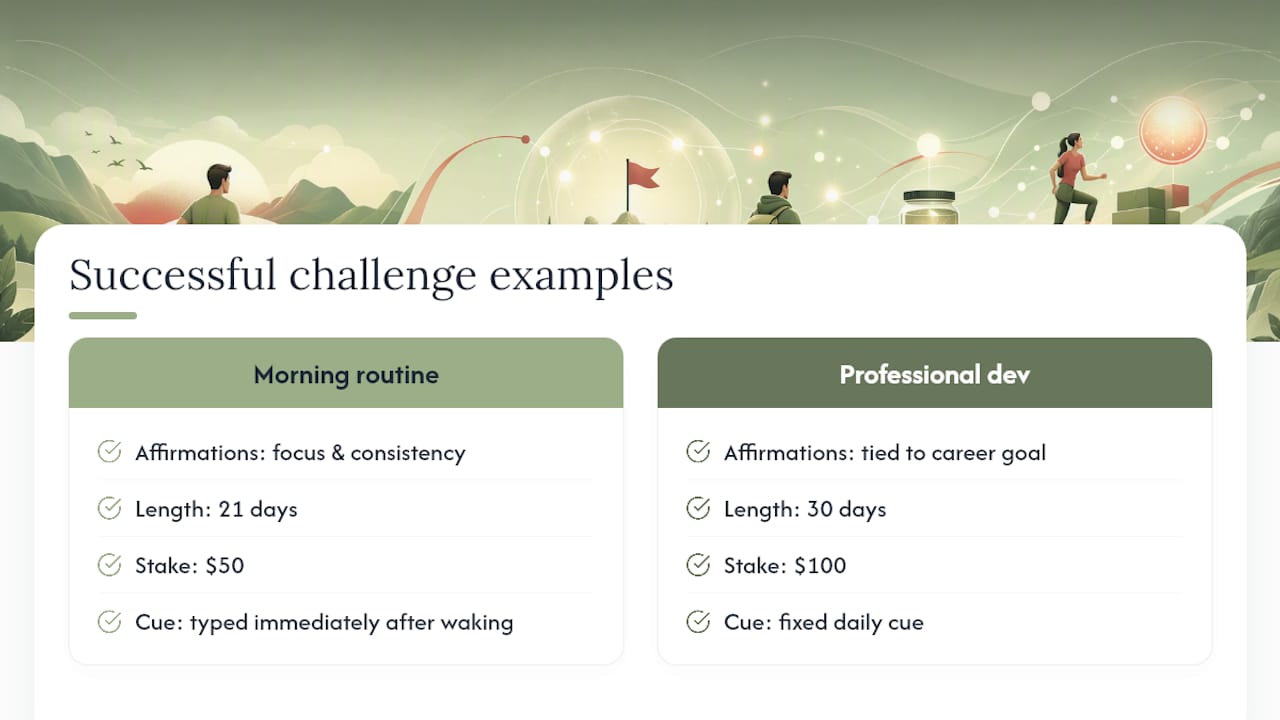
The most common successful challenges share three traits: a specific affirmation set, a fixed daily cue, and a stake amount that felt slightly uncomfortable to commit.
A morning-routine challenge might use affirmations centered on focus and consistency, typed immediately after waking, staked at $50 for 21 days. The financial stake makes skipping feel concrete rather than abstract, and the fixed cue (waking up) removes the daily decision of when to do it.
A professional development challenge might run 30 days at $100, with affirmations tied to a specific career goal. The higher stake reflects a higher personal priority. Users who complete these longer challenges consistently report that the habit persists beyond the challenge window, which aligns with the NBER finding that longer commitments help behaviors shift from deliberate effort to automatic routine.
No invented testimonials are included here. The pattern described above reflects the mechanics the platform is built around and the research that supports them.
How do you track progress and measure success?
The dashboard is your primary tracking tool. It shows a daily completion record, streak length, and the number of days remaining. Check it at the same time you complete your affirmations.
Beyond the dashboard, keep a simple external log: a note in your phone or a paper journal with one line per day. Note whether the typing felt effortful or automatic. When it starts feeling automatic, that's the signal the habit is taking hold.
Measure success on two levels. The first is completion: did you type all five affirmations every day? The second is behavioral: has the underlying habit you were affirming actually changed? At the end of a 30-day challenge, compare your behavior in week four to week one. The gap between those two weeks is the real return on your stake.
A note on platform safeguards
The financial-stake model is only as trustworthy as the platform running it. Flourishorforfeit uses Stripe for payments, which means your card data never touches the platform's own servers. The refund-on-success policy is built into the product, not a discretionary courtesy. The mulligan option on longer challenges exists specifically because life is unpredictable and a single missed day shouldn't erase 20 days of work.
If you have questions about how your data is handled, where to find the terms of service, or how disputes are resolved, the platform's help resources are the right place to start. Choose a stake you can genuinely afford to forfeit, pick a duration that matches your goal, and the structure does the rest.
Ready to put your money where your habits are?
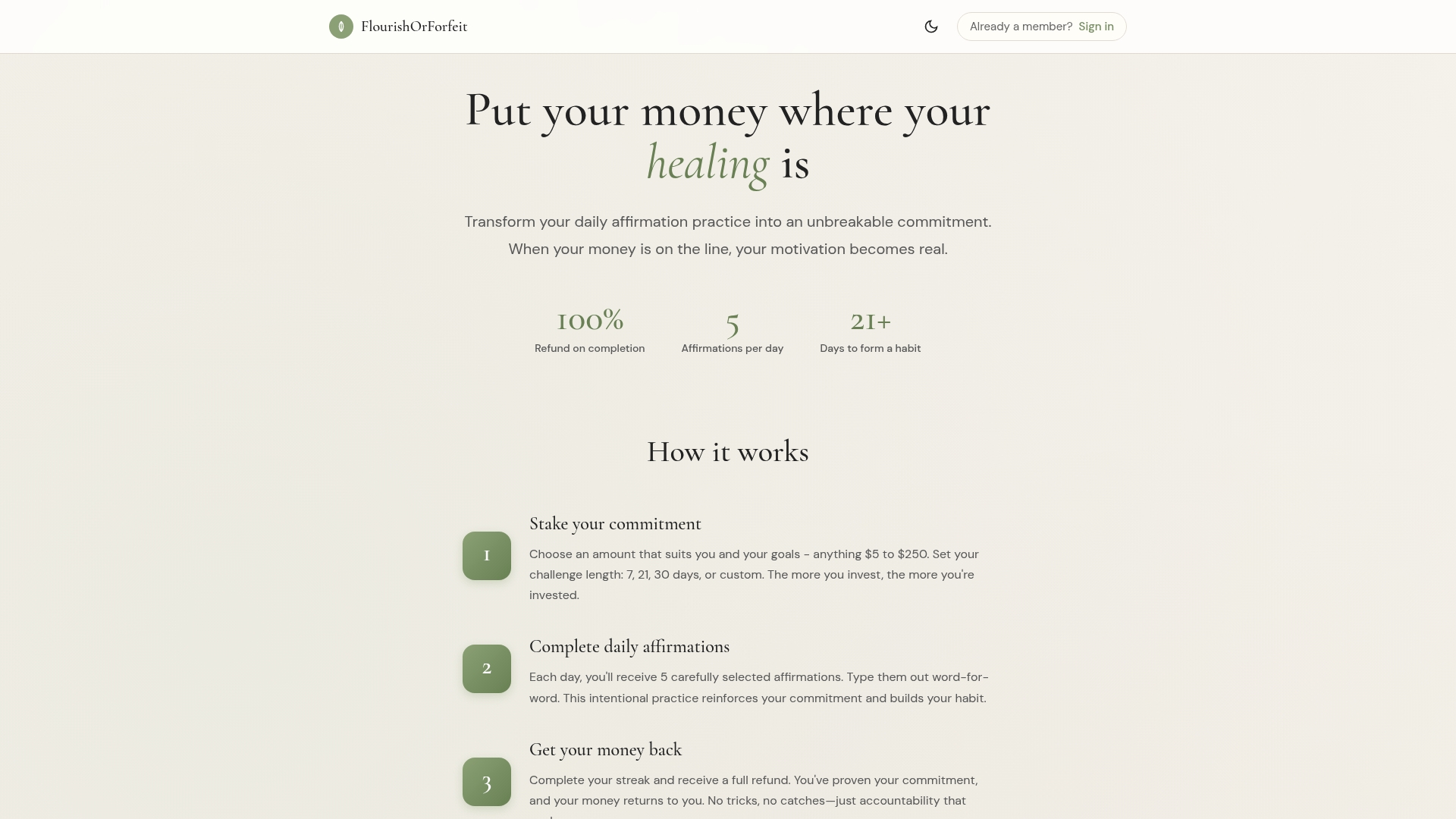
Flourishorforfeit turns a daily affirmation practice into a real commitment by attaching a financial consequence to every missed day and a full refund to every completed challenge.
Here's what you get when you start a challenge:
- Stake range: $5–$250, chosen by you
- Durations: 7, 21, or 30 days
- Verification: typed word-for-word affirmations, time-stamped daily
- Refund on success: complete the challenge, get your money back
- Mulligan option: one recovery day on 21- and 30-day challenges
- Payments: processed securely through Stripe
Pick an amount you can afford to forfeit, choose a 21- or 30-day challenge for the best chance of lasting habit change, and start your challenge on Flourishorforfeit today.