

Adopt a system instead of a goal, and your daily affirmations will run on autopilot rather than willpower. Here is a concrete example you can copy today: commit to a several-week challenge, stake $25, type five affirmations word-for-word each morning, and collect a full refund when you finish. That is a system. "I want to think more positively" is a goal. James Clear puts it plainly: goals set direction, but systems make progress inevitable regardless of how motivated you feel on any given Tuesday.
The distinction matters more than most personal development advice admits. A goal gives you something to aim at. A system gives you something to do today, and tomorrow, and the day after, whether or not you feel inspired.
- System: a repeatable daily process with a defined cue, a specific action, and built-in accountability
- Goal: an outcome target you either hit or miss
- Financial stake: a commitment device that makes the process feel real from day one
Flourishorforfeit is built around exactly this logic: stake between $5 and $250, choose a duration of 7, 21, or 30 days, type your affirmations daily, and get your money back when you complete the challenge.
Table of Contents
- Why systems outperform goals, according to the research
- How to build a concrete daily-affirmation system
- Designing your financial-stake system: amounts, durations, and safeguards
- Common pitfalls of goal-focused approaches and how to avoid them
- How to measure progress and iterate toward automaticity
- Key Takeaways
- The part most habit advice skips
- Flourishorforfeit puts this system to work for you
- Useful sources
Why systems outperform goals, according to the research
The psychological case for process over outcome is not new, but the evidence keeps getting sharper. Three distinct research threads converge on the same conclusion.
Automaticity. Wendy Wood's habit research shows that rewarded actions performed in stable contexts gradually shift from deliberate choices into procedural memory. The behavior stops requiring a decision. You brush your teeth without negotiating with yourself first. A daily affirmation system, anchored to the same cue every morning, follows the same path.
Iterative mindset. A study published in Springer found that an assess-iterate-practice mindset is positively correlated with habit automaticity and predicts sustained outcomes including weight loss and work productivity. People who treat their routine as something to tune, not just execute, build stronger habits than people who treat it as a fixed target to hit.
Goal-induced stress. Wharton research warns that over-prescribed goals create stress, narrow focus, and perverse behaviors. The more tightly you define the outcome, the more psychologically costly a near-miss becomes. Systems sidestep this by making the daily process the win.
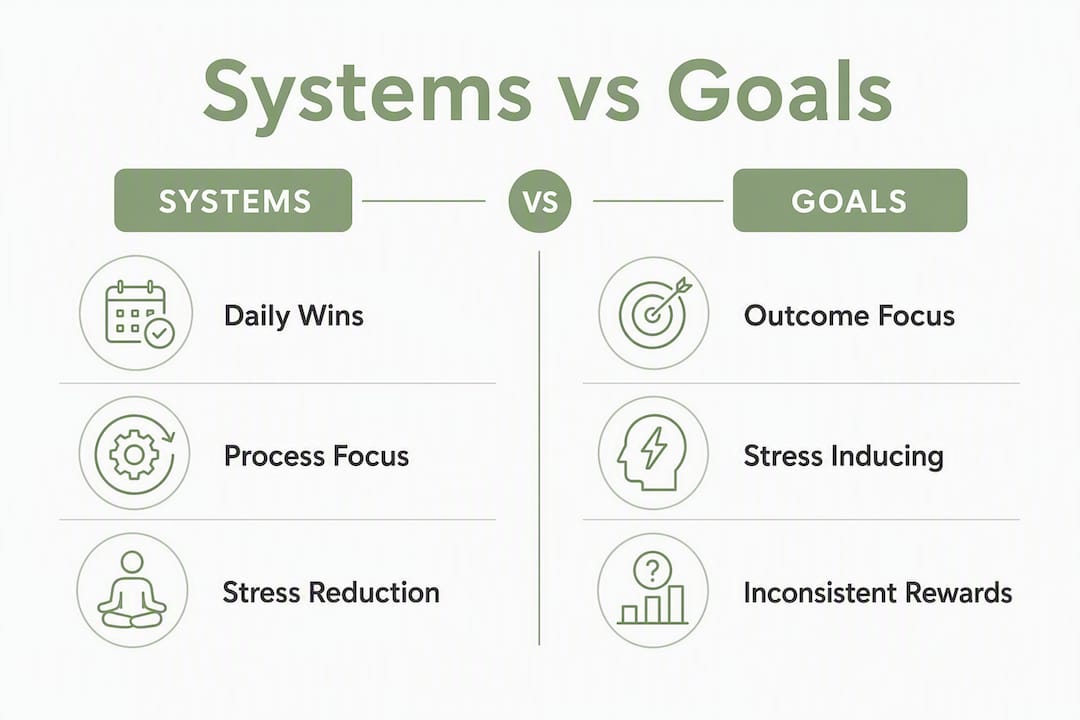
Time magazine's synthesis captures the practical upshot: a system produces a daily win every time you run it, while a goal produces satisfaction only at the end, if at all.
How to build a concrete daily-affirmation system
This is a step-by-step blueprint you can set up in under 20 minutes.
- Choose your cue. Attach the affirmation session to something you already do every morning: brewing coffee, sitting down at your desk, or finishing a shower. The cue is what fires the behavior automatically over time.
- Write five specific affirmations. Keep them present-tense, first-person, and tied to a real area of your life ("I make clear financial decisions" beats "I am successful"). Specificity is what makes typing them word-for-word feel meaningful rather than mechanical.
- Pick your duration. Seven days if you want a low-risk proof-of-concept. Twenty-one days if you are targeting the habit window supported by research. Thirty days for a deeper commitment.
- Set your stake. Choose an amount that stings a little if you lose it but does not cause genuine financial hardship. More on calibration in the next section.
- Define your verification rule. Typing affirmations word-for-word is the standard on Flourishorforfeit. It forces active engagement rather than passive reading.
- Build a minimum-viable fallback. On a chaotic morning, your fallback is one affirmation typed in 90 seconds. The system survives; the streak continues.
- Use an if/then plan. Implementation intentions dramatically increase follow-through: "If I sit down with my coffee, then I open my affirmation dashboard and type before I check email."
Pro Tip: Write your five affirmations once, save them somewhere permanent, and never rewrite them on the fly. Decision fatigue before the session is the most common reason people skip it.
The reward is immediate: you completed the process. You do not need to wait for your mindset to shift to feel the win.
Designing your financial-stake system: amounts, durations, and safeguards
Choosing the right parameters is where most people either under-commit (and feel no accountability) or over-commit (and panic-quit).
| Stake range | Who it fits | Psychological effect |
|---|---|---|
| $5–$25 | First-timers, habit explorers | Low-risk entry; enough to sting without stress |
| — | Motivated self-improvers | Meaningful loss aversion; strong daily pull |
| $250 | High-commitment challengers | Maximum accountability; use only when confident |
Flourishorforfeit supports the full $5–$250 range, so you can start at the low end and scale up once the system feels natural.
Duration logic:
- 7 days works as a proof-of-concept sprint. You learn whether the cue and affirmations are well-designed before committing longer.
- A few weeks aligns with commonly cited habit-formation research. This duration is long enough for the behavior to begin shifting toward automaticity.
- 30 days is the right choice when you want to cement a habit that already has some momentum.
Safeguards to look for in any commitment platform:
- Secure payment processing (Flourishorforfeit uses Stripe)
- SMS verification to confirm daily completion
- A dashboard that shows your streak at a glance
- A mulligan policy for longer challenges so one missed day does not erase the entire effort
- Clear refund-on-completion rules stated before you stake
Pro Tip: Keep your stake proportional to your monthly discretionary income. A $250 stake on a $1,500 monthly budget creates anxiety that works against the calm, consistent mindset affirmations are meant to build.
Common pitfalls of goal-focused approaches and how to avoid them
Goal-only thinking fails in predictable ways. Recognizing the pattern is half the fix.
- Motivation dependency. Goals require you to feel motivated. Systems run whether you do or not, because the cue fires regardless of mood.
- The all-or-nothing response. Miss one day toward a goal and the psychological cost of "failing" often triggers a complete abandonment. A system with a minimum-viable fallback and a mulligan policy keeps you in the game.
- Goal-induced stress. As Wharton's analysis shows, over-prescribing outcomes narrows focus and creates unintended pressure. Monitoring the process instead of the outcome removes that pressure.
- The yo-yo effect. Goals produce bursts of effort followed by collapse. Systems produce consistent output because the behavior is tied to a cue, not to a motivational state.
- Identity attacks after a slip. "I failed" is a goal-frame response. "The cue wasn't strong enough; I'll adjust it" is a systems-frame response. One shuts you down; the other keeps you iterating.
Pro Tip: If you miss a day, do not interrogate your willpower. Ask one question instead: was the cue clear and easy to act on? If not, fix the cue before the next session.
How to measure progress and iterate toward automaticity
Tracking whether a system is working does not require a spreadsheet. Three metrics cover it.
- Daily completion boolean. Did the process run today? Yes or no. Track this as a streak on your dashboard.
- Subjective ease score. Once a week, rate how effortless the session felt on a 1–5 scale. A rising score over three weeks is the clearest signal that automaticity is building.
- Weekly adherence percentage. Days completed divided by days attempted. Anything below 80% in week one signals a design problem, not a character problem.
Weekly system review (takes five minutes):
- Was the cue clear and consistently present?
- Was the task size right, or did it feel like a chore?
- Did the verification step create friction or flow?
- What is the single tweak for next week?
Practitioner guides consistently recommend one targeted fix per review cycle rather than a wholesale redesign. The iterative-mindset research supports this: small, deliberate adjustments compound into automaticity faster than dramatic overhauls.
Quick fixes usually resolve within a week. Behavior tuning takes two to four weeks. Full automaticity, where the session runs without conscious effort, typically emerges somewhere within a few weeks, which is why that duration is often favored on Flourishorforfeit.

Key Takeaways
Choosing a repeatable system over an outcome target is the single most reliable way to build a daily affirmation habit that survives low-motivation days.
| Point | Details |
|---|---|
| System beats goal | A daily process produces a win every time it runs; a goal only rewards you at the finish line. |
| habit window | Research links the assess-iterate-practice mindset to automaticity, making a few weeks the most evidence-backed duration. |
| Stake calibration matters | Keep your financial stake between $5 and $250 and proportional to your income to motivate without creating anxiety. |
| Weekly review drives iteration | One targeted tweak per week compounds into automaticity faster than any motivational reset. |
| Flourishorforfeit | Provides the full system: typed affirmations, $5–$250 stakes, 7/21/30-day durations, refund on completion, and SMS verification. |
The part most habit advice skips
The conventional wisdom on affirmations focuses almost entirely on what you say. Pick the right words, visualize hard enough, and change will follow. That framing puts all the weight on belief and none on structure, which is why most affirmation practices collapse within two weeks.
What actually drives completion is not the quality of the affirmation. It is the quality of the system around it. A mediocre affirmation typed every single day for 21 days will do more for your mindset than a perfectly crafted one you read occasionally when you feel like it.
Financial stakes sharpen this further. The refund-on-completion model is not a gimmick. It converts an abstract intention into a concrete daily decision: run the process or lose the money. That decision is made once, at signup, not every morning when willpower is at its lowest. The platform's SMS verification and dashboard tracking reduce the friction of showing up, and the mulligan policy keeps a single bad day from becoming an excuse to quit entirely.
Realistic expectations matter here. No platform, no stake, and no affirmation wording guarantees a specific outcome. What the system guarantees is the process, and consistent process is what the research actually supports.
Flourishorforfeit puts this system to work for you
The gap between knowing the systems-over-goals framework and actually running it comes down to one thing: a ready-made structure you do not have to build yourself.

Flourishorforfeit gives you the complete commitment device. Choose a stake from $5 to $250, pick a 7, 21, or 30-day challenge, and type five curated affirmations word-for-word each day. Stripe-secured payments protect your stake. SMS verification confirms each session. Your dashboard shows your streak in real time. Complete the challenge and your full stake comes back. Miss a day without using your mulligan and you forfeit it. The financial accountability is built in from the moment you sign up, so the only decision left is whether to start.
Start your affirmation challenge today and put a real system behind your personal growth practice.
Useful sources
The research and practical guides that shaped this article:
- Forget About Setting Goals. Focus on This Instead. — James Clear's foundational framing of systems vs. goals; supports the core claim throughout.
- Motivation and successful goal pursuit: an iterative mindset predicts habits, weight loss, and work productivity — Springer study linking the assess-iterate-practice mindset to habit automaticity.
- How goals can backfire (Wharton research summary) — Wharton analysis of goal-induced stress and perverse behaviors.
- Habit formation and automaticity (Wendy Wood et al.) — Foundational review of cue-reward habit mechanisms.
- Systems beat goals: why direction alone is not enough — Practitioner analysis of how repeatable routines outperform outcome targets.
- Habit systems versus habit goals — Applied guide covering if/then planning, habit stacking, and minimum-viable fallbacks.
- Systems vs goals explained — Practitioner guide to weekly system reviews and iterative fixes.
- How goals are less effective than systems (Time) — Accessible synthesis of the systems approach for a broad audience.
- Flourishorforfeit — The ready-made platform for financially motivated affirmation challenges.