

Miss one day on a paid affirmation challenge and you will almost certainly forfeit your stake, unless the platform explicitly offers a skip, mulligan, or grace period. That is the default assumption you should make the moment you realize a day slipped by. On FlourishOrForfeit, refunds require full completion of the challenge, though mulligan options exist for the longer 21 and 30 day commitments.
Here is what to do right now if you already missed a day:
- Open your challenge dashboard and find the exact skip/mulligan wording for your challenge length.
- Screenshot everything: your submission history, timestamps, and any error messages.
- Check whether a mulligan is still available and whether there is a deadline to request one.
- If you believe a technical failure caused the miss, contact support immediately, before the appeal window closes.
Key Takeaways
A single unexcused missed day triggers forfeiture on most paid affirmation challenges unless a documented mulligan, grace period, or technical exception applies.
| Point | Details |
|---|---|
| Default outcome is forfeiture | Treat every missed day as a loss unless your platform's terms explicitly grant a skip or mulligan. |
| Wording determines your options | Look for "mulligan," "grace period," or "automatic forfeiture" in the terms of service before you pay your stake. |
| Evidence and speed win appeals | Screenshots, timestamps, and a same-day support request give technical-failure appeals a real chance. |
| Longer challenges carry more flexibility | 21 and 30 day challenges more commonly include mulligans than 7 day sprints. |
| FlourishOrForfeit ties refunds to full completion | Stakes run within a certain range across various challenge lengths, with mulligan options available on longer commitments and refunds issued only when the challenge is fully completed. |
Table of Contents
- What the Skip Day Rule Usually Covers
- How Mulligan Mechanics Actually Work
- How to Avoid Forfeiting Your Stake in the First Place
- If You Missed a Day: Protect Your Stake Now
- How This Works Specifically on FlourishOrForfeit
- Where Consumer Protection Fits Into Skip Day Rules
- Common Misconceptions About the Skip Day Rule
- Why the Rules Are Strict, and Why That Is the Point
- Get the Full Rules Before You Stake Your Money
- Frequently Asked Questions
- Sources
What the Skip Day Rule Usually Covers
Every stakes-based challenge platform writes its own version of a skip day rule, but the vocabulary tends to repeat. Knowing the terms helps you find your actual policy fast instead of guessing.
- Skip or mulligan: a preauthorized pass that lets you miss one day (sometimes more, depending on challenge length) without losing your stake.
- Grace window: a short buffer, often a few hours past midnight, during which a late submission still counts as on time.
- Automatic forfeiture: the default outcome when no skip or grace period applies. One miss ends the challenge and the stake is lost.
- Appeals window: a limited period, frequently 24 to 72 hours, during which you can dispute a missed day caused by a technical or verification error.
Challenge length changes how much flexibility you get. A 7 day challenge is short enough that most platforms allow zero skips. Once you commit to 21 or 30 days, some form of mulligan becomes more common, since the odds of a single accidental miss rise with more days on the calendar.
Pro Tip: Before you pay your stake, search the terms of service for the words "mulligan," "grace," and "forfeit." Copy that exact sentence into a notes app. If you ever need to dispute a missed day, quoting the platform's own language back to support is far more effective than describing the rule from memory.
How Mulligan Mechanics Actually Work
A mulligan is not a blank check. Most platforms attach specific limits and timing rules to it, and missing those details is often what turns a recoverable slip into a real loss.
The common mechanics look like this:
- Preselected free mulligans: some challenges bake in one automatic skip, no request needed, that activates the first time a day is missed.
- Paid or limited mulligans: longer challenges sometimes cap mulligans at one or two uses total, and using them may require an active request rather than an automatic trigger.
- Auto-apply windows: the system checks whether you completed the prior day within a set number of hours before deciding whether the mulligan kicks in automatically.
- Evidence requirements: platforms that require typed, word-for-word affirmations can log a timestamped submission, which becomes your strongest proof of completion or attempted completion.
Timing is where most people lose ground. If your platform gives you 24 to 72 hours to request a mulligan or flag a technical issue, that clock usually starts the moment the missed day closes, not when you notice the problem. Server logs, SMS delivery receipts, and app screenshots all count as evidence in a dispute, and saving them the same day you notice an issue puts you in a far stronger position than trying to reconstruct a timeline a week later.
How to Avoid Forfeiting Your Stake in the First Place
Preventing a missed day is cheaper than appealing one. Research on real-world stake-based commitments backs up a few specific tactics.
- Raise the stakes deliberately. Analysis of real-world habit commitments found that higher monetary stakes correlate with better survival rates, meaning the amount you put on the line is doing real behavioral work, not just symbolic pressure.
- Add a referee or supporter. The same dataset found that commitments with an external referee or more supporters succeeded more often than solo attempts. Tell a friend your challenge dates and ask them to check in.
- Pick your start date on purpose. The research also found that commitments launched on symbolic dates like New Year's Day saw more signups but worse survival, so starting on an ordinary Tuesday when your schedule is stable beats waiting for a "fresh start" moment.
- Stack the habit onto something fixed. Attach your affirmation to a task you never skip, like brushing your teeth or making coffee.
- Turn on every notification. Enable SMS and email receipts so you have a paper trail even if the app itself glitches.
Pro Tip: Set two reminders at different times of day, not one. The first is a nudge; the second is a backstop for the days your schedule actually goes sideways.
Choosing a 21 day challenge instead of 7 also matters here, since that window aligns with the commonly cited timeline for habit formation, giving the behavior enough repetition to start feeling automatic rather than effortful.

If You Missed a Day: Protect Your Stake Now
Follow these steps in order, and do them the same day you realize a day was missed.
- Read your exact policy. Open the dashboard, find the skip or mulligan clause, and copy the precise wording.
- Capture your evidence. Screenshot your submission history, save any error messages, and pull your payment receipt.
- Use the mulligan flow or file a ticket immediately. Do not wait past the stated window, whether that is 24 hours or a few days. If a technical failure caused the miss, say so explicitly and ask for that exception to be reviewed.
- Keep a paper trail. Save every email and text exchange with support, and note the date and time you first reached out.
- Follow up if you hear nothing. A missed response after a reasonable window is worth a second message, quoting your original ticket number.
Rule sets in these challenges tend to function as a connected system rather than a single checkbox. Just as prop trading challenges stack daily loss limits, maximum loss limits, and consistency rules together so that meeting one target does not guarantee passing, a daily-affirmation challenge can have interacting conditions, evidence rules, timing rules, and mulligan limits, where satisfying one does not automatically satisfy the others. Read the full policy, not just the headline promise of a refund.
How This Works Specifically on FlourishOrForfeit
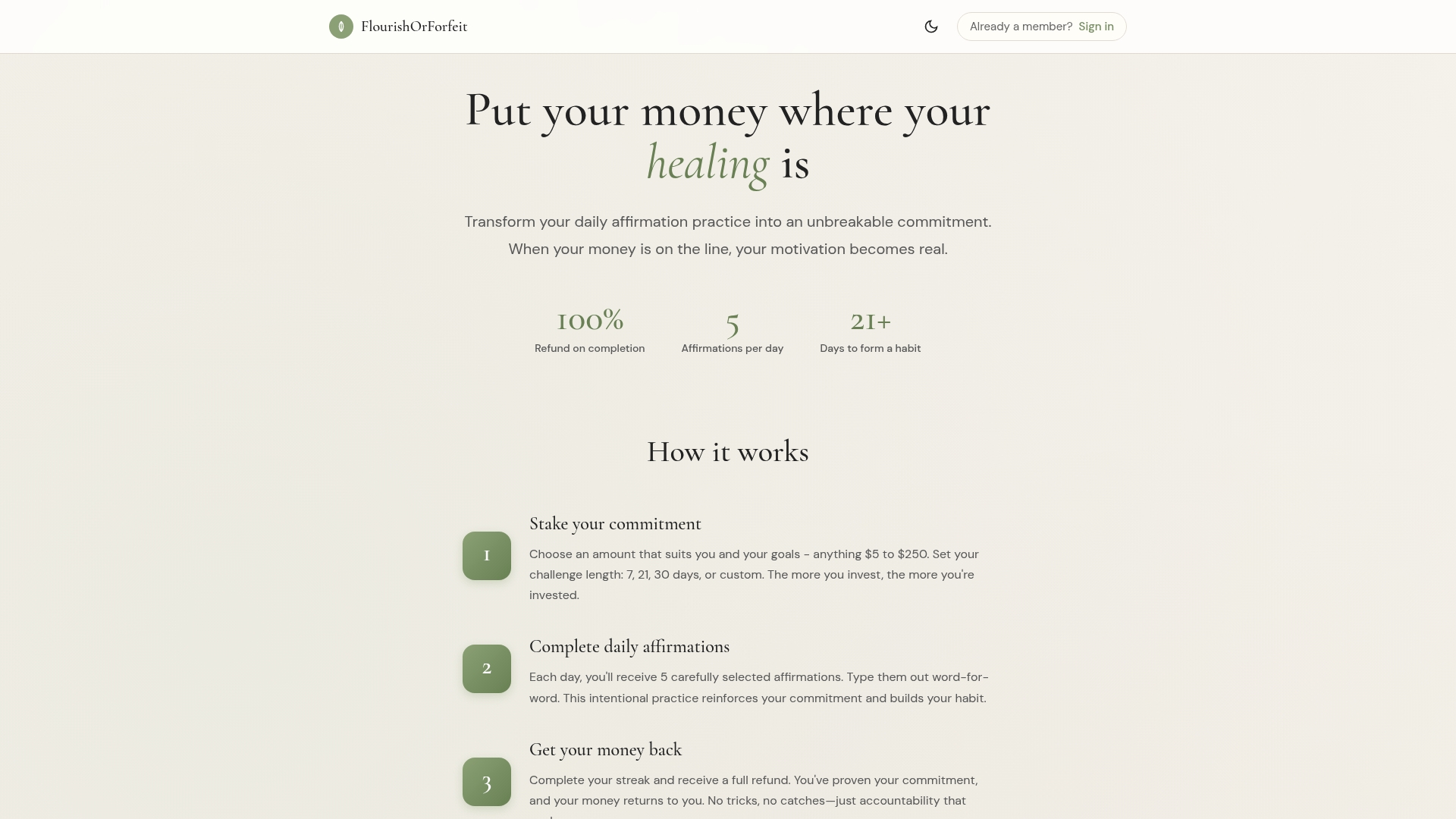
FlourishOrForfeit lets you choose a stake between $5 and $250 and a challenge length of 7, 21, or 30 days. The mechanics are built around active participation: you type five curated affirmations word-for-word each day, and that submission is what gets logged and verified.
On FlourishOrForfeit, a full refund is issued only when the entire challenge is completed. Missing a day without an available mulligan results in forfeiture of the stake, and mulligan options are typically tied to the longer 21 and 30 day challenges rather than the shortest 7 day option.
A few things worth knowing before you commit:
- Payments run through Stripe, so your stake and refund are processed through a payment system most people already trust from other services.
- Every submission is logged and timestamped, since typing the affirmation itself (rather than just tapping a checkbox) creates a verifiable record of daily completion.
- The 21 day option lines up with the widely cited research window for habit formation, which is part of why that length carries mulligan flexibility that the 7 day sprint does not.
- You get a receipt for every payment, so there is always a documented record if you ever need to reference your original stake amount or start date in a support request.
Where Consumer Protection Fits Into Skip Day Rules
Financial-stake challenges sit in a gray zone between a subscription service and a wager, and that matters for how you should think about your rights as a paying participant. A platform that takes your money and defines the conditions for forfeiture is, functionally, entering a contract with you the moment you pay your stake and agree to its terms.
That means the terms of service are not boilerplate you can skip. They are the actual document that determines whether a missed day is excusable, and vague or contradictory language in that document works against the platform in most consumer disputes, not the paying customer. If a platform's marketing promises "flexible skip days" but the fine print says otherwise, that gap is worth screenshotting before you pay, not after you miss a day.
Reputable platforms make their forfeiture and refund policy explicit and easy to find, rather than burying it in a long legal document you would need a lawyer to parse. Look for plain language describing exactly what counts as a missed day, exactly what a mulligan requires, and exactly how disputes get resolved. If a platform cannot answer "what happens if my phone dies at 11:58 PM" in a sentence or two, that is a signal worth taking seriously before you stake real money.
None of this replaces reading your specific agreement or, for larger stakes, getting independent advice about your rights as a consumer in your jurisdiction. But knowing that these policies function as binding terms, not just app copy, changes how carefully you should read them.
Common Misconceptions About the Skip Day Rule
"A missed day always means an automatic refund of a partial amount." Almost never true. Most platforms operate on a binary: full refund on completion, full forfeiture on failure, with no partial payout in between unless the terms explicitly say otherwise.
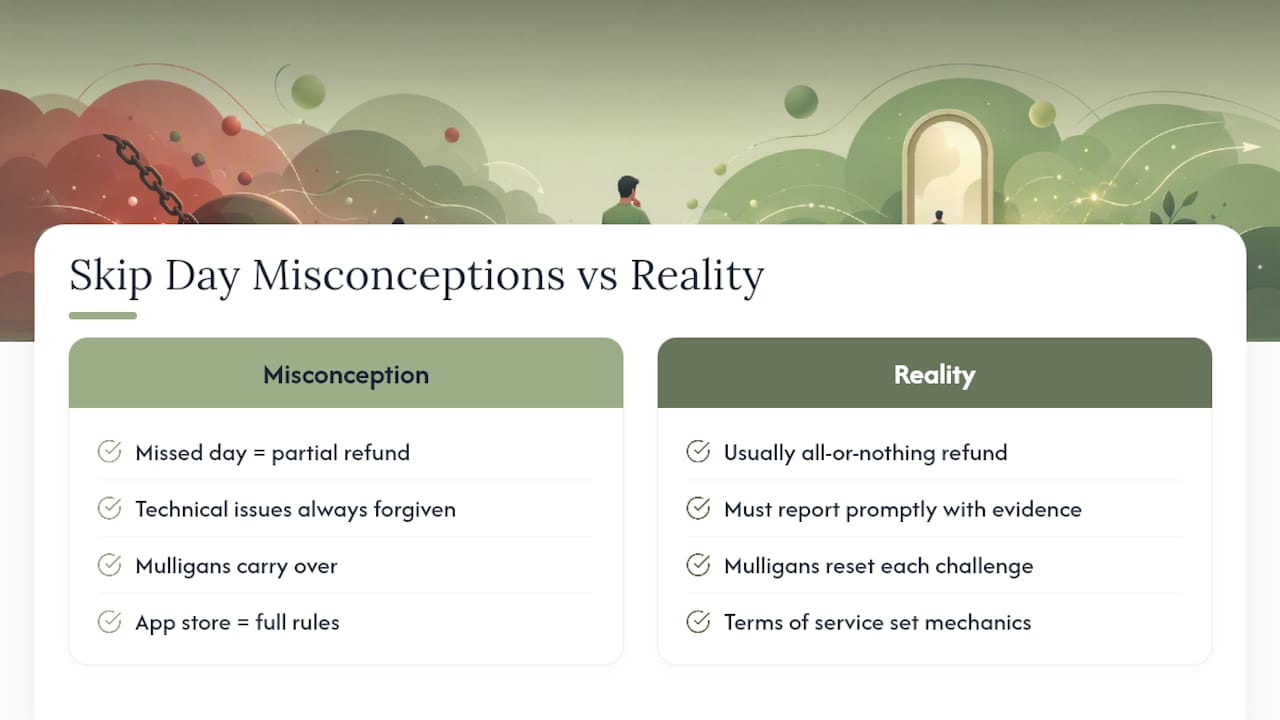
"Technical issues are always forgiven." Not automatically. Most platforms require you to report the issue within a specific window and provide evidence. Silence is read as a missed day, not as an implied excuse.
"Mulligans roll over between challenges." They typically do not. A mulligan tied to a 21 day challenge does not carry into your next challenge; it resets when the challenge ends, whether you used it or not.
"Reading the app store description is the same as reading the rules." It is not. Marketing copy describes the concept; the terms of service describe the actual mechanics, including deadlines and evidence requirements. Always check both.
"If I complete 20 out of 21 days, I get most of my money back." This misunderstands the entire model. The financial stake works precisely because completion is all or nothing. Partial credit would remove the loss aversion that makes these challenges effective in the first place.
"Support will always side with the user." Support teams follow the written policy. A well-documented, promptly filed request has a real chance of success; a vague message sent a week late usually does not.
Why the Rules Are Strict, and Why That Is the Point
Strict skip rules exist because loss aversion is the entire mechanism at work here. Soften the penalty and you soften the motivation. Platforms that keep forfeited stakes tend to see better completion rates than those with lenient exits, which tells you the firmness itself is doing behavioral work, not just protecting revenue.
That said, accidents happen. Phones die, apps crash, timezones confuse a deadline. A fair policy should let you appeal a genuine technical failure while still holding the line on plain forgetfulness. Act fast, save your evidence, and use the support channel the way it is designed to be used.
Get the Full Rules Before You Stake Your Money
The single best move you can make before staking a dollar on any affirmation challenge is reading the skip and mulligan clause in full, not skimming it. FlourishOrForfeit publishes its refund and forfeiture terms in plain language on its own site, so you know exactly what a missed day costs before you ever type your first affirmation.
Before you start a challenge, run through a short checklist: turn on SMS notifications, read the exact mulligan wording for your chosen length (7, 21, or 30 days), and line up at least one accountability partner who knows your schedule. If you already missed a day mid challenge, do not wait. Visit the FlourishOrForfeit dashboard, check your mulligan status, and open a support request the same day, since the evidence and timing you provide now determine whether your stake is recoverable.
Frequently Asked Questions
Does one missed day always mean I lose my stake? On most platforms, yes, unless a mulligan, grace period, or documented technical exception applies. Check your specific terms before assuming either way.
Can I get a partial refund if I complete most of the challenge? Typically no. Most stake-based challenges operate on full completion or full forfeiture, with no partial payout structure.
How long do I have to request a mulligan after missing a day? This varies by platform, but windows of 24 to 72 hours are common. Check your dashboard immediately if you miss a day.
Do mulligans carry over to my next challenge? No. Mulligans are almost always scoped to a single challenge and reset once that challenge ends.
What counts as proof that I completed a day? Timestamped submissions, SMS delivery receipts, and app-generated logs are the strongest forms of evidence, especially on platforms that require active, typed input rather than a simple checkbox.