

A small, affordable money-backed commitment is the fastest way to build reliable daily self-discipline with money. Here's what that looks like in practice: pick one daily task simple enough to finish in under two minutes, attach a stake you'd actually miss if you lost it, and set up a way to verify you did it. Do these three things:
- Choose a single measurable task (no vague goals like "be better with money")
- Pick a stake between $5 and $50 that stings but doesn't hurt
- Set up automated verification or a referee so cheating isn't an option
Large-scale platform data on nearly 76,000 posted goals found that stakes, recipient choice, and social accountability predict success more than almost any other factor. Losing money you already committed activates loss aversion, a stronger motivator than the promise of a future reward. Platforms like FlourishOrForfeit build this exact mechanism into a structured daily challenge.
Key Takeaways
Money-backed commitment contracts work because they convert an abstract future goal into an immediate, verifiable financial stake that loss aversion won't let you ignore.
| Point | Details |
|---|---|
| Stakes beat willpower alone | A financial stake creates immediate consequences that motivation and good intentions can't reliably match. |
| Verification is non-negotiable | Referees, SMS check-ins, or logged proof close the loophole that lets self-reported goals quietly fail. |
| Recipient choice changes outcomes | Anti-charity forfeiture tends to produce stronger adherence than pledges to a friend or charity. |
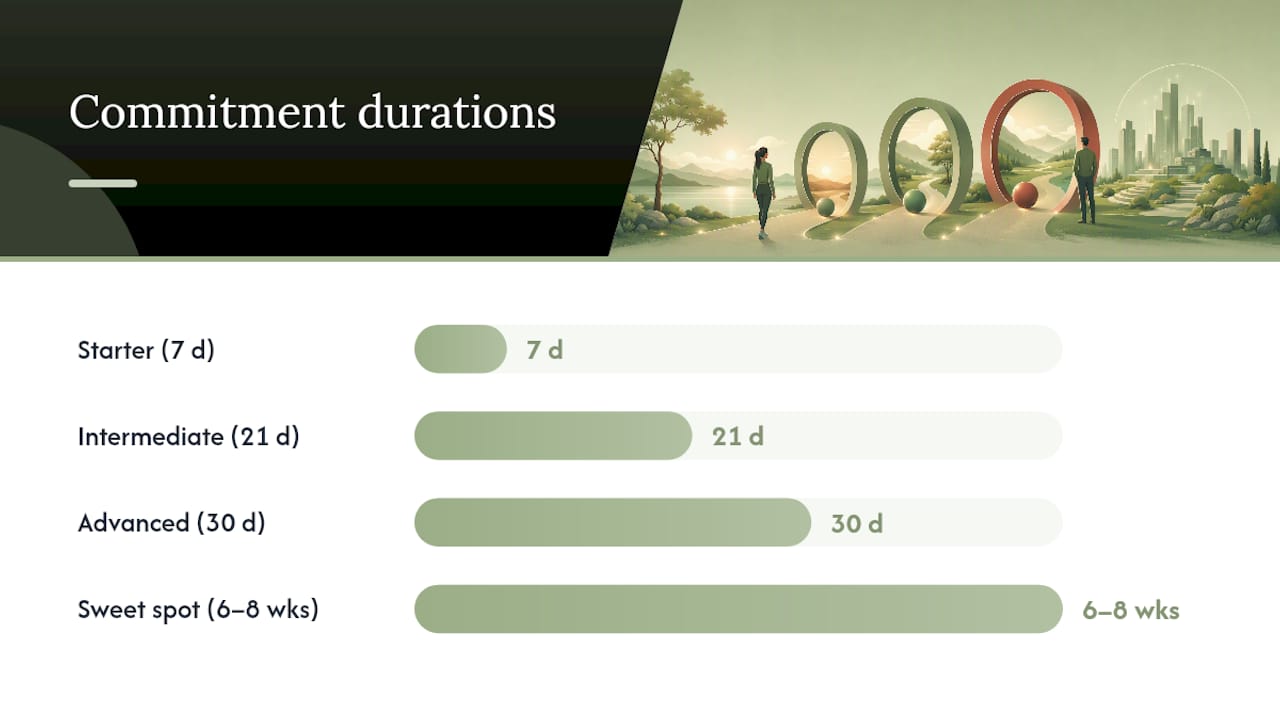
| Six to eight weeks is the sweet spot | Long enough to build a habit, short enough to avoid the fatigue that kills open-ended commitments. |
| FlourishOrForfeit applies these principles directly | Stakes from $5 to $250, 7 to 30 day challenges, SMS verification, and full refunds on completion put the research into a ready-to-use format. |
Table of Contents
- How Money-Backed Commitments Build Self-Discipline With Money
- What Do Randomized Trials Say About Commitment Devices?
- How to Design Your Own Money-Backed Commitment
- Common Mistakes That Sink Commitment Contracts
- Your 7-Day Plan to Start Building Self-Discipline With Money
- Why the Money Matters More Than the Motivation
- How FlourishOrForfeit Puts This Research Into Practice
- Sources
How Money-Backed Commitments Build Self-Discipline With Money
A stake changes the math on procrastination. Instead of weighing a small, unpleasant task today against a fuzzy long-term benefit, you're weighing it against an immediate, concrete loss. That reframing is the entire trick behind commitment contracts as a behavior-change tool, and it works because of three overlapping mechanisms:
- Time-inconsistency: your present self wants comfort; your future self wants results. A stake forces the present self to act like the future self actually cares.
- Loss aversion: losing $20 feels worse than gaining $20 feels good, so the threat of forfeiture outweighs the effort of doing the task.
- Choice architecture: once money is on the line, skipping the task is no longer the default, easy choice. It becomes a decision you have to actively justify.
Verification tightens the loop. A referee, a supporter who gets notified, or an automated check-in removes the option to quietly let it slide. Research on real-world commitment platforms shows social accountability features like referees and supporters amplify the deterrent effect of stakes, often more than raising the dollar amount would.
Pro Tip: Keep the task boringly simple and objectively verifiable. "Type today's affirmation" is easy to check. "Feel more confident" is not, and vague goals are where most commitment contracts quietly fail.

Daily reporting windows beat weekly ones for early habit formation. A week of silence gives your brain room to rationalize a lapse; a daily check-in doesn't.
What Do Randomized Trials Say About Commitment Devices?
The research on money-backed commitments is more encouraging than most behavior-change interventions, though results vary by design. A few findings stand out.
- A Swedish field experiment found hard, self-funded contracts increased monthly gym visits by about 21% relative to a control group, while soft contracts only produced around an 8% gain. The money has to actually be at risk for the effect to show up.
- An employer-sponsored study found that offering a self-funded contract after a temporary incentive period led participants to place a median stake of $58, with meaningfully better long-run attendance among those who committed.
- A separate trial testing flexible versus routine incentive windows found that flexible schedules sometimes generated more activity during the intervention and stronger persistence afterward, though the advantage depended heavily on context.
- Default nudges matter more than people expect. Experiments show that simply suggesting a longer contract duration shifts what people choose, without reducing how many people sign up in the first place.
Platform-scale data adds a sharper edge: an analysis of real-world habit-tracking commitments found that only about 29% of posted goals had a stake attached at all, but those with stakes were substantially more likely to survive to completion. The same analysis found anti-charity recipients (where forfeited money goes somewhere the person actively dislikes) produced stronger adherence than pledges made to a charity or a friend.
That recipient effect is worth sitting with. Losing money to a cause you support still feels like a loss, but losing it to something you'd rather not fund at all removes any silver lining. It's a small design choice with an outsized behavioral consequence, and it's part of why platforms lean toward forfeiture models instead of charitable pledges.
How to Design Your Own Money-Backed Commitment
Building a contract that actually works isn't complicated, but skipping a step is usually why people quit by day four. Work through this in order:
- Define one measurable daily task. Not "improve mindset," but "type five affirmations before 9 a.m."
- Set your reporting frequency. Daily beats weekly for new habits; the feedback loop needs to be tight.
- Choose your stake size and recipient. More on this below.
- Set your duration. Six to eight weeks is the sweet spot for early habit formation, long enough to build momentum without inviting fatigue.
- Lock in verification. A referee, SMS check-in, or automated log, not the honor system.
- Decide your mulligan rules. One skip day per week, or none at all if you want maximum pressure.
Three starter configurations to steal:
- Starter: $5 to $15 stake, 7-day challenge, self-verified with a daily app check-in. Good for testing whether the mechanism motivates you at all.
- Intermediate: $25 to $50 stake, 21-day challenge, weekly reporting to a friend acting as referee. This matches the classic window for early habit consolidation.
- Advanced: $75 to $250 stake, 30-day challenge with an anti-charity recipient and social sharing turned on. Built for people who've tried lower stakes and coasted through them anyway.
Pro Tip: Set your stake at the "affordability threshold," the amount that would genuinely annoy you to lose, not the amount that would derail your budget. A stake too small won't beat inertia; a stake too large invites anxiety instead of discipline.
Anti-charity recipients work best when you've already tried a friend or charity option and found the guilt too easy to shrug off. And favor 6 to 8 week windows over open-ended ones. Longer contracts without a defined end tend to lose their psychological grip well before they lose their financial one.
Common Mistakes That Sink Commitment Contracts
Most failed commitment contracts fail for the same handful of reasons, not because the underlying idea is flawed.
- Setting a stake so high it creates real financial strain instead of a manageable sting
- Writing a goal too vague to verify ("be more disciplined") instead of a concrete daily action
- Choosing an open-ended duration with no natural endpoint or review date
- Skipping verification entirely and relying on self-report alone
- Betting everything on the money and ignoring social accountability as a second layer
A quick safeguard checklist keeps the design honest: cap your stake at something you could lose without hardship, use automated or escrow-style payment handling instead of an informal IOU, require a verifiable log (photo, SMS, typed text) rather than a self-check, and agree on refund and dispute rules before you start, not after a disagreement.
Pro Tip: If a platform or arrangement can't clearly explain how disputes get resolved before you commit money, that's a signal to renegotiate the terms, not a detail to sort out later.
One more note worth stating plainly: commitment devices should never target people in genuine financial hardship or be used in a way that resembles gambling rather than habit-building. The stake exists to focus attention, not to create risk.
Your 7-Day Plan to Start Building Self-Discipline With Money
Treat the first week as a test run, not a life overhaul.
- Day 1: Pick your single daily task and write it down in one sentence.
- Day 2: Set your stake (start small: $5 to $15) and choose your recipient.
- Day 3: Recruit a referee or set up automated verification.
- Days 4 to 6: Commit and report daily, same time each day.
- Day 7: Debrief. Did the stake change your behavior? Adjust the amount or duration for round two.
Use this template to invite a referee: "I'm running a 7-day challenge and staking money on finishing it. Can you check in with me daily and call me out if I miss a day?"
If you skipped fewer than two days, raise the stake or extend the duration next round. If you skipped more, the task was probably still too vague or the stake too low to matter.
Why the Money Matters More Than the Motivation
Most advice about building better habits leans on motivation, willpower, or "finding your why." The evidence on commitment contracts suggests that's backwards. Motivation is unreliable by design. It fluctuates with sleep, stress, and how your day went. Money doesn't fluctuate. A stake sits there, indifferent to your mood, which is exactly why it works when willpower alone doesn't.
What surprises people most isn't the discipline itself. It's how quickly a small daily win, five typed affirmations, a completed check-in, starts to feel like proof rather than a chore.
How FlourishOrForfeit Puts This Research Into Practice
Everything covered above, the stake, the verification, the recipient choice, the defined duration, maps directly onto how FlourishOrForfeit is built. You choose a stake between $5 and $250, commit to a 7, 21, or 30-day challenge (landing right in the window researchers associate with strong habit formation), and type five affirmations daily under SMS verification and dashboard tracking.
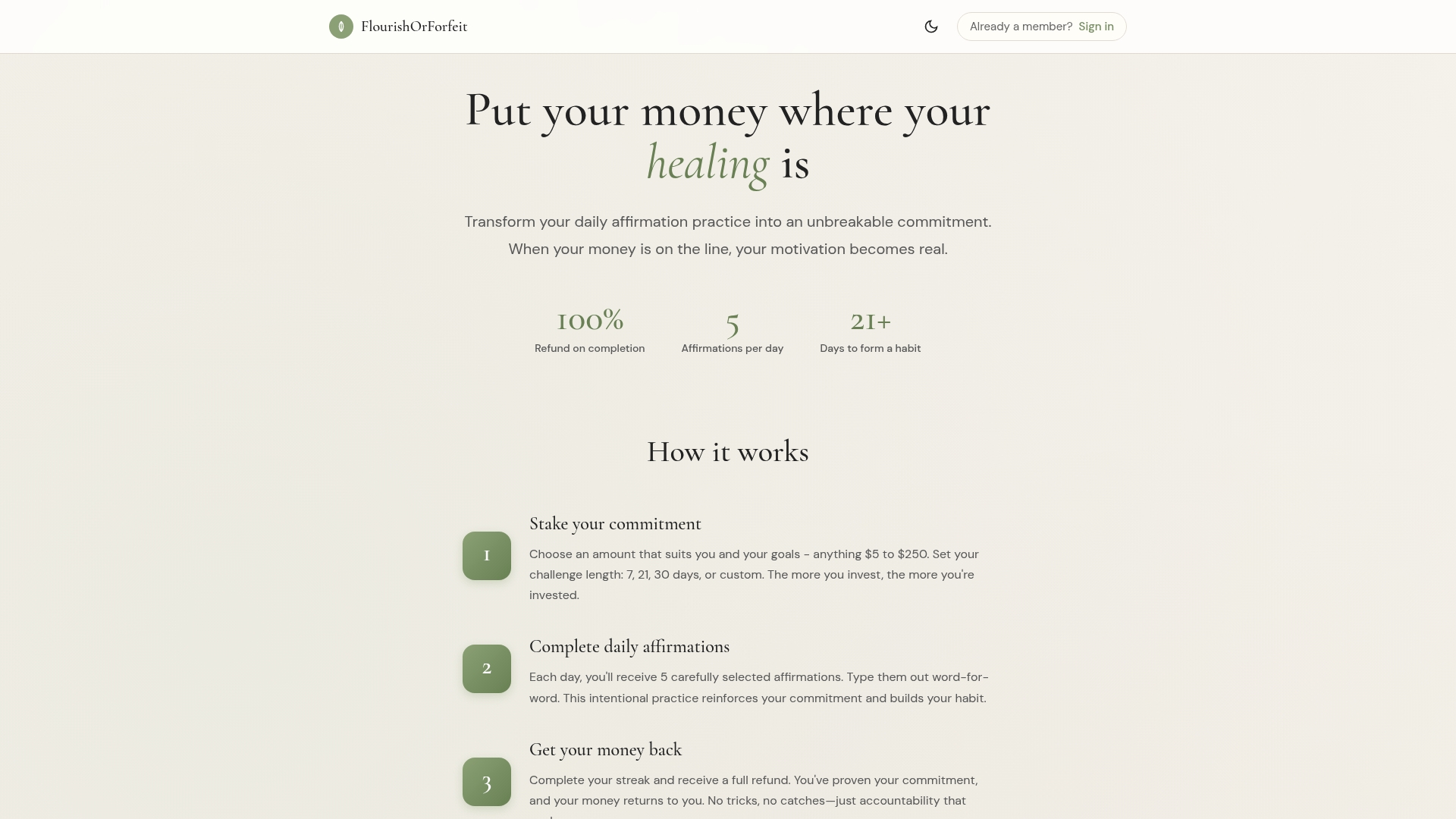
Complete the challenge and your stake is fully refunded. Miss too many days and it's forfeited, the same forfeiture mechanism that field experiments tie to stronger follow-through than soft, no-stakes pledges. Mulligans are built in for longer challenges, so one bad day doesn't sink a 30-day streak. If you want a ready-built version of everything this article just walked through instead of assembling your own spreadsheet and referee system, start a challenge on FlourishOrForfeit and pick your stake today.
Sources
- Commitment contracts as a way to health - PMC
- Sticky Goals: Understanding Goal Commitments for Behavioral Changes in the Wild
- Self-funded commitment contracts after temporary incentives (NBER w18580)
- Put a bet on it: Can self-funded commitment contracts curb fitness procrastination? (Journal of Health Economics, 2024)