

Daily affirmations work. Not because of wishful thinking, but because repeating personally meaningful statements about your values activates specific brain circuits tied to reward, self-processing, and behavior change. The science of daily affirmations draws on decades of psychological theory and, more recently, neuroimaging research that shows exactly which brain regions light up when you affirm your core values.
Here is the short version: when you engage in a genuine self-affirmation, your brain's valuation and self-processing systems respond in measurable ways, reducing defensiveness and opening you up to change. That is not a metaphor. It shows up on fMRI scans.
- Self-affirmations are brief, personally meaningful statements that reflect your core values or strengths.
- They work by protecting your global sense of self-worth when it comes under threat.
- Psychologist Claude Steele developed self-affirmation theory in 1988, establishing the foundational framework still used in research today.
- fMRI studies confirm activation in the VMPFC (ventromedial prefrontal cortex) and ventral striatum during affirmation tasks.
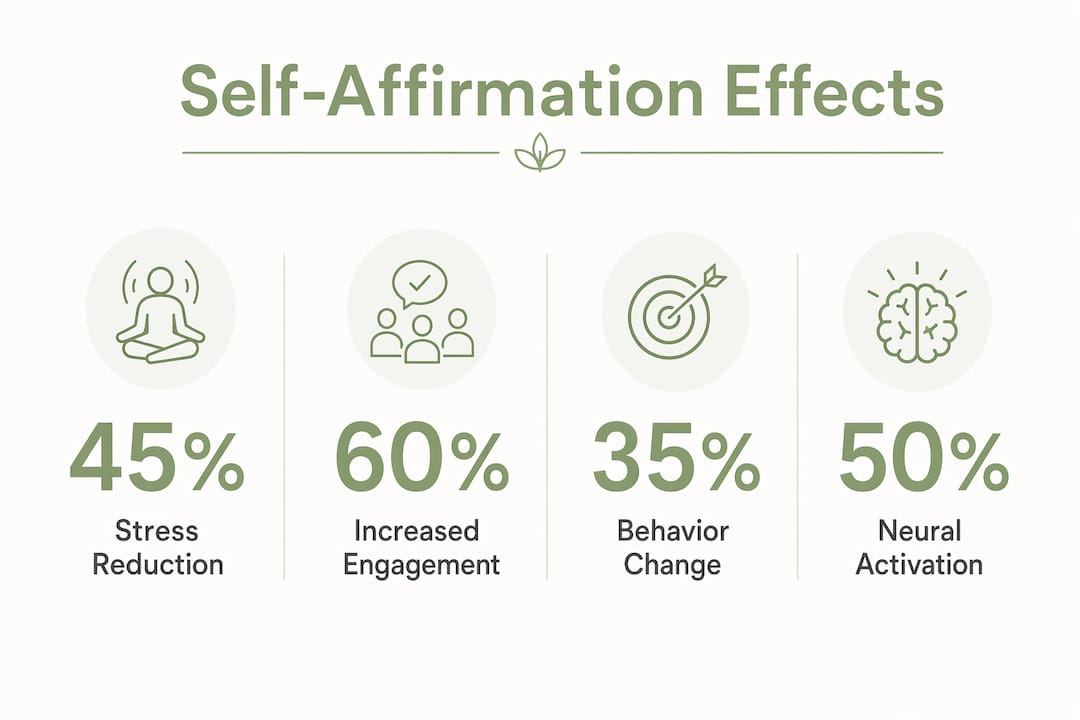
- Research links affirmation practice to improved academic outcomes, healthier behaviors, and reduced stress responses.
How does the science of daily affirmations actually work?
The psychological engine behind affirmations is Claude Steele's self-affirmation theory, published in 1988. Steele proposed that people are motivated not to be perfect in any one area, but to maintain a global narrative of themselves as morally and adaptively adequate. When something threatens that narrative, whether it is a failure, criticism, or stressful situation, the self-system looks for ways to restore its sense of integrity.
That is where affirmations come in. Reflecting on a value that genuinely matters to you, say, your commitment to your family or your creativity, shores up your overall self-concept even when a specific part of it is under pressure. The threat loses its grip because your sense of self is no longer riding entirely on the outcome of that one situation.
Self-affirmation theory helps people uncouple their self-worth from specific threats by reinforcing broader personal values, which is what makes it genuinely useful rather than just feel-good. Steele's original experiments showed that people who affirmed an important value before encountering a threatening situation were less defensive, more open to difficult information, and more likely to change their behavior in adaptive ways.
The psychological foundations: self-affirmation theory and how it protects you
Steele's self-affirmation framework rests on a key insight: the self is a system, not a single point. Because identity is multidimensional, you can maintain an overall sense of worth by affirming a part of yourself that has nothing to do with the source of the threat.
A student struggling in a difficult course might feel inadequate academically. But if that student reflects on their close friendships or their artistic ability, the academic stress is less likely to damage their core self-concept. The affirmation does not fix the grade. It keeps the threat from spiraling into a global verdict about their worth.
Several psychological mechanisms explain how this plays out in practice:
- Reduced cognitive load. Threats consume mental resources through rumination and intrusive thoughts. Affirmations free up those resources, allowing more adaptive thinking.
- Less defensive processing. Affirmed individuals are more willing to accept threatening health information and act on it, rather than dismissing it to protect their ego.
- Broader self-perspective. Affirmations shift attention from a narrow, threat-focused view of the self to a wider view that includes strengths, values, and relationships.
- Dissonance reduction. Steele's early research showed that affirming a valued self-concept can reduce the psychological discomfort of cognitive dissonance, even without resolving the original inconsistency.
The practical implication is that affirmations reduce defensiveness and allow people to engage more honestly with difficult information, which is the opposite of the "toxic positivity" critique often leveled at the practice.
What brain imaging reveals about affirmations
The neuroscience of self-affirmation moved from theoretical to concrete once researchers started putting people in fMRI scanners. The findings are specific enough to be worth knowing in detail.

A landmark study published in Social Cognitive and Affective Neuroscience examined neural activity during a self-affirmation task designed for fMRI. Participants who affirmed their values showed increased VMPFC and ventral striatum activity compared to control participants, and this effect was driven specifically by future-oriented affirmations rather than past-oriented ones.
Critically, that neural activity predicted real behavior change. Participants whose brains showed stronger affirmation-related activation subsequently reduced their sedentary behavior following a physical activity intervention. The brain response was not just a correlate. It was a predictor.
| Brain region | Primary function | Role during affirmation |
|---|---|---|
| Ventromedial prefrontal cortex (VMPFC) | Positive valuation, reward processing | Activated during value reflection; core affirmation pathway |
| Ventral striatum (VS) | Reward, motivation | Increased activity during future-oriented affirmations |
| Medial prefrontal cortex (MPFC) | Self-related processing, self-insight | Active when reflecting on personal values and future goals |
| Posterior cingulate cortex (PCC) | Self-referential thought, memory | Engaged during future-oriented self-affirmation tasks |
| Ventrolateral prefrontal cortex (VLPFC) | Emotion regulation | Primed by affirmations to manage emotional responses to threat |
| Anterior cingulate cortex (ACC) | Conflict monitoring, emotion regulation | Supports adaptive coping during threatening situations |
One important limitation: most fMRI affirmation studies use small samples, and the field has not yet established whether these neural effects persist over months of daily practice. The behavioral predictions are promising, but the long-term neural picture is still being mapped.
What the research actually says about effectiveness
The honest answer on effectiveness is: affirmations work, but not for everyone, not always, and not in isolation.
A 2025 meta-analysis reviewing 67 studies found modest improvements in self-perception and mental health from positive affirmation practices. The word "modest" is doing real work there. Affirmations are not a substitute for therapy, medication, or structural change. They are a psychological tool with a specific mechanism, and their effects depend heavily on how they are used and who is using them.
Key findings from the research base:
- Baseline self-esteem matters. People with higher self-esteem tend to benefit more from standard affirmation exercises. For people with low self-esteem, generic positive statements can actually worsen mood by highlighting the gap between the affirmation and their felt reality.
- Academic and health outcomes show real gains. Studies have documented improved grades, test scores, and academic motivation in students who completed values-affirmation exercises before threatening academic situations.
- Replication is inconsistent. A large-scale replication study found no significant effects of self-affirmation on GPA in middle school students, even in a setting where a prior study had shown positive results. The authors concluded that affirmation effects may be fragile when implemented broadly without careful attention to context and delivery.
- Health behavior change is documented. Affirmed individuals show greater acceptance of health-risk information and stronger intentions to change behavior, compared to non-affirmed controls.
The takeaway is not that affirmations are ineffective. It is that they are context-sensitive. Timing, framing, individual differences, and the presence of a genuine threat all shape whether an affirmation lands or falls flat.
How affirmations actually change your mindset and behavior day to day
Understanding the mechanism helps you use the practice more deliberately. Affirmations do not work by convincing you of something false. They work by shifting the psychological resources available to you when you face a challenge.
Here is what happens at the cognitive and neural level during a well-constructed affirmation:
- Cognitive load drops. Rumination and threat-monitoring consume working memory. Reflecting on a core value interrupts that cycle, freeing mental bandwidth for clearer thinking.
- Defensive bias decreases. When your self-worth feels secure, you are less likely to dismiss uncomfortable information. You can hear criticism, acknowledge a health risk, or sit with uncertainty without your ego needing to fight back.
- Self-concept broadens. Instead of evaluating yourself solely on the basis of one performance or one failure, you access a wider view of who you are. That broader perspective is what makes adaptive coping possible.
- Positive feedback loops form. When affirmations reduce defensiveness and you respond to a challenge more effectively, that success reinforces the value of the practice. The behavior and the belief begin to support each other.
- Future orientation amplifies the effect. fMRI data shows that affirmations focused on future-oriented values produce stronger activation in reward and self-processing regions than past-focused ones. Framing your affirmation toward who you are becoming, not just who you have been, appears to matter neurologically.
The critical variable is authenticity. Rote repetition of phrases that feel disconnected from your actual values produces weaker effects than genuine reflection on what matters to you. The brain responds to meaning, not to volume.
How to create affirmations that actually do something
Generic affirmations fail for a specific reason: they do not connect to anything real. "I am successful and confident" means nothing to your brain if it contradicts your current felt experience. The research points to a more grounded approach.
The most widely cited framework for constructing effective affirmations is the five P's:
- Positive. State what you are moving toward, not what you are avoiding. "I handle pressure with clarity" rather than "I am not anxious."
- Present tense. Frame the affirmation as a current truth or an ongoing practice, not a future hope.
- Personal. Ground it in your actual values. What do you genuinely care about? Start there.
- Powerful. Choose language that carries emotional weight for you specifically, not language that sounds impressive in general.
- Pointed. Keep it specific enough to be meaningful. Vague affirmations produce vague effects.
Timing also shapes effectiveness. Research suggests affirmations work best when used before a threatening or stressful situation, not after you are already deep in defensive mode. Morning practice, before the day's pressures accumulate, gives the affirmation room to set the psychological tone.
Pro Tip: If a positive affirmation feels hollow or even irritating when you say it, that is data. Try a compassion-centered reframe instead: "I am doing my best with what I have right now." Research shows this approach tends to work better for people who struggle with low self-esteem, because it acknowledges difficulty rather than papering over it.

The values-affirmation format used in most research studies asks you to write briefly about why a chosen value is meaningful to you. That writing component, not just the statement, appears to deepen the effect by forcing genuine reflection rather than passive repetition.
How Flourishorforfeit uses financial stakes to make affirmations stick
Knowing the science is one thing. Showing up every day is another. This is where most affirmation practices quietly collapse. The research on habit formation is clear that consistency over several weeks is what produces lasting psychological and neural change, and consistency requires more than good intentions.
Flourishorforfeit addresses this directly through a financial commitment model. You choose a stake between $5 and $250, select a challenge duration of 7, 21, or 30 days, and then type five curated affirmations word-for-word each day. Complete the challenge and you get a full refund. Miss a day and you forfeit your stake.
"A financial commitment approach can support sustained habit development by increasing accountability and motivation for daily affirmation practice." — Flourishorforfeit, financial stake habit model
The psychological rationale is grounded in loss aversion, one of the most replicated findings in behavioral economics. People respond more strongly to the prospect of losing something they already have than to the prospect of gaining an equivalent reward. By putting real money on the line, Flourishorforfeit converts a vague intention into a concrete daily commitment with genuine consequences.
The platform's design reinforces this through several features:
- SMS verification confirms daily completion and keeps the practice from becoming passive.
- A personal dashboard tracks your streak and progress, making consistency visible.
- Secure Stripe-integrated payments handle stakes and refunds transparently.
- A mulligan option on longer challenges gives you one grace day without losing your stake.
The 21-day challenge duration maps directly onto research suggesting that most people begin to notice mindset shifts after roughly 3–4 weeks of steady practice. The 30-day option extends that window for people who want to consolidate the habit further.

Flourishorforfeit does not replace the psychological work of genuine self-reflection. It creates the structural conditions that make that work happen consistently, which is exactly what the science says is needed for affirmations to produce lasting change.
Do the benefits of daily affirmations last?
Short-term studies show clear effects. The longer-term picture is more nuanced, and the research is honest about that.
The psychological benefits of affirmations are context-dependent and can be fragile when the practice is implemented without attention to individual fit and broader adaptive strategy. A single affirmation session before a stressful event can reduce defensiveness in the moment. But sustained benefits, the kind that show up as durable changes in self-concept, stress resilience, and behavior, require consistent practice embedded in a wider approach to personal growth.
What the research does support is that people who naturally tend to self-affirm when facing threats, what researchers call "spontaneous self-affirmation," show consistently higher levels of both hedonic and eudaimonic well-being across multiple studies. This suggests that the habit of returning to your values under pressure is itself a meaningful predictor of long-term psychological health, not just a short-term coping tool.
For affirmation benefits to hold over time, three conditions tend to matter. The practice needs to stay connected to values that are genuinely meaningful to you, not recycled phrases that have lost their weight. It needs to be paired with real behavioral effort, because affirmations open the door to change but do not walk through it for you. And it needs to be consistent enough for the neural and psychological patterns to consolidate, which is why the 21-to-30-day window appears repeatedly in both habit research and affirmation studies.
The honest ceiling on what daily affirmations can do is this: they are a powerful psychological tool for maintaining self-integrity, reducing defensiveness, and supporting behavior change. They are not a substitute for therapy, medical care, or the hard work of actually changing your circumstances. Used well, within a broader commitment to growth, the evidence suggests their benefits can extend well beyond the moment of practice.
Key Takeaways
Daily affirmations produce measurable psychological and neural effects when grounded in genuine personal values and practiced consistently over several weeks.
| Point | Details |
|---|---|
| Brain activation is specific | fMRI studies show increased VMPFC and ventral striatum activity during value-based affirmations, especially future-oriented ones. |
| Claude Steele's theory explains the mechanism | Self-affirmation protects global self-worth by reinforcing core values, uncoupling identity from specific threats. |
| Effects are real but context-dependent | A 2025 meta-analysis of 67 studies found modest improvements; effectiveness varies by individual and delivery method. |
| Generic affirmations can backfire | For people with low self-esteem, compassionate self-talk often works better than forced positive statements. |
| Consistency over weeks is required | Most people notice mindset shifts after roughly 3–4 weeks of steady daily practice; financial accountability can support that consistency. |