

Choose a refundable model when you need fairness, automated verification, and a clear refund path. Choose a self-refundable model when you want maximum loss-aversion pressure and are comfortable managing your own accountability.
Refundable: A platform or escrow holds your stake and returns it automatically once objective verification confirms you completed the challenge. You never have to ask for your money back.
Self-refundable: You retain control of the funds. Forfeiture depends on social pressure, moral commitment, or a manual transfer to a third party you dislike. The loss is real only if you enforce it on yourself.
Three factors drive the decision:
- Who controls the funds — platform-held stakes remove the option to quietly back out; self-held stakes leave that door open.
- Behavioral pressure strength — platform-managed forfeiture creates a harder, more credible threat; self-managed forfeiture depends on your willingness to follow through.
- Emotional cost — refundable models feel fair and neutral; self-refundable models can carry shame or moral conflict that either motivates or drives avoidance.
Commitment devices with financial deposits consistently outperform reminder-only approaches in smoking cessation, weight loss, and exercise adherence.
Table of Contents
- How do refundable and self-refundable stake models actually work?
- Why these models change your behavior differently
- Side-by-side comparison: pros, cons, and trade-offs
- How to pick the right model for your next challenge
- When a platform-managed refundable model is the better choice
- Legal and ethical considerations you should know
- How each model affects long-term engagement and habit formation
- Strategies to maximize your success probability
- Common disputes and how each model handles them
- Key Takeaways
- The model you pick is a bet on your own self-knowledge
- Flourishorforfeit puts your stake where your goals are
- Useful sources and further reading
How do refundable and self-refundable stake models actually work?
In a refundable model, a platform collects your stake upfront via a secure payment processor (typically Stripe, which is PCI-compliant). Funds sit in the platform's account. When you complete the challenge, the system verifies completion automatically using objective criteria — typed affirmations, check-ins, photo uploads — and triggers a refund without you filing a claim. If you miss a day, the stake is forfeited. Refund timelines typically follow standard bank processing (3–7 business days after verification).
In a self-refundable model, you keep the money. The commitment is social or moral: you tell friends, post publicly, or pledge to donate to a cause you oppose if you fail. The behavioral pressure exists, but so does the exit. Nobody forces the transfer if you quietly give up.

| Dimension | Refundable model | Self-refundable model |
|---|---|---|
| Who holds funds | Platform / escrow | Participant |
| What triggers return | Automated objective verification | Self-report or social enforcement |
| Forfeiture mechanism | Automatic on missed task | Manual transfer or social shame |
| Refund timeline | a few business days after verification | Immediate (funds never left) |
| Verification type | Objective, real-time | Confession-based or honor system |
Why these models change your behavior differently
The core mechanism is loss aversion: the pain of losing money you have already deposited is roughly twice as powerful as the pleasure of an equivalent gain. Self-refundable designs leverage this by making the loss feel immediate and real the moment you stake the funds.
Secondary mechanisms matter too. Social accountability (telling others about your commitment) adds reputational stakes. Anti-charity pledges — promising to donate to a cause you actively dislike if you fail — amplify the aversion further. Verification timing is also critical: real-time enforcement keeps the behavior-consequence link sharp, while end-of-period reviews let that link fade.
Statistic callout: Meta-analytic evidence and practitioner reports show commitment devices with financial deposits produce meaningfully higher success rates than reminders alone across habit domains including exercise, diet, and smoking cessation.
Pro Tip: Pick a stake that would "slightly ruin your week" if lost. Token amounts function as theater. An amount that genuinely stings creates the discomfort that drives follow-through, without being so large that you avoid signing up at all.
Side-by-side comparison: pros, cons, and trade-offs
| Dimension | Refundable model | Self-refundable model |
|---|---|---|
| Who holds funds | Platform (third party) | Participant |
| Motivation strength | High — credible, external threat | Variable — depends on self-discipline |
| Perceived fairness | High — business-neutral, no shame | Lower — relies on personal integrity |
| Emotional cost | Low — no admission of failure required | Higher — shame, moral conflict possible |
| Verification method | Automated, objective | Confession-based or social |
| Refund trigger | Objective completion criteria | Self-report or peer enforcement |
| Typical stake range | a moderate amount suitable for short to month-long challenges | Flexible, user-defined |
| Best use case | Discrete verifiable tasks, first-time challengers | High self-discipline users, social accountability seekers |
Confession-based refund policies shift emotional labor onto the participant and are widely considered an unfair practice. Automated, objective verification removes that burden entirely.
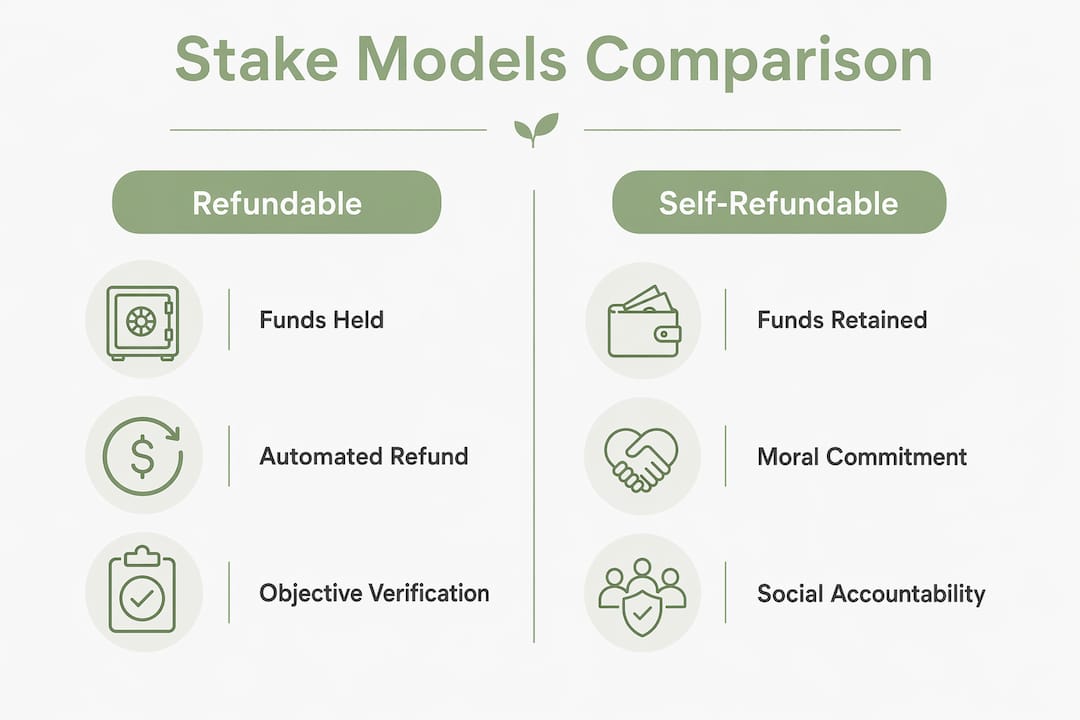
Trust signals to look for in any platform: automated verification with no "admit failure" requirement, transparent refund timelines, Stripe or equivalent PCI-compliant payments, and clearly stated stake ranges and challenge durations.
How to pick the right model for your next challenge
Start with four profile questions: How much do you trust yourself to enforce a self-imposed penalty? Do you need the money back if you succeed? How sensitive are you to public shame? Do you prefer automatic or manual verification?
Checklist:
- Challenge length: 7-day sprints suit self-refundable; 21- or 30-day habits benefit from platform-managed accountability.
- Daily friction: High-friction tasks (typing exact affirmations, photo check-ins) need objective verification to avoid disputes.
- Stake size: Meaningful but not catastrophic. Enough to sting, not enough to paralyze.
- Verification preference: If you want zero subjectivity, choose a platform with automated checks.
- Refund timeline tolerance: Platform refunds take 3–7 business days; self-refundable returns are instant.
- Platform trust signals: Clear refund windows and drip-fed content reduce fraudulent claims and protect genuine participants.
Red flags to avoid: confession-based refund requirements, opaque or negotiable terms, unverifiable tasks, stakes so low they feel trivial, and stakes so high they trigger avoidance.
Pro Tip: For discrete, verifiable tasks like daily affirmations, per-task evidence (typed text, check-in confirmation) is the most defensible verification method. Continuous behaviors like screen time need real-time monitoring or daily caps — otherwise delayed feedback weakens the behavior-consequence link.
When a platform-managed refundable model is the better choice
Platform-managed refundable stakes are the stronger option when you value fairness, want zero ambiguity about what triggers your refund, and prefer not to rely on willpower alone to enforce forfeiture.
Flourishorforfeit is built around exactly this model. Here is what that means in practice:
- Automated objective verification: You type five curated affirmations word-for-word each day. The system confirms completion without requiring you to self-report success or failure.
- Transparent refund terms: Complete the 7, 21, or 30-day challenge and your full stake ($5–$250) is returned automatically.
- Secure payments: Stripe integration with PCI compliance handles all transactions.
- Dashboard and SMS verification: Real-time tracking keeps the behavior-consequence link active throughout the challenge.
- Mulligan provision: Longer challenges include a mulligan, reducing the all-or-nothing pressure that can cause early abandonment.
"Operational best practices for fair refundable platforms: automated verification, transparent refund timelines, secure Stripe integration, and no requirement for customers to 'admit' failure." — Practitioner guidance on ethical refund design
Refunds are triggered the moment the system confirms challenge completion. No claim required, no negotiation.
Legal and ethical considerations you should know
In the United States, stake-based commitment platforms operate in a legal gray area that depends heavily on how funds are structured. A platform that holds user funds and returns them on completion is generally operating a conditional payment arrangement, not a gambling product, provided the outcome is within the participant's control. Self-refundable models carry less regulatory exposure because the platform never holds the funds.
Ethically, the refund trigger matters most. Requiring a participant to declare failure to receive a refund is considered coercive by many practitioners and can expose a platform to reputational and legal risk. Automated, objective verification sidesteps this entirely. Participants should always read the terms before staking: confirm what counts as completion, what triggers forfeiture, and where forfeited funds go.
How each model affects long-term engagement and habit formation
Research on habit formation suggests 21 days as a commonly cited threshold for establishing a new behavior pattern. Platform-managed refundable models tend to sustain engagement longer because the financial incentive (getting your money back) remains active throughout the challenge, not just at the start.
Commitment devices with external enforcement consistently outperform self-managed pledges over multi-week periods.
Refundable models also reduce the shame spiral that can follow a missed day. Because the consequence is financial and automatic rather than social and public, participants are more likely to restart after a setback rather than abandon the challenge entirely.
Strategies to maximize your success probability
Under a refundable model:
- Set your stake at the upper end of your comfort zone, not the minimum.
- Use the dashboard daily, not just on days you feel motivated.
- Treat the refund as a bonus, not the goal — the habit is the goal.
Under a self-refundable model:
- Make the pledge public and specific: name the anti-charity, the amount, and the deadline.
- Appoint an accountability partner with actual authority to enforce the transfer.
- Pre-commit the verification method before you start — photo, check-in, or timestamped log — so there is no room for self-negotiation later.
Both models benefit from matching stake size to challenge difficulty. A 30-day challenge warrants a larger stake than a 7-day sprint simply because the opportunity cost of failure is higher.
Common disputes and how each model handles them
The most frequent dispute in refundable models is a participant claiming completion that the system did not record. Automated, objective verification resolves this cleanly: either the task was logged or it was not. Clear disqualifiers and shorter refund windows further reduce the surface area for disagreement.
Self-refundable models generate a different kind of dispute: the participant and their accountability partner disagree on whether a task was completed. Without objective criteria, these disputes are resolved by social negotiation, which often ends in the participant keeping the money regardless of actual performance.
Platforms that remove negotiation from the refund process protect both parties. The participant knows exactly what they owe; the platform knows exactly what it owes back.
Key Takeaways
Refundable models with automated, objective verification produce fairer outcomes and stronger long-term engagement than self-managed pledge systems that rely on confession or social enforcement.
| Point | Details |
|---|---|
| Model selection | Choose refundable for fairness and automation; choose self-refundable for maximum loss-aversion pressure with high self-discipline. |
| Behavioral mechanism | Loss aversion makes deposited stakes roughly twice as motivating as equivalent promised gains. |
| Verification matters | Automated, objective verification eliminates confession-based emotional labor and reduces disputes. |
| Stake sizing | Set your stake at an amount that would "slightly ruin your week" if lost — enough to sting, not enough to cause avoidance. |
| Flourishorforfeit | Offers a platform-managed refundable model with automated verification, Stripe payments, and stakes from $5–$250 across 7, 21, or 30-day challenges. |
The model you pick is a bet on your own self-knowledge
Most people default to self-refundable arrangements because they feel lower-risk. No platform, no fees, no one holding your money. But that framing gets the psychology exactly backward. The credibility of the threat is what drives behavior, and a threat you control is the weakest kind.
The edge cases worth thinking through: if you are in a financially tight period, a refundable model with a modest stake ($10–$25) gives you real skin in the game without catastrophic downside. If you have intermittent availability — travel, irregular schedules — look for a platform that builds in a mulligan rather than an all-or-nothing forfeiture. The goal is sustained pressure, not a single high-stakes moment that collapses the moment life gets complicated.
One micro-rule that holds across both models: never set a stake you would be relieved to lose. If losing the money feels like a reasonable exit from the commitment, the stake is too low.
Flourishorforfeit puts your stake where your goals are
If you want the refundable model done right — automated verification, no confession required, full refund on completion — Flourishorforfeit is built for exactly that. You stake $5 to $250, pick a 7, 21, or 30-day affirmation challenge, and type five curated affirmations daily. The system tracks every entry. Complete the challenge and your money comes back automatically via Stripe. Miss a day and the stake is forfeited, funding the platform's operations transparently.

No ambiguity about what counts as completion. No negotiating your refund. Just a clear, financially-backed commitment to a habit that matters to you. Start your challenge and put real stakes behind your next 21 days.
Useful sources and further reading
The claims in this guide draw on behavioral finance research and practitioner commentary on commitment devices, refund ethics, and habit formation. The table below lists the primary sources.
| Source | Focus |
|---|---|
| Commitment Devices: A Complete Guide for Behaviour Change | Loss aversion, stake sizing, verification cadence, real-time enforcement |
| Self-Control and Commitment Devices in Money Behavior | Fairness perceptions, anti-charity dynamics, empirical effectiveness of commitment contracts |
| Offering a Refund, Only If You Admit You Didn't Get Value, Is Not Generosity | Ethical refund design, confession-based policies, automated verification best practices |
| Refunds, Defaults & the Reality of Running a Business with Boundaries | Refund window design, dispute reduction, operational best practices for platform operators |