

If you want a stake-backed daily-affirmation platform right now, Flourishorforfeit is the strongest pick. It requires you to type five curated affirmations word-for-word each day, stakes range from a few to several hundred dollars, and you get a full refund when you complete the challenge. SMS verification and Stripe payments handle the accountability layer. No vague honor system.
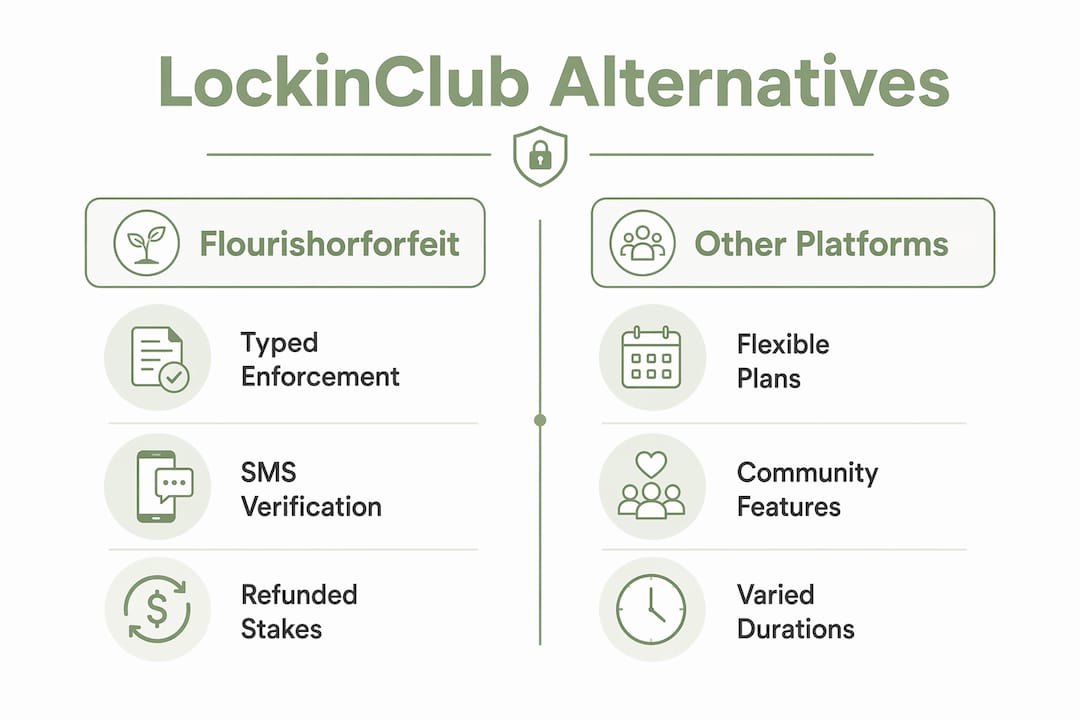
For context, commitment contracts with self-funded stakes produce persistent behavior change that incentives alone cannot. Research on a large sample of users found that commitments lasting 6–8 weeks paired with external accountability and weekly reporting show the highest success rates. Flourishorforfeit's shorter durations (7, 21, or 30 days) help introduce the habit, but research indicates that a 6–8-week commitment produces the best results.
Quick shortlist of alternative categories to consider:
- Affirmation-specialized stake platforms — daily typing enforcement, refund-on-success model (Flourishorforfeit fits here)
- General deposit-contract platforms — flexible goal types, user-set stakes, external referee options
- Automated metric trackers with stakes — syncs to wearables or apps, verifies by data rather than manual entry
Table of Contents
- What do the best LockinClub alternatives look like side by side?
- How do you pick the right alternative for your affirmation habit?
- What does the research say about which configurations actually work?
- What does each alternative category actually offer in practice?
- Why Flourishorforfeit is the recommended pick for affirmation stakes
- How accessible is Flourishorforfeit across devices?
- What happens when something goes wrong with your challenge?
- Key Takeaways
- A note on perspective
- Ready to put money behind your affirmations?
- Sources and further reading
What do the best LockinClub alternatives look like side by side?
| Dimension | Affirmation-specialized stake platforms | General deposit-contract platforms | Automated metric trackers with stakes | Coach/referee-managed contracts |
|---|---|---|---|---|
| What you stake | $5–$250 | Varies; user-set | Varies; user-set | Varies; often higher minimums |
| Refund vs. forfeiture | Full refund on completion; forfeiture on miss | Partial or full refund; charity/anti-charity forfeiture | Refund on verified goal; forfeiture on miss | Negotiated; coach may hold funds |
| Durations offered | 7, 21, or 30 days | Flexible; days to months | Flexible; often weekly cycles | Custom; typically 4–12 weeks |
| Enforcement/verification | Word-for-word typing + SMS verification | External referee or self-report | Automatic data sync (wearable, app API) | Coach review; weekly check-ins |
| Best use-case | Daily affirmations, mindset habits | Broad goals (fitness, diet, study) | Metric-driven goals (steps, weight, sleep) | Long-term lifestyle or coaching clients |
| Platforms | Web | Web, iOS, Android | Web, iOS, Android | Web or direct communication |
| Fees/pricing model | Forfeited stake goes to platform | Forfeited stake to charity or anti-charity | Subscription or forfeited stake | Coach fee plus optional stake |
Affirmation-specialized platforms
- Typing enforcement makes passive skipping impossible
- Refund-on-success removes the "lottery" feel
- Limited to affirmation-style habits; not suited for metric tracking
General deposit-contract platforms
- Flexible enough for almost any goal
- Anti-charity forfeiture (donating to a cause you dislike) adds psychological pressure
- Verification relies heavily on self-report or a referee you recruit yourself
Automated metric trackers with stakes
- Removes human error from verification entirely
- Requires a compatible device or app; setup friction is real
- Works poorly for habits that have no measurable data output, like affirmations
Coach/referee-managed contracts
- Highest accountability ceiling when the coach is engaged
- Cost is the barrier; ongoing coach fees add up fast
- Success depends entirely on the quality of the individual coach
How do you pick the right alternative for your affirmation habit?
Choose by enforcement model first: typing-and-verification beats self-report for affirmation habits because it removes the temptation to click "done" without actually doing the work.
Decision checklist:
- Define the habit and how you'll measure it. Affirmations are text-based, so a platform that requires active typed input fits better than one that logs a checkbox.
- Choose your stake size and refund rule. Pick an amount that stings if lost but doesn't destabilize your budget. Confirm whether forfeited funds go to the platform, a charity, or an anti-charity.
- Pick a commitment duration. A 7-day trial tests fit; commitments lasting 6–8 weeks with external accountability show the highest success rates in research.
- Choose your verification method. SMS or timestamped entry beats a pure honor system for daily habits.
- Confirm payment security and dispute path. Stripe integration and a written refund policy are the minimum bar.
- Start short, then scale. A 7-day trial before committing to a 30-day stake is a low-risk way to test the platform and your own consistency.
Questions to ask any platform before you commit:
- How exactly is daily compliance verified?
- Who receives forfeited funds, and is that disclosed upfront?
- What is the refund policy, and is there a mulligan for longer challenges?
- Are payments processed through a recognized processor like Stripe?
- What happens if there's a technical error on the platform's side?
- How do I contact support if a completed day isn't logged?
- Can I pause or cancel, and what are the conditions?
- Is my payment data stored securely?
Four red flags that should disqualify a platform:
- No clear explanation of how compliance is verified
- Vague or absent refund/forfeiture rules
- Opaque fee structure (hidden charges beyond the stated stake)
- No accessible customer support channel
What does the research say about which configurations actually work?
The highest-performing configuration is a self-funded deposit paired with external accountability and a commitment of 6–8 weeks. That combination outperforms incentives alone, and the effects tend to persist after the commitment ends.
Research highlight: An analysis of a large sample of users and 397,456 commitments found that commitments lasting 6–8 weeks with weekly reporting and an external referee are strongly associated with higher success rates in habit-building attempts.
Self-funded deposit contracts outperform pure incentive programs because loss aversion kicks in: you're protecting money you already put up, not chasing a reward. That psychological difference is measurable. Financial incentives alone tend to produce short-term gains that fade after the incentive is removed, which is exactly why the structure around the stake matters as much as the stake itself.
Longer-duration contracts around 20 weeks correlate with higher re-enrollment and ongoing accountability cycles. For daily affirmations specifically, that suggests starting with a 7 or 21-day trial, then scaling toward a 6–8 week commitment once the habit feels natural. Weekly self-check-ins and an optional referee add the social layer that sustained behavior change research consistently identifies as necessary alongside financial stakes.

What does each alternative category actually offer in practice?
Affirmation-specialized stake platforms (e.g., Flourishorforfeit)
- Stakes from $5 to $250; full refund on completion
- Verification via word-for-word typed affirmations and SMS confirmation
- Durations: 7, 21, or 30 days; mulligan available on longer challenges
- Best for: daily mindset work, affirmation-based habit building
General deposit-contract platforms
- User-sets stake amount and goal; referee is self-recruited
- Forfeiture often goes to a charity or anti-charity of your choice
- Flexible durations; most support multi-week to multi-month windows
- Best for: fitness, diet, study goals with measurable milestones
Automated metric trackers with stakes
- Syncs to wearables (Fitbit, Apple Watch, Garmin) or health apps
- Verification is automatic; no manual entry required
- Stake and duration vary by platform; often subscription-based
- Best for: step counts, sleep targets, workout frequency
Coach/referee-managed contracts
- Coach holds accountability; weekly video or written check-ins
- Stakes can be held by the coach or a third-party escrow
- Durations typically 4–12 weeks; highly customizable
- Best for: complex lifestyle goals, clients who need human feedback
Why Flourishorforfeit is the recommended pick for affirmation stakes
Flourishorforfeit matches affirmation-specific needs better than general deposit-contract or metric-tracking alternatives because the verification model is built for text-based habits. You type five curated affirmations word-for-word each day. That active input requirement, combined with SMS verification, makes passive non-compliance impossible.
Feature highlights mapped to research-backed practices:
- Challenge durations (7/21/30 days) align with the short-trial-to-habit window the research supports
- Full refund on completion preserves the loss-aversion dynamic without punishing success
- Mulligan rule on longer challenges reduces abandonment for honest slip-ups while keeping the financial pressure intact
- Stripe-integrated payments mean your card data is handled by a PCI-compliant processor, not stored on a proprietary system
- SMS verification adds the lightweight external accountability layer that research links to higher completion rates
Disclosure: This article is published by Flourishorforfeit. The recommendations reflect both the platform's design and the independent research cited throughout.
How accessible is Flourishorforfeit across devices?
Flourishorforfeit runs as a web-based platform, accessible from any modern browser on desktop, tablet, or mobile. There is no dedicated iOS or Android app required; the mobile browser experience handles daily affirmation entry without friction. For users who prefer native apps, general deposit-contract platforms and automated metric trackers typically offer iOS and Android apps with push notification reminders. If daily mobile notifications are a priority for your habit stack, factor that into your platform choice. Flourishorforfeit's web-first design keeps onboarding simple: no app store download, no device permissions, just a browser and your commitment.
What happens when something goes wrong with your challenge?
Flourishorforfeit handles disputes through direct customer support, with Stripe's payment infrastructure providing an additional layer of transaction security and recourse. If a completed day isn't logged correctly, contacting support with your SMS verification timestamp is the fastest resolution path. For general deposit-contract platforms, dispute resolution typically runs through the platform's referee system; if your referee marks a day incorrectly, most platforms have an appeal window. Automated trackers resolve disputes by pulling raw device data, which removes human judgment from the equation but requires you to trust the sync. The clearest sign of a trustworthy platform in any category is a written dispute policy you can read before you pay.
Key Takeaways
Flourishorforfeit is the strongest lockinclub alternative for daily-affirmation stakes because it pairs word-for-word typing enforcement with a full refund on success, Stripe payments, and SMS verification built specifically for text-based habits.
| Point | Details |
|---|---|
| Top pick for affirmations | Flourishorforfeit combines typed enforcement, SMS verification, and a refund-on-success model purpose-built for daily affirmations. |
| Best research-backed configuration | Self-funded deposit + external accountability + 6–8 week commitment produces the highest success rates per analysis of a large sample of users. |
| Start with a short trial | A 7-day challenge tests platform fit before you scale toward a 6–8 week (42–56 day) commitment. |
| Red flags to avoid | No verification method, unclear refund rules, opaque fees, and absent customer support should disqualify any platform. |
| Flourishorforfeit stake range | Stakes range from a few to several hundred dollars across 7, 21, or 30-day challenges, with a mulligan available on longer commitments. |
A note on perspective
Full disclosure: I'm affiliated with Flourishorforfeit, which means I have a stake in how this article lands. That said, every recommendation here maps directly to independent research on commitment contracts, deposit mechanics, and verification design. The guidance is useful whether you choose Flourishorforfeit or a different category entirely.
This article is written for affirmation-focused habit builders in the U.S. who want financial skin in the game, not just a tracking app. If that's you, the research and the platform features point in the same direction.
Ready to put money behind your affirmations?
Getting started with Flourishorforfeit takes about three minutes. Choose your affirmation pack, set your stake ($5–$250), pick a challenge length, and your first day begins immediately.
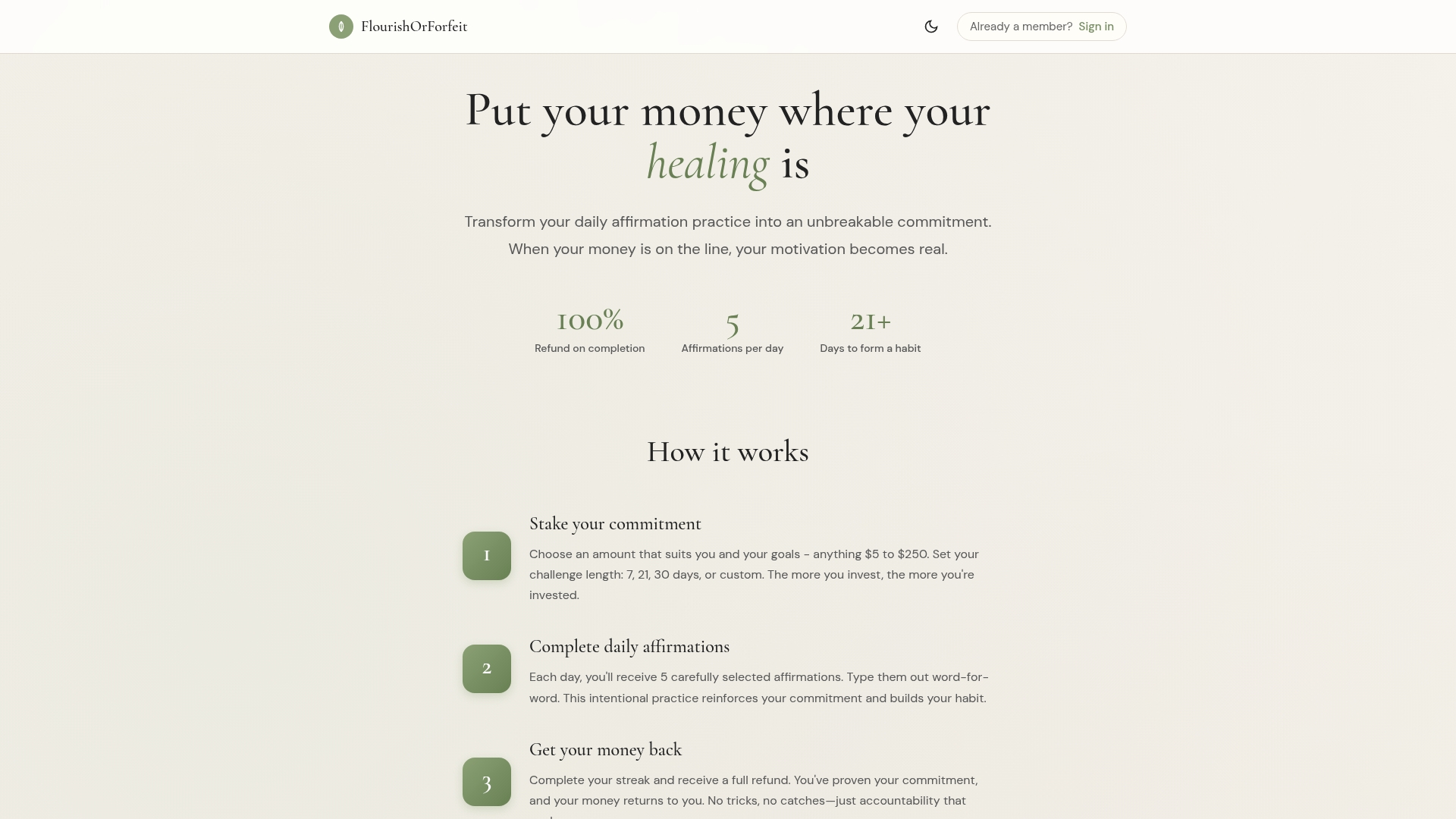
Onboarding steps:
- Create your account at flourishorforfeit.com
- Verify your phone number via SMS
- Choose your stake amount and challenge duration (7, 21, or 30 days)
- Type your five affirmations on Day 1 to lock in your commitment
Payments run through Stripe, and your stake is fully refunded when you complete the challenge. If you're ready to turn daily affirmations into a financially backed habit, start your challenge today.
Sources and further reading
| Source | What it shows |
|---|---|
| ICWSM habit-building dataset — a large sample of users | commitments lasting several weeks with weekly reporting and an external referee show the highest success rates; underpins duration and referee recommendations throughout. |
| NBER working paper on self-funded commitment contracts | Self-funded deposit contracts produce persistent behavior change detectable a year later; supports the case for stake-backed over incentive-only programs. |
| NBER revision — commitment contracts and incentives | Commitment contracts paired with incentives are more cost-effective and produce longer-lasting change than incentives alone. |
| NBER — nudges toward longer-duration contracts | Longer-duration contracts (~20 weeks) correlate with higher re-enrollment and sustained accountability cycles. |
| Winkler-Schor & Bräuer — multi-factor determinants of sustained behavior change | Money alone rarely sustains long-term change; social and recursive supports are necessary alongside financial stakes. |
| PMC — financial incentives for health behavior change (narrative review) | Incentives produce short-term gains; combining them with structural interventions improves outcomes. |