

Identity-based habits are behaviors you repeat to prove who you are, not to reach a destination. Instead of asking "what do I want?" you ask "who do I want to become?" and then act accordingly. Each repetition is a vote for that identity. Start right now with a Minimum Viable Action (MVA): pick one behavior so small it takes under 60 seconds, then do it once today.
Your three-step launch checklist:
- Identity: Write one sentence: "I am the type of person who ___."
- MVA: Choose the smallest possible version of that behavior (one push-up, one sentence, one deep breath).
- Cue/context: Attach it to something you already do daily (morning coffee, brushing your teeth, opening your laptop).
That is the whole engine. Everything below shows you how to run it.
Table of Contents
- Why identity-based habits actually stick
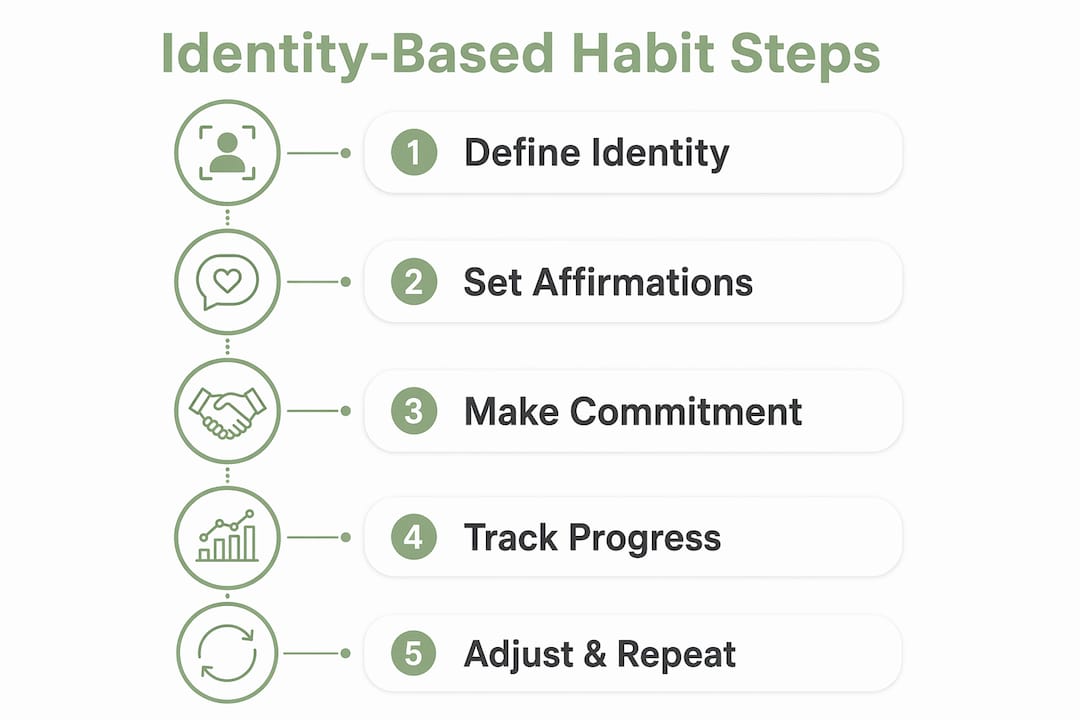
- How to build an identity-based habit step by step
- How to design a financially committed affirmation challenge around your identity
- Ready-to-copy identities, MVAs, and affirmation scripts
- How to know when your new identity is starting to stick
- Common mistakes and quick fixes
- Key Takeaways
- Why I think this combination works better than either approach alone
- Flourishorforfeit puts your identity on the line
- Useful sources
Why identity-based habits actually stick
Outcome-based goals give you a finish line. Identity-based habits give you a compass. The difference matters because finish lines disappear once you cross them, but a compass keeps pointing.
Behavioral research backs this up. A 12-week repeated-measures study found that identity alignment and automatic habit impulses work as complementary drivers, each reinforcing the other to sustain long-term behavior change. Identity predicted behavior at both within-person and between-person levels for physical activity, even after accounting for motivation and intention.
The practical implication: when motivation dips (and it always does), identity acts as a floor. You do not need to feel inspired to act like yourself. That is the buffer identity-based framing provides that pure outcome-chasing cannot.
How to build an identity-based habit step by step
The playbook is short. The discipline is in following it exactly.
- Define the target identity. Start with the outcome you want, then reverse-engineer the person who achieves it. Want to be fit? Write: "I am someone who moves every day." Want to write more? "I am a writer." Keep it one sentence.
- Choose your MVA. Make it laughably small. "Read one page." "Write one sentence." "Do one push-up." Practitioners consistently warn that MVAs set too large are the most common failure point. If you can refuse it on your worst day, it is too big.
- Select a cue. Attach the MVA to an existing anchor: after pouring your morning coffee, after sitting at your desk, after your alarm goes off. The cue removes the decision.
- Stack it. Once the first MVA is automatic (roughly one to two weeks), add a second behavior right after it. Keep each addition small.
- Repeat and track. Mark a yes/no in a simple log each day. You are not tracking performance; you are tracking votes for your identity.
- Scale deliberately. Only increase the MVA when skipping it feels strange, not when you feel motivated. Motivation is a bad signal for scaling; automaticity is the right one.
Pro Tip: Write your identity statement on a sticky note and put it where your cue happens. Seeing "I am a writer" next to your keyboard before you open a blank document cuts decision friction in half.
How to design a financially committed affirmation challenge around your identity

A financially committed challenge turns your identity votes into a contract. Here is how to map the playbook onto a structured challenge.
Affirmation templates that reinforce identity:
| Goal | Identity statement | Sample affirmation |
|---|---|---|
| Fitness | I am someone who moves daily | "I am a person who honors my body with movement every single day." |
| Writing | I am a writer | "I show up to write every day because that is who I am." |
| Focus | I am someone who protects deep work | "I guard my attention because focused work is my identity." |
| Calm | I am a calm, grounded person | "I choose calm responses because that reflects who I am." |
| Connection | I am someone who nurtures relationships | "I invest in the people I love because connection defines me." |
Stake sizing. Choose an amount that stings without being catastrophic. A small stake is easy to dismiss; a moderate stake on a short challenge creates real accountability without financial stress. For longer challenges, a larger range of stakes tends to create genuine investment. The Flourishorforfeit model runs $5–$250, so you can calibrate to your own threshold.
Challenge durations. Short-term to month-long challenge durations are commonly used benchmarks in habit programs, with shorter challenges serving as low-risk proofs of concept and longer ones supporting deeper identity integration and habit consolidation.
Daily check-in protocol. Type your affirmations word-for-word each day. Do not copy-paste. The act of typing forces active engagement with the language, which reinforces the identity claim at a cognitive level.
Pro Tip: Treat a missed day as data, not failure. Note what disrupted the cue, adjust it, and use any available mulligan before abandoning the challenge entirely.
Ready-to-copy identities, MVAs, and affirmation scripts
These five pairs are designed for the most common personal development goals. Copy them directly into your challenge log.
- Fitness: Identity: "I am someone who moves every day." MVA: One set of 10 bodyweight squats. Affirmation: "I am a person who moves daily because my health is non-negotiable."
- Writing: Identity: "I am a writer." MVA: Write one sentence in a document. Affirmation: "I write every day because that is the kind of person I am."
- Focus: Identity: "I am someone who does deep work." MVA: Work without a phone for five minutes. Affirmation: "I protect my attention because focused work is my identity."
- Social connection: Identity: "I am someone who nurtures relationships." MVA: Send one genuine message to a friend. Affirmation: "I invest in people I care about because connection is who I am."
- Calm: Identity: "I am a calm, grounded person." MVA: Take three slow breaths before responding to any stressor. Affirmation: "I choose calm because it reflects who I am at my core."
One-line daily checklist: "Did I cast at least one vote for my identity today? Yes / No."
How to know when your new identity is starting to stick
Three signals tell you the identity is integrating:
First, streak length matters less than automaticity. A 10-day streak where you still have to remind yourself is weaker than a 7-day streak where skipping feels genuinely odd. Watch for the moment the cue triggers the behavior before you consciously decide.
Second, decision friction drops. You stop negotiating with yourself. The habit–identity association strengthens when behaviors are explicitly linked to values, which is exactly what typed affirmations accomplish.
Third, self-identity check-in questions are useful weekly: "Did I act like the person I said I was this week?" A yes builds confidence; a no surfaces a specific gap to fix, not a reason to quit.
Repair protocol for a missed day: Do the MVA within 24 hours of the miss, even if it is out of sequence. One vote does not define the election. What matters is returning to the pattern immediately.
Common mistakes and quick fixes
- Identity mismatch: Your stated identity conflicts with your actual values. Fix: choose a behavior you genuinely want, not one you think you should want.
- MVA too large: You set "run 3 miles" as your daily minimum. Fix: cut it to "put on running shoes and walk to the end of the block."
- Unclear cue: The habit floats with no anchor. Fix: name the exact trigger ("after I pour my first coffee") before you start.
- Relying on motivation: You only act when you feel like it. Fix: treat the MVA as non-negotiable, like brushing your teeth, regardless of mood.
- Stakes too high: A $250 stake on your first challenge creates anxiety that undermines performance. Fix: start at $10–$25 and scale up after one successful completion.
- No verification: You track loosely and rationalize missed days. Fix: use a binary yes/no log with a timestamp; ambiguity is the enemy of streaks.
A note on punitive framing: Financial stakes work best when they feel like a commitment device, not a punishment. If a stake size is causing anxiety rather than motivation, lower it. The goal is accountability, not stress.
Key Takeaways
Identity-based habits outperform outcome-only goals because identity provides continuous internal fuel, not just a finish line to chase.
| Point | Details |
|---|---|
| Identity first, outcomes second | Define who you want to become before choosing any behavior. |
| MVA must be tiny | If you can refuse it on a bad day, it is too large; shrink it until it is impossible to skip. |
| Cue anchors the habit | Attach every MVA to an existing daily trigger to remove the decision. |
| Financial stakes sharpen commitment | A stake in the $10–$50 range creates real accountability without punitive pressure. |
| Flourishorforfeit operationalizes this | The platform maps directly to define-identity → MVA → repeat → track with typed affirmations and a refund-on-completion model. |
Why I think this combination works better than either approach alone
Most habit advice treats identity and accountability as separate tools. They are not. Identity tells you who to be; accountability makes it harder to pretend you already are.
What I find compelling about pairing identity-based habits with a financial commitment is that the stake does something motivation cannot: it makes the cost of inconsistency concrete and immediate. Motivation is a feeling. A forfeited $50 is a fact. When you type an affirmation word-for-word each day, you are not just repeating a phrase; you are actively rehearsing the self-concept you are trying to build. The financial layer removes the option to coast.
The pattern I see most often is someone who starts a 21-day challenge with a vague goal and finishes it with a specific identity. The challenge duration is not arbitrary; it is long enough for the behavior to stop feeling like effort and start feeling like character.
Flourishorforfeit puts your identity on the line
If you have read this far, you have the framework. What you need now is a structure that holds you to it.
Flourishorforfeit is built exactly for this: you choose a stake ($5–$250), pick a challenge duration (7, 21, or 30 days), and type five curated affirmations word-for-word each day. Complete every day and you get a full refund. Miss a day without using your mulligan and you forfeit the stake. There is no ambiguity, no self-reporting on the honor system, and no way to rationalize a skip.

The platform maps directly to the steps above: define your identity, write it into your affirmation, stake a real amount, and repeat daily. A 7-day challenge at $10 is a low-risk way to test whether financial commitment changes how seriously you take your identity votes. Start your first challenge and find out what a week of genuine accountability feels like.
Useful sources
- James Clear, Atomic Habits and Identity-Based Habits QuickStart — The foundational framework for identity-first habit design and the "votes for identity" model.
- PMC: The Influence of Identity Within-Person and Between Behaviours (12-week study) — Empirical evidence that identity and habit impulses work as complementary drivers of sustained behavior change.
- Frontiers in Psychology: Habit and Identity — Research showing that linking behaviors explicitly to values strengthens habit–identity associations.
- Encoded.ai: Identity-Based Habits Glossary — A clear applied summary of why identity-first framing outperforms outcome-only approaches for long-term adherence.
- Psychology Today: The Identity Hack to Behavioral Change — Practical application of reverse-engineering identity as a roadmap for daily behavior.