

Write short, present-tense "I" statements tied to a personal value, rate each one on a 1–10 believability scale, and practice daily. That's the core recipe. Everything else in this guide is about making those three steps work for your specific goals.
The minimum elements for an affirmation that sticks:
- First person: Start with "I" or "I am" so the statement is clearly about you.
- Present tense: Write as if the quality is already true, not something you're chasing.
- Believable stretch: Aim for a score of 6–8 on a 1–10 belief scale. Too low and your brain rejects it; too high and it's just a wish.
A quick example: instead of "Someday I'll be confident," write "I handle challenges with calm and focus." Then say it aloud each morning before you check your phone, write it in a journal at night, or set a phone reminder for a moment you usually feel stressed.
Key Takeaways
Writing affirmations that work comes down to one thing: a short, present-tense "I" statement tied to a personal value, rated 6–8 on a believability scale, and practiced daily with consistency.
| Point | Details |
|---|---|
| Use the core writing formula | Short, present-tense "I" statements, 5–12 words, tied to a personal value you already hold. |
| Run the belief check | Rate each affirmation 1–10; aim for 6–8. Below 6, shrink the claim or add a bridge phrase. |
| Practice daily, not intensely | Three to five repetitions per day, attached to an existing habit, beats sporadic long sessions. |
| Pair with action for faster results | Affirmations produce stronger behavior change when followed immediately by a relevant action. |
| Flourishorforfeit adds accountability | Stake $5–$250 on a 7, 21, or 30-day challenge; complete it for a full refund or forfeit for missed days. |
Table of Contents
- What are affirmations and what can they actually do for you?
- Why the science behind affirmations supports personalization
- What mistakes make affirmations feel useless?
- How to write affirmations step by step
- Affirmation examples organized by goal
- How to practice affirmations so they actually stick
- Three quick exercises to write your own affirmations right now
- Why do affirmations feel silly or stop working?
- Why starting small beats going all-in
- Flourishorforfeit turns your affirmation practice into a real commitment
- Sources
What are affirmations and what can they actually do for you?
Affirmations are short, deliberate statements you repeat to yourself to reinforce a belief, identity, or behavior you want to strengthen. They're not magic mantras. They work by directing your attention toward a chosen self-concept, which gradually shapes how you interpret situations and what actions feel available to you.
Population survey data from the HINTS study found that people who spontaneously self-affirm report higher levels of happiness and optimism than those who don't. That's a correlation, not a cause-and-effect proof, but it suggests the habit is worth building.
Practical benefits you can realistically expect:
- Stress buffering: Affirmations can reduce the psychological sting of criticism or setbacks by reminding you of a stable self-concept.
- Clearer goals: Writing an affirmation forces you to name what you actually want, which sharpens intention.
- Improved focus: Repeating a value-based statement before a task primes your attention toward behavior that aligns with it.
- Motivation to act: Research links repeated, personalized affirmations to reduced stress and improved motivation when integrated into a daily routine.
One honest limit: affirmations don't replace therapy, skill-building, or real-world action. They work best as a mindset primer, not a substitute for doing the work.
Why the science behind affirmations supports personalization
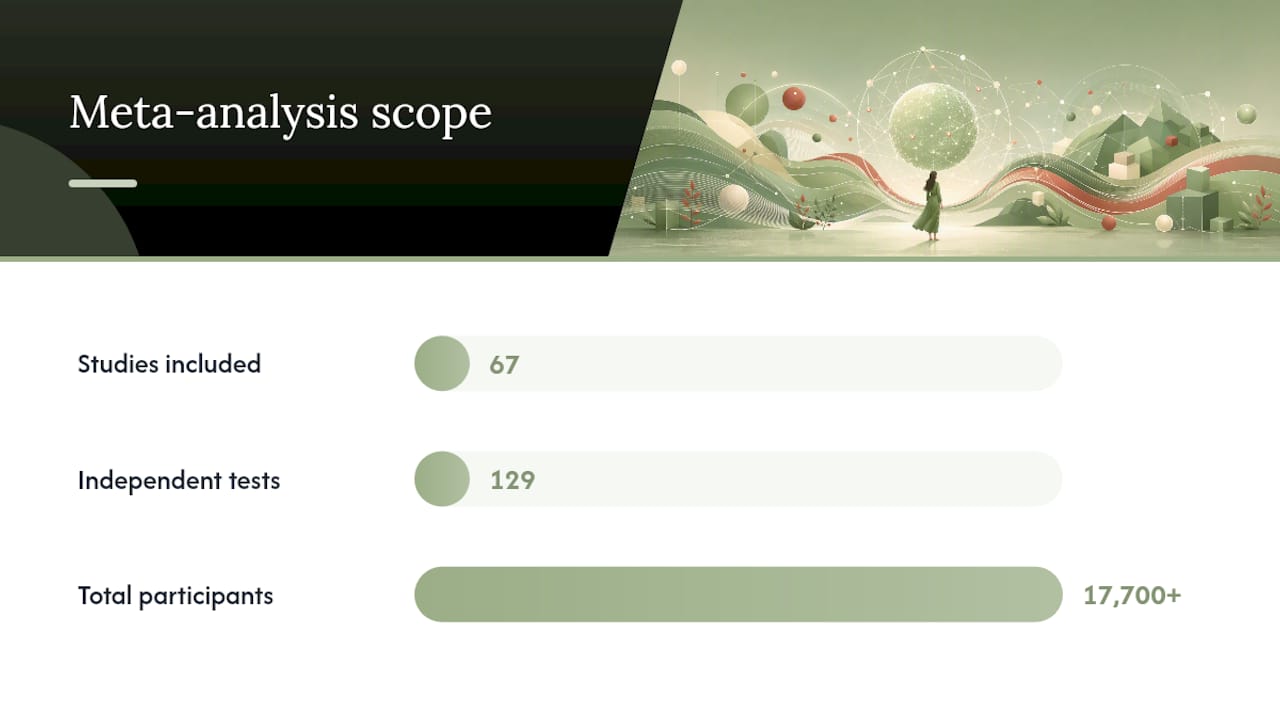
The evidence base is real, though modest. A meta-analysis of 67 studies pooling 129 independent tests and over 17,700 participants found that self-affirmation produces statistically significant improvements in well-being, self-perception, and reduced psychological barriers. Some follow-ups showed persistent behavior change, not just short-term mood shifts.
| Meta-analysis stat | Figure |
|---|---|
| Studies included | 67 |
| Independent tests | 129 |
| Total participants | 17,700+ |
| Effect type | Modest but statistically significant |
The neuroscience adds a useful layer. fMRI research shows that value-based affirmation tasks increase activity in the medial prefrontal cortex (MPFC) and ventromedial prefrontal regions, areas involved in self-related valuation. In plain terms: when you affirm something tied to a value you genuinely hold, your brain processes it differently than a generic positive statement. That's the core argument for personalization. "I am worthy" is weaker than "I show up for the people I love because family is my anchor."
Statistic callout: The meta-analysis covered more than 17,700 participants across 67 studies, making it one of the larger evidence pools for a behavioral psychology intervention of this type.
There's also a practical variation worth knowing: Self-Affirming Implementation Intentions, or S-AII. Instead of a standalone affirmation, you build an if-then plan: "If I feel anxious before a presentation, then I will remind myself that I prepare thoroughly and care about my audience." This format makes the affirming thought accessible exactly when you need it most, under stress, rather than only during calm morning routines.
What mistakes make affirmations feel useless?
Most affirmations fail before they're even practiced. The problem is usually in how they're written.
Common writing mistakes:
- Future tense: "I will be confident" keeps confidence permanently in the future. Flip it to present.
- Negative wording: "I don't let fear stop me" forces your brain to process "fear" and "stop." Rewrite as "I move forward even when I'm nervous."
- Overreaching claims: "I am the most successful person I know" scores a 2 on believability for most people. It triggers skepticism, not inspiration.
- Too long: A statement that runs three sentences is hard to recall under pressure. Keep it under 12 words.
- No personal value tie: Generic affirmations ("I am amazing") have no anchor. Tie the statement to something you actually care about.
The belief-check workflow
Rate every affirmation you write on a 1–10 scale: 1 means "I don't believe this at all," 10 means "This is already completely true." The sweet spot is 6–8: a believable stretch that feels possible without feeling like a lie.
If a score lands below 6, follow these three steps:
- Find the anchor. Ask yourself: "Is there any evidence, even small, that this is sometimes true?" Write one example down.
- Shrink the claim. Replace "I am fearless" with "I am learning to face discomfort one step at a time."
- Add a value frame. Connect it to something real: "Because I value growth, I take one uncomfortable action each week."
If a score lands at 9 or 10, the affirmation isn't doing much work. It's already a settled belief. Push it one notch further toward a goal you haven't fully reached yet.
Pro Tip: Swap "I am" for "I am becoming" or "I choose to" when a statement feels too far from your current reality. These bridge phrases lower the psychological resistance without weakening the direction.
How to write affirmations step by step
Follow this sequence once and you'll have 3–5 usable affirmations in under 15 minutes. The University of Wisconsin–Madison Health Services recommends keeping affirmations to roughly 5–12 words, starting with "I" or "I am," and grounding them in present tense.
- Pick a domain. Choose one area: confidence, anxiety, productivity, relationships, body image, studying, or abundance.
- Name the desired outcome. Write one sentence: "I want to feel calm when I'm criticized at work."
- Connect to a value. Ask: "Why does this matter to me?" (e.g., "Because I value doing good work and being respected.")
- Write the affirmation in present tense starting with "I" or "I am." Draft it in 5–12 words.
- Run the belief check. Score it 1–10. Revise if below 6.
- Shorten it. Cut any word that doesn't add meaning.
Fill-in-the-blank templates
Use these as starting points, then swap in your own values and specifics:
- Bridge style: "I am becoming someone who _____."
- Stretch style: "I _____ with confidence and purpose."
- Value-based: "Because _____ matters to me, I _____."
- Behavior-based: "I choose to _____ even when _____."
- Identity shift: "I am the kind of person who _____."
- Strength anchor: "I have already shown I can _____, and I bring that same strength to _____."
Six quick negative-to-positive conversions
| Negative thought | Affirmation |
|---|---|
| "I'm terrible at public speaking." | "I grow more confident every time I speak." |
| "I never finish what I start." | "I follow through on what matters to me." |
| "I'm not smart enough." | "I learn quickly and ask good questions." |
| "I'm always anxious." | "I breathe through discomfort and keep going." |
| "I don't deserve success." | "I create value and I receive it in return." |
| "My body isn't good enough." | "I treat my body with respect and gratitude." |
Pro Tip: Use active verbs ("I lead," "I create," "I choose") over state verbs ("I am," "I have") when you want an affirmation to drive behavior rather than reinforce identity. Both have a place, but action verbs tend to produce a stronger pull toward doing something.
Affirmation examples organized by goal
Each category below includes 6–8 starter lines you can personalize. For identity shifts (confidence, body image), value-based templates work best because they anchor the new belief to something already real. For behavior goals (productivity, studying), behavior-based or if-then formats tend to produce faster results.
To personalize any line: swap the generic value or action for one specific to your life. "I handle challenges well" becomes "I handle client feedback with patience because I care about my craft."
Confidence
- "I trust my judgment in difficult situations."
- "I am becoming more assured with every conversation."
- "I bring something real to every room I enter."
- "I speak up because my perspective has value."
- "I am comfortable being seen."
- "I recover quickly from setbacks."
Anxiety
- "I breathe through uncertainty and stay present."
- "I am safe right now, in this moment."
- "I have handled hard things before and I will again."
- "I choose calm over catastrophe."
- "My nervous system is learning to settle."
- "I release what I cannot control."
Productivity
- "I start before I feel ready."
- "I do the most important thing first."
- "I work with focus and finish what I begin."
- "I am someone who follows through."
- "I protect my time because my goals matter."
- "I take one clear step forward every day."
Relationships
- "I show up honestly in my relationships."
- "I attract people who respect and support me."
- "I communicate what I need with clarity and care."
- "I am a thoughtful and present partner/friend/parent."
- "I set boundaries because I value connection."
- "I give generously and receive gracefully."
Body image
- "I am grateful for what my body can do."
- "I treat myself with the same kindness I'd give a friend."
- "I am more than how I look on any given day."
- "I nourish my body because I respect it."
- "I am becoming more at peace with myself."
- "My worth is not determined by my appearance."
Studying and exams
- "I retain information when I focus with intention."
- "I am capable of understanding difficult material."
- "I prepare well and trust my preparation."
- "I stay calm and think clearly under pressure."
- "I am a disciplined and curious learner."
- "I improve with every study session."
Abundance
- "I create value and money flows toward that value."
- "I am open to opportunities I haven't seen yet."
- "I manage my resources with confidence and care."
- "I deserve to earn well for the work I do."
- "I am building financial security one decision at a time."
- "Abundance is available to me and I am ready for it."
How to practice affirmations so they actually stick
Writing good affirmations is half the job. The other half is building a practice consistent enough to shift how you think. Daily repetition matters more than exact counts, and consistency beats intensity every time.
Four routines that work in real life:
- Morning mirror work: Stand in front of a mirror and say your affirmations aloud before you leave the bathroom. The eye contact with yourself is uncomfortable at first, and that discomfort is the point. It forces genuine engagement rather than passive repetition.
- Evening journaling: Write each affirmation by hand once before bed. The physical act of writing slows you down enough to actually absorb the words. Three to five affirmations take under three minutes.
- Pre-event trigger: Pick a specific high-stress moment (before a meeting, a workout, a difficult conversation) and say one targeted affirmation right before it. This is where the S-AII format shines.
- Phone reminder: Set a recurring alarm at a time you're typically low-energy (mid-afternoon for most people). The notification text is the affirmation itself.
Using implementation intentions to make affirmations automatic
The if-then format removes the need to remember your affirmation in the moment. Three examples:
- "If I feel self-doubt before a presentation, then I will say: I prepare well and I trust what I know."
- "If I reach for my phone to scroll instead of work, then I will say: I choose focus because my goals are worth it."
- "If I feel anxious in a social situation, then I will say: I am enough exactly as I am right now."
Write your if-then plan on a sticky note or in your phone notes for the first two weeks. You're building a retrieval cue, not just a habit.
Frequency: A few repetitions daily is a reasonable starting point. A week or more of consistent practice helps build familiarity and can lead to noticeable shifts in self-talk over time. Track with a simple daily checkbox, a habit app, or a paper calendar.
Three quick exercises to write your own affirmations right now
These three exercises take 5–10 minutes each. Do them in order and you'll leave with 3–5 personalized affirmations and a plan to use them.
Exercise 1: Value mapping (5 minutes)
Write answers to these three prompts:
- "The quality I most want to strengthen in myself is _____."
- "The reason it matters to me is _____."
- "One small piece of evidence that I already have this quality is _____."
Now combine them: "I am _____ [quality] because _____ [value], and I have already shown this when _____ [evidence]." Shorten it to 12 words or fewer.
Exercise 2: Negative-to-positive flip (5 minutes)
Write down three thoughts that regularly undermine you. For each one, ask: "What would I tell a close friend who said this about themselves?" Write that response as a present-tense "I" statement. Run the belief check on each. Revise any that score below 6.

Exercise 3: If-then S-AII micro-plan (5 minutes)
Pick the affirmation from Exercise 1 or 2 that matters most right now. Write this sentence:
"If _____ [the specific situation where you most need this], then I will say: _____ [your affirmation]."
Write it on a sticky note and put it somewhere you'll see it during that exact situation.
Pro Tip: Don't try to write ten affirmations in one sitting. Three well-crafted, high-belief statements practiced consistently outperform a long list you never actually use.
Why do affirmations feel silly or stop working?
If your affirmations feel hollow or nothing has shifted after a few weeks, run through this checklist before you quit.
Diagnostic checklist:
- Belief score below 6? The statement is too far from your current self-concept. Use the bridge phrasing ("I am becoming") or anchor it to a specific past example.
- No personal value tie? Generic affirmations don't activate the self-related brain regions that make the practice work. Rewrite with a "because" clause tied to something you genuinely care about.
- Inconsistent practice? Sporadic repetition produces sporadic results. If you've missed more days than you've hit, simplify the routine. One affirmation, one moment, every day.
- Affirmation not matched to behavior? Research shows that affirmations produce stronger behavior change when paired with a relevant action. If your affirmation is about productivity, pair it with a specific task you do immediately after saying it.
- Cultural or language mismatch? Studies suggest that affirmations phrased in language that feels natural to your cultural or personal background are more effective. If the wording feels foreign or stiff, rewrite it in your own voice.
On timelines: Four to six weeks of consistent daily practice is a reasonable window to expect a noticeable shift in how you talk to yourself. If nothing has changed after that, the affirmation itself probably needs revision, not more repetition. Change the wording, the domain, or the format before you abandon the practice entirely.
Why starting small beats going all-in
The most common mistake people make with affirmations isn't writing them wrong. It's treating the practice as an all-or-nothing commitment. They write ten affirmations, practice intensely for a week, then stop entirely when life gets busy.
A better approach: pick one affirmation, attach it to one existing habit, and track it for seven days. That's it. If it shifts your thinking even slightly, add a second. If it doesn't, revise the wording before you add anything new. Small, testable iterations beat ambitious routines that collapse under pressure.
For readers who know they need external accountability to stay consistent, a commitment device can close the gap between intention and follow-through. Flourishorforfeit uses financial stakes to make the practice feel real. The accountability structure it provides is worth considering if you've tried affirmations before and drifted after a few days.
Flourishorforfeit turns your affirmation practice into a real commitment
Most people who write affirmations quit within a week. Not because the method doesn't work, but because there's no cost to skipping a day. Flourishorforfeit changes that equation.
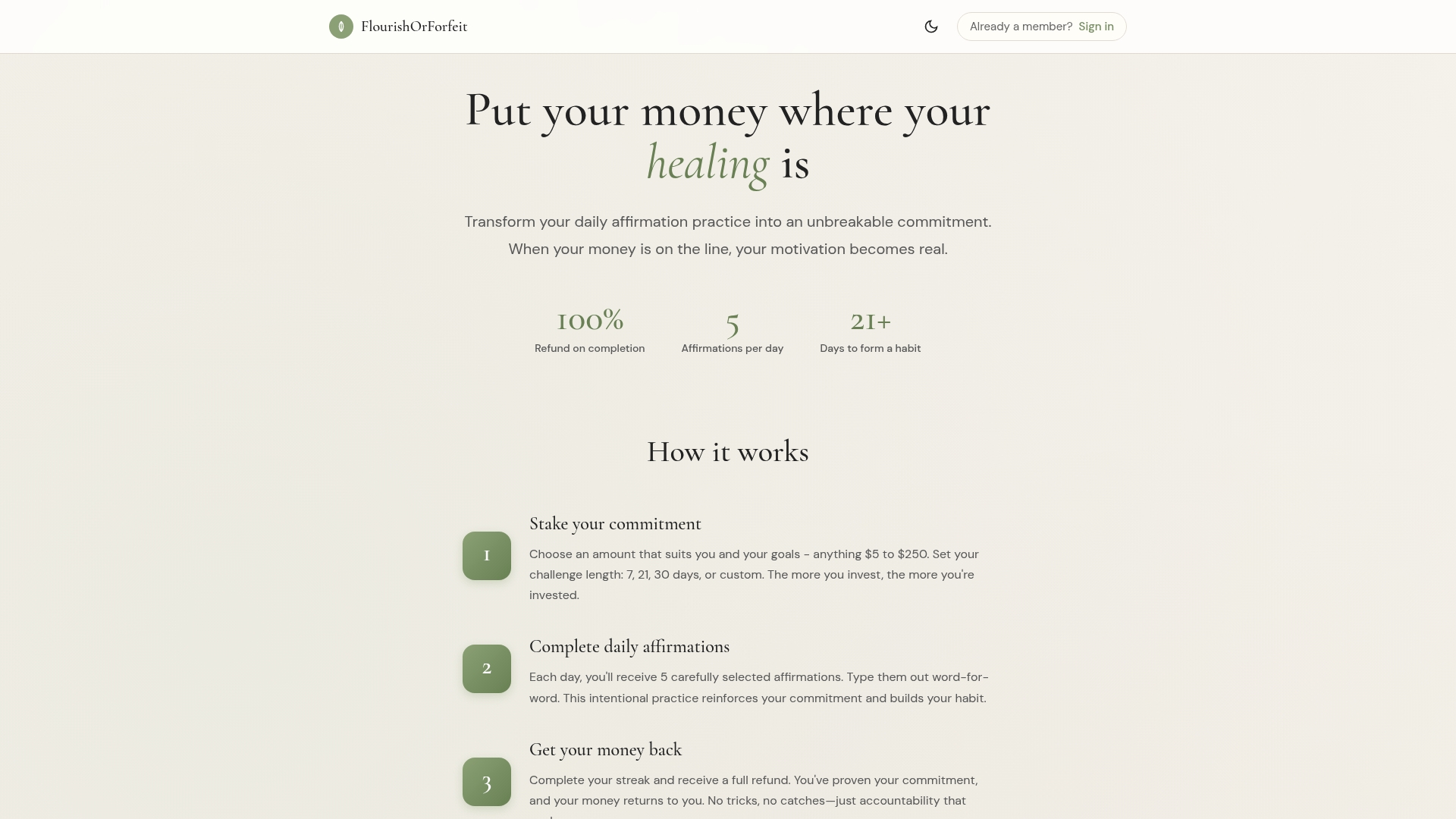
You stake between $5 and $250, choose a 7, 21, or 30-day challenge, and type five curated affirmations word-for-word each day. Complete the challenge and you get a full refund. Miss a day and you forfeit the stake. Payments are processed securely through Stripe, and SMS verification keeps the system honest. Longer challenges include a mulligan for one missed day.
This model works best for people who are self-aware enough to know they need a consequence to stay consistent: busy professionals, anyone who has tried journaling or habit apps and drifted, and people who want the practice to feel like a real commitment rather than a soft suggestion. If that's you, start a challenge at Flourishorforfeit and put something real on the line.