

Staying accountable to your goals comes down to four things working together: a financial stake that makes quitting costly, a specific and measurable goal tied to a daily cue, a reporting structure that creates external pressure, and a consistent affirmation practice that keeps your mindset aligned with your actions. Research on 742,923 users confirms that monetary stakes combined with weekly reporting produce the highest habit completion rates. Skip any one of these, and the system gets fragile.
The core elements that make accountability work:
- Financial commitment: Staking real money activates loss aversion, making you fight harder to avoid losing than you would to gain an equivalent reward
- Specific, cue-linked goals: Vague intentions collapse; goals anchored to a time, place, or trigger hold
- External reporting: Telling someone else or logging progress publicly converts a private intention into a social contract
- Daily affirmations: Practiced consistently, they reduce the psychological friction that causes people to quit
- Realistic commitment windows: Six to eight weeks is the sweet spot for forming durable habits without burning out
- Regular self-review: Weekly check-ins let you catch drift before it becomes abandonment
Table of Contents
- How does the science of accountability actually work?
- How do you build an accountability system that fits your life?
- Why daily affirmations are a serious accountability tool
- What commitment length and check-in frequency actually work?
- What does accountability to goals actually mean?
- How environmental cues drive habit formation
- Why financial commitment changes your follow-through rate
- How to track your goals without losing momentum
- How social support strengthens your accountability
- How to handle setbacks without abandoning your goals
- Why specific goals outperform vague ones
- How self-reflection keeps your goals on course
- Key Takeaways
How does the science of accountability actually work?
Accountability is not about willpower. Psychologist Wendy Wood's research shows that habit activation is triggered by environmental cues, not motivation. Peter Gollwitzer's work on implementation intentions demonstrates that linking a specific behavior to a specific situation, using an "if-then" format, dramatically increases goal completion rates. The mechanism is simple: you stop relying on remembering to act and start relying on the situation to trigger the action automatically.
Financial stakes add a second layer. Loss aversion means people are more motivated to avoid losing $50 than to earn $50. When you put money on the line, your future self is protected from your present self's impulse to skip today's habit. A large-scale field experiment found that workers who combined financial incentives with a self-funded commitment contract attended the gym at rates 47% of their in-treatment effect even after the incentive period ended, with effects lasting a full year.
Key finding: A dataset of 742,923 users showed that financial stakes paired with weekly accountability reporting produced the highest habit completion rates of any structure tested.
Social accountability adds a softer but real layer. Social pledges convert private intentions into social contracts, creating reputational costs that increase adherence, especially during the early, fragile phase of a new habit.
How do you build an accountability system that fits your life?
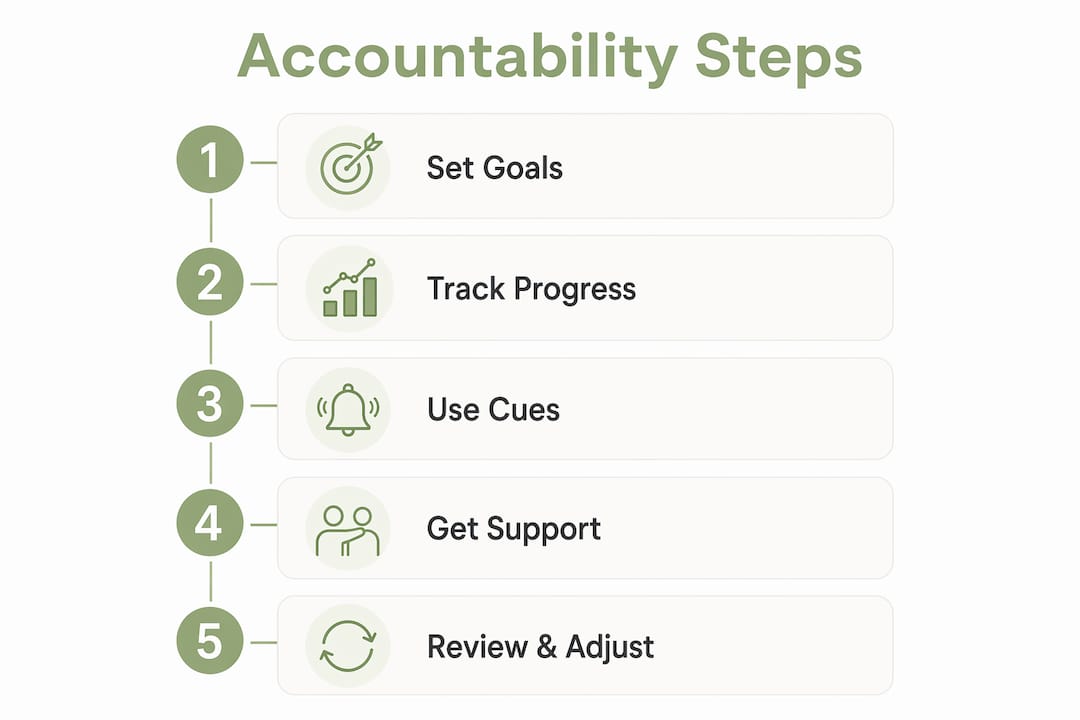
The goal is to design your environment so that following through is easier than quitting. Here is how to build that system:
- Choose a 6–8 week commitment window. This covers the highest-risk phase of habit formation, when abandonment is most likely before automaticity sets in
- Write a specific, measurable goal. "Exercise more" fails. "Do 20 minutes of movement at 7:00 AM after making coffee" works
- Stake real money. A refundable stake, forfeited only if you quit, leverages loss aversion without requiring external reward
- Set up weekly reporting. A trusted partner, a group, or a platform dashboard creates the external pressure that keeps private intentions honest
- Write "if-then" plans. Gollwitzer's implementation intentions work because they delegate control to the situation: "If it's 7:00 AM and I've made coffee, then I start my workout"
- Track visibly. A physical calendar, a streak counter, or a dashboard makes progress concrete and motivating
- Build in flexibility. A single mulligan for longer challenges prevents one missed day from becoming a full collapse
- Pair affirmations with your goal. Daily affirmations matched to your specific challenge reinforce the mindset that makes consistent action possible
Pro Tip: Match the rigidity of your commitment to the strength of your temptation. A habit you find genuinely hard to maintain needs a harder binding mechanism, like a financial stake, not just a sticky note.

Why daily affirmations are a serious accountability tool
Affirmations are not wishful thinking. A meta-analysis of 67 studies covering over 17,700 participants found that self-affirmation produces measurable improvements in self-perception, reduces anxiety, and enhances motivation. Functional MRI studies show that self-affirmation activates the ventral striatum and ventromedial prefrontal cortex, the brain regions tied to reward and self-worth.
What makes affirmations work within an accountability system:
- They reduce the psychological friction, anxiety, negative mood, that causes people to slip on goals
- Realistic, specific affirmations outperform vague positive statements; linking affirmations to personal values closes the gap between intention and action
- Daily repetition gradually rewires negative self-talk into a supportive internal narrative
- Typing affirmations word-for-word, rather than passively reading them, forces active engagement that deepens the effect
- When deeply rooted negative beliefs are present, therapeutic support can amplify affirmation effectiveness
The key is consistency. Affirmations practiced sporadically function as a mood boost. Practiced daily, within a structured challenge, they become a cognitive habit that supports every other accountability mechanism you have in place.
What commitment length and check-in frequency actually work?
The data is clear on this. Commitments of several weeks, paired with regular progress reporting, produce the highest completion rates in habit studies. Here is why that window matters:
- Habit formation averages 66 days, with a range of 18 to 254 days depending on the behavior and the person. The 6–8 week window covers the most dangerous phase
- Weekly reporting balances accountability pressure with the breathing room needed to avoid burnout
- Milestones and mulligans within longer commitments prevent a single bad day from ending the challenge entirely
- Visual progress tracking increases engagement; seeing a streak grow is itself motivating
- Starting on a Monday feels meaningful but does not statistically improve outcomes. Structure matters more than timing
Shorter challenges, like 7 or 21 days, work well as entry points. They lower the barrier to starting and let you build confidence before committing to a longer window.
What does accountability to goals actually mean?
Accountability means you have created a structure where failing to follow through carries a real consequence, financial, social, or reputational. Without that structure, goals remain intentions. With it, they become commitments. The difference is not motivation; it is design.
How environmental cues drive habit formation
Your environment is doing more work than you realize. Behavior becomes habitual when it is performed consistently in the same context, not when you feel motivated. Placing your running shoes by the door, scheduling your affirmation practice at the same time each morning, or using an app blocker during work hours are all forms of environmental precommitment that remove the need for in-the-moment willpower.
Why financial commitment changes your follow-through rate
A refundable stake is not a punishment. It is a contract with your future self. When the money is already committed, the psychological calculus shifts: quitting now means losing something you already own. That loss aversion is more powerful than the abstract promise of future gain. Platforms like Flourishorforfeit structure this precisely, with stakes from $5 to $250 and a full refund on completion, so the financial pressure is real without being punitive.
How to track your goals without losing momentum
Tracking works best when it is visible and frictionless. A dashboard that shows your current streak, a simple paper calendar where you mark each completed day, or SMS check-ins that confirm daily completion all serve the same function: they make your progress concrete. The act of recording also creates a brief moment of self-reflection that catches drift early.
How social support strengthens your accountability
An accountability partner does not need to be a coach. A friend who checks in weekly, a group working toward similar goals, or a platform community all create the reputational cost that makes quitting feel more expensive. Social commitments are softer than financial ones but particularly effective during the initiation phase, when habits are most fragile.
How to handle setbacks without abandoning your goals
One missed day is not failure. Treating it as failure is what causes abandonment. Build a recovery protocol into your system before you need it: a single mulligan for longer challenges, a defined "restart" procedure, and an affirmation practice that addresses the specific negative self-talk that follows a slip. The goal is to shrink the gap between a setback and getting back on track.
Why specific goals outperform vague ones
"Get healthier" gives your brain nothing to act on. "Type five affirmations at 8:00 AM every day for 21 days" does. Specificity creates the environmental trigger that habit formation depends on. It also makes tracking binary: you either did it or you did not. That clarity is what makes accountability systems function.
How self-reflection keeps your goals on course
A weekly review does not need to be elaborate. Ten minutes to ask three questions: Did I follow through? What got in the way? What needs to change? That cycle of action, reflection, and adjustment is what separates people who complete challenges from people who restart the same goal every few months.
Key Takeaways
Accountability to goals works when financial stakes, environmental cues, daily affirmations, and consistent tracking are combined into a single system rather than used in isolation.
| Point | Details |
|---|---|
| Financial stakes drive follow-through | Loss aversion makes forfeiting money more motivating than any abstract future reward. |
| 6–8 weeks is the optimal commitment window | This covers the highest-risk abandonment phase before habits become automatic. |
| Affirmations reduce psychological friction | A meta-analysis of 67 studies and 17,700+ participants found measurable reductions in anxiety and boosts to motivation. |
| Environmental cues beat willpower | Habit activation is triggered by context, not motivation, so design your environment before temptation arrives. |
| Weekly reporting closes the accountability loop | External check-ins convert private intentions into social contracts with real reputational stakes. |