

The most effective way to motivate yourself to reach your goals combines three things: writing your goals down in specific terms, attaching a real financial consequence to failure, and building daily habits that keep your commitment visible. Research backs this up. A Dominican University study found that written goals paired with accountability structures triple success rates compared to vague, uncommitted intentions.
The core elements that actually move the needle:
- Write goals down with specific, measurable language
- Attach financial stakes to trigger loss aversion
- Use daily affirmations to reinforce your commitment
- Build accountability that supports rather than controls
- Repeat for 21 days to lock in the habit
Loss aversion is the engine here. Psychologically, the pain of losing $50 outweighs the pleasure of gaining $50 by a wide margin. That asymmetry is exactly what financial commitment devices exploit to keep you showing up when motivation fades.
How financial commitment devices boost your motivation for goals
A financial commitment device is a voluntary arrangement where you put money on the line for a behavioral pledge. Miss the target, lose the stake. Hit it, get your money back. The mechanism works because it converts a future abstract goal into a present, concrete cost for failure.
Setting one up well requires a few decisions:
- Stake amount: Choose something that stings without causing panic. Research on loss aversion design confirms that stakes must engage discomfort without triggering so much anxiety that you abandon the challenge entirely.
- Recipient type: Stakes can go to a charity you support, a cause you oppose (an "anti-charity"), or a friend. Anti-charity stakes tend to generate stronger motivation because the moral cost of losing feels worse.
- Commitment period: Ongoing commitments work best for gradual behavior change. One-shot deadlines suit discrete tasks.
- Verification: SMS check-ins and dashboard tracking substitute effectively for a human accountability partner. Digital verification triggers the same social norms as a real observer.
- Pair with affirmations: Typing your affirmations word-for-word daily keeps your stated goals mentally active, not just financially enforced.
Pro Tip: Set a stake that you would genuinely regret losing but would not lose sleep over. The sweet spot is discomfort, not dread. For most people, a moderate financial stake per challenge period hits that range.
Hard commitments outperform soft ones precisely because they remove the easy exit. A soft commitment is a promise to yourself. A hard commitment is a contract with a financial penalty. When motivation dips at day 12 of a 21-day challenge, the soft version folds. The hard version holds.

The science behind goal-setting and habit formation
Thirty-five years of goal-setting research by Edwin Locke and Gary Latham established a clear pattern: specific, challenging goals consistently outperform vague or easy ones across every type of task studied. Specificity directs attention. Challenge sustains effort. Together they produce performance that "do your best" goals simply cannot match.
Key behavioral principles that underlie sustained motivation:
- Intrinsic vs. extrinsic motivation: Autonomy preserves intrinsic drive. When accountability feels imposed rather than chosen, Self-Determination Theory predicts motivation collapse, not improvement.
- Supportive accountability works; controlling accountability backfires. A partner who asks genuine questions fuels effort. One who nags triggers resistance.
- The Accountability Spectrum runs from self-monitoring at the low end to financial stakes at the high end. Match the intensity to the goal's difficulty and your own relationship with external pressure.
- Hard vs. soft commitments: Hard commitments impose real costs for quitting. Soft commitments rely on psychological friction alone, which wanes when temptation peaks.
- 21-day habit formation: Flourishorforfeit's challenge durations of 7, 21, and 30 days are grounded in habit science. The 21-day window is when repeated behaviors begin to consolidate into automatic routines.
The accountability research is equally clear on what kills motivation: shame-based accountability, identity-based public announcements before the work is done, and oversight that strips autonomy. The goal is not maximum accountability. It is the right kind, calibrated to the goal.
How Flourishorforfeit puts this into practice
Flourishorforfeit translates the behavioral science above into a daily structure. Users stake between $5 and $250, choose a 7, 21, or 30-day challenge, and type five curated affirmations word-for-word each day. Completion earns a full refund. A missed day forfeits the stake.
Getting started on the platform:
- Choose your stake amount ($5–$250) based on what genuinely motivates you
- Select your challenge duration (7, 21, or 30 days)
- Review and commit to the five daily affirmations
- Verify each day's completion via SMS and the dashboard
- Use the mulligan option on longer challenges if you need a recovery day
The refund model preserves autonomy. You chose the stakes, you chose the duration, and you control daily completion. That self-directed structure is what keeps the accountability supportive rather than punitive, consistent with what Self-Determination Theory identifies as the condition for sustained intrinsic motivation.
The 21-day option is particularly well-matched to habit formation science. Typing affirmations daily for three weeks builds the kind of repetition that shifts a deliberate action into something closer to automatic. Financial stakes keep you in the game long enough for that shift to happen.

Ready to back your goals with something real? Start your challenge on Flourishorforfeit today.
Key takeaways on motivating yourself with financial commitment and affirmations
The single most durable finding across goal-setting and commitment research: written, specific goals backed by a real financial consequence produce roughly triple achievement rates compared to intentions alone.
- Write specific goals, not vague aspirations. "Exercise three times a week" beats "get healthier."
- Use financial stakes sized to trigger loss aversion without overwhelming anxiety.
- Choose supportive accountability that preserves your autonomy and asks questions rather than issuing judgments.
- Repeat daily affirmations to keep your commitment mentally active, not just financially enforced.
- Stay in the challenge for 21 days to give habit formation science a real chance to work.
Strategies to overcome procrastination that hinder motivation
Procrastination is not a character flaw. It is a present-bias problem: the cost of starting feels immediate, while the benefit of finishing feels distant. Commitment devices directly address this by bringing a future consequence into the present.
Beyond financial stakes, two techniques consistently cut through the delay. First, implementation intentions: decide in advance the exact time, place, and trigger for your goal behavior ("When I sit down with my morning coffee, I will type my affirmations"). This pre-decision eliminates the daily negotiation with yourself. Second, reduce the startup cost. The hardest part of most habits is beginning, not sustaining. Logging into a platform and typing five sentences takes under two minutes. That low barrier is a feature, not a shortcut.
How SMART goals sharpen your motivation
SMART goals (Specific, Measurable, Achievable, Relevant, Time-bound) are the practical application of Locke and Latham's specificity principle. Each element does real work.
Specific removes ambiguity so your brain knows exactly what success looks like. Measurable gives you a clear signal when you have hit the target. Achievable keeps the goal within reach without making it trivial. Relevant connects the goal to something you actually care about, which is where intrinsic motivation lives. Time-bound creates the deadline pressure that prevents indefinite deferral.
A SMART goal paired with a financial commitment device is particularly effective because the time-bound element aligns naturally with a challenge period. "Type my five affirmations daily for 21 days" is specific, measurable, achievable, personally relevant, and time-bound. It is also exactly what Flourishorforfeit structures for you.
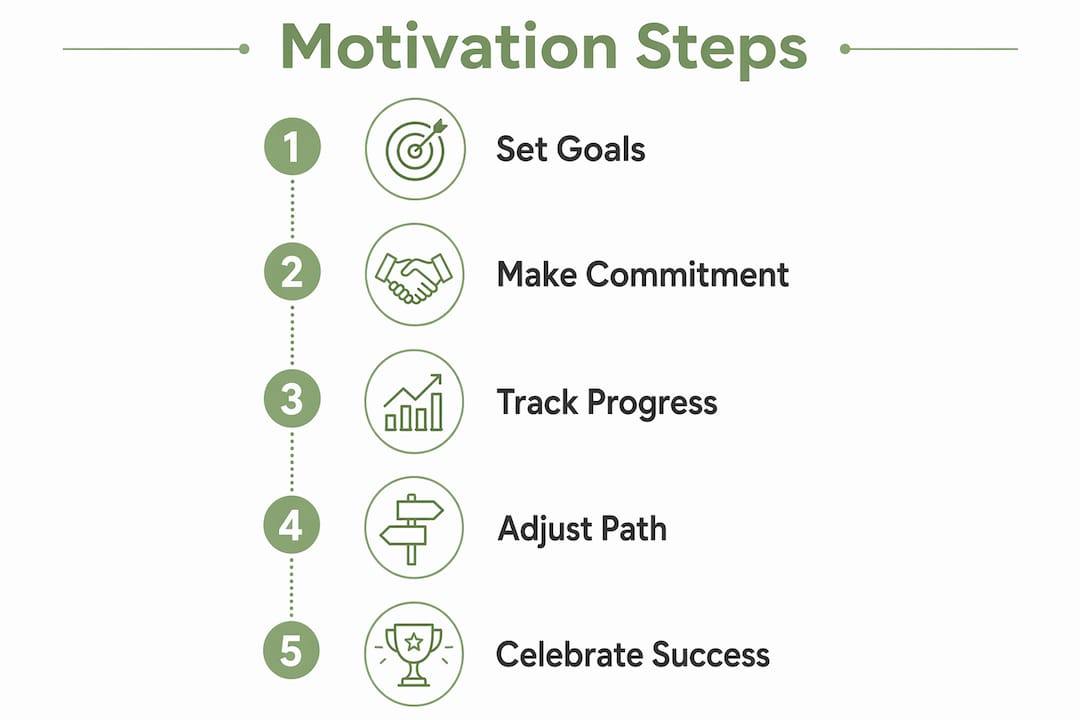
Methods to track and measure your progress toward goals
Tracking works because observation changes behavior. Even self-observation activates a mild version of the social accountability effect. A wall calendar with daily X marks, a streak counter, or a platform dashboard all create visible evidence of momentum.
The key is tracking behavior, not just outcomes. You cannot control whether you lose five pounds this week, but you can control whether you complete your daily affirmation. Behavior tracking keeps you focused on the actions within your control and builds the consistency that eventually produces the outcome.
How to maintain motivation when setbacks happen
Setbacks are not evidence that the goal is wrong. They are evidence that the path needs adjustment. The distinction matters because shame-based responses to failure trigger withdrawal, while guilt-based responses trigger course correction.
When you miss a day, the question is not "what is wrong with me?" It is "what got in the way, and what changes tomorrow?" Flourishorforfeit's mulligan option on longer challenges builds this recovery logic directly into the structure. One missed day does not end the challenge. It uses the mulligan and continues.
Key Takeaways
Financial commitment devices combined with written, specific goals and daily affirmations roughly triple goal achievement rates compared to intention or willpower alone.
| Point | Details |
|---|---|
| Write goals with specificity | Specific, challenging goals consistently outperform vague ones across 35 years of research. |
| Stake real money | Financial consequences trigger loss aversion, the strongest short-term motivator behavioral science has identified. |
| Keep accountability supportive | Controlling oversight kills intrinsic motivation; self-chosen accountability preserves it. |
| Repeat for 21 days | The 21-day challenge window aligns with habit formation science and gives new behaviors time to consolidate. |
| Recover from setbacks | Treat a missed day as a behavior problem to fix, not an identity failure, and use recovery options to stay in the challenge. |