

The fastest way to keep up with daily affirmations is a three-part system: attach your practice to an existing daily cue, write statements you actually believe (score them ≥6 on a 1–10 scale), and back the habit with a financial stake so missing a day costs you something real. That combination turns a vague intention into a repeatable, loss-averse commitment.
Start right now in three steps:
- Pick one existing cue (brushing teeth, morning coffee, pre-sleep wind-down)
- Write three affirmations, 10–15 words each, present tense, scored ≥6/10 for believability
- Choose a challenge on Flourishorforfeit lasting about a week to a month, and set a stake at a modest amount
Table of Contents
- How do you actually keep up with daily affirmations?
- How to write affirmations that actually stick
- Accountability and tracking systems that keep you returning
- Why financial stakes increase follow-through (and how to choose yours)
- What to do when you miss a day
- Three copyable challenge plans (7, 21, and 30 days)
- Key Takeaways
- Small affirmations outlast grand ones
- Flourishorforfeit puts your stake where your affirmations are
- Useful sources and further reading
How do you actually keep up with daily affirmations?
The answer is a 3-minute anchored ritual you run at the same time, same place, every day. Here is the exact sequence:
The 3-minute daily script:
- 0:00–0:30 — Sit or stand still. Take two slow breaths. This is your anchor moment; it signals your brain that the ritual is starting.
- 0:30–2:00 — Say or type your three affirmations, one at a time, with a brief pause between each. Feel the words rather than rushing through them.
- 2:00–3:00 — Close with 60 seconds of visualization: picture one concrete scene where the affirmation is already true.
Anchor options by time of day:
- Morning: right after brushing teeth or while coffee brews
- Midday: before opening your first afternoon app or email
- Evening: immediately before turning off your bedroom light
The ritual works because it borrows the momentum of a habit you already have. You are not building from scratch; you are attaching to an existing cue so the trigger fires automatically.
Pro Tip: On travel days or chaotic mornings, drop to a minimum-viable practice: one affirmation, 30 seconds, anywhere. That single rep preserves the chain and prevents a full reset.
Habit research puts the median time to automaticity at about 66 days (with a wide range of 18–254 days depending on the behavior). A 3-minute daily ritual, practiced consistently, compounds faster than you expect.
How to write affirmations that actually stick
Most affirmations fail because they are either too vague or too far from what you currently believe. Both problems are fixable.
The four writing rules:
- Present tense only. "I am" beats "I will be" every time.
- 10–15 words max. Shorter statements are easier to internalize and type accurately.
- Identity- or process-focused. "I am becoming" and "I choose to" produce deeper shifts than outcome statements like "I will be wealthy."
- Believability score ≥6/10. Before you commit to a statement, rate it honestly. Anything below 6 triggers subconscious pushback and the affirmation backfires.
Before → after pairs (copy and adapt):
| Too aspirational | Believable version |
|---|---|
| I am a millionaire. | I am building financial habits that grow my wealth. |
| I am fearless. | I choose courage even when I feel uncertain. |
| I am perfectly healthy. | I am making choices today that strengthen my body. |
Pro Tip: Write your affirmations in a notes app first, score each one 1–10, and only keep the ones that hit 6 or above. If a statement makes you roll your eyes, rewrite it until it feels true enough to say out loud.

To customize for specific triggers, add a context phrase: "At work, I bring calm focus to every challenge" or "In social situations, I show up as my genuine self." Specificity makes the statement more credible, which raises the believability score automatically.
As your self-perception shifts over weeks, revisit your statements. An affirmation that scored 6 in week one might score 9 by week four. When that happens, write a slightly bolder version and test it again.
Accountability and tracking systems that keep you returning
Tracking does not need to be complicated. The goal is a low-friction signal that tells you whether you showed up today.
Low-friction tracking options:
- A paper calendar with a daily X (the "don't break the chain" method)
- SMS confirmation through a platform that verifies completion
- A streak counter on a habit app or dashboard
- A shared Google Sheet with an accountability partner
How to set up a reciprocal accountability check-in:
- Choose a partner with a similar goal (not necessarily affirmations).
- Agree on a daily check-in window: a text, a voice note, or a platform notification.
- Keep it binary: done or not done. No lengthy explanations required.
- Set a weekly 5-minute review: what worked, what got in the way.
Pro Tip: Match friction to difficulty. If you are just starting out, a simple calendar X is enough. Once the habit is solid, raise the stakes with a financial commitment so the accountability has real teeth.
Return script for missed days: The moment you notice a miss, say this: "One miss does not erase the pattern. I return today." Then do the minimum-viable practice immediately, even if it is just one statement. The real threat to habit continuation is not the missed day itself but the "what the hell" spiral that follows it. The return rule cuts that spiral off before it starts.
Why financial stakes increase follow-through (and how to choose yours)
Commitment contracts work because of loss aversion: losing $25 feels roughly twice as painful as gaining $25 feels good. That asymmetry is what makes a financial stake a powerful consistency tool for binary, measurable habits like daily affirmations.
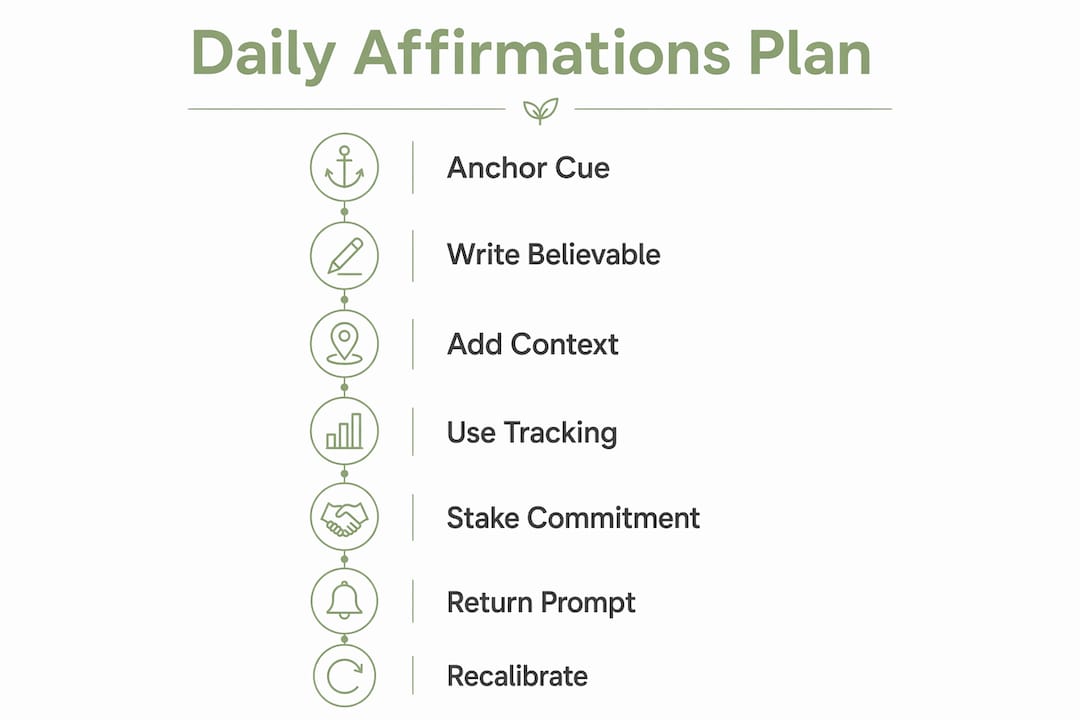
Start your stake at a level that creates mild discomfort. A suggested starting range is a modest weekly amount; recalibrate after some weeks if the amount no longer motivates you. The goal is a number that makes you think twice before skipping, not one that causes anxiety.
Stake-based accountability: trade-offs at a glance
| Factor | Advantage | Watch out for |
|---|---|---|
| Loss aversion | Strong daily motivation | Too-high stakes can cause avoidance |
| Refund on completion | Reward for finishing | May reduce urgency if refund feels guaranteed |
| Forfeiture on miss | Real consequence | Can trigger shame spiral if no return rule exists |
| Referee/verification | External accountability | Needs a trusted, available contact |
| Mulligan option | Safety net for genuine disruptions | Overusing it removes the commitment edge |
Platform features worth looking for: secure payment processing, a clear refund-on-completion policy, forfeiture enforcement, a mulligan for longer challenges, and SMS or dashboard verification. Shorter commitment windows tend to have higher success rates, which is why 7-day challenges are a smart entry point before moving to 21 or 30 days.
What to do when you miss a day
Missing a day is not the problem. Deciding the streak is ruined is.
Recovery steps:
- Forgive immediately. One miss is data, not failure.
- Do the minimum-viable practice right now — one affirmation, 30 seconds. This re-establishes the behavior before the day ends.
- Resume the full routine tomorrow at your normal cue. No doubling up, no punishment sessions.
- Say the return script: "One miss does not erase the pattern. I return today."
Common barriers and specific fallbacks:
- Travel: Use the minimum-viable practice in a hotel bathroom mirror or on a flight.
- High stress: Drop to one affirmation focused on calm ("I handle pressure with steadiness").
- Illness: Record a voice note of one statement. Counts as done.
The one-sentence rule to prevent the "what the hell" effect: return the same day or the next morning, no matter how small the practice.
Three copyable challenge plans (7, 21, and 30 days)
7-day starter plan
A low-risk entry point. Pick three affirmations and use the same ones all week.
- Days 1–3: Morning anchor only, 3 minutes, full script
- Days 4–5: Add a brief evening check-in (30 seconds, one statement)
- Days 6–7: Write a reflection: "What shifted this week, even slightly?"
Weekly reflection question: On a scale of 1–10, how much more natural did the statements feel by day 7 compared to day 1?
21-day habit-building plan
Three weeks aligns with early habit consolidation. Divide into three phases:
- Week 1: Lock in the cue and the three core statements
- Week 2: Add one identity-focused statement; score all four for believability
- Week 3: Introduce a brief visualization close (60 seconds)
Weekly reflection question: Which statement produced the most noticeable shift in how you approached a real situation this week?
30-day deep-change plan
At 30 days, you have enough data to evolve your affirmations.
- Weeks 1–2: Follow the 21-day structure above
- Week 3: Replace any statement scoring below 7 with a bolder version
- Week 4: Add one affirmation tied to a specific upcoming challenge (a presentation, a difficult conversation)
Completion checklist: Every day logged, minimum-viable practice used on disrupted days, at least one statement updated to reflect growth.
Recalibrating mid-challenge: If a stake no longer motivates after two weeks, note it and raise the amount on your next challenge. If the timeframe feels too long, finish the current one and choose a shorter next window.
Key Takeaways
Keeping up with daily affirmations requires three things working together: a reliable cue, believable statements, and a consequence for skipping.
| Point | Details |
|---|---|
| Anchor to an existing cue | Attach your practice to brushing teeth, morning coffee, or pre-sleep to fire the trigger automatically. |
| Write believable statements | Keep affirmations to 10–15 words, present tense, and score each ≥6/10 before committing. |
| Use minimum-viable practice | One affirmation in 30 seconds preserves the chain on disrupted days and prevents abandonment. |
| Return immediately after a miss | Say the return script and do the minimum practice the same day; the "what the hell" spiral starts with delay. |
| Flourishorforfeit for staked challenges | Choose a $5–$250 stake and a 7-, 21-, or 30-day challenge; get a full refund on completion or forfeit for missed days. |
Small affirmations outlast grand ones
The most common mistake people make with affirmations is writing statements they wish were true rather than statements that feel almost true. "I am a confident, wealthy, thriving person" sounds motivating for about three days. Then the gap between the words and your actual experience creates friction, and the practice quietly dies.
Identity- and process-based statements work differently. "I am becoming someone who handles pressure well" is not a lie. It is a direction. Your brain can accept a direction without triggering the internal skeptic that kills grand claims. The behavioral science signals in this guide, including anchoring to a cue, the believability threshold, and the return-to-practice rule, all exist to keep the practice alive long enough for that direction to become a default.
Financial stakes add a layer that pure willpower cannot replicate. Loss aversion is not a character flaw; it is a feature. Using it deliberately, through a structured commitment contract with a real refund-or-forfeit mechanic, is simply applying what behavioral science already knows about how humans actually change.
The goal is not a perfect streak. It is a practice you return to so reliably that missing a day feels genuinely strange.
Flourishorforfeit puts your stake where your affirmations are
If you have read this far, you already have the system. What Flourishorforfeit adds is the financial consequence that makes the system stick.
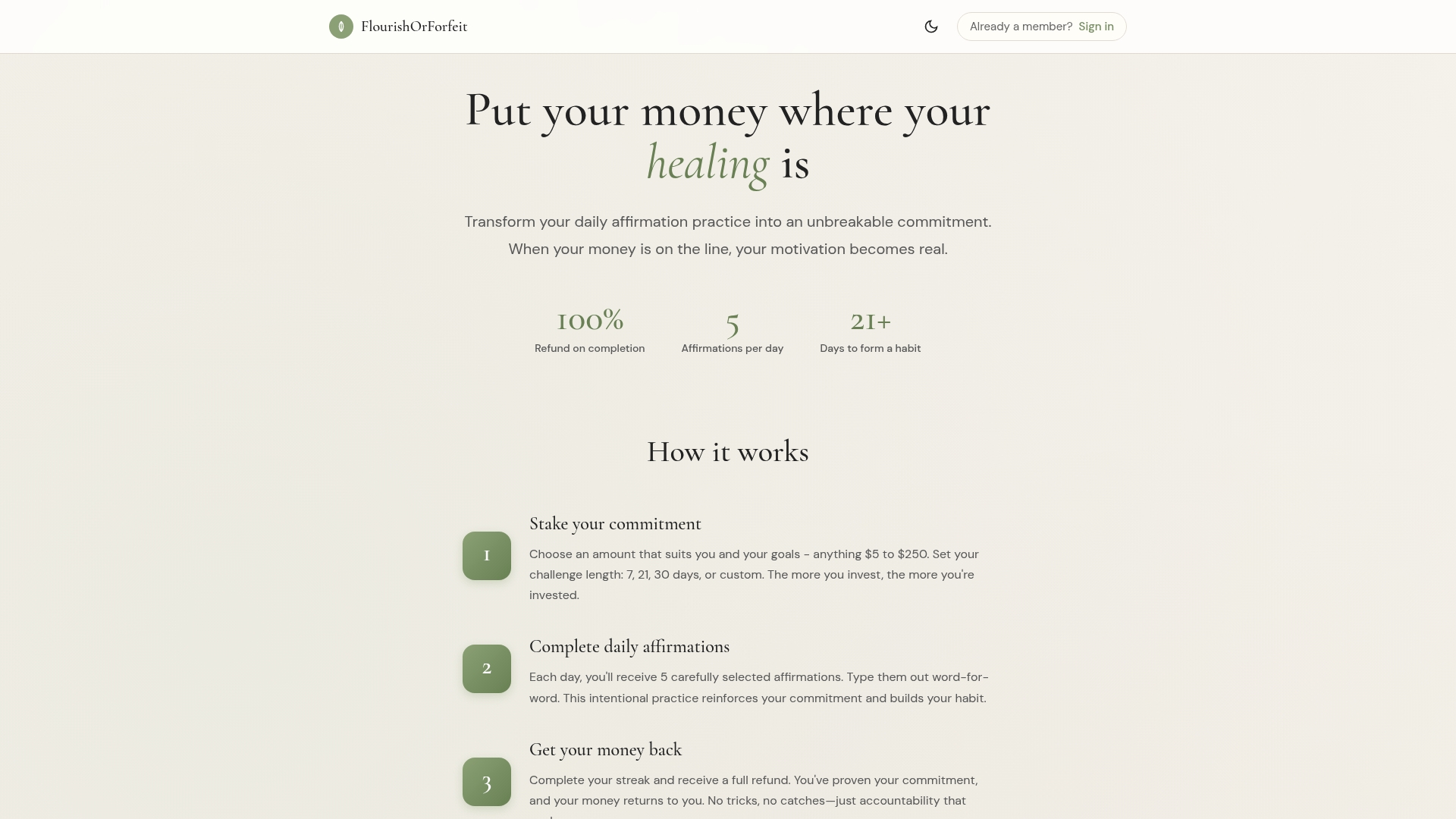
Pick a stake between $5 and $250, choose a 7-, 21-, or 30-day challenge, and type your three daily affirmations word-for-word each day. Secure payments via Stripe handle the money. SMS verification confirms your daily check-in. Complete the challenge and you get every dollar back. Miss a day without using your mulligan and you forfeit. The dashboard tracks your streak so you always know exactly where you stand.
Start a challenge on Flourishorforfeit today and put a real number behind the habit you are building.
Useful sources and further reading
- Sticky Goals: CHI21 commitment-contract analysis — Empirical research on how commitment contracts with financial stakes, referees, and social features affect goal achievement in real-world settings.
- Daily Affirmation Routine: 10 Steps — Practitioner guide covering cue-based anchoring, the believability scale, and writing rules for present-tense affirmations.
- Daily Affirmation Rituals: Morning and Evening Practice Guide — Covers ritual framing, minimum-viable practice, and the "what the hell" effect as the primary threat to habit continuation.
- Uncommon Accountability Systems — Practical guidance on calibrating financial stakes ($10–$25/week starting range) and recalibrating at 6–8 weeks.
- Positive Daily Affirmations: Is There Science Behind It? — Reviews the evidence for identity- and process-focused affirmation framing versus outcome-focused statements.
- Daily Affirmation Rituals for Positive Thinking — Covers habit automaticity research, including the median 66-day timeline, to set realistic expectations for affirmation practice.