

Lasting habits are automatic behaviors triggered by contextual cues, formed through consistent repetition in a stable environment until the action requires almost no conscious effort. The core requirements are straightforward: start small, repeat in the same context, attach the behavior to an existing cue, and give yourself enough time. That last part trips most people up.
Here is what the research actually shows:
- Habit automaticity takes 2 to 5 months to develop for most health behaviors, not 21 days
- Six factors drive habit strength: autonomous motivation, behavior frequency, context stability, feeling energized, positive emotion, and perceived difficulty
- Missing a single day does not derail your progress; extended lapses do
- Habit formation follows four stages: deciding to act, translating intention into behavior, repeating the behavior, and developing automaticity
- Context cues, not willpower, are what ultimately trigger habits once formed
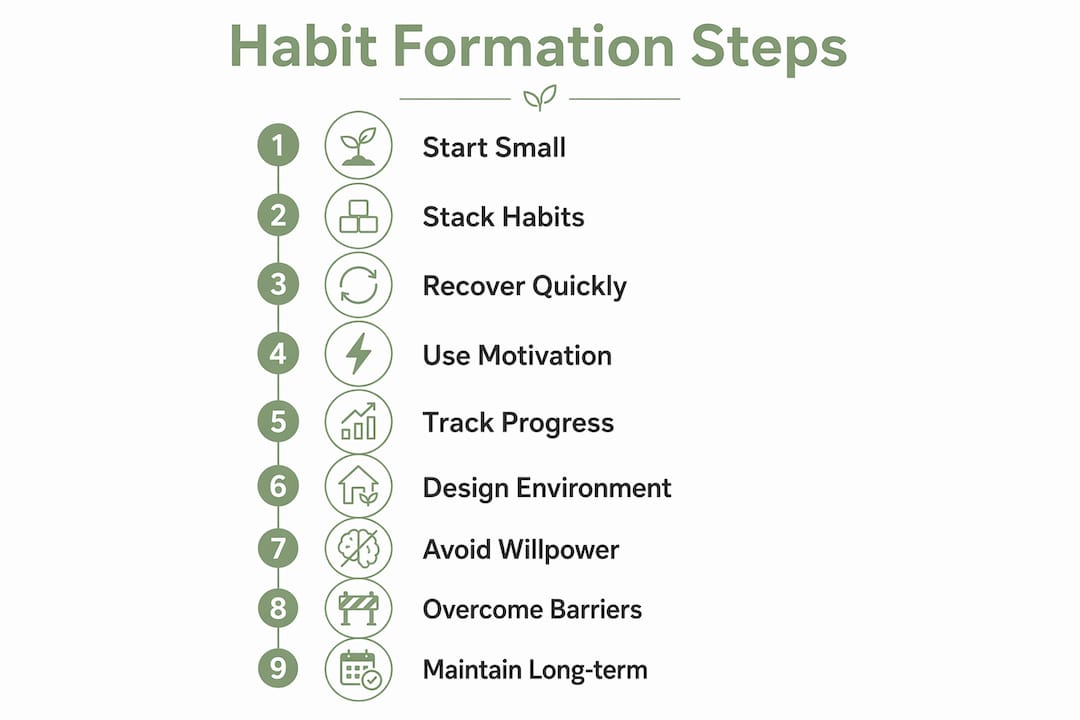
1. Start absurdly small and build from there
The most common reason people abandon new habits is that they start too big. A sedentary person who commits to a 45-minute daily run is fighting friction at every step. The same person who commits to walking two extra bus stops faces almost none.
Behavioral science backs this up: simpler actions become automatic faster, and small wins build the self-efficacy needed to pursue bigger changes later. The goal in the first two weeks is not transformation. It is repetition.
- Start with a version of the habit that takes under two minutes
- Increase duration or complexity only after the behavior feels automatic at the current level
- Treat each small completion as evidence that you are the kind of person who does this
Pro Tip: Write your starting habit as a specific action tied to a time and place: "After I pour my morning coffee, I will read one page." Specificity removes the decision, and removing the decision removes the friction.
2. Use habit stacking to anchor new behaviors
Habit stacking means linking a new behavior to one you already do automatically. The existing habit becomes the cue. This works because context cues trigger habitual behaviors independently of conscious motivation, bypassing the goal-directed thinking that requires effort.

The formula is simple: "After I [existing habit], I will [new habit]."
Practical examples:
- After I start the coffee maker, I will write three things I am grateful for
- After I sit down at my desk, I will review my top priority for the day
- After I brush my teeth at night, I will do five minutes of stretching
Why context stability matters so much:
- A fixed cue creates a reliable trigger that fires without deliberate thought
- Repeating in the same context strengthens the cue-behavior association faster
- Context stability enhances automaticity gains more than repetition outside fixed contexts
- Once the association is strong, the habit runs even when motivation is low
3. How to recover from slips without losing momentum
Slipping is not failure. It is a normal part of the process, and the research is clear: missing a single day does not materially affect habit formation progress. What matters is how quickly you return.
The danger is not the missed day. It is the story you tell yourself about it. "I ruined it" leads to abandonment. "I missed one, back tomorrow" leads to a habit.
- Treat a slip as data, not a verdict: what made that day harder?
- Return to the habit the very next opportunity, without adding punishment or extra reps
- Reframe the entire process as a multi-month experiment, not a pass/fail test
Pro Tip: If you miss two days in a row, that is the real warning sign. One miss is human. Two misses is the start of a new pattern. Catch it there.
4. Use positive motivation and emotional reinforcement

Motivation that comes from outside, such as a reward or a financial stake, gets you started. Motivation that comes from inside keeps you going. The transition between the two is where most habits either stick or dissolve.
Positive emotion during or immediately after a behavior is one of the six primary determinants of habit strength. This means the feeling you associate with the habit matters as much as the habit itself.
- Pair the new behavior with something you genuinely enjoy: a specific playlist, a good cup of coffee, a satisfying check mark
- Notice and name the positive feeling after completing the habit, even briefly
- As automaticity grows, the behavior itself tends to become intrinsically rewarding
- External rewards work best as a bridge, not a permanent structure
5. What the latest research says about habit formation
The 21-day myth originated from anecdotal observations of plastic surgery patients adjusting to their new appearance. It has nothing to do with behavioral automaticity. A systematic review of 20 studies involving 2,601 participants found that health habits typically require 2 to 5 months to develop, with individual timelines ranging from 4 to 335 days.
"Individuals should anticipate a timeframe of at least two to five months to develop automaticity in new health habits, rather than the commonly cited 21-day period. Having a realistic expectation that habit formation takes time can help individuals stay motivated and persist through the initial stages of behaviour change." — Time to Form a Habit: A Systematic Review and Meta-Analysis
The average time to reach automaticity in real-world studies is around 66 days, but the range is wide. Some behaviors plateau in under three weeks; others take nearly a year. Complexity, frequency, and context stability all shift that timeline.
Financial commitment contracts have emerged as a practical tool for bridging the gap between early motivation and genuine automaticity. By putting something at stake, people compensate for the present-biased thinking that makes skipping feel easier than showing up.
6. How to track your habit progress effectively
Tracking serves two functions: it creates a visual record that reinforces identity, and it surfaces patterns you would otherwise miss. You do not need a sophisticated system. You need consistency.
A simple paper calendar where you mark each completed day works. So does a notes app. The format is less important than the act of recording immediately after the behavior, while the positive feeling is still fresh.
- Track the behavior itself, not the outcome: "Did I do it?" not "Did it work?"
- Review weekly to spot which days or contexts cause misses
- Keep the tracking method as simple as the habit itself
7. Design your environment to make habits easier
Reducing the effort required for a good behavior increases habit success more reliably than relying on willpower. Environment design is the practical application of that finding.
Put the running shoes by the door. Keep the book on the pillow. Move the phone charger out of the bedroom. These are not tricks. They are cue management: arranging your physical space so the right behavior is the path of least resistance.
- Remove friction from desired habits by making them visible and accessible
- Add friction to competing behaviors: make the bad habit harder to start
- Change your environment when a habit is stuck, since a new context can reset a stale cue
8. Why willpower is the wrong tool for habit building
Willpower is a depletable resource. Using it to force a behavior every day is a losing strategy because the supply runs lowest exactly when you need it most: at the end of a long day, under stress, or when the behavior feels least appealing.
The goal of habit formation is to move the behavior out of the willpower system entirely, into the automatic response system triggered by context cues. Until that transfer happens, protect your willpower by scheduling habits early in the day, reducing decisions around them, and leaning on environment design rather than self-discipline.
9. Common psychological barriers and how to get past them
Most habit failures come down to a handful of predictable patterns. Recognizing them in advance makes them easier to handle when they show up.
All-or-nothing thinking treats a missed day as total failure. Counter it by defining the minimum viable version of the habit you will do on hard days.
Motivation dependency means waiting to feel ready before acting. Motivation follows action more often than it precedes it. Act first; the feeling catches up.
Vague intentions leave too much room for avoidance. "I will exercise more" fails. "I will walk for 15 minutes after lunch on weekdays" has a cue, a duration, and a context.
Underestimating context cues is perhaps the most common trap. People assume they can control habits through conscious decision-making, but habits are activated by cues, not intentions. If the cue is missing or inconsistent, the habit will not form regardless of how motivated you feel.
10. How to maintain habits over the long term
Once a habit reaches automaticity, the work shifts from formation to protection. The biggest threats to established habits are major life disruptions: moving, changing jobs, or a shift in daily routine. These break the context cues that trigger the behavior.
When disruption hits, treat the habit as if it is new again. Reattach it to a stable cue in the new context. Give it a few weeks to re-anchor. The behavior will return to automaticity faster the second time because the underlying association is already partially formed.
For habits you want to sustain for years, commitment contracts can provide structure during vulnerable periods, particularly when intrinsic motivation has not yet fully replaced external incentives. Platforms like Flourishorforfeit put real financial stakes behind daily commitments, creating accountability that carries you through the stretches where motivation alone would not.
Key Takeaways
Lasting habits form through consistent repetition in stable contexts over several months, not through willpower or short-term challenges.
| Point | Details |
|---|---|
| Realistic timeframe | Health habits typically take multiple months to become automatic, with individual times varying widely. |
| Start small | Begin with a version of the habit that takes under two minutes to remove friction and build early wins. |
| Context over willpower | Stable cues trigger habits automatically; environment design beats self-discipline for long-term success. |
| Slips are recoverable | Missing one day does not derail habit formation; returning the next day is what matters. |
| Commitment accelerates change | Financial stakes and commitment contracts help bridge the gap until intrinsic motivation takes hold. |