

There is no single fixed number. The best available evidence puts the range at 18 to 254 days, with most people landing somewhere in the middle. Here is what that looks like in practice:
- The fastest observed cases in the Lally et al. study involved simple behaviors in stable contexts.
- A typical planning benchmark is around two months.
- More complex or inconsistent behaviors may require substantially longer periods.
The 21-day myth comes from a misreading of plastic surgeon Maxwell Maltz's 1960 self-help observations, not peer-reviewed research. Dr. Phillippa Lally's longitudinal work at UCL is the actual evidentiary anchor here, and it tells a more honest story: habit formation is individual, nonlinear, and far more forgiving of missed days than most people assume.
Table of Contents
- How long does it really take to build a good habit?
- What actually speeds up or slows down habit formation?
- Why financial commitment contracts work better than willpower alone
- A practical day-by-day plan for affirmation challenges
- How do you know when a habit has actually formed?
- What to do when you miss a day or hit a wall
- Key Takeaways
- Why stakes-based affirmations work when nothing else has
- Flourishorforfeit puts these principles to work for you
- Authoritative sources and further reading
How long does it really take to build a good habit?
The most rigorous data comes from Lally et al. (2009), a 12-week study of 96 volunteers who chose a daily eating, drinking, or exercise behavior and tracked their automaticity scores every day. The model fit well for 39 participants, and their median time to reach 95% of peak automaticity was 66 days, with a range of 18–254 days.
| Study / Source | Key Finding | Limitation |
|---|---|---|
| Lally et al. (2009) | Median 66 days; range 18–254 days to reach 95% of asymptotic automaticity | Self-report measures; small sample (n=39 good-fit); single behavior per person |
| NBER field experiment | Commitment contracts + incentives produced larger, more persistent behavior change than incentives alone | Gym-attendance context; may not generalize to all habit types |
| PMC incentive study (n=2,508) | Flexible incentives sometimes outperformed rigid routines for post-intervention persistence | Exercise-specific; context dependency limits generalization |
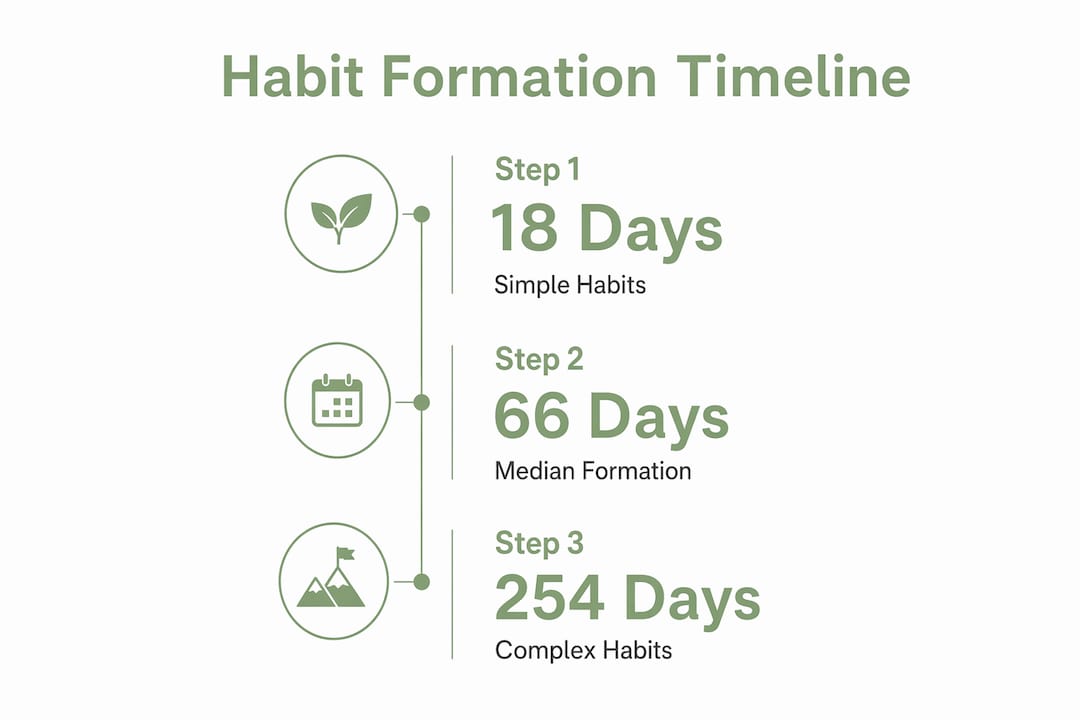
Two things stand out from this data. First, the 18-day lower bound is real but rare, reserved for simple behaviors with near-perfect cue consistency. Second, the upper bound of 254 days is not a failure — it reflects behaviors that are genuinely complex or practiced in unstable environments.
What actually speeds up or slows down habit formation?
Not all habits are created equal, and several factors under your control shift the timeline significantly.
- Behavior complexity: Drinking a glass of water after waking is faster to automate than a 20-minute journaling session. Simpler micro-actions reach automaticity sooner.
- Context consistency: Performing a behavior in the same place at the same time, every time, is the single strongest accelerator. Stable contextual cues reduce cognitive load and speed automaticity.
- Repetition frequency: Daily practice outperforms every-other-day practice. Gaps slow the curve.
- Motivation and affect: Positive emotional associations with the behavior improve adherence, especially early on when the habit is not yet automatic.
- Social support: Accountability partners and group challenges reduce dropout, particularly in weeks 2–4 when novelty fades.
- Stress and environment change: Travel, illness, or major life disruptions break cue chains. They do not erase progress, but they do pause it.
Physical habits (exercise, hydration) tend to form faster than mental habits (gratitude, affirmations) because physical behaviors have clearer completion signals. Social habits, like checking in with a friend daily, depend heavily on the other person's consistency too.
Pro Tip: Pick one fixed contextual cue, such as right after your morning coffee, and start with the smallest possible version of the behavior. A 30-second affirmation typed on your phone beats a 10-minute journaling ritual you skip half the time.

Why financial commitment contracts work better than willpower alone
Willpower is a depleting resource. Commitment contracts work differently: they convert a future, abstract benefit ("I'll feel better about myself") into an immediate, concrete loss ("I'll lose $50 today if I skip"). That shift is the behavioral-economics mechanism behind why stakes-based accountability outperforms good intentions.
The NBER field experiment tested this directly. Groups that received only temporary financial incentives saw modest long-run behavior change. Groups offered self-funded commitment contracts alongside incentives showed far larger and more persistent increases in the target behavior, with effects persisting up to a year after the intervention ended.
The core insight: Temporary incentives jump-start participation but rarely create durable habits on their own. Self-funded stakes, where you put up money you can lose, address present bias in a way that external rewards simply cannot. The cost of failure becomes real and immediate.
Interestingly, the same NBER data showed that self-control awareness did not predict who took up commitment contracts. People sign up for identity reasons, convenience, or genuine accountability needs. That breadth matters for design: a good stakes-based challenge should be accessible, not punishing.
Practical guidelines for structuring a commitment contract well:
- Set a stake that is meaningful but not financially destabilizing. Somewhere between $5 and $100 is the typical effective range for most people.
- Choose a duration that matches your habit-building goal: 7 days to test a behavior, 21–30 days to build early momentum, 66 days to target genuine automaticity.
- Use objective verification, such as typed text confirmation or SMS check-in, rather than self-report alone.
- Build in a mulligan or grace rule for longer challenges so one bad day does not trigger full forfeiture.
A practical day-by-day plan for affirmation challenges
Setting up your challenge
- Choose your cue. Pick a fixed daily trigger: right after waking, after your first coffee, or before opening email.
- Define the micro-action. Type five curated affirmations, word for word. Typing beats reading silently because it demands active engagement.
- Set your stake. Pick an amount that would genuinely sting to lose. $25 is a common starting point.
- Choose your duration. Match it to your goal (see templates below).
- Set verification. Use a platform with SMS confirmation or a dashboard log so completion is objective.
Timeline templates
- 7-day challenge: Proof-of-concept. You are testing whether the cue and micro-action fit your life. Expect high motivation, low automaticity. Treat it as a pilot.
- 21-day challenge: Early habit momentum. By day 14 most people report the behavior feeling slightly less effortful. This is the window where behavior pairing (stacking affirmations onto an existing routine) pays off most.
- 30-day challenge: Consolidation. Completion rates tend to stabilize here. A good time to increase stake or add a second affirmation set.
- 66-day challenge: Targeting genuine automaticity. Expect a motivation dip around days 20–35. That dip is normal and does not mean the habit is failing.
Sample daily schedule
- 6:45 AM: Morning coffee (existing anchor behavior)
- 6:50 AM: Open platform, type five affirmations word for word (2–3 minutes)
- 6:53 AM: SMS or dashboard verification logged
- 6:54 AM: 60-second reflection: did any affirmation feel different today?
Pair this with a weekly accountability check-in, either a text to a friend or a small-group challenge, to add social reinforcement on top of the financial stake.
How do you know when a habit has actually formed?
Automaticity is not a switch. It is a curve that flattens gradually. These four metrics give you a concrete read on where you are.
| Metric | How to measure it | Sign of progress |
|---|---|---|
| Completion rate | Track daily in a log or app dashboard | substantial consistency over a 14-day window |
| Streak length | Count consecutive days without a miss | Streaks of 14+ days with no forced effort |
| Self-rated effort | Score 1–10 each day: "How much effort did this take?" | Score drops from 7+ to 3 or below over 4–6 weeks |
| Time to complete | Note how long the behavior takes | Completion time shortens and stabilizes |
Run a 14-day midpoint check and a 30-day review. If your effort score has not dropped at all by day 30, revisit your cue. A drifting or inconsistent trigger is usually the culprit.
What to do when you miss a day or hit a wall
Missing one day does not reset your habit. Lally et al.'s modeling confirmed that single missed opportunities did not materially affect the automaticity curve. The danger is not the miss itself. It is the all-or-nothing thinking that turns one miss into a week-long dropout.
Common failure modes and quick fixes:
- Overly large stake: If the financial pressure feels paralyzing rather than motivating, reduce the stake. Anxiety is not accountability.
- Cue drift: Your trigger stopped happening reliably. Reassign the behavior to a more stable anchor.
- Life disruption: Travel or illness broke the chain. Use your mulligan, restart the next morning, and treat the disruption as a pause, not a failure.
- Perfectionism: You skipped because you could not do the "full" version. A 60-second abbreviated version still counts and keeps the curve moving.
After a missed day: log it honestly, do not double up the next day, and return to the exact same cue and micro-action. The rebound rule is simple: one miss, one restart, no penalty to the curve.
Key Takeaways
Habit formation takes 18–254 days depending on the behavior and context, with 66 days as the best evidence-based median planning benchmark for reaching habit automaticity; financial commitment contracts consistently outperform willpower alone for long-run behavior change.
| Point | Details |
|---|---|
| No fixed day-count | Habit timelines range from 18 to 254 days; 66 days is the evidence-based median time to reach 95% automaticity in most cases. |
| Cue consistency is the lever | Performing the same behavior in the same context every day is the fastest path to automaticity. |
| Stakes beat willpower | Self-funded commitment contracts produce more persistent behavior change than incentives or intentions alone. |
| Slips don't erase progress | Missing one day does not reset the habit curve; the asymptotic model absorbs single lapses. |
| Flourishorforfeit puts this into practice | Stake-based affirmation challenges ($5–$250, 7/21/30 days, with verification and mulligan rules) put these principles into a structured daily practice. |
Why stakes-based affirmations work when nothing else has
Most people who struggle with habit formation are not lazy. They are under-committed. There is a real difference between wanting to build a habit and putting something on the line to do it. The research on commitment contracts is not subtle: when you fund the cost of failure yourself, the behavior becomes a different kind of priority.
What I find most compelling about the affirmation-challenge model specifically is that it targets the mental habit layer, not just the physical one. Typing affirmations word for word is not passive. It is a small, daily act of deliberate attention, and that is exactly the kind of behavior that benefits most from a structured cue and a financial stake. The 66-day median is not a guarantee, but it is a realistic target for reaching 95% habit automaticity when the conditions are right: fixed cue, daily repetition, and a consequence that matters.
Flourishorforfeit puts these principles to work for you
If you have read this far, you already know that a fixed cue, a small daily action, and a real financial consequence are the three ingredients that move the needle. Flourishorforfeit builds all three into a single daily challenge.
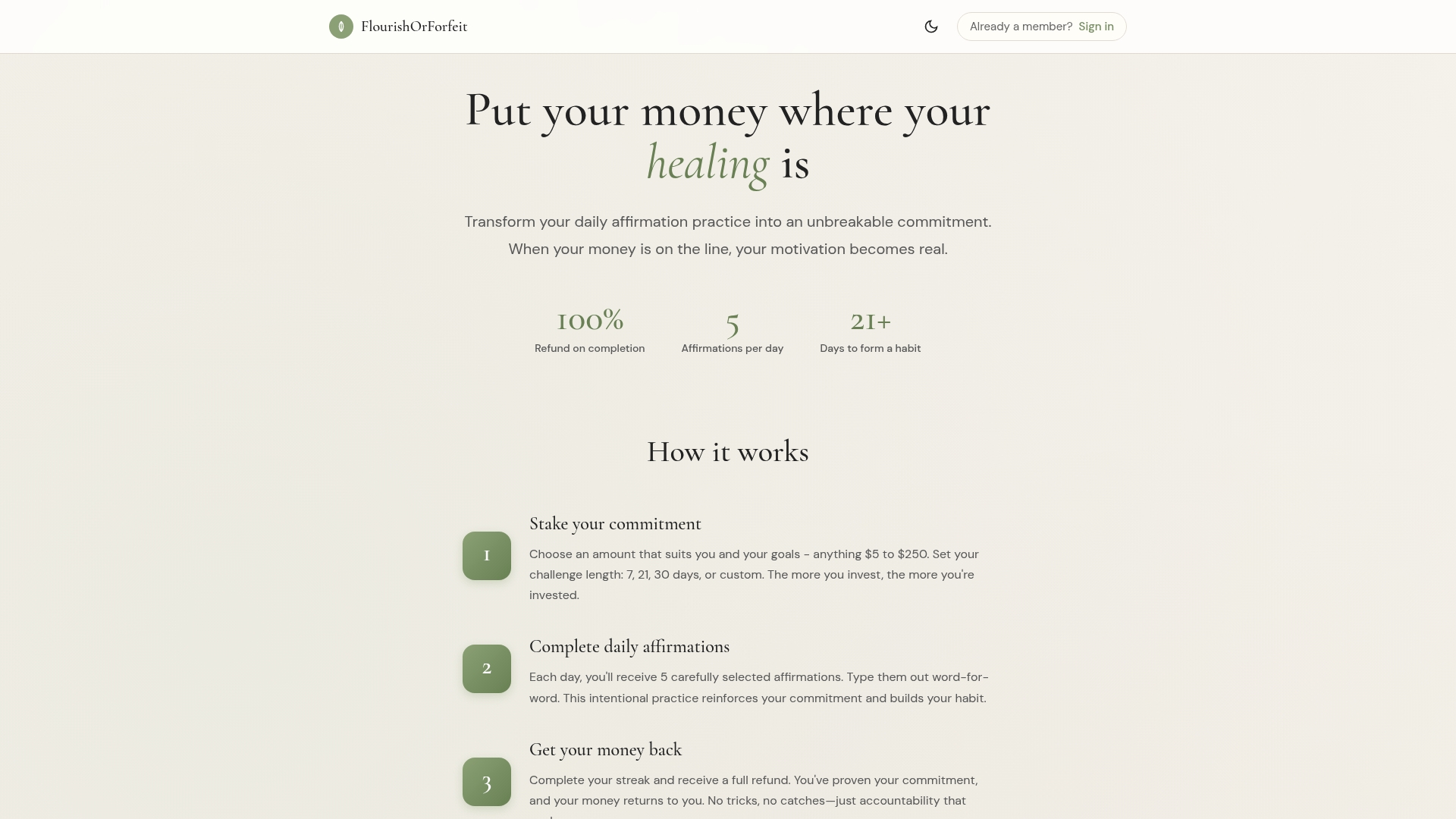
You pick a stake from $5 to $250, choose a 7, 21, or 30-day duration, and type five curated affirmations each day. Completion earns a full refund. Miss a day and you forfeit the stake. Longer challenges include a mulligan so one rough morning does not end your streak. Secure Stripe payments and SMS verification handle the accountability layer so you do not have to rely on willpower. Ready to put something real behind your next habit? Start your challenge today.
Authoritative sources and further reading
- Lally et al. (2009), European Journal of Social Psychology — The primary peer-reviewed study establishing the 18–254 day range and asymptotic automaticity model; the most cited evidence base for realistic habit timelines.
- UCL News: "How long does it take to form a habit?" — Dr. Lally's own plain-language explanation of the study findings and their practical implications for anyone trying to build a new behavior.
- NBER Working Paper on commitment contracts and gym attendance — Field experiment evidence that self-funded commitment contracts produce stronger and more persistent behavior change than temporary incentives alone.
- PMC: "Creating Exercise Habits Using Incentives" (n=2,508) — Large randomized trial comparing flexible vs. rigid incentive structures; key source for cue-consistency and behavior-pairing recommendations.
- Behavioral regulation and habit automaticity review — Meta-analytic perspective on how stable contextual cues reduce cognitive cost and accelerate habit formation across behavior types.