

If you want a habit tracking app with rewards that actually changes behavior, Flourishorforfeit is the clearest starting point. It uses a financial-stake model grounded in behavioral economics: you put $5–$250 on the line, complete daily affirmation challenges over 7, 21, or 30 days, and get every dollar back if you finish; miss a day, and you forfeit. That asymmetry is the whole point.
The short version:
- Stake an amount that stings a little but won't wreck your budget
- Start with a 7-day challenge to test the format
- Type 5 daily affirmations word-for-word to log proof
- Complete the challenge, get a full refund; miss it, lose the stake
- The 21-day window is where habit formation actually takes hold
Commitment contracts that require a deposit returned only on goal completion leverage loss aversion and can dramatically increase success rates compared with standard approaches, with some randomized trials showing roughly 50% success for deposit-based contracts versus 10% for usual care.
Table of Contents
- How does a financial-stake habit app actually work?
- Who should use a stakes-based habit tracker — and who shouldn't?
- What features should you check before choosing an app?
- How to use Flourishorforfeit step by step
- What do typical costs and timelines look like?
- Privacy and payment security basics before you stake money
- Key Takeaways
- What the research actually tells us about stakes-based habits
- Put your money where your habit is with Flourishorforfeit
- Selected research and primary sources
How does a financial-stake habit app actually work?
The mechanism is loss aversion, not willpower. Behavioral economists call it a commitment device: you bind your future self to a cost that exists right now, which counteracts the very human tendency to prioritize today's comfort over tomorrow's goals.
Most people have time-inconsistent preferences. They plan to exercise Monday, then Monday arrives and they don't feel like it. A financial stake moves the cost of skipping into the present tense. The money is already gone in your mind; completing the challenge is how you get it back.
Hard contracts with self-funded deposits outperform soft commitments in randomized field experiments, increasing gym visits by roughly 21% over the experimental period. Soft commitments, like writing a goal in a journal, carry only psychological costs, which most people discount quickly.
The honest caveat: incentive effects often fade after the program ends. Systematic reviews show that for weight loss and many health behaviors, gains shrink months after incentives are removed. The goal, then, is to use stakes as a training wheel, not a permanent crutch. Multi-week incentive schedules that taper over time produce more lasting behavior change than one-off rewards, which is exactly why the 7 → 21 → 30-day progression matters.
Who should use a stakes-based habit tracker — and who shouldn't?
Stakes-based apps work best for people who already know what habit they want to build but keep failing to start or sustain it. If you've tried free apps and quit after two weeks, a financial stake changes the calculus.
Good fit:
- You have a clear, specific habit goal (daily affirmations, morning workouts, journaling)
- You can afford to lose the stake without real hardship
- You respond to accountability more than inspiration
- Short-term, structured challenges suit your schedule
Proceed carefully if:
- Money is tight — losing even $20 adds stress, not motivation
- You have a history of compulsive or gambling-like behaviors
- Anxiety around failure already undermines your habits
- You're in an acute mental-health episode
Research shows a consistent self-other gap in how people choose penalties: participants select tougher monetary contracts for others than for themselves, even when stronger penalties correlate with higher success. The practical takeaway is to push yourself slightly above your comfort zone on stake size, but not so far that losing the money would genuinely hurt.
Start at $5–$20 for your first challenge. Prove the format works for you before escalating.

What features should you check before choosing an app?
The three non-negotiables are secure payments, a clear refund-on-completion policy, and a reliable verification method. Everything else is secondary.
Full feature checklist:
- Stake range: Does the app let you start small ($5) and scale up? Field studies confirm higher enrollment for low-deposit programs, so a low floor matters.
- Challenge durations: 7, 21, and 30-day options give you a progression path.
- Verification method: SMS confirmation, photo upload, or typed affirmations — each has different friction levels. Typed affirmations require active engagement, not a passive tap.
- Refund policy: Is it explicit, unconditional on completion, and written in plain language?
- Forfeiture destination: Does the platform keep forfeited funds, donate them, or send them to an anti-charity? Each option carries different motivational and ethical weight.
- Mulligans: Can you miss one day without losing everything? Longer challenges often need a grace provision.
- Payment security: Stripe integration or equivalent PCI-compliant processor is the baseline.
Pro Tip: Before staking $100, run a $5 trial. Read the terms that define what counts as valid proof, test the payment flow end-to-end, and confirm the refund process. If the app can't explain its refund policy in two sentences, that's a signal.
How to use Flourishorforfeit step by step
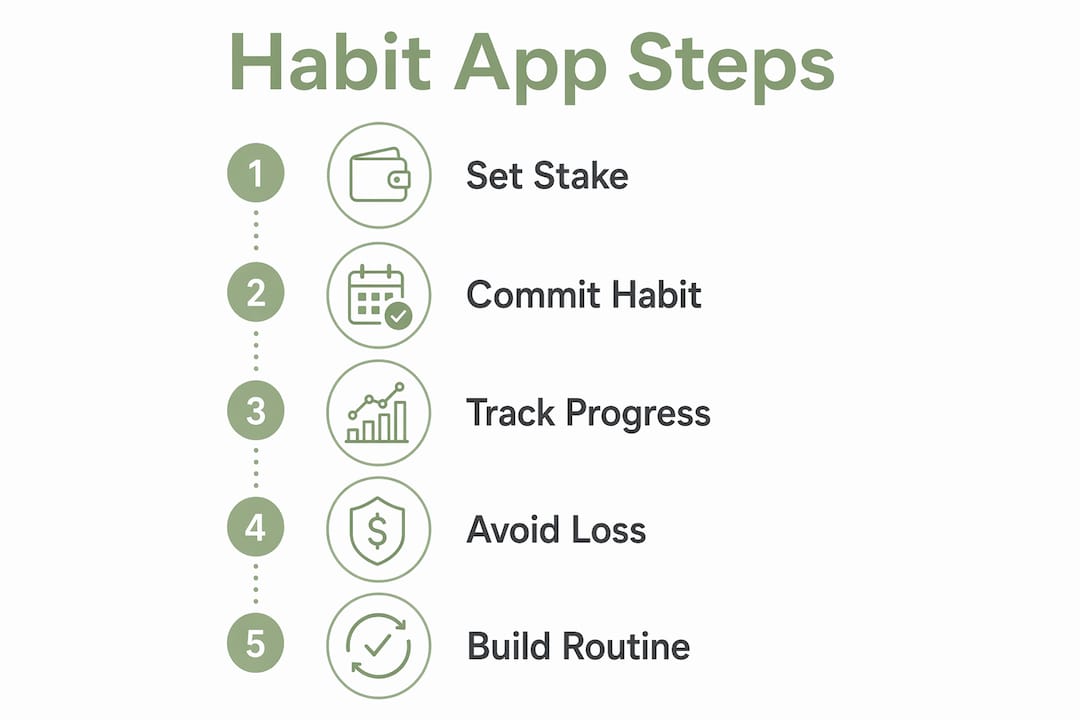
The most effective setup is a progressive challenge plan: 7 days first, then 21, then 30. Each stage builds the routine before the stakes get serious.
- Pick one habit. Affirmations work best when they map to a single goal — confidence, focus, or a specific life area. Don't stack five habits on day one.
- Set an affordable stake. Start between $5 and $50. Enough to sting, not enough to cause real stress.
- Choose the 7-day challenge. This is your proof-of-concept. You're testing the format, not transforming your life yet.
- Complete daily proof. Type all 5 affirmations word-for-word each day. The active typing is intentional — it forces genuine engagement rather than a passive checkbox.
- Use mulligans sparingly. On 21 and 30-day challenges, a mulligan can save your streak. Reserve it for genuine emergencies.
- Escalate to 21 days. This is where the habit window research points. Behavioral economics literature supports multi-week incentive schedules that build repetition before tapering.
- Complete the 30-day challenge. By this point, the routine should feel automatic. Collect your refund.
Pro Tip: Once the 30-day challenge ends, keep the affirmation habit without the stake for two weeks. If it holds, you've internalized it. If it slips, run one more 21-day challenge at a higher stake.
What do typical costs and timelines look like?
Flourishorforfeit accepts stakes from $5 to $250. Here's how the math and motivation trade-offs play out across common brackets:
| Stake bracket | Who it suits | Motivation level | Acceptance rate |
|---|---|---|---|
| $5–$20 | First-time users, skeptics | Moderate | High |
| $5–$250 | Repeat users, moderate goals | Strong | Moderate |
| $100–$250 | High-commitment users | Very strong | Lower |
Larger deposits raise per-person efficacy but reduce enrollment; smaller deposits with accessible entry points recruit more users and can produce higher total success numbers. Neither extreme is universally right.
On timelines: 7-day challenges test the format. The 21-day window is where repetition compounds into something that starts to feel automatic. Thirty days adds durability. The important caveat is that incentive effects frequently disappear months after removal for many behaviors, so the goal is always to build internal motivation before the stakes come off.
Privacy and payment security basics before you stake money
The top three checks: confirm the payment processor, verify the refund terms are explicit, and understand how forfeited funds are handled.
- Payment processor: Flourishorforfeit uses Stripe, a PCI-compliant processor. Never stake money through an app that can't name its payment provider.
- Refund terms: The policy should state plainly that successful completion triggers a full refund, with no discretionary clauses.
- Forfeiture handling: Know where your money goes if you miss a day. Flourishorforfeit's model keeps forfeited stakes as platform revenue, which is disclosed upfront.
- Verification integrity: SMS confirmation and typed affirmations create an audit trail. Understand what counts as valid proof before you start.
- Data retention: Check whether the platform stores your payment data beyond the challenge period and whether you can request deletion.
- Customer support: Confirm there's a real support channel before depositing anything meaningful.
Key Takeaways
Flourishorforfeit works because loss aversion is a stronger motivator than reward anticipation, and a full refund on completion removes the financial risk for anyone who follows through.
| Point | Details |
|---|---|
| Loss aversion drives results | Randomized trials show roughly 50% success rates for deposit-based contracts versus 10% for standard approaches. |
| Start small, then escalate | A $5–$20 first stake lets you test the format before committing to higher-efficacy, higher-risk amounts. |
| 21-day window is the target | Multi-week incentive schedules build more lasting habits than single short challenges. |
| Taper stakes intentionally | Incentive effects fade after removal; use the 7 → 21 → 30-day progression to build internal motivation. |
| Flourishorforfeit de-risks the trial | The refund-on-completion policy means a successful challenge costs you nothing except the time. |
What the research actually tells us about stakes-based habits
Most people underestimate how much the structure of a commitment contract matters relative to the dollar amount. A $10 stake with clear verification, an explicit refund policy, and a 21-day duration will outperform a $100 stake on a vague platform with no proof mechanism. The behavioral science is consistent on this: the conditions that make people feel genuinely accountable matter more than the size of the penalty.
What I find underappreciated is the self-other gap finding. People routinely choose softer penalties for themselves than they'd recommend to a friend in the same situation. If you're designing your own challenge, ask what you'd tell a friend to stake. That number is probably closer to the right answer than your first instinct.
The other thing worth saying plainly: these apps are not magic. They work as a bridge between intention and routine, not as a substitute for genuine motivation. The readers who get the most out of Flourishorforfeit are the ones who already want the habit and just need the external structure to get past the first few weeks.
Put your money where your habit is with Flourishorforfeit
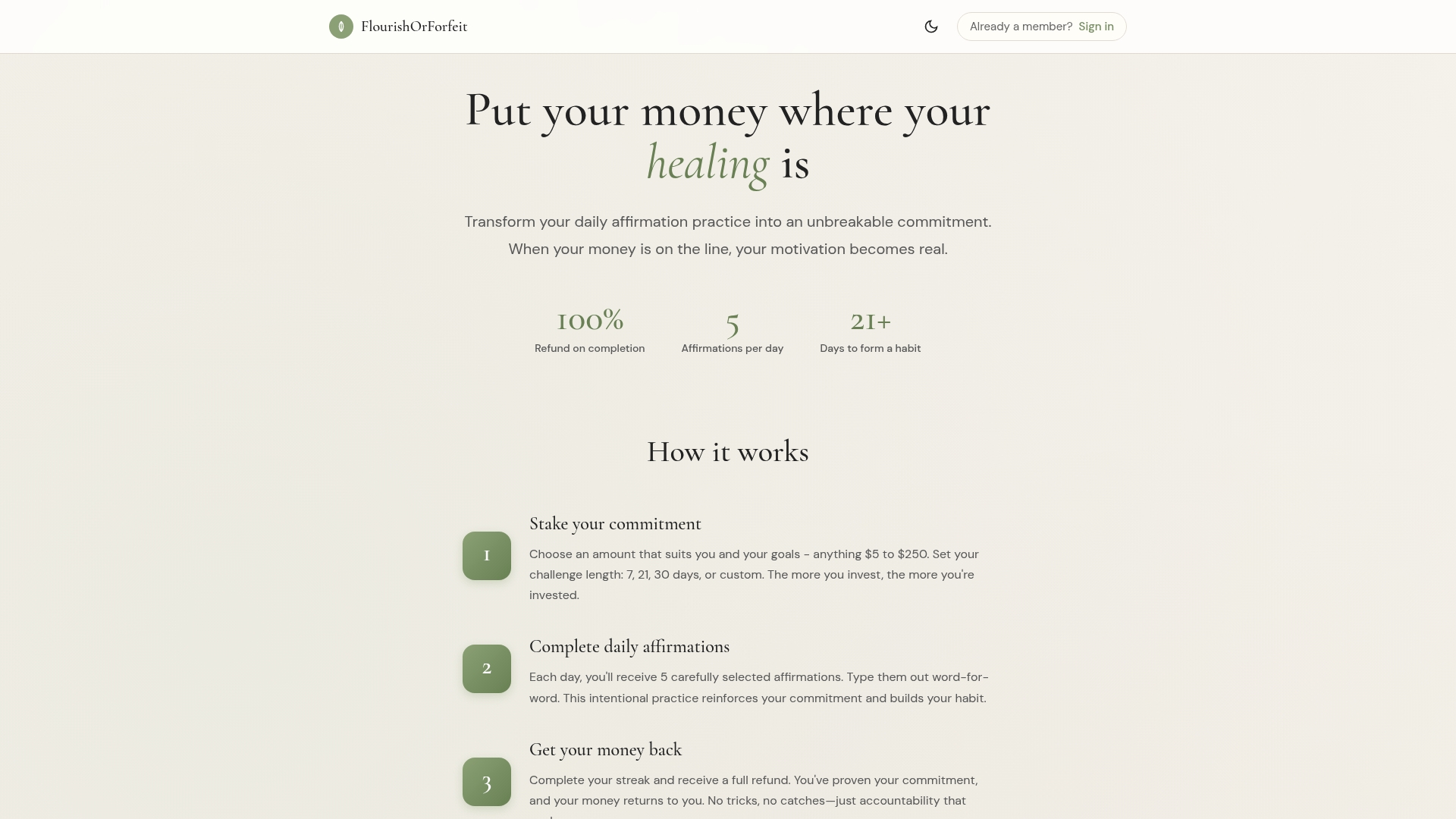
Flourishorforfeit gives you a concrete, low-risk way to test whether financial stakes actually change your behavior. Stake between $5 and $250, type 5 daily affirmations word-for-word, and get every dollar back when you finish. No subscription, no recurring fees.
What you get:
- Stake range of $5–$250 with flexible challenge lengths (7, 21, or 30 days)
- Stripe-secured payments and SMS verification
- Full refund on successful completion
- Mulligan provision for longer challenges
- Research-backed 21-day habit window built into the challenge design
Start with a 7-day challenge at a stake that feels slightly uncomfortable. If you complete it, you've proven the format works for you and your money comes back. That's a low-cost way to find out whether financial accountability is the missing piece.
Selected research and primary sources
- Commitment contracts as a way to health (PMC) — Randomized trial and review evidence on deposit contracts, loss aversion, and success rates versus usual care.
- Personal financial incentives: systematic review and meta-analysis (UCL) — Documents how incentive effects fade after removal and which behaviors show sustained gains.
- Choosing more aggressive commitment contracts for others than for the self (Cambridge Core) — Explains the self-other penalty gap and anti-charity contract dynamics.
- Put a bet on it: Self-funded commitment contracts get people to the gym (Lund University) — Field experiment showing hard contracts increased gym visits by ~21% versus control.
- Incentive-Based Interventions, Gneezy et al. — Covers multi-week incentive schedules, tapering design, and habit carryover evidence.
- Commitment devices: theory and empirics (Yale/EliScholar) — Comprehensive review of hard vs. soft commitment devices and welfare implications.