

Flourishorforfeit is the fastest way to run a stake-backed daily-affirmation challenge with a real habit tracking dashboard. You pick a stake within a moderate range, choose a short trial or longer challenge durations commonly cited for habit formation, type five curated affirmations each day to verify completion, and the dashboard logs your streak automatically. Succeed and you get every dollar back. Miss a day and you forfeit. That single mechanic, loss aversion working in your favor, is why this approach outperforms passive journaling or reminder apps.
What to expect when you follow this playbook:
- A dashboard showing your current streak, today's completion status, and a 30/90-day heatmap
- SMS verification that removes any ambiguity about whether you completed the day
- A Stripe-secured payment flow with a clear refund-on-completion policy
- Typed-affirmation input that forces active engagement instead of a passive checkbox tap
- Challenge durations matched to evidence-backed habit windows (7-day trial, 21/30-day formation)
Table of Contents
- How does Flourishorforfeit's dashboard and stake model work?
- What does the research say about self-monitoring and financial stakes?
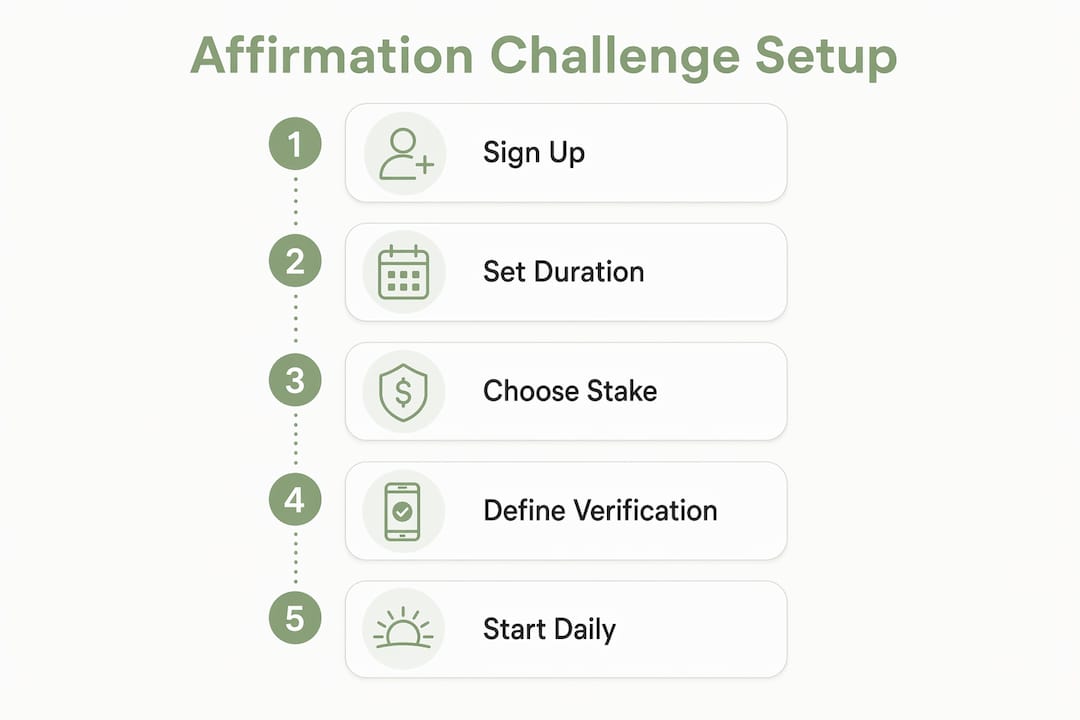
- How to set up a daily-affirmation challenge step by step
- How do you choose the right stake, duration, and verification?
- What dashboard features actually matter for affirmation challenges?
- What payment and privacy signals should you verify before staking money?
- What mistakes kill stake-backed affirmation challenges?
- Which US-available habit tracker apps support financial stakes and dashboards?
- Practical tips for integrating financial stakes with daily affirmations
- Key Takeaways
- Why the design of Flourishorforfeit maps directly to behavioral science
- Flourishorforfeit turns your affirmation practice into a real commitment
- Research and references
How does Flourishorforfeit's dashboard and stake model work?
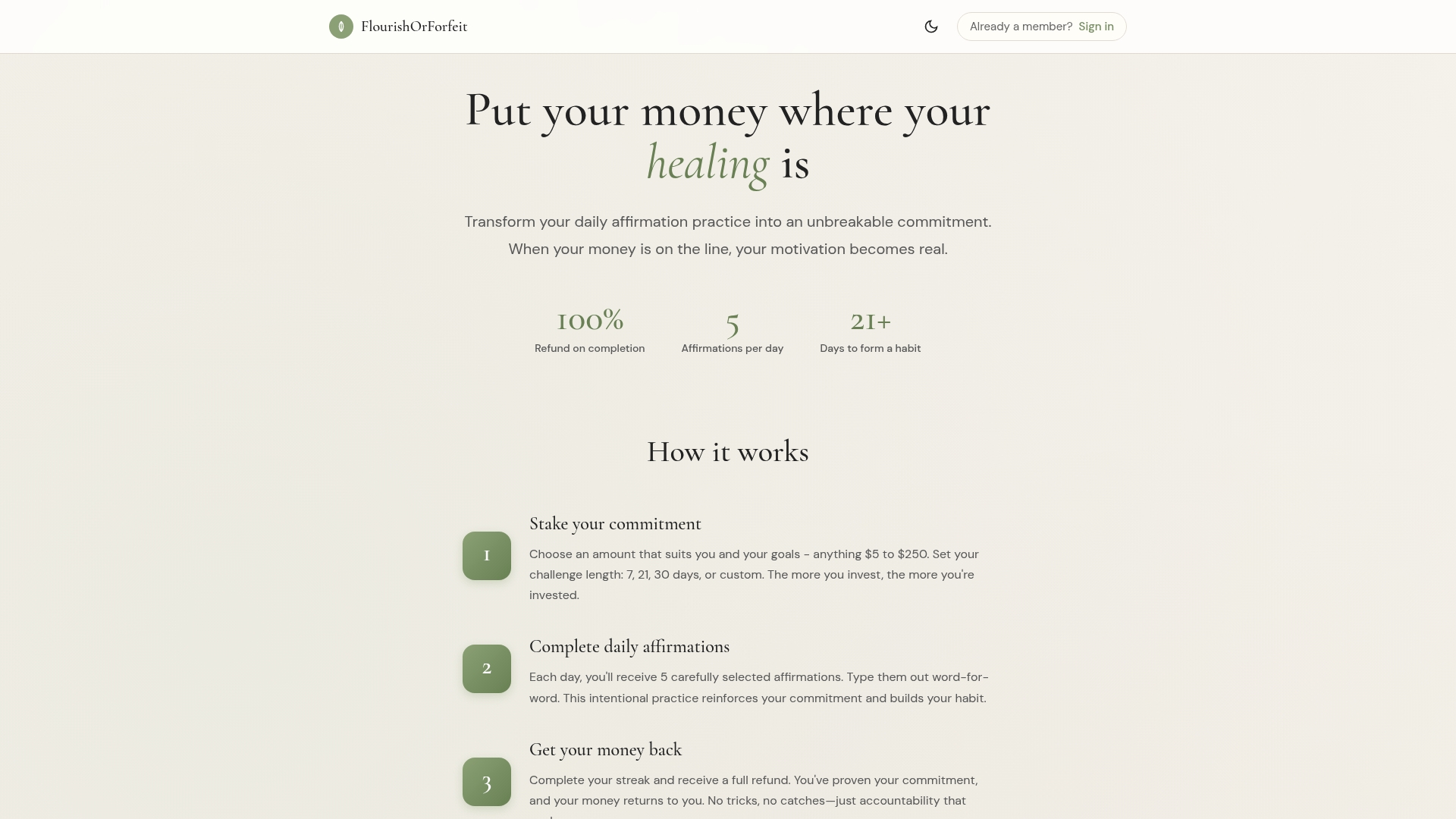
The flow is straightforward. You sign up, configure your challenge, and the platform handles the rest.
| Stage | What happens |
|---|---|
| Setup | Choose duration (7, 21, or 30 days) and stake amount ($5–$250) |
| Daily task | Type five curated affirmations word-for-word to log completion |
| Verification | SMS confirmation locks in your entry for the day |
| Dashboard | Streak counter, completion indicator, and heatmap update immediately |
| Outcome | Full refund on successful completion; stake forfeited on failure |

The dashboard is deliberately minimal. Current streak and today's completion status sit at the top, followed by a heatmap that fills in as days accumulate. Build guides for habit-tracker apps consistently recommend this top-down layout because it drives faster daily check-ins and reduces cognitive load. Longer challenges include a mulligan option so one missed day does not end a 30-day run.
Key trust signals:
- Stripe integration for PCI-compliant payment processing
- Explicit forfeiture and refund terms visible before you commit
- SMS opt-in verification with clear consent language
- Mulligan policy for 21- and 30-day challenges
What does the research say about self-monitoring and financial stakes?
Self-monitoring reliably increases goal attainment by providing immediate feedback that enhances motivation that memory alone cannot replicate. Visual streaks and checkmarks supply micro-rewards that reinforce the habit loop after each completed day.
Financial stakes add a second, stronger layer. A large-scale analysis of real-world commitments covering 742,923 users and 397,456 commitments with a collective $35.5 million on stake found that monetary stakes, external accountability, and reporting frequency are all associated with higher success rates. Commitments lasting multiple weeks with frequent reporting and external accountability performed best.
The behavioral mechanism matters here. Loss aversion implies the pain of losing money is significantly stronger than the pleasure of equivalent gains. A forfeited stake stings more than a missed reward feels good, which is exactly why the forfeit model produces stronger follow-through than reward-only apps.
Psychology Today's review of habit-tracking science confirms that streaks and immediate visual feedback supply the dopamine cues that strengthen habit loops over time. Dashboards act as an external executive-function tool, offloading reminders and logging so the user's mental energy stays on the affirmation itself.
How to set up a daily-affirmation challenge step by step
The whole setup takes about 10 minutes.
- Write your affirmations first. Flourishorforfeit provides multiple curated affirmations per challenge for daily completion. Read them once before day one so typing them feels deliberate, not mechanical.
- Choose your stake. Start at $5–$25 if this is your first round. Higher stakes ($50–$250) work better once you have one successful challenge behind you.
- Pick your duration. A 7-day trial proves the format works for you. A 21- or 30-day challenge is where durable habit formation happens.
- Complete payment via Stripe. The refund and forfeiture terms display at checkout. Read them.
- Enable SMS verification. This is the step most people skip on other platforms. Don't. External verification is one of the strongest predictors of success in commitment research.
- Log daily at the same time. Open the dashboard, type the five affirmations, confirm via SMS. The streak counter updates immediately.
- Check your heatmap weekly. A growing streak of colored squares is a stronger motivator than any notification.
Pro Tip: Don't be discouraged by an empty heatmap on day one or two. The dashboard shows a placeholder until your streak builds. Three days of data is enough to see the pattern start, and that visual progress is what keeps early momentum alive.
How do you choose the right stake, duration, and verification?
Stake size should feel uncomfortable but not catastrophic. That tension is the point.
- $5–$25: Good for first-timers or anyone testing a new affirmation set. Low enough to start without anxiety, high enough to sting if forfeited.
- $50–$100: Appropriate after one successful round. The behavioral intensity increases noticeably at this range.
- $150–$250: Reserve for high-commitment goals where you want maximum deterrence. Only use this range when you have already proven you can complete a shorter challenge.
For duration, the ICWSM dataset points to 6–8 weeks as the sweet spot for durable habit formation. A 7-day challenge is a proof-of-concept run. A 21-day challenge aligns with the commonly cited habit-formation window. A 30-day challenge provides an extended run, and repeating back-to-back approaches this evidence-backed 6–8 week sweet spot for durable habit formation.
SMS or external verification improves accountability and success rates especially when stakes exceed a modest threshold in large-scale commitment data.
Pro Tip: If you are unsure what stake to set, ask yourself: "Would losing this amount genuinely bother me for a day?" If the answer is no, go higher. If it triggers real anxiety, go lower. The sweet spot is mild dread, not paralysis.
What dashboard features actually matter for affirmation challenges?
Not every habit management dashboard is built for stake-backed affirmations. Here is what separates useful from decorative:
Must-have features:
- One-tap or typed-entry logging (typed input increases active commitment)
- SMS verification with clear opt-in consent
- Streak counter visible at the top of the screen
- 30- or 90-day heatmap for visual progress
- Completion-today indicator so you know at a glance whether you are done
- Secure payment processing with explicit refund and forfeiture terms
Performance and UX:
- Fast load on mobile (slow dashboards get skipped)
- Minimal widget clutter — over-customized dashboards slow load times and reduce daily return rates
- Top-down status layout (streak first, heatmap second, history third)
Support features:
- Mulligan option for longer challenges
- Exportable completion history for personal records
- Clear dispute resolution and customer support channel
What payment and privacy signals should you verify before staking money?
Before you commit any amount, confirm these four things:
- Payment processor: Stripe or another PCI-compliant processor. Flourishorforfeit uses Stripe, which means your card data never touches the platform's servers directly.
- Refund and forfeiture terms: These should be written in plain language, not buried in a terms-of-service wall. You need to know exactly what triggers a forfeiture before you pay.
- SMS consent: Verification texts require explicit opt-in. Confirm the platform states how your phone number is used and stored.
- Dispute process: Know where to go if a technical error causes a missed log. A platform with no support channel is a red flag at any stake level.
"Practices like accountability and stakes are not often used but are strong determinants of success." — ICWSM / StickK dataset analysis
What mistakes kill stake-backed affirmation challenges?
Most failures are predictable and avoidable.
- Running too many challenges at once. The ICWSM data shows simultaneous commitments often fail early. One focused affirmation challenge at a time until you clear the initial threshold.
- Skipping SMS verification. Self-reported completion is easy to rationalize. External verification removes that escape hatch.
- Ignoring the heatmap early. An empty grid feels discouraging. Use the placeholder mindset: the first three days are setup, not failure.
- Not reading the fine print. Refund and forfeiture policies vary. Read them at checkout, not after a missed day.
- Setting a stake that doesn't sting. A $5 stake on a $500 monthly budget is noise. Calibrate to your actual financial sensitivity.
Which US-available habit tracker apps support financial stakes and dashboards?
For stake-backed daily affirmations with a built-in visual habit tracking dashboard, Flourishorforfeit is the purpose-built US option. It combines typed-affirmation verification, SMS confirmation, Stripe payments, and a streak-plus-heatmap dashboard in a single platform designed specifically for this use case. General-purpose habit tracking tools like spreadsheet dashboards or productivity apps can track daily habits visually, but they require manual stake enforcement and offer no refund-on-completion mechanic. The accountability gap is significant: without a financial consequence tied to a verified external system, self-reported tracking relies entirely on willpower.
Practical tips for integrating financial stakes with daily affirmations
- Anchor your logging to an existing routine. Right after morning coffee or before your first work task. Habit stacking reduces the chance of forgetting.
- Type slowly and deliberately. The typed-affirmation format works because it forces attention. Rushing defeats the purpose.
- Tell one person about your challenge. External accountability and social support both correlate with higher success rates in commitment research.
- Review your heatmap every Sunday. Weekly reflection converts daily data into a visible narrative of consistency.
- After a successful round, raise the stake. Graduated stakes keep the loss-aversion mechanism active as the habit becomes easier.
Key Takeaways
A habit tracker with dashboard and financial stakes outperforms passive tracking because loss aversion and immediate visual feedback work together to drive daily follow-through.
| Point | Details |
|---|---|
| Financial stakes drive adherence | The ICWSM dataset of 742,923 users and 397,456 commitments with a collective $35.5 million on stake confirms monetary stakes are strong determinants of success. |
| Typed affirmations increase commitment | Word-for-word entry forces active engagement, unlike a passive checkbox tap. |
| SMS verification closes the accountability gap | External verification removes self-reporting bias and correlates with higher success rates. |
| Dashboard simplicity matters | Top-down layout (streak, completion today, heatmap) drives faster daily check-ins and less friction. |
| Flourishorforfeit is the purpose-built option | Stake ranges of $5–$250, 7/21/30-day durations, Stripe payments, and refund-on-completion in one platform. |
Why the design of Flourishorforfeit maps directly to behavioral science
Most habit apps treat accountability as a feature. Flourishorforfeit treats it as the product. The typed-affirmation requirement is not a quirk; it is a deliberate friction that forces conscious engagement, which is exactly what self-monitoring research shows increases goal attainment. The refund-on-completion model flips the standard reward structure: instead of earning something new, you are protecting something you already paid. That framing activates loss aversion far more reliably than a badge or a notification. SMS verification closes the loop by making completion externally verifiable, which the ICWSM data identifies as one of the strongest predictors of success across hundreds of thousands of real commitments. The design choices are not cosmetic. They are the mechanism.
Flourishorforfeit turns your affirmation practice into a real commitment
If you have been tracking daily habits in a notes app or a spreadsheet and still skipping days, the missing ingredient is almost always consequence. Flourishorforfeit gives you a clean dashboard for habits, Stripe-secured stakes from $5 to $250, SMS-verified daily affirmations, and a full refund when you finish. The platform is built for exactly this: people who want their affirmation practice to mean something beyond good intentions.
Select a stake between $5 and $250, pick your duration, and start your challenge today. The refund is waiting for you on the other side.
Research and references
- Put Your Money Where Your Mouth Is: ICWSM / StickK dataset — Primary source for stake effectiveness, accountability structures, and the 742,923-user dataset cited throughout.
- Self-monitoring effect (EasyHabits) — Meta-analytic support for self-monitoring and goal attainment.
- The science behind habit tracking (Psychology Today) — Behavioral mechanisms: streaks, dopamine, and habit-loop reinforcement.
- How to build a habit tracker app (Blink) — UX best practices: top-down layout, one-tap logging, and the early-placeholder approach.
- Habit tracker Notion dashboard (Widgetly) — Dashboard customization trade-offs and performance considerations.
- Kick that habit (IITM Shaastra) — Real-world accountability structures and external referee effects.