

What are the best habit trackers for 2026?
The strongest habit tracker solutions for 2025 span three formats: dedicated apps with analytics and gamification, customizable digital templates, and printable sheets you can pin to your wall. No single format wins for everyone. Your choice depends on whether you want data, flexibility, or zero screen time.
| App/Tool | Type | Platform | Price | Best For | Customization | Gamification | Analytics | Ease of Use |
|---|---|---|---|---|---|---|---|---|
| TickTick | Productivity app | iOS, Android, Web | Free / Premium | Cross-platform + task management | High | No | Weekly/monthly charts | Moderate |
| Habitica | Gamified app | iOS, Android, Web | Free / Premium | Game mechanics + community | Moderate | Full RPG system | Basic | Easy |
| Loop | Minimalist app | Android | Free (open-source) | Simple, ad-free tracking | Low | No | Heatmaps, scores | Very easy |
| Streaks | Streak-focused app | iOS only | $4.99 one-time | Apple users, streak motivation | Moderate | Streak rings | Calendar heatmap | Very easy |
| Habitify | Analytics app | iOS, Android, Mac | Free / Premium | Detailed insights + reminders | Moderate | No | Completion trends | Easy |
| Pattrn | Simple app | iOS | Free / Premium | Quick daily logging | Low | No | Basic | Very easy |
| Everyday | Minimalist app | iOS, Web | Free / Premium | Daily routine consistency | Low | No | Streak calendar | Very easy |
| Done | Streak/visual app | iOS | Free / Premium | Visual streak progress | Moderate | No | Streak visualization | Easy |
| HabitNow | Goal-focused app | Android | Free / Premium | Goal setting + reminders | High | No | Basic | Easy |
The apps above cover the four main categories industry reviews identify: standalone trackers, productivity-integrated apps, gamified platforms, and minimalist options. Printable and Notion-based templates fill a fifth lane for users who prefer analog or fully custom setups.
How to select the ideal habit tracker for your 2025 goals
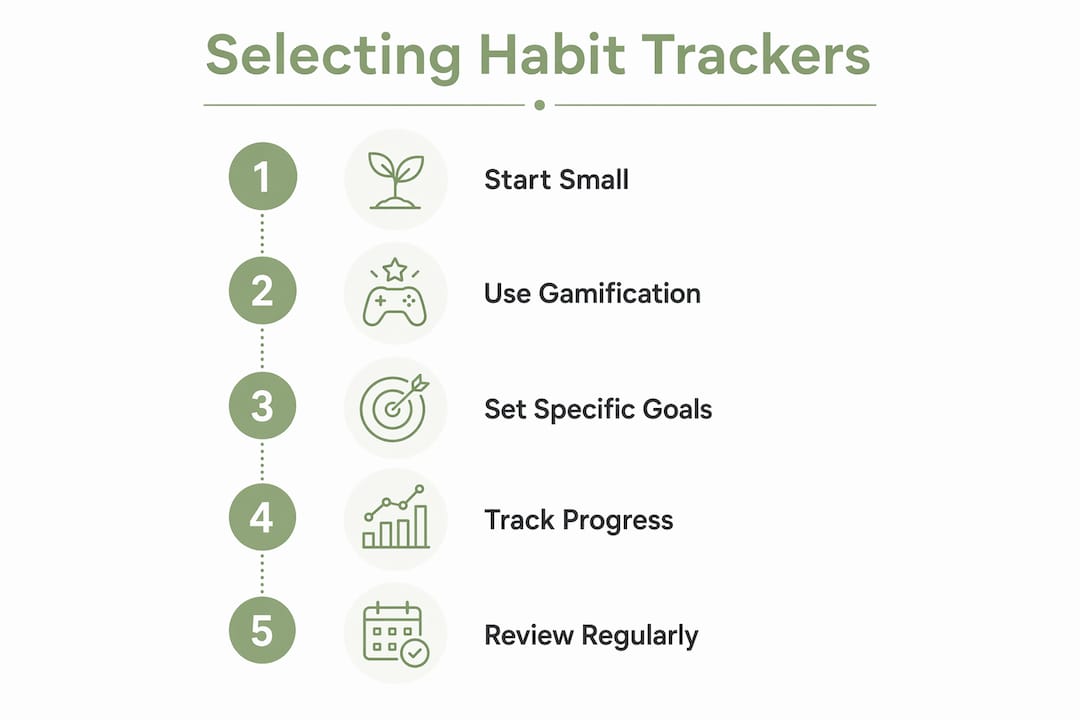
The single biggest mistake people make is picking the most feature-rich app and then abandoning it by week three. Feature overload is a real dropout driver. Start with what you actually need, not what looks impressive in screenshots.
Key selection factors:
- Habit type: Physical habits (exercise, sleep) benefit from measurable tracking and reminders. Mental habits (journaling, meditation) often work better with simple check-off systems.
- Platform preference: iOS users have Streaks and Done as polished native options. Android users get Loop for free and open-source reliability. Cross-platform users should look at TickTick or Habitify.
- Goal specificity: Apps like HabitNow and TickTick let you attach goals directly to habits. Minimalist apps like Everyday and Pattrn skip that layer entirely.
- Privacy: Loop stores all data locally on your device. Cloud-based apps like Habitica and Habitify sync to external servers, so check their privacy policies if that matters to you.
- Integration: TickTick connects with Google Calendar and task management workflows. Habitify offers Apple Watch and widget support. Most printable templates require no integration at all.
Pro Tip: Start with three habits maximum. Research on behavior change consistently shows that tracking too many habits at once leads to abandoning all of them. Build the tracking routine first, then add habits one at a time.
Gamification suits users who need external motivation early on. But if you already care about the habit, game mechanics can actually get in the way. Streaks and Habitica work brilliantly for some people and feel patronizing to others. Know which camp you're in before you commit.
Printable and digital habit tracker templates worth using in 2026
Printable trackers remain genuinely useful, especially for people who spend too much time on screens already. A monthly grid you fill in with a pen creates a tactile record that no app quite replicates.
Common printable formats:
- Monthly grid: One row per habit, one column per day. Simple, visual, and printable from any PDF. Etsy and Pinterest host hundreds of free and paid versions updated for 2025.
- Planner-style: Weekly layouts with space for notes and reflection. Works well alongside bullet journals or physical planners like the Passion Planner.
- Themed trackers: Color-coded designs for specific goal areas (fitness, reading, hydration). Popular on sites like Canva, where you can edit them directly before printing.
Digital templates occupy a middle ground between apps and paper. Notion-based habit trackers are the most popular in this category. A well-built Notion template gives you a monthly calendar view, habit checkboxes, and streak counts without requiring a subscription to a dedicated app. Gumroad and Etsy both sell polished Notion habit tracker templates for $5–$15, and several creators offer free versions.
Google Sheets trackers are another strong option. They're free, fully customizable, and accessible on any device. The tradeoff is that you build the logic yourself, or find a pre-built template, since Sheets has no built-in habit-tracking features.

What printable and template-based trackers do well: They work offline, they don't send you notifications, and they don't try to retain your attention. For users who want habit formation without app dependence, they're often the better long-term choice.
Top updated habit tracker apps available in 2026
The comparison table in the first section covers the full lineup. Here's where the meaningful differences actually show up in practice.
TickTick stands out because it doesn't ask you to choose between habit tracking and task management. You get both in one place, with weekly and monthly completion charts and support for any custom frequency. It's the strongest pick for users who already live in a task manager.

Habitica takes a completely different approach. Missing a habit causes your RPG avatar to take damage. Your party members suffer too, which adds real social accountability. That mechanic works well for users motivated by community and game rewards, though it can feel absurd to users who just want a clean checklist.
Loop is the best free option on Android, full stop. It's open-source, contains no ads, and shows habit strength scores and heatmaps. The tradeoff is that it's Android-only and the interface is functional rather than beautiful.
Streaks costs $4.99 once and runs only on iOS. Its ring-based progress display is the cleanest streak visualization in the category. It supports up to 24 habits with flexible scheduling, including daily, weekly, and custom frequencies.
Habitify earns its place for data-focused users. Completion rate trends over 30, 60, and 90-day windows, plus Apple Watch and widget support, make it the analytics leader among dedicated habit apps. The free tier covers three habits.
Pattrn and Everyday both prioritize speed of input over depth of analysis. If you want to log a habit in under two seconds and move on, either works. Everyday adds a clean web app alongside its iOS version.
Done focuses on visual streak progress and supports habits you want to do multiple times per day, which most apps handle poorly. HabitNow, the only Android-native option in this group, combines goal setting with reminders and high customization.
On privacy: Loop's local-only storage is the most private option. For cloud-synced apps, review each app's data policy before entering personal health or behavioral data.
What does the research actually say about habit tracking in 2026?
Self-monitoring works. A meta-analysis of 138 studies with nearly 20,000 participants found that monitoring goal progress produces a medium effect size on goal attainment, and that more frequent monitoring produces better outcomes than weekly check-ins. That's the foundation everything else builds on.
But tracking alone is weaker than tracking tied to a specific goal. Research consistently shows that connecting behavior recording to clear intentions produces significantly larger effect sizes than passive logging. An app that records whether you did something without asking why you're doing it leaves effectiveness on the table.
Reminders and incentives compound the effect further. A pilot randomized controlled trial found that daily reminders combined with monetary incentives raised adherence higher than that of the control group. The mechanism is behavioral economics: reminders increase salience, and stakes counter present bias.
Streaks have a documented failure mode. When users break a streak, many experience what researchers call the "what-the-hell effect" and abandon the habit entirely rather than simply resuming. Apps that visualize progress as trends or percentages rather than fragile streak counts tend to produce better long-term outcomes for users prone to this response.
Most apps also neglect the later stages of habit formation, specifically context anchoring and the gradual phasing out of app dependence. A habit that requires an app reminder to trigger it indefinitely hasn't actually become automatic. The goal is to eventually not need the tracker.
Pro Tip: View your tracker as a diagnostic tool, not a performance review. A missed day is information about your system, not a verdict on your character. Adjust the trigger or the habit definition rather than quitting.
A different kind of habit commitment: Flourishorforfeit
Most habit apps track whether you showed up. Flourishorforfeit raises the stakes by making you pay if you fail.
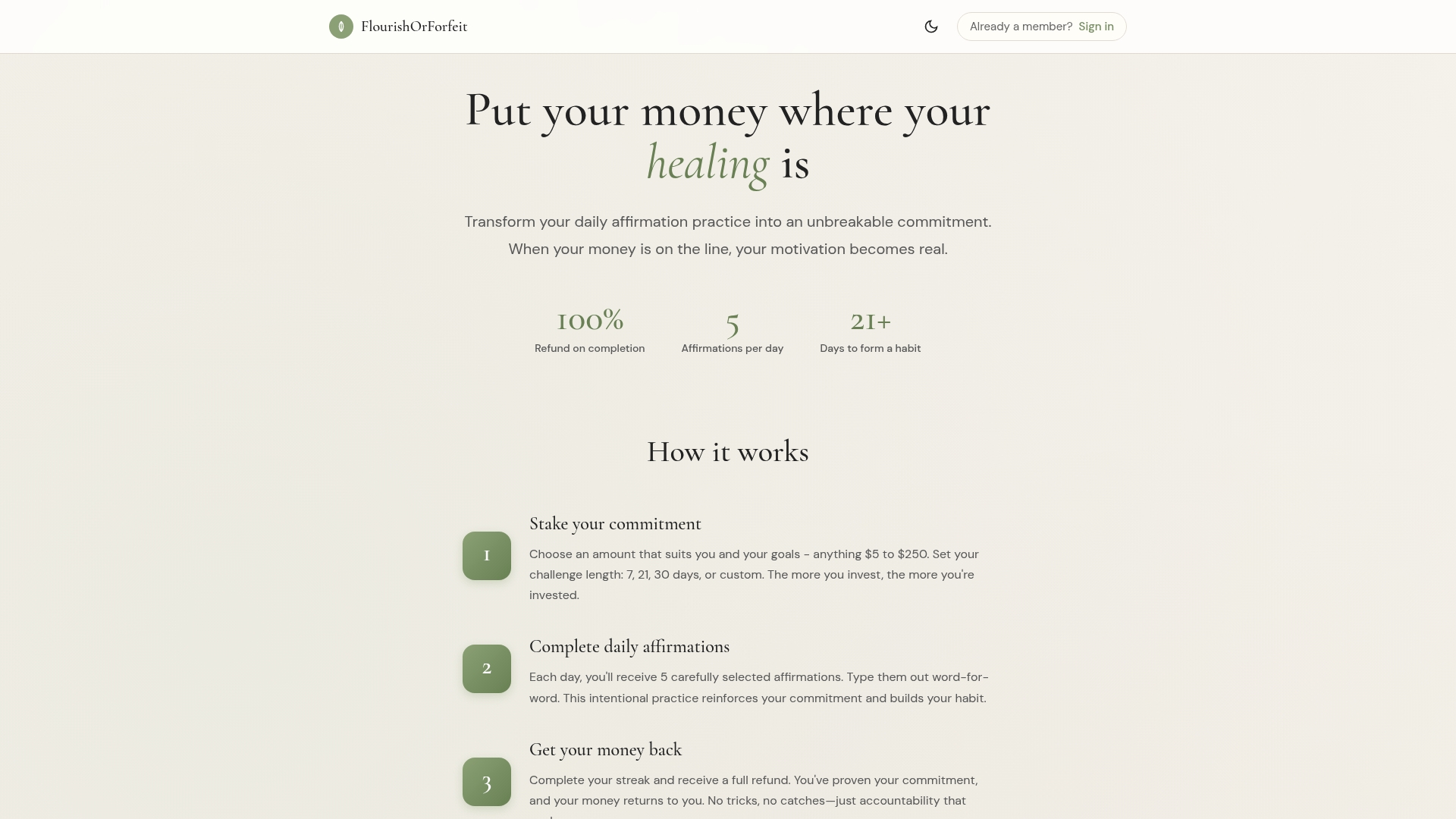
Flourishorforfeit is a commitment-based platform where you stake between $5 and $250 on completing a daily affirmation challenge over 7, 21, or 30 days. You type five curated affirmations word-for-word each day. Complete the challenge and you get a full refund. Miss a day without using your mulligan and you forfeit the stake. Payments run through Stripe, and your progress is tracked through a personal dashboard with SMS verification.
It's a different category from the apps compared above. Where TickTick or Habitify track behavior passively, Flourishorforfeit creates a financial commitment that makes skipping genuinely costly. For users who've tried tracking apps and found them too easy to ignore, that concrete stake changes the equation.
Key Takeaways
The most effective habit trackers in 2025 combine frequent self-monitoring with specific goal-setting, since tracking tied to clear intentions produces meaningfully stronger results than passive logging alone.
| Point | Details |
|---|---|
| Tracking works best with goals | A meta-analysis of 138 studies found self-monitoring produces a medium effect size, strongest when linked to specific intentions. |
| Format depends on your needs | Apps suit data-driven users; printable and Notion templates work better for those avoiding screen time. |
| Streaks can backfire | Apps showing completion percentages or trend views reduce the risk of full abandonment after a missed day. |
| Most apps skip late-stage habit support | Context anchoring and phasing out app dependence are rarely supported, yet both are critical for lasting automaticity. |
| Flourishorforfeit adds financial stakes | For users who need more than a reminder, staking $5–$250 on a 7, 21, or 30-day challenge creates real accountability. |