

Staking real money on a daily habit is one of the most effective behavior change tools behavioral economics has produced. A habit-driven financial commitment challenge works by requiring you to deposit money upfront, which you only get back if you complete every day of your chosen challenge. Miss a day, and you forfeit the stake. That immediate financial risk converts a vague intention into a concrete, daily obligation. Flourishorforfeit applies this principle directly to daily affirmations, letting you stake $5 to $250 over 7, 21, or 30 days to build a habit-based lifestyle grounded in real accountability.
TLDR: Financial commitment challenges use loss aversion to make habit formation stick. You stake money, complete daily affirmations word-for-word, and get a full refund on success. The financial risk is the mechanism, not the goal.
Table of Contents
- How habit-driven commitment contracts actually work
- What the daily challenge cycle looks like in practice
- Key success factors for developing good habits with financial stakes
- How Flourishorforfeit structures the challenge for you
- Tracking your progress and measuring whether it's working
- Key Takeaways
- Put your money where your habit is with Flourishorforfeit
How habit-driven commitment contracts actually work
Commitment contracts are classified as "hard" commitment devices in behavioral economics because they attach real monetary consequences to behavior. The distinction from "soft" commitments matters. A soft commitment is a promise to yourself or a note on your mirror. A hard commitment puts money on the line, and the psychology shifts entirely.
The core mechanism is loss aversion: people are more motivated to avoid losing something they already have than to gain an equivalent reward. When you deposit $100 into a challenge, that $100 feels like yours to lose, not a bonus to earn. That framing increases motivation in ways that reward-only programs rarely match.
Research from a large-scale field experiment tracking over 4,000 participants found that people who added a commitment contract after an incentive program ended showed significant long-run behavior changes, detectable even years later. Shorter incentive programs alone produced only small lasting effects.
- Hard commitments (monetary stakes) outperform soft commitments for sustained behavior change.
- Loss aversion makes financial stakes psychologically more powerful than equivalent rewards.
- Peer or provider witnessing of a commitment contract further strengthens accountability and outcomes.
Key finding: Financial incentives sustained behavior change up to 18 months from baseline, with effects remaining three months after incentive removal, before dissipating without habit integration.
What the daily challenge cycle looks like in practice
The mechanics of a financial affirmation challenge are straightforward, and that simplicity is part of why they work.
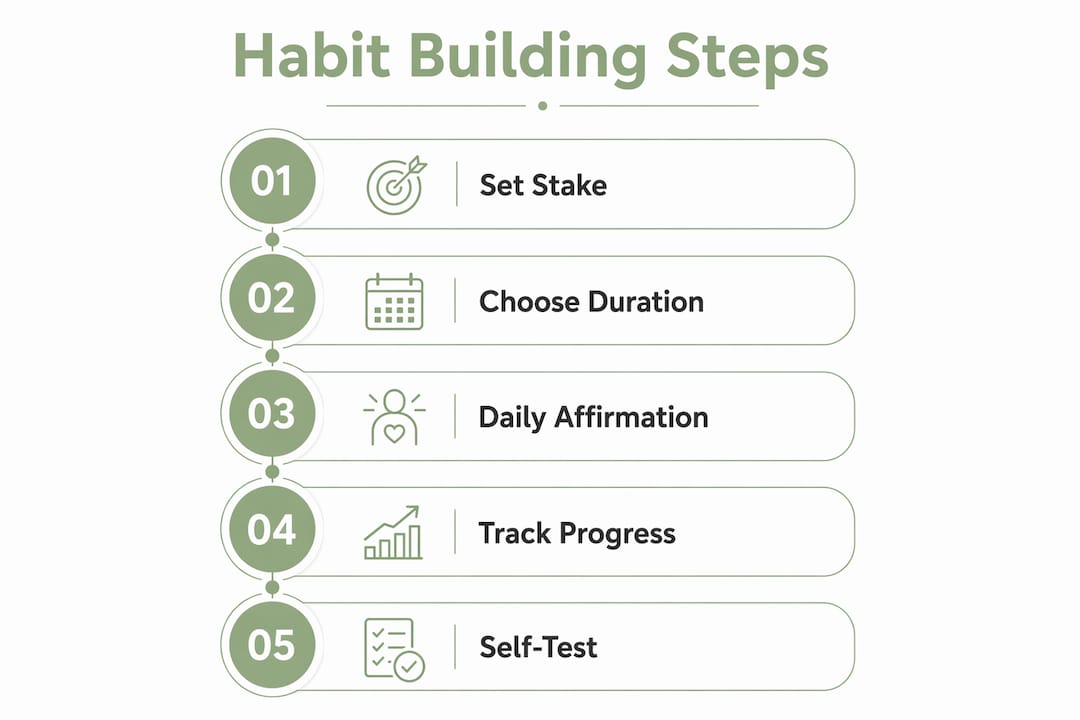
- Choose your stake. You select an amount that feels meaningful without being paralyzing.
- Pick your duration. Options with varying durations align with the widely cited habit formation window, with longer durations producing stronger behavioral routines.
- Complete daily affirmations. Each day, you type five curated affirmations word-for-word. Typing, rather than reading passively, forces active engagement with the content.
- Verify and track. SMS verification and a progress dashboard confirm completion and keep your streak visible.
- Collect your refund or forfeit. Finish every day and your full stake comes back. Miss one, and you lose it.
The typing requirement is not arbitrary. Active recall and physical engagement with a statement reinforce neural pathways differently than passive reading. Pairing that with a financial consequence makes each session feel weighted.
Pro Tip: Schedule your affirmation session at the same time each day, attached to an existing routine like morning coffee or brushing your teeth. Consistency in timing accelerates habit formation faster than doing it whenever you remember.

Key success factors for developing good habits with financial stakes
Getting the most from a financial commitment challenge comes down to a few decisions made before you start.
Set the right stake amount. Practitioners emphasize a balance point: large enough to create genuine discomfort at the thought of losing it, small enough that the stress of the amount does not itself become a reason to quit. For most people, that sits within a moderate range, though the right amount is personal.
Choose a longer duration deliberately. The field experiment data is clear that longer contracts produce stronger habit formation. A 30-day challenge gives the behavior more time to become automatic. A 7-day challenge is a useful entry point, but it rarely produces the cue-triggered automaticity that defines a true habit.
Treat the stake as a tool, not a goal. The Annual Review of Psychology research is direct on this: financial stakes must support routine-building, not replace intrinsic motivation. If you complete affirmations only to avoid losing money, the habit often collapses once the financial pressure is gone. The goal is to build a cue-triggered routine that persists on its own.
- Use a mulligan option on longer challenges to recover from a single missed day without forfeiting entirely.
- Anchor your affirmation to a consistent environmental cue, the same location, the same time.
- Financial incentives work best when paired with habit integration into daily life, not treated as standalone motivation.
Pro Tip: After week two of a 30-day challenge, write down one way the affirmation content has changed how you think or act. That reflection builds intrinsic connection to the habit, which is what carries it past the challenge's end date.
How Flourishorforfeit structures the challenge for you
Flourishorforfeit is built around the specific mechanics that behavioral research identifies as effective. Every design decision on the platform connects to a known lever in habit formation.
- Stake range of $5–$250 lets you calibrate financial pressure to your personal motivation threshold.
- Three duration options (7, 21, or 30 days) map directly to the habit formation research consensus on duration and behavioral automation.
- Word-for-word affirmation typing creates active engagement rather than passive exposure.
- Stripe-integrated secure payments handle the financial transaction with no friction or ambiguity about the terms.
- SMS verification adds a daily accountability touchpoint outside the app environment.
- Progress dashboard makes your streak visible, which itself functions as a behavioral cue to continue.
- Mulligan option on longer challenges gives you one recovery day without losing your entire stake, reducing the all-or-nothing anxiety that causes early dropout.
The combination of secure payments and SMS verification increases user engagement and trust in the daily challenge process. Flourishorforfeit's 21-day and 30-day options align with the habit formation window that behavioral research consistently identifies as the threshold for behavioral automation.
Pro Tip: Use the dashboard streak as a visual cue. When you see a long streak, the thought of breaking it becomes its own form of loss aversion, layered on top of the financial stake.
Tracking your progress and measuring whether it's working
Progress in a financial commitment challenge is partly visible and partly something you have to measure yourself.
The platform dashboard handles the objective layer: daily completion, streak length, and challenge status are tracked automatically. But habit formation is a behavioral shift, not just a completion record. To measure whether the habit is actually forming, track two things separately.
First, notice whether the affirmation session starts to feel automatic rather than effortful. Early in a challenge, you remember to do it because you are afraid of losing money. Later, if the habit is forming, you start before you consciously think about it. That shift is the real signal.
Second, watch what happens to your behavior outside the challenge. Long-term behavior change requires that the incentivized action integrates into daily life through social norms, motivation, and cue-triggered repetition. If the affirmation content starts influencing decisions you make during the day, the habit is moving beyond the challenge structure.
After a challenge ends, run a simple self-test: go seven days without the financial stake and see whether the behavior continues. If it does, you have built something real.
Key Takeaways
Financial commitment challenges are most effective when the stake is personally meaningful, the duration is at least 21 days, and the habit is anchored to a consistent daily cue.
| Point | Details |
|---|---|
| Loss aversion is the core mechanism | Financial stakes motivate because losing money feels worse than gaining an equal reward. |
| Duration determines habit strength | Longer contracts produce stronger and more lasting behavioral routines. |
| Stakes are tools, not goals | Financial pressure must support routine-building; intrinsic motivation carries the habit past the challenge. |
| Track automaticity, not just completion | A habit is forming when the session starts before you consciously decide to do it. |
| Flourishorforfeit | Offers $5–$250 stakes, 7/21/30-day durations, SMS verification, and a full refund on completion. |
Put your money where your habit is with Flourishorforfeit
Most habit-building approaches ask you to rely on willpower. Flourishorforfeit asks you to put something real on the line instead.
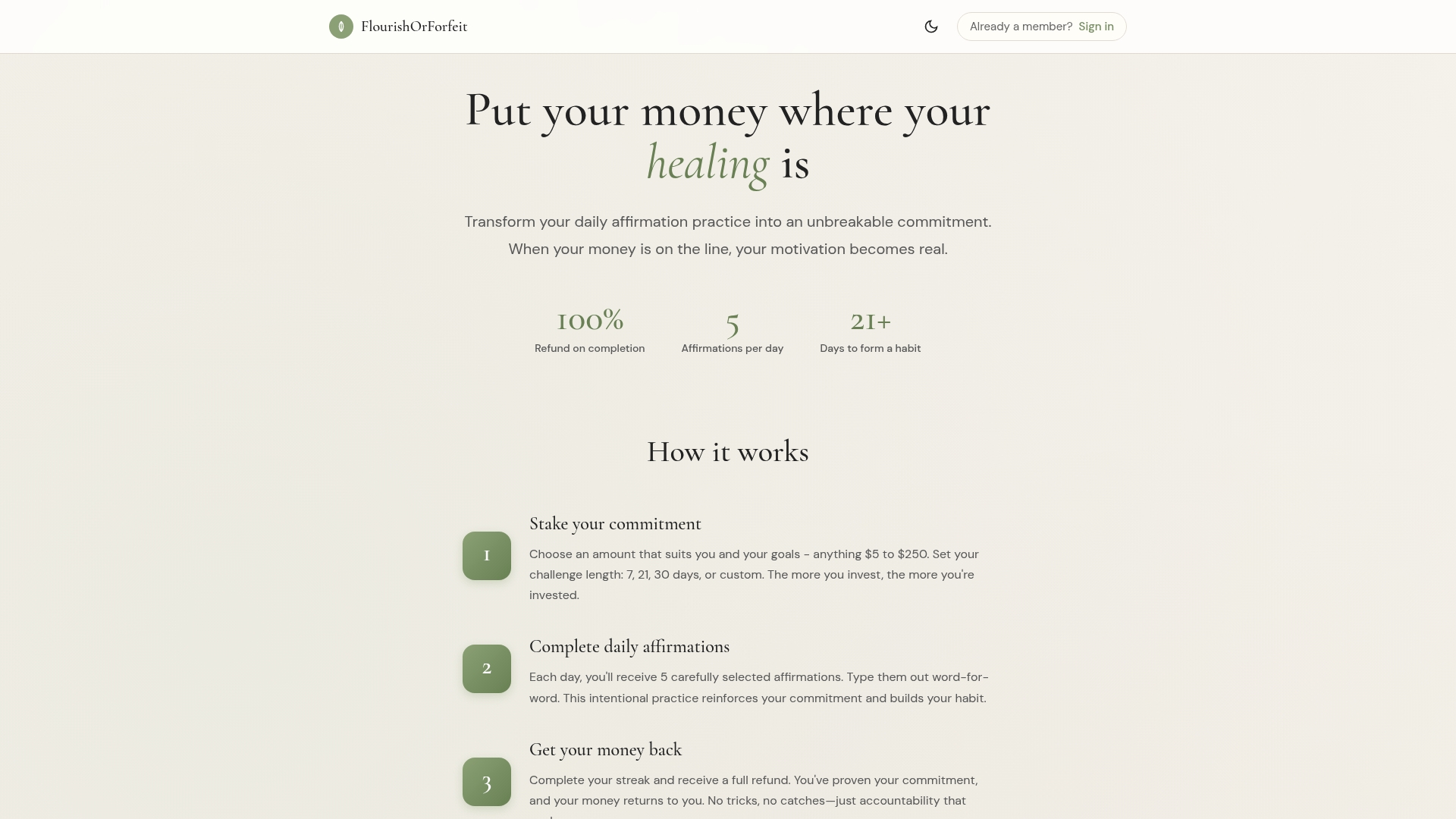
The platform gives you a stake between $5 and $250, a challenge duration of 7, 21, or 30 days, and five daily affirmations you type word-for-word to confirm completion. Finish every day and your full stake comes back. Miss one and you forfeit it. The financial structure is simple, the accountability is built in through SMS verification and a live dashboard, and the mulligan option on longer challenges means one bad morning does not end your streak.
If you are ready to stop intending and start building, start your challenge at Flourishorforfeit today.