

A ready-to-use, printable goal contract template is right here. Copy it, paste it into Word or Google Docs, print it, sign it, and start today. No account required, no waiting.
The template includes every field you need:
- Goal statement: one specific, measurable outcome
- Action steps: the exact behaviors you will perform
- Success criteria: binary pass/fail definition
- Start date, end date, and check-in schedule
- Accountability partner / referee name and contact
- Consequences or stakes (penalty for breach, reward for completion)
- Resources and support you will use
- Signature lines for you and your referee
Table of Contents
- What does a goal contract template look like?
- How do you fill out and customize the contract?
- What does a completed contract example look like?
- What does the research say about commitment contracts?
- How do you sign and store the contract?
- Key Takeaways
- Why a signed contract changes behavior more than a goal list
- Flourishorforfeit puts financial stakes on autopilot
What does a goal contract template look like?
Copy the block below and paste it anywhere you can print or share it.
GOAL COMMITMENT CONTRACT
I, _____________________________ (full name), commit to the following goal:
Goal Statement:
Specific Action Steps (what I will do, how often):
Measurable Success Criteria (how I know I succeeded):
Start Date: _____________ End Date: _____________ Duration: ________ days
Check-In Schedule (frequency and method):
Accountability Partner / Referee: Name: __________________________ Contact: _________________________________
Consequence if I breach this contract:
Reward if I complete this contract:
Resources / Support I will use:
Signed (Committed Party): _________________________ Date: _____________
Signed (Referee / Witness): _________________________ Date: _____________
Not every commitment contract is built the same way. The style you choose affects how seriously you and your referee treat it.
| Style | Effectiveness | Ease of setup | Emotional cost | Enforceability |
|---|---|---|---|---|
| Financial-stakes contract | High | Moderate | High | Strong |
| Social-accountability contract | Moderate | Easy | Moderate | Moderate |
| Soft-promise contract | Low | Very easy | Low | Weak |
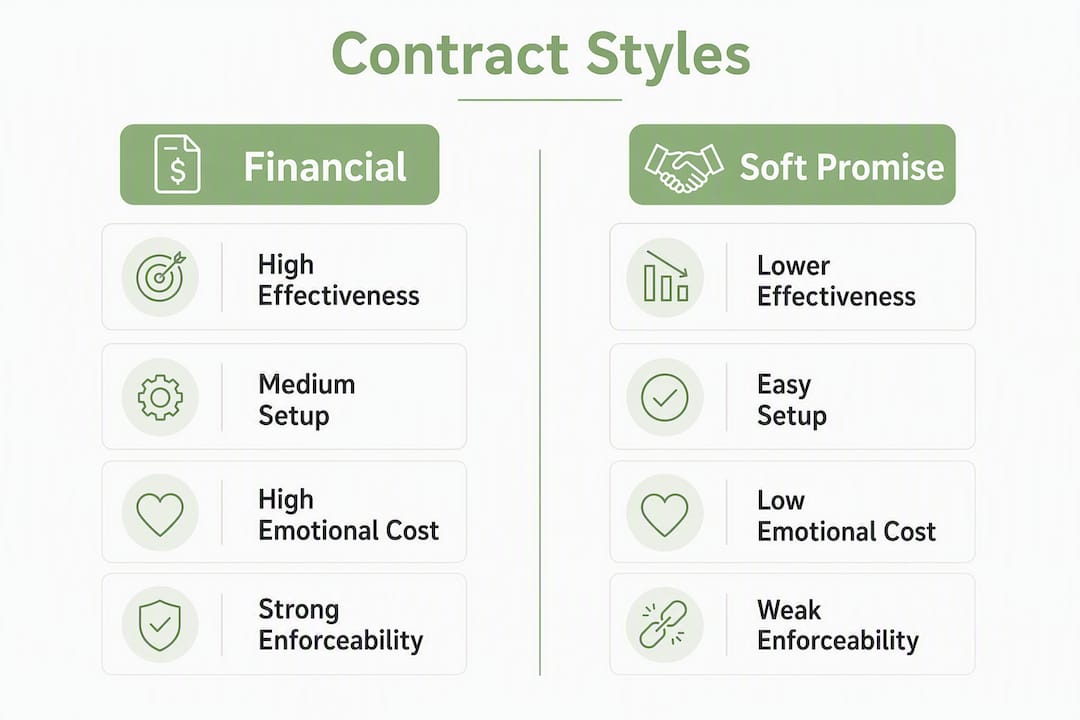
Research confirms that financial stakes outperform soft promises because loss aversion makes the cost of failure feel real. Social accountability sits in the middle: a referee who knows your goal helps, but without money on the line, it is easier to rationalize a miss.
How do you fill out and customize the contract?
Write one goal, not five. The most common mistake is stacking multiple goals into a single contract. Pick one. A contract that covers running, diet, and journaling simultaneously gives you three ways to negotiate with yourself when motivation dips.

Make the success criteria binary. "Exercise more" fails as a criterion because it has no clear breach point. "Run 20 minutes before 8 AM every weekday" passes or fails each day with zero ambiguity. Practical guides consistently recommend keeping the habit single and all-or-nothing, because binary rules remove the gray area where self-negotiation lives.
Apply SMART framing to the goal statement field. Specific, Measurable, Achievable, Relevant, and Time-bound. Write the goal as a complete sentence: "I will complete a 20-minute run before 8 AM on every weekday from March 3 to April 2, 2026." That sentence alone answers who, what, when, and how long.
Choose a consequence that actually stings. A $5 penalty you can absorb without noticing will not change your behavior. Behavioral research shows people consistently pick harsher penalties for others than for themselves, which means your first instinct about your own penalty is probably too soft. Push it one level higher than feels comfortable.
Name a specific referee, not a vague "someone." Your referee needs a name, a phone number, and explicit permission to enforce the penalty. A friend who "knows about your goal" is not a referee. A friend who has agreed to collect $50 from you if you miss a day is.
Common personalization mistakes:
- Fuzzy success criteria ("do better at sleep")
- No named referee, just a general social circle
- Penalty that resets or expires mid-contract
- Goal that depends on external factors you cannot control
Pro Tip: Make the penalty painful enough that you think about it before you go to bed. If you can shrug it off in advance, it will not hold.
Pro Tip: Pre-commit to enforcement in writing. Add a line to the contract: "My referee has my permission to collect the penalty without asking me first."
What does a completed contract example look like?
Goal: Complete a 30-day morning run habit. Action: Run outdoors for at least 20 minutes before 8 AM, every weekday (Monday through Friday). Success criteria: 20 of 22 weekdays completed (one mulligan allowed). Start: March 3, 2026. End: April 2, 2026. Check-ins: Text my referee a post-run photo by 8:15 AM each weekday. Referee: Jamie Reyes, 555-0147. Penalty: $50 sent to Jamie if I miss more than one day. Reward: New running shoes if I complete the contract. Signed: Alex M. — March 3, 2026 | Jamie R. — March 3, 2026
The photo-text check-in is the key structural choice here. It creates a time-stamped record that neither party can dispute, and it makes skipping feel immediately visible rather than quietly private. The habit contract framework from James Clear's Atomic Habits uses the same logic: a public, painful penalty plus daily reporting.
What does the research say about commitment contracts?
The evidence is clear enough to shape how you design your contract. Financial stakes improve success rates compared with non-monetary alternatives, with larger stakes producing better outcomes through loss aversion. Randomized controlled trials show that external referees and mandatory check-ins increase the likelihood of hitting short-term habit goals at six-month markers.
One important caveat: time-varying penalties that can be switched off can actually reverse the behavior gains once removed. Build your penalty as a fixed, pre-paid deposit rather than a recurring threat you can cancel.
Practical implications for your contract setup:
- Use binary daily checks, not weekly averages
- Name an external referee with real enforcement authority
- Pre-pay or pre-commit the stake so it cannot be quietly cancelled
- Keep the contract duration short (21–30 days) for a first run
- Schedule check-ins at a fixed time so they become part of the routine
How do you sign and store the contract?
Signing checklist:
- Write today's date before you sign
- Print your full name, then sign in cursive or initials
- Have your referee sign and date the same copy
- Keep a printed copy somewhere visible (desk, fridge)
- Scan or photograph it and store it in cloud storage or email it to yourself
- Send your referee their own copy
A personal commitment contract is a moral and accountability tool, not a legally enforceable agreement. For binding financial obligations, consult a qualified attorney. For most personal development goals, the social and financial weight of a signed document is more than enough.
Recordkeeping tip: Use time-stamped texts, photos, or a short daily log entry as your check-in record. If a dispute arises about whether you completed a day, a 7:58 AM photo is better evidence than a memory.
Resist renegotiating once the contract is signed. The moment you start adjusting terms mid-contract, you have converted a commitment into a wish.
Key Takeaways
A signed goal commitment contract with a financial stake, a named referee, and binary daily checks gives you the strongest setup the research supports.
| Point | Details |
|---|---|
| One goal per contract | Multiple goals create room for self-negotiation; one goal keeps the breach condition clear. |
| Binary success criteria | Pass/fail rules remove gray areas and make enforcement straightforward for your referee. |
| Financial stake matters | Research confirms larger financial stakes correlate with higher achievement through loss aversion. |
| Name a real referee | A named person with explicit enforcement authority outperforms a vague social circle. |
| Flourishorforfeit option | For a turnkey stake-based approach, Flourishorforfeit handles the deposit, verification, and refund mechanics automatically. |
Why a signed contract changes behavior more than a goal list
Most people treat goal-setting as a private mental event. You decide, you intend, you forget. What a signed contract does differently is convert intention into a social and financial fact. The moment someone else's name is on that paper, the goal exists outside your own head, and that changes the calculus entirely.
The self-other bias in penalty selection is worth taking seriously. Research shows that people reliably choose harsher penalties for others than for themselves, not because they are hypocrites, but because they instinctively protect their own future flexibility. The fix is structural: pre-pay the stake before motivation fades, and give your referee permission to collect without asking. You are essentially designing around your own future reluctance.
One practical tip that goes beyond the template: pair the signed contract with a short public announcement, even just a text to two or three people. The social cost of a public miss is a separate accountability layer that costs nothing to add.
Flourishorforfeit puts financial stakes on autopilot
Writing a personal commitment contract by hand works. Adding a pre-paid financial stake makes it work significantly better, and Flourishorforfeit handles the mechanics so you do not have to chase your own referee for $50.

The platform lets you stake between $5 and $250 on a 7, 21, or 30-day challenge. Complete every day and you get a full refund. Miss a day and you forfeit the stake. Daily verification runs through SMS and a dashboard, so there is no ambiguity about whether you showed up. Longer challenges include a mulligan for one missed day.
It suits anyone who has tried the soft-promise version of a personal goal setting contract and found it too easy to ignore. The financial accountability model is the same mechanism the research recommends, built into a product you can start today.