

The fresh start effect is the documented tendency for people to pursue aspirational goals more aggressively right after a meaningful date — a new week, a birthday, a new semester — because that landmark creates a psychological clean slate. The research behind it is solid: Dai, Milkman, and Riis (2014) showed this pattern across three independent field studies. You don't need to wait for January 1st to use it.
Here's what you can do right now:
- Pick a meaningful date. Monday works. So does your next birthday, the first of the month, or even the first day of a new season. The label matters more than the calendar position.
- Announce the start. Tell one person — a friend, a colleague, anyone. Social commitment raises follow-through.
- Define one tiny first action. Not a goal. An action. "Walk 10 minutes after lunch" beats "get fit."
- Set a simple completion rule. Decide in advance what counts as a successful day so you're not negotiating with yourself at 10 PM.
Key Takeaways
The fresh start effect is most useful when you pair a meaningful date with a specific daily action and a real accountability structure — not when you rely on motivation alone.
| Point | Details |
|---|---|
| Pick a named landmark | Label your start date deliberately; a named date triggers the clean-slate effect more reliably than an arbitrary one. |
| Define one verifiable daily action | Specificity is what converts a fresh start into a habit; vague goals fade within days. |
| Attach accountability before day one | Public commitment or a financial stake raises follow-through before motivation has a chance to dip. |
| Use resets repeatedly | The effect recurs at every Monday, month start, and meaningful date — treat it as a renewable tool, not a one-time event. |
| Flourishorforfeit as a commitment structure | Stake-based daily challenges with SMS verification and a full refund on completion put the fresh-start research into a repeatable format. |
Table of Contents
- What the fresh start effect actually is and why it works
- What the research actually shows
- Which temporal landmarks trigger a fresh start
- How to use the fresh start effect for any goal
- When the fresh start effect backfires
- How commitment devices extend a fresh start into real follow-through
- An editorial perspective on what people get wrong about fresh starts
- What the fresh start effect gets wrong about itself
- The case for putting something on the line at your next fresh start
- Primary sources and further reading
- Sources
What the fresh start effect actually is and why it works
Most people think motivation is about willpower. The research says it's more about timing and framing. A temporal landmark — any date that feels like a meaningful boundary — does three things simultaneously in the mind.
First, it separates your past self from your present self. When you cross a landmark, failures and missed workouts from "before" get mentally filed under a prior period. They belong to an earlier version of you. This psychological separation isn't self-deception; it's a documented shift in how people mentally organize their personal timelines. Dai and Li's review in Current Opinion in Psychology describes it as the landmark creating a new "mental accounting period" — past imperfections get relegated to the previous ledger, and the new one starts clean.
Second, it triggers big-picture thinking. Landmarks pull attention away from the immediate, tactical grind and toward longer-term identity and values. You stop thinking "I have to go to the gym today" and start thinking "I'm someone who exercises." That shift in perspective, even if brief, is often enough to get the first action started.
Third, it resets mental accounting. Think of it like a new fiscal quarter for your personal goals. The slate isn't literally clean — your habits and history follow you — but the accounting starts fresh. That's enough to reduce the psychological drag of past failures.
A simple way to picture it:
Past self (failures, missed days, abandoned goals) → Temporal Landmark → Present self (renewed commitment, clean slate, big-picture mindset)
The mechanism isn't magic. It's a predictable feature of how humans organize time and identity — which means you can engineer it deliberately.
What the research actually shows
The 2014 paper by Hengchen Dai, Katherine Milkman, and Jason Riis didn't just theorize about temporal landmarks. It measured real behavior across three independent data sets.
| Study | Data Source | Finding |
|---|---|---|
| Google search volume | Google Trends data for "diet" | Searches spiked at the start of each week, month, and year — not just New Year's Day |
| University gym attendance | Gym swipe records at a large university | Attendance increased measurably after Mondays, the first of the month, and semester starts |
| Goal commitments on stickK | User commitment records on stickK.com | New goal commitments rose significantly following temporal landmarks |
The stickK finding is worth pausing on. StickK is a goal-commitment website where users publicly set goals and, optionally, put money on the line. The fact that commitment rates spiked around landmarks — not just searches or passive attendance — suggests the effect goes beyond curiosity. People were taking deliberate, effortful action.
What the data doesn't show is that the effect lasts indefinitely. The spikes are real, but they're spikes. Field data from the same research shows repeated periodic bumps aligned with calendar cycles — week starts, month starts, semester starts — which implies people are repeatedly resetting rather than sustaining a single long arc of motivation. That's actually useful information: the fresh start effect is a renewable resource, not a one-time event.
Which temporal landmarks trigger a fresh start
Not all dates carry equal weight. The effect depends on how meaningful the landmark feels to the person using it, and that varies considerably.
Calendar-based landmarks are the most common:
- Mondays (the most frequently recurring reset point)
- The first of the month
- New Year's Day
- The start of a new semester or school year
- The first day of a new season
Life-event landmarks tend to be more powerful because they're personally meaningful:
- Birthdays (especially milestone ones)
- Moving to a new home or city
- Starting a new job
- Getting married or ending a relationship
- Recovering from an illness
Socially salient dates sit somewhere in between — they feel significant because culture amplifies them:
- Back-to-school season
- The start of spring or fall
- Major holidays that carry a "new chapter" feeling
Research in Scientific American confirms you don't need to wait for New Year's. Birthdays, the back-to-school period, and even the start of spring can generate the same psychological clean-slate feeling. The key variable is perceived significance, not calendar position.
Creating a self-designated landmark is also legitimate. Experimental evidence from Dai et al. found that simply labeling a day — calling it "the first day of spring" rather than "March 20th" — raised the likelihood that people chose it to start a goal. The label does real psychological work. So if you want to start something next Thursday, call it something. "The day I start" is a landmark. "Next Thursday" is not.
How to use the fresh start effect for any goal
The effect gives you a window. What you do in that window determines whether the motivation converts into a habit or fades by day three.
Before the landmark
Pick your date and write it down. Define the single smallest action that would count as a successful first day — not the full vision, just the first step. Decide how you'll track it (a note in your phone, a habit app, a paper calendar). Then tell someone. Public commitment is one of the most reliable adherence tools in behavioral science, and it costs nothing.
On the landmark day
Use an implementation intention. The format is simple: "If [situation], then I will [behavior]." For example: "If it's 7 AM on Monday, I will put on my running shoes before I check my phone." This converts the abstract goal into a specific, triggered action. The research on implementation intentions is separate from the fresh-start literature but complements it directly — the landmark creates the motivation, and the if/then statement converts that motivation into a concrete behavior.
Pro Tip: Mark the start with a small symbolic action. Delete the old notes app folder. Buy a new notebook. Sign up for the challenge. Send the email. The ritual doesn't need to be elaborate — it just needs to feel like a real separation from what came before. That physical act reinforces the psychological boundary the landmark is trying to create.

After the first day
Keep the first action small enough that missing it would feel embarrassing. A 10-minute walk is harder to skip than a 45-minute gym session. Once the behavior is running, you can scale it. The goal on day one is to prove to yourself that you started, not to prove you're committed for life.
Nielsen Norman Group's applied guide notes that labeling the date and pairing it with a commitment action are the two highest-leverage moves — both for product designers and for individuals managing their own goals. The principle is the same either way: make the landmark feel real, then attach a specific action to it.
When the fresh start effect backfires
The effect is real, but it's not unconditional. Knowing where it breaks down is as useful as knowing where it works.
Common pitfalls:
- Deadline distancing. A landmark can make a future deadline feel farther away, which reduces urgency. If your goal has a hard deadline and you're already behind, a "fresh start" framing can become a rationalization for delay.
- Overreliance on one big date. Treating a single landmark as the only acceptable start point means every missed day before it is wasted. This is how people spend three weeks "waiting for Monday."
- Ignoring existing progress. If you're already three weeks into a habit, a landmark can actually interrupt momentum by making you feel like you're starting over. The clean-slate effect is a liability when the slate wasn't dirty.
- Treating failures as final. Missing a day after a fresh start often feels catastrophic — the "all-or-nothing" trap. One missed day becomes evidence that the whole attempt failed.
Dai and Li's review identifies a specific boundary condition: when a landmark makes a deadline seem farther away, or when it interrupts an already-active implemental mindset, it can reduce rather than raise motivation. Context matters.
Mitigations:
- Break the larger goal into micro-deadlines so no single landmark carries all the weight.
- Schedule a check-in at day 7 and day 14, not just at the start.
- Treat a missed day as data, not a verdict. The University of Chicago research on resolutions makes the same point: frequent small resets and treating setbacks as learning points outperform the single-landmark approach over time.
- Use the fresh start effect repeatedly. Mondays come every week. The first of the month comes every month. You have more resets available than you think.
How commitment devices extend a fresh start into real follow-through
A fresh start creates motivation. A commitment device converts that motivation into behavior over time. The two work together in a way that neither does alone.
The mechanism is straightforward. When you attach a forcing cost to a goal — financial stakes, a public pledge, an accountability partner who checks in daily — you raise the cost of quitting. The initial surge from a temporal landmark gets you started; the commitment device keeps the cost of stopping high enough that you don't drift back to baseline.
A practical workflow:
- Pick your landmark date and name it.
- Open your commitment device (a platform, an accountability partner, a public post) and set the stake or the social commitment on that day.
- Define the daily micro-action that counts as completion. Make it specific and verifiable.
- Build in a verification step — a check-in, a photo, a typed confirmation — so completion feels real rather than self-reported.
- Decide in advance what happens if you miss a day. The decision made in advance is almost always better than the one made at 11:45 PM.
Questions to ask before choosing a commitment device:
- Is my goal specific enough to verify daily?
- Am I motivated more by potential loss or potential gain?
- Do I need external accountability, or is self-monitoring enough?
- How long does the behavior need to run before it feels automatic?
Pro Tip: Financial stakes work best when the amount is meaningful but not punishing. Too small and you'll rationalize skipping. Too large and the anxiety of potential loss can undermine performance. A stake that would sting but not devastate tends to hit the right motivational register.
Flourishorforfeit is built around exactly this model. Users pick a challenge duration (7, 21, or 30 days), stake an amount between $5 and $250, and complete a daily affirmation task with SMS verification. Successful completion earns a full refund; a missed day forfeits the stake. The structure pairs a meaningful start date with daily verification and a real financial consequence — which is the commitment-device formula the research supports.

BBC Future's synthesis of the habit research makes the same point from a different angle: pairing a fresh-start moment with habit scaffolding, social support, and monitoring is what separates a spike in motivation from a durable behavior change.
An editorial perspective on what people get wrong about fresh starts
What the fresh start effect gets wrong about itself
The research on temporal landmarks is some of the most practically useful work in behavioral science. But the way it gets discussed — in productivity blogs, in New Year's resolution think-pieces, in self-help frameworks — tends to oversell one thing and undersell another.
What gets oversold: the idea that the right date will carry you. It won't. The landmark lowers the activation energy for starting. That's genuinely valuable. But it does nothing about the second week, the third week, or the moment when the novelty wears off and the behavior is just hard. People who treat a fresh start as a motivational event rather than a structural setup almost always end up back where they started, waiting for the next Monday.
What gets undersold: the fact that you can manufacture landmarks. Most people assume a landmark has to be socially recognized — New Year's, a birthday, a new job. The research says otherwise. Labeling a date, framing it as meaningful, and attaching a commitment action to it produces the same psychological effect as a "real" landmark. That's not a loophole. It's the actual mechanism. The brain responds to perceived significance, not to the Gregorian calendar.
The practical implication is that you don't need to wait for anything. You need to decide that today — or next Monday, or the first of next month — is the date, and then do the one thing that makes it feel real: commit to something specific, publicly, with a consequence attached. The landmark is the setup. The commitment is the thing that actually matters.
The case for putting something on the line at your next fresh start
The fresh start effect gives you a real psychological window. Flourishorforfeit is built to help you use it before it closes.
The model is simple: choose a challenge length (7, 21, or 30 days), stake between $5 and $250, and complete a daily affirmation task verified by SMS. Finish the challenge and you get every dollar back. Miss a day and you forfeit the stake. There's no subscription, no vague "accountability" feature that amounts to a push notification — just a clear daily action, a real financial consequence, and a dashboard that shows you where you stand.
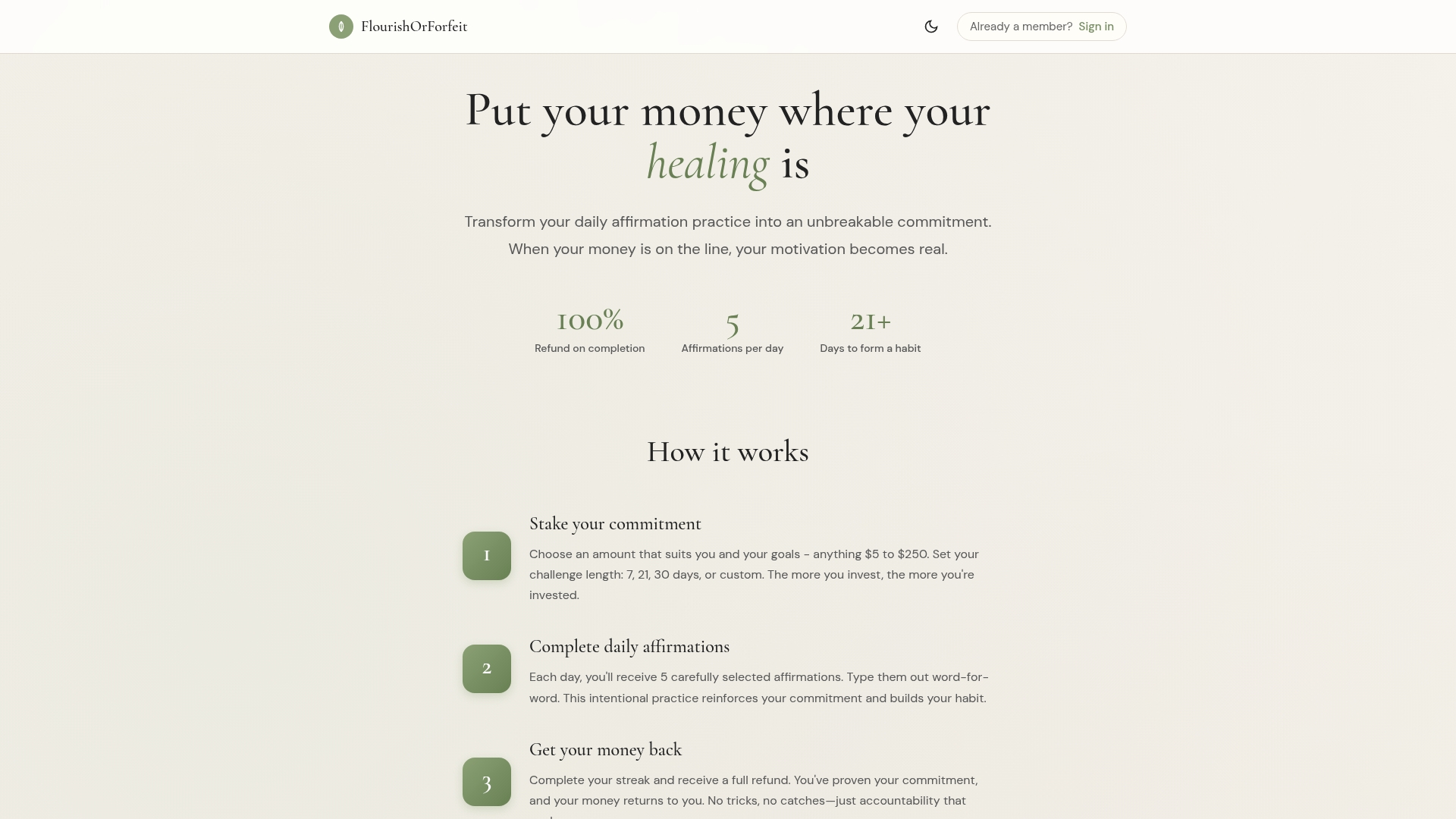
This structure fits the research well. The financial stake raises the cost of quitting past the point where most people rationalize stopping. The daily verification step makes completion feel concrete rather than self-assessed. And the challenge duration maps onto the window where habit formation research suggests consistency matters most.
If you've been circling a goal and waiting for the right moment, the right moment is the one you designate. Start a challenge at Flourishorforfeit and put something real behind the fresh start you've already been planning.
Primary sources and further reading
- The Fresh Start Effect: Temporal Landmarks Motivate Aspirational Behavior — Dai, Milkman & Riis, Management Science, 2014 — The primary peer-reviewed paper; covers all three field studies and the core mechanism.
- Management Science abstract/DOI — Dai, Milkman & Riis — Official journal record for citation and institutional access.
- Fresh Start Effect — Nielsen Norman Group — Applied guide for practitioners; covers design and messaging tactics grounded in the research.
- Is It the Right Time for a Fresh Start? — Scientific American — Accessible public-facing summary of the landmark research and when to use it.
- How the 'fresh start' effect can help you stick to good habits — BBC Future — Journalistic synthesis pairing the landmark research with practical habit-formation advice.
- How experiencing and anticipating temporal landmarks influence motivation — Dai & Li, Current Opinion in Psychology — Review paper covering mechanisms, boundary conditions, and where the effect weakens.
- How to stick to your resolutions — University of Chicago — Research-backed perspective on treating setbacks as learning points and using frequent small resets.