

A structured daily routine genuinely improves mental health. Research from UCLA Health confirms that people with structured routines show lower levels of anxiety and depression than those without them. The mechanism is straightforward: predictability reduces cognitive load and decision fatigue, freeing up mental energy for what actually matters. You get improved sleep, less stress, better productivity, and a stronger sense of control over your day.
Key benefits of a consistent mental health daily routine include:
- Reduced anxiety and depression through predictability
- Improved emotional regulation and mood stability
- Lower cognitive load by eliminating repeated decision-making
- Better sleep quality tied to circadian rhythm support
- Increased sense of control, especially during stressful periods
Essential daily habits that support mental health effectively
The habits below are not a wishlist. Each one has a direct, documented effect on how you feel day to day.
- Consistent sleep schedule. Going to bed and waking at the same time every day supports your circadian rhythm. In a 2025 study, regular sleepers had a 38% lower risk of depression and a 33% lower risk of anxiety compared to irregular sleepers, even when total sleep hours were similar.
- Daily movement. Walking for just 10–15 minutes daily may lower depression risk by 18%, according to the American Psychological Association. Exercise releases serotonin and dopamine, which directly improve focus and reduce stress.
- Planned hydration and balanced meals. Scheduling meals and water breaks prevents dehydration and blood sugar dips, both of which affect mood. The National Institute of Mental Health (NIMH) lists regular meals and hydration as foundational self-care practices.
- Digital breaks. Adolescents on devices for two or more hours daily during weekdays double their anxiety risk and are four times more likely to experience emotional and behavioral difficulties. Passive scrolling carries the strongest negative effect. Adults are not immune.
- Mindfulness or journaling. Mindfulness practice reduces stress and supports positive emotional regulation, with strong evidence across both preventive and therapeutic mental health contexts.
- Social connection. Meaningful communication with others reduces poor coping behaviors and encourages positive help-seeking. Even a brief daily check-in with a friend or family member counts.
How to build and actually maintain a mental health routine
Starting strong is easy. Staying consistent is where most people struggle. These strategies address both.
Start small, then layer. Pick one habit to anchor your week, not six. Small changes accumulate. Once a habit feels automatic, add the next one.
Use habit stacking. Linking new habits to existing non-negotiable anchors, like making your bed or brewing coffee, reduces the cognitive effort of remembering to do them. A new habit attached to an old one becomes a natural extension of your day.

Plan for disruption. Life will interrupt your routine. Having a backup option, a home workout for gym days you miss, or a five-minute breathing exercise when meditation time disappears, keeps the rhythm alive without requiring perfection.
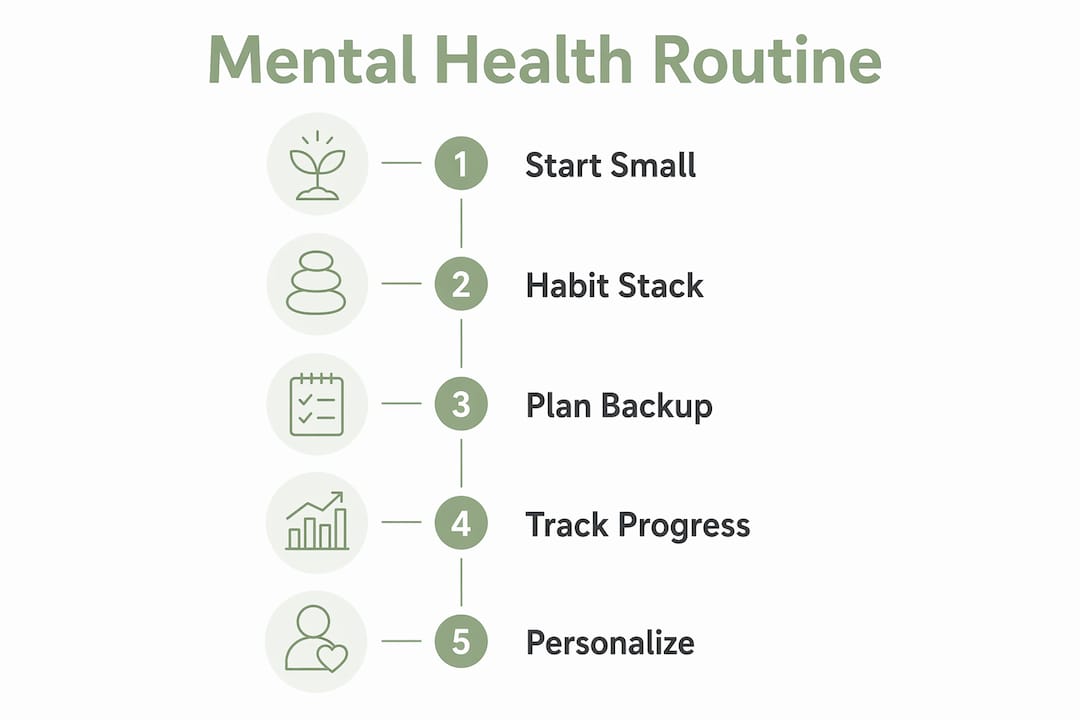
Track progress and reward consistency. Set a small goal, then celebrate reaching it. Mental Health America recommends rewarding yourself for two weeks of consistent effort, not just for completing a single day.
Limit new habits at once. Adding too many changes simultaneously creates cognitive overload. One or two new behaviors at a time is enough.
Personalize based on your energy. Morning people and night owls have different windows of peak focus and motivation. Build your mental health daily schedule around your actual energy patterns, not an idealized version of someone else's morning.

Pro Tip: Use an existing anchor you already do without thinking, like your morning coffee or your commute, as the trigger for a new mental health habit. The cue is already there; you are just attaching a new behavior to it.
What mental health experts say about routines as psychological anchors
Routines do more than organize your day. Mental health professionals describe them as psychological anchors that provide stability and a sense of control when stress threatens to overwhelm. That framing matters because it shifts the goal from rigid scheduling to building a reliable foundation.
Behavioral activation, a core component of cognitive behavioral therapy (CBT), uses structured daily scheduling of positive activities to treat depression. Routines are not just self-help advice. They are a clinical tool.
Skipping a day does not erase your progress. Research on habit formation confirms that missing one opportunity does not materially derail the process. What matters is returning to the rhythm the next day, not punishing yourself for the gap.
Pro Tip: Think of your routine as a flexible framework, not a rigid contract. If Tuesday falls apart, Wednesday is a fresh start, not a failure.
Sample daily routines you can start with today
No two people have the same schedule, obligations, or mental health needs. These examples are starting points, not prescriptions.
Morning anchor routine (15 minutes)
- Wake at a consistent time
- Expose yourself to natural light within 30 minutes of waking
- Drink a full glass of water before coffee
- Five minutes of light stretching or a short walk
Midday reset (10 minutes)
- Step away from screens for a scheduled break
- Eat a real meal at a consistent time
- Send one message to a friend or family member
Evening wind-down (20 minutes)
- Set a consistent bedtime and begin dimming screens 30–60 minutes before
- Write three things you are grateful for
- Five to ten minutes of breathing exercises or meditation
For high-stress periods: Anchor your day around just two non-negotiables: consistent sleep and one form of movement. Everything else is optional until stability returns.
For anxiety management: Add a scheduled worry window, a specific 10-minute block where you write down concerns, then close the notebook. This contains anxious thinking rather than letting it bleed into the whole day.
The National Alliance on Mental Illness (NAMI) recommends easing into mornings with sunlight exposure, light movement, and mindfulness as the most accessible starting points for building a mental health morning routine.
Habit formation takes longer than most people expect. Research shows the process typically requires at least two to five months for a behavior to become automatic. Starting with the simplest version of a habit and repeating it consistently in the same context gives you the best chance of it sticking.
Flourishorforfeit offers a direct way to put this into practice. By staking real money on a 7, 21, or 30-day affirmation challenge, you create the kind of financial accountability that turns good intentions into daily action. Complete the challenge and you get a full refund. Miss a day and you forfeit your stake. That structure is exactly what makes a new habit feel worth protecting.
Key Takeaways
A consistent daily routine reduces anxiety and depression by providing predictability that lowers cognitive load and supports healthier sleep, movement, and emotional regulation habits.
| Point | Details |
|---|---|
| Sleep consistency matters most | Regular sleepers had a 38% lower depression risk and 33% lower anxiety risk than irregular sleepers. |
| Short movement sessions count | Walking 10–15 minutes daily can lower depression risk by 18%, according to research from UCLA Health. |
| Habit stacking speeds adoption | Linking new habits to existing anchors reduces cognitive load and improves follow-through. |
| Routines are clinical tools | Behavioral activation in CBT uses structured daily scheduling as a core treatment for depression. |
| Flexibility beats perfection | Missing one day does not derail habit formation; returning to the rhythm the next day is what counts. |