

The daily check-in deadline is the latest time each day you can submit your typed affirmations to keep your challenge active and stay eligible for a full refund. Miss it, and that day counts as a forfeit. Your exact cutoff lives on your challenge page inside the Flourishorforfeit dashboard. Timestamps are authoritative, and your account timezone governs everything.
Key Takeaways
Meeting your daily check-in deadline on Flourishorforfeit requires confirming your account timezone, submitting before the server-side cutoff, and anchoring the habit to an existing daily routine from day one.
| Point | Details |
|---|---|
| Deadline is server-stamped | Your account timezone governs the cutoff; device time does not count. |
| Mulligans are limited | 21-day and 30-day challenges include one mulligan; 7-day challenges do not. |
| Start earlier in the day | Research shows earlier starts raise completion odds; aim for morning, not 11 PM. |
| Stakes and consistency matter | The StickK dataset of 742,923 users shows anti-charity stakes and consistent enforcement raise success rates. |
| Flourishorforfeit dashboard | Confirm your exact cutoff, timezone, and mulligan status on your challenge page before day one. |
Table of Contents
- How does the daily check-in deadline work on Flourishorforfeit?
- What grace periods, mulligans, and appeals does the platform offer?
- Practical steps to reliably meet your check-in deadline every day
- What does behavioral science say about deadlines and stakes?
- What to do immediately after you miss a check-in
- How Flourishorforfeit verifies check-ins and secures your stake
- Flourishorforfeit makes deadline management straightforward
- The part most people skip, and why it costs them
- Sources
How does the daily check-in deadline work on Flourishorforfeit?
Every time you type your five affirmations and submit, the platform records a server-side timestamp. That timestamp, not your device clock, is the official record. If your submission lands one second after the cutoff, the platform treats it as a missed day.
Which timezone controls your deadline? Your account timezone, set in your dashboard settings, not the timezone on your phone or laptop. This catches people off guard when they travel or forget to update settings after a move. Before your challenge starts, open your account settings and confirm the timezone is correct.
Daylight saving time adds another wrinkle. The platform normalizes timestamps against your account timezone, including DST adjustments, so a cutoff that reads 11:59 PM in March will shift by one hour when clocks spring forward. Check your challenge settings page for the exact rule applied to your challenge.
A few enforcement rules worth knowing:
- No backdating. Submissions are recorded at the moment they arrive on the server, not when you started typing.
- No retroactive edits. Once the cutoff passes, the window closes.
- SMS or two-factor verification codes carry their own timestamps, and those must also fall before the cutoff.
- Late submissions are rejected automatically when the cutoff passes.
A concrete example: If your account timezone is set to Eastern Time and your cutoff is 11:59 PM ET, a challenger in Los Angeles on Pacific Time has until 8:59 PM local time. Missing that mental conversion is one of the most common reasons people forfeit a day they thought they completed.
What grace periods, mulligans, and appeals does the platform offer?
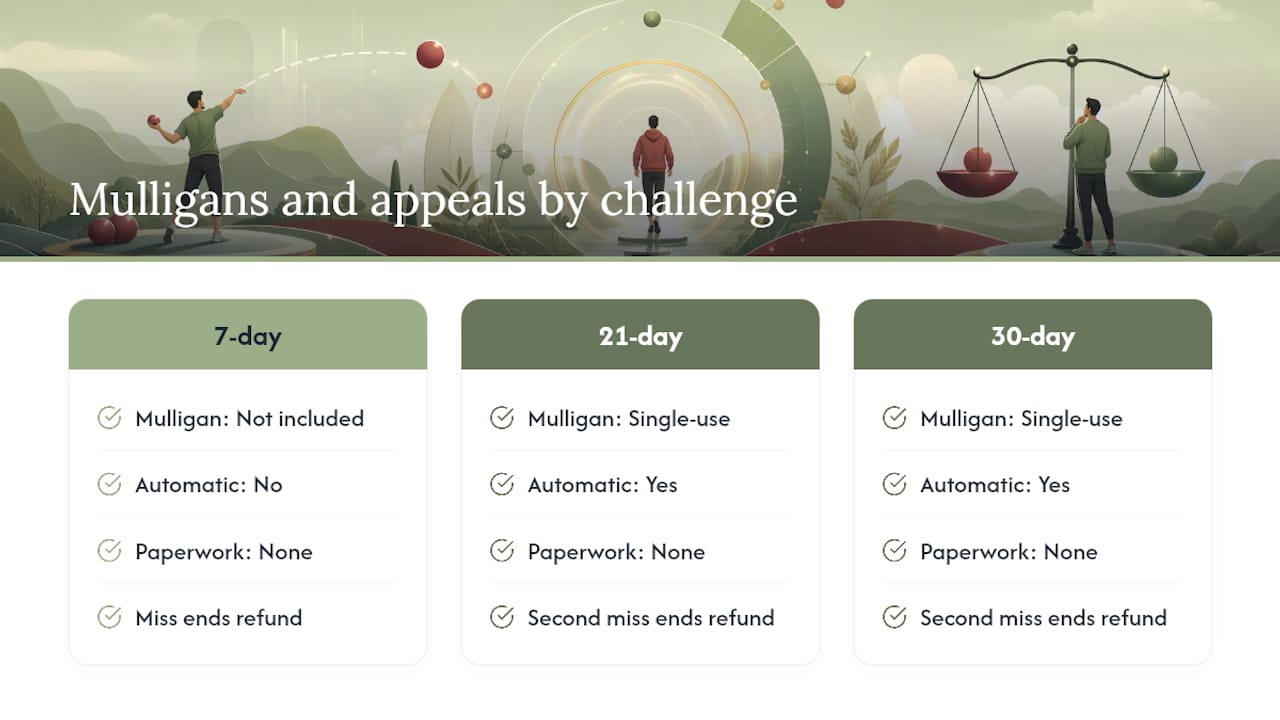
Flourishorforfeit does not offer an open-ended grace period. The cutoff is firm. However, challengers on 21-day and 30-day challenges have access to a mulligan, a single-use exception that lets one missed day slide without ending your eligibility. Seven-day challenges do not include a mulligan, given the shorter window.
Mulligans are finite and automatic once the conditions are met. You do not need to file paperwork to use one, but once it is consumed, a second miss ends your refund eligibility for that challenge.
Appeals exist for a narrower set of circumstances: a documented platform outage, a verified payment processing failure through Stripe, or a confirmed SMS delivery failure that prevented you from completing verification. What qualifies is evidence-based. A general claim that you forgot or were busy does not typically meet the threshold.
To file an appeal, submit a support ticket through the Flourishorforfeit help center. Include a concise timeline, screenshots of any error messages, your SMS confirmation logs, and a clear statement of what happened. Appeals are reviewed case-by-case, and outcomes range from a mulligan credit to a denial. Exact policy terms can also vary by challenge length and any promotional rules active at the time you enrolled.
Practical steps to reliably meet your check-in deadline every day
Consistency is a system problem, not a willpower problem. Research on self-imposed deadlines shows that people who pair binding commitments with external structure outperform those relying on intention alone. Here is a numbered routine that removes the guesswork:
- Confirm your account timezone before day one. Open dashboard settings, verify the timezone, and screenshot it.
- Set a fixed anchor event. Tie your check-in to something you already do every day, morning coffee, brushing your teeth at night, or your lunch break. Anchoring to an existing habit creates automaticity faster than a standalone reminder.
- Create two calendar reminders. One fires 90 minutes before the cutoff as a warning. The second fires 15 minutes before as a hard alert.
- Enable push and SMS notifications in your Flourishorforfeit account so the platform itself can prompt you.
- Test the verification flow before your challenge starts. Run through a dry submission to confirm SMS codes arrive promptly on your device.
- Pre-type your affirmations in a notes app. Keep a saved draft you can copy and paste. This cuts the friction to under 30 seconds.
Morning vs. evening workflows: A morning check-in, completed before 9 AM, removes the risk of an evening emergency eating your window. An evening check-in tied to a wind-down ritual (reading, journaling) works well too, but set the reminder for 8 PM rather than 11 PM to give yourself a buffer. Short, regular check-ins paired with a partner or accountability contact add a social layer that raises follow-through.
Pro Tip: Draft all five affirmations in Apple Notes, Google Keep, or any notes app the night before your challenge starts. Each morning, open the draft, copy, paste, and submit. The entire process takes less than a minute and eliminates the "I'll do it later" trap.

What does behavioral science say about deadlines and stakes?
Neural and computational evidence shows that deadline pressure shifts motivation from effort avoidance to active progress-seeking, with measurable changes in putamen and midcingulate cortex activity as a cutoff approaches. A fixed daily cutoff is not just a rule. It is a neurological trigger.
The StickK dataset, covering 742,923 users and 397,456 commitments, provides a real-world baseline for how stakes and reporting cadence interact with success:
| Metric | Figure |
|---|---|
| Total users in dataset | 742,923 |
| Total commitments analyzed | 397,456 |
| Weekly reporting prevalence | a large portion of commitments |
| Daily reporting prevalence | a smaller portion of commitments |
| Total money at stake (historical) | stakes ranging from $5 to $250 |
Daily reporting is far less common than weekly, and early dropout is steeper. Challengers who survive the first three to four weeks, however, show stronger long-term adherence. That pattern maps directly onto Flourishorforfeit's 21-day and 30-day challenge structures.
The anti-charity effect is worth noting. Stakes directed at recipients the user finds emotionally aversive produce higher compliance than neutral or friend-directed stakes. Choosing a stake amount that genuinely stings ($50 rather than $5) sharpens that effect. Research also cautions that time-varying incentives with inconsistent enforcement can produce behavioral reversals during low-pressure periods, which is exactly why Flourishorforfeit's consistent daily enforcement matters more than a lenient system would.
Starting earlier relative to a deadline also raises completion probability in controlled experiments. Do your check-in at 8 AM, not 11:45 PM.
What to do immediately after you miss a check-in
Move fast. The window for useful evidence collection closes quickly.
Within the first hour: Take screenshots of your device's notification log, any SMS confirmation attempts, and your app activity. Note your exact local time and your timezone offset from UTC at that moment.
Building your appeal: Write a short, factual timeline. "I attempted submission at 11:47 PM ET. I received an SMS code at 11:52 PM ET. The code expired before I could enter it." Attach every screenshot. Avoid editorializing. Reviewers need facts, not frustration.
Possible outcomes: a mulligan credit if one remains and the evidence supports a technical failure, or a denial if the miss was behavioral. If the appeal is denied, the practical move is to reset your anchor routine and consider whether a different challenge length or stake amount better fits your schedule.
Proactive habit: After every successful check-in, take a five-second screenshot of the confirmation screen. Date it with your phone's timestamp. If a dispute ever arises, you have a dated log that predates any appeal.
How Flourishorforfeit verifies check-ins and secures your stake
The platform's verification stack covers several layers:
- Server-side timestamps recorded at the moment of typed submission, stored in secure audit logs.
- SMS or email verification codes with their own timestamps, cross-checked against the submission record.
- Stripe integration for payment processing, which creates an independent, PCI-compliant financial log tied to each challenge enrollment.
- IP and device metadata cross-checks that support the integrity of the submission record.
Stripe's payment logs and the platform's timestamp audit trail are the two records that matter most in an appeal. Keep your own confirmation emails and screenshots as a parallel record. Enabling two-factor authentication on your account adds a layer of protection against unauthorized access that could compromise your challenge status.
The data logged for verification is minimal and functional: submission time, verification code status, and payment event records. That audit trail is what makes an appeal reviewable rather than a he-said-she-said situation.
Flourishorforfeit makes deadline management straightforward

Your challenge page on Flourishorforfeit displays your exact cutoff time, your current timezone setting, and your mulligan status in one place. Before your challenge begins, spend two minutes there: confirm the timezone, note the cutoff, and run a test notification. The dashboard surfaces everything you need to avoid a preventable forfeit.
Stakes run from $5 to $250 across 7, 21, or 30-day challenges. Payments process through Stripe, and the refund is waiting for you at the finish line if you complete every daily check-in. The forfeiture model is the point. It is what makes the commitment real. Start your challenge with the settings confirmed and the anchor routine in place, and the deadline becomes a daily win rather than a daily risk.
The part most people skip, and why it costs them
The research on deadlines is clear, and the platform rules are not complicated. What trips people up is the gap between knowing the rule and building the system that makes following it automatic.
The challengers who protect their refund are not the ones with the most willpower. They are the ones who confirmed their timezone on day zero, set two reminders instead of one, and pre-typed their affirmations the night before. That is the whole edge. Check your dashboard today, set one reminder right now, and treat the cutoff as a hard wall from the first day. The habit forms faster than you expect once the system is in place.
Sources
- Neural and computational mechanisms of effort under the pressure of a deadline | Nature Communications
- Put Your Money Where Your Mouth Is: Dataset and Analysis of Real World Habit Building Attempts
- Procrastination, Deadlines, and Performance: Self-Control by Precommitment
- Self-Control by Precommitment (NBER working paper / related experimental findings)
- Effects of time-varying financial incentives on behavior (ScienceDirect abstract)