

What are the best daily affirmation apps right now?
Some of the popular daily affirmation apps currently recommended include I am - Daily Affirmations, ThinkUp, Gratitude, Shine, and Flourishorforfeit. Each earns its spot for a different reason: I am - Daily Affirmations leads on AI-powered personalization, ThinkUp wins for audio learners, Gratitude pairs journaling with affirmations, Shine adds community and self-care tools, and Flourishorforfeit is the only option that puts real money on the line to keep you showing up.
Here is a quick look at the top picks and what makes each one worth your time:
- I am - Daily Affirmations — AI-curated affirmations tailored to your goals; one of the most downloaded positivity apps on both iOS and Android
- ThinkUp — Record affirmations in your own voice and play them back over music; built specifically for audio learners
- Innertune — Audio loops with deep customization; best for users who want a fully guided, sound-first practice
- Gratitude — Combines daily affirmations with a gratitude journal and mindfulness reminders in one clean interface
- Believe - Daily Affirmations — Wide library of confidence-focused categories; solid for users targeting self-esteem and belief
- Louise Hay Affirmations — Draws directly from Louise Hay's healing philosophy; the go-to for fans of her work
- I Am (by Monkey Taps LLC) — Lets you record affirmations in your own voice and connects you with a supportive community
- Unique Daily Affirmations — Algorithm-generated affirmations every day so the content never feels stale
- Motivation: Daily Motivation — Blends affirmations with motivational quotes; good for users who want variety in their daily content
- Shine — Combines affirmations, guided meditations, and an active community; the most complete self-care package on this list
- Flourishorforfeit — Stakes real money ($5–$250) on your commitment to type five affirmations daily; the only app where missing a day costs you cash
Pro Tip: If you have tried passive reminder apps and quit within a week, the problem is not motivation. It is accountability. Look for apps with streak tracking, voice recording, or financial stakes before downloading another passive notification tool.
How do the top daily affirmation apps compare?
Every app on this list takes a different approach to the same goal. The table below maps the key differences across features, platform, pricing, and who each app suits best.

| App | Key Features | Platform | Pricing | Customization | Best For |
|---|---|---|---|---|---|
| I am - Daily Affirmations | AI-powered affirmations, daily reminders, mood tracking | iOS, Android | Free; premium available | High (AI-tailored) | Personalized affirmations |
| I Am (by Monkey Taps LLC) | Voice recording, community support, custom affirmations | iOS, Android | Free; premium available | High | Social encouragement |
| ThinkUp | Record in your own voice, music overlay, affirmation loops | iOS, Android | Free; premium subscription | High (audio-first) | Audio learners |
| Innertune | Audio loops, guided affirmations, deep customization | iOS, Android | Free; premium available | Very high | Audio-centric growth |
| Gratitude | Affirmations + gratitude journal, mindfulness reminders | iOS, Android | Free; premium available | Medium | Journaling + affirmations |
| Believe - Daily Affirmations | Confidence categories, daily reminders, affirmation library | iOS, Android | Free; premium available | Medium | Confidence building |
| Louise Hay Affirmations | Healing-themed affirmations, curated library | iOS | Free; in-app purchases | Low | Healing-oriented practice |
| Unique Daily Affirmations | Algorithm-generated unique daily content | iOS, Android | Free | Low | Avoiding repetition |
| Motivation: Daily Motivation | Affirmations + motivational quotes, reminders | iOS, Android | Free; premium available | Medium | Mixed affirmation + quotes |
| Shine | Meditations, affirmations, community, self-care tools | iOS, Android | Free; premium subscription | Medium | Full self-care package |
| Flourishorforfeit | Financial stakes ($5–$250), typed affirmation challenges, SMS verification, dashboard | Web | Stake-based (refunded on success) | Medium (curated affirmations) | Commitment-driven habit formation |
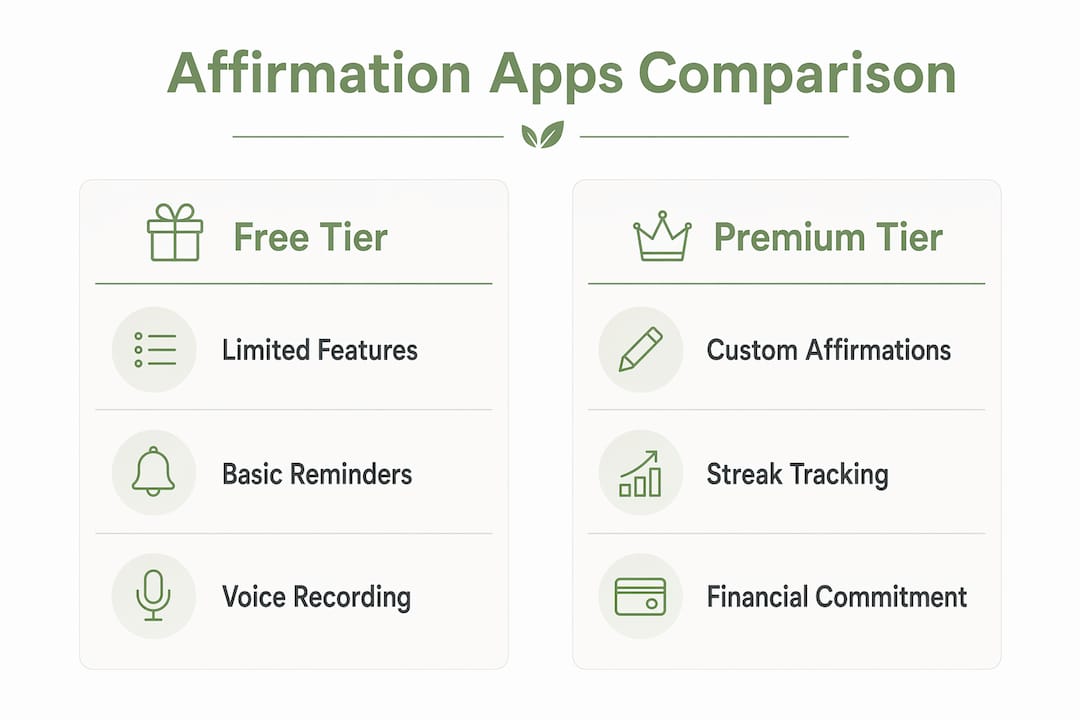
A few things worth noting after looking at this side by side. Most apps offer a free tier, but the free versions typically limit the affirmation library or lock audio features behind a paywall. ThinkUp and Innertune are the clearest examples: the core audio-loop feature that makes them distinctive requires a premium subscription.
On privacy, the apps that collect voice recordings (ThinkUp, Innertune, I Am by Monkey Taps LLC) store audio on their servers. If that concerns you, check each app's privacy policy before recording. Flourishorforfeit uses Stripe for payment processing and SMS verification for identity confirmation, which is a higher security bar than most passive reminder apps.
For integration with other wellness tools, Gratitude syncs with calendar reminders and works alongside journaling habits. Shine pairs naturally with meditation apps. None of the apps on this list currently offer native integration with platforms like Apple Health or Google Fit, though several support calendar-based scheduling.
Why do daily affirmation apps actually work?
The short answer: they work when they do more than send you a push notification. Research published in the Journal of Medical Internet Research found that higher doses of self-affirmation resulted in measurably improved adherence to health and behavior change goals, with a dose coefficient of 1.42 (P=.04) across 3,556 observations. The catch is that increased adherence did not automatically reduce dropout. People stayed on task longer, but they still quit the app.
That finding points to something the best affirmation apps understand: keeping someone engaged is a separate problem from keeping them on track. Apps that only push text alerts often fail to keep users engaged or on track.
fMRI research shows that self-affirmation activates the ventral striatum and medial prefrontal cortex, the brain regions tied to reward processing and self-related thinking. Future-oriented affirmations, the kind that picture where you are going rather than where you have been, produce the strongest activation in those regions. That neural activity also predicted actual behavior change in follow-up measurements. So the framing of an affirmation matters as much as the habit of saying it.
Studies on app-delivered affirmations found measurable improvements in self-esteem, flourishing, and life satisfaction after 14 days of receiving two affirmations daily. The delivery method, text message versus app, did not significantly change the outcome. What mattered was consistency and the quality of the affirmation content.
Here is what the research and wellness reviewers consistently flag as the features that separate effective apps from forgettable ones:
- Voice recording — Hearing affirmations in your own voice increases personal relevance and engagement
- Streak tracking — Visual progress creates a commitment device; breaking a streak feels like a real loss
- Active customization — Tailoring affirmations to your specific goals outperforms generic positive statements
- Context engagement — Apps that prompt reflection, not just reading, produce better outcomes
- Future-oriented framing — Affirmations written toward a desired future state activate stronger neural reward responses than past-focused statements
- Accountability features — Apps without verification or rewards tend to see rapid dropout despite frequent usage prompts
Pro Tip: Write affirmations in the future-present tense ("I am becoming someone who...") rather than flat present tense ("I am confident"). The forward-looking frame is what activates the brain's reward circuitry most strongly, according to the fMRI research above.
How to choose and use a daily affirmation app for best results
Picking the right app comes down to one honest question: what has made you quit before? If the answer is boredom, choose Unique Daily Affirmations or I am - Daily Affirmations for fresh, personalized content. If the answer is forgetting, any app with strong reminder scheduling works. If the answer is "I just didn't care enough," that is an accountability problem, and no passive notification app will fix it.
Criteria that actually matter when choosing
- Personal goal alignment — Confidence work points toward Believe - Daily Affirmations or Louise Hay Affirmations. Healing and mindset shifts point toward Gratitude or Shine. Pure habit formation with stakes points toward Flourishorforfeit.
- Platform availability — Most apps run on both iOS and Android. Louise Hay Affirmations is iOS-only, which matters if you are on Android.
- Pricing and commitment — Free tiers are fine for testing. If you are serious about a 30-day practice, a premium subscription or a financial stake removes the "I'll start tomorrow" exit.
- Privacy comfort level — Apps that store voice recordings require more trust. Read the privacy policy before recording anything personal.
- Customization depth — ThinkUp and Innertune offer the deepest audio customization. I am - Daily Affirmations and I Am by Monkey Taps LLC lead on text-based personalization.
How to build the habit once you pick an app
The app is just the container. The habit is built by what you do with it.
- Set your affirmation reminder at a time you are already doing something calm: morning coffee, after brushing your teeth, or before bed. Attaching a new habit to an existing one is the fastest way to make it stick.
- Start with five affirmations, not twenty. Shorter sessions have higher completion rates, and completion is what builds the habit loop.
- Use streak tracking deliberately. When you can see a 10-day streak, the psychological cost of breaking it becomes a real motivator.
- Revisit your affirmations every two weeks. Goals shift, and an affirmation that felt powerful on day one can feel hollow by day 14 if your situation has changed.
- If you miss a day, do not restart from zero mentally. Resume the next morning. The research on self-affirmation shows that consistent ongoing practice matters more than a perfect unbroken record.
How financial commitment changes the affirmation habit
Most affirmation apps rely on intrinsic motivation: you want to feel better, so you open the app. That works for some people. For others, wanting to feel better is not enough to override a busy morning or a bad week.

Flourishorforfeit takes a different approach. Users stake between $5 and $250, choose a challenge duration of 7, 21, or 30 days, and then type five curated affirmations word-for-word each day. Complete the challenge and you get a full refund. Miss a day and you forfeit the stake. The money does not go to a charity or a friend. It is gone. That structure is not punitive for its own sake. It is built on a well-documented principle in behavioral economics: loss aversion drives stronger behavior change than the prospect of a reward. People work harder to avoid losing $50 than they do to gain $50.
The typing requirement is also deliberate. Passive reading of an affirmation is easy to ignore. Typing it word-for-word forces active engagement with the content, which is closer to the "active elements" that research identifies as the difference between apps that change behavior and apps that get deleted.
Flourishorforfeit also uses SMS verification and a dashboard to track daily completion, so there is no ambiguity about whether you showed up. The secure payment infrastructure runs through Stripe. For users who have tried passive apps and quit, the financial stake adds the external accountability layer that self-motivation alone cannot always provide.
Pro Tip: Pair the financial stake with a written "why" statement before you start the challenge. Knowing exactly what you are working toward makes the affirmations feel connected to a real goal, which the neuroscience research suggests amplifies the brain's reward response during practice.
Key Takeaways
The most effective daily affirmation apps combine active engagement features like voice recording, streak tracking, and customization with consistent daily practice, because passive reminders alone do not prevent dropout.
| Point | Details |
|---|---|
| Consistency beats intensity | Research shows 14 days of two daily affirmations produces measurable gains in self-esteem and life satisfaction. |
| Active features drive results | Apps with voice recording, streak tracking, and customization outperform single-function reminder apps in behavioral outcomes. |
| Future-oriented framing works best | fMRI studies show affirmations focused on future goals activate the brain's reward and self-processing regions most strongly. |
| Accountability closes the gap | Higher self-affirmation doses improve goal adherence but do not reduce dropout; external accountability like financial stakes addresses that gap. |
| Flourishorforfeit adds skin in the game | Staking $5–$250 on a 7, 21, or 30-day typed affirmation challenge creates the loss-aversion pressure that passive apps cannot replicate. |
The part most affirmation app reviews skip
Most roundups treat all affirmation apps as interchangeable delivery mechanisms for positive statements. Pick one with good design, set a reminder, feel better. That framing misses the actual problem.
The research is clear that self-affirmation works at a neurological level. Future-oriented affirmations genuinely activate reward circuitry in the brain. Consistent practice over two weeks produces real, measurable improvements in self-esteem and satisfaction. None of that is in dispute.
What the research also shows, and what most app reviews quietly ignore, is that adherence is the hard part. Higher doses of affirmation practice improve goal adherence, but they do not stop people from quitting the app. The mechanism that makes affirmations work, repetition and consistency, is exactly the mechanism that most apps fail to protect.
This is why the design of an app matters more than its content library. An app with 10,000 affirmations that you open twice and forget is worth less than an app with 5 affirmations and a streak you are afraid to break. ThinkUp understood this when it built audio loops you record in your own voice. Flourishorforfeit understood it when it added a financial stake. The apps that treat engagement as a design problem, not a content problem, are the ones worth your time.
The other thing worth saying plainly: affirmation apps are not therapy. They are habit tools. They work best when paired with a clear personal goal, not as a vague mood-improvement strategy. The users who get the most out of these apps tend to know exactly what they are working on before they open the app for the first time.
Flourishorforfeit: affirmations with something real at stake
Most affirmation apps ask for your attention. Flourishorforfeit asks for your commitment.
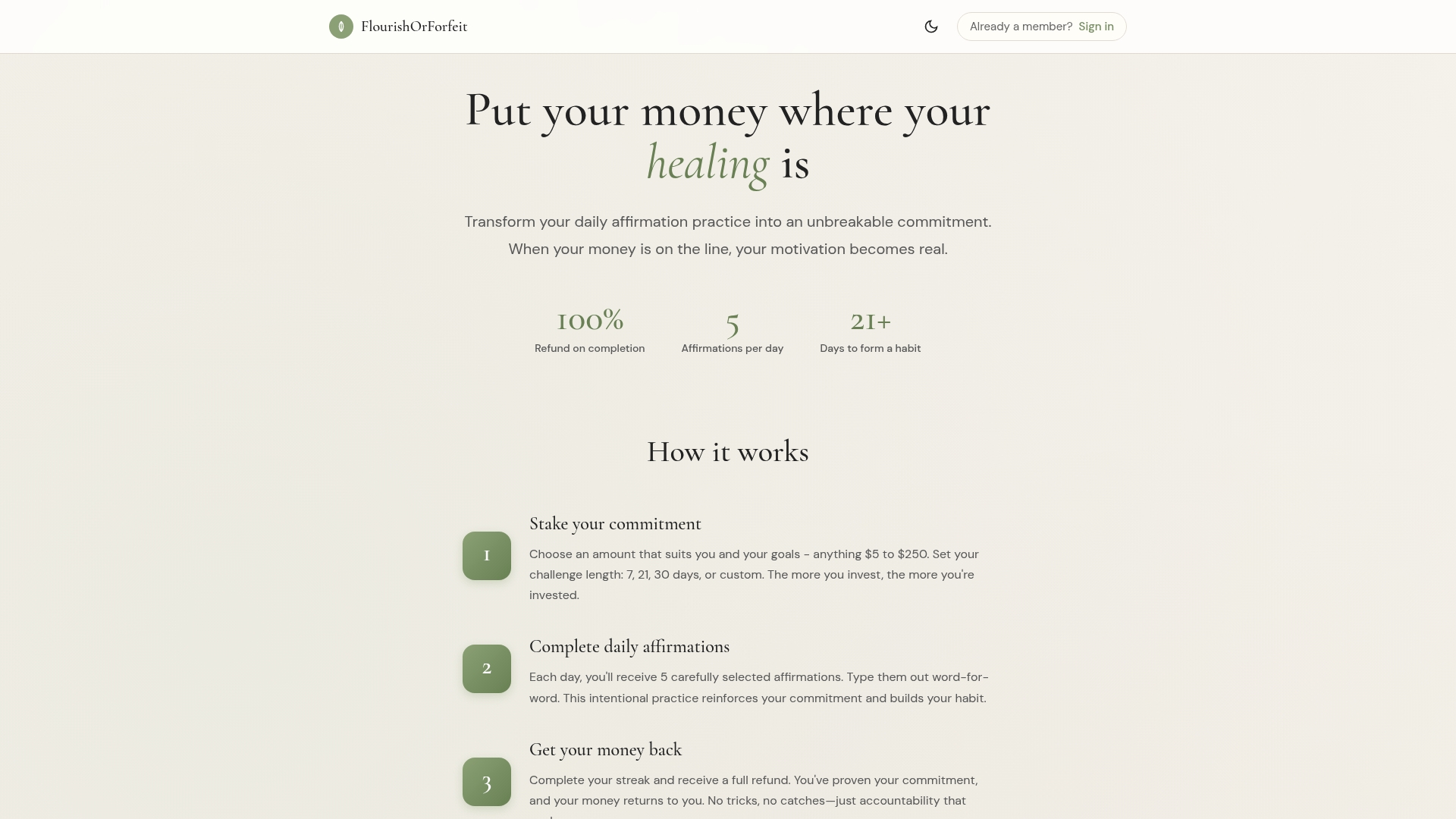
The model is straightforward. You choose a stake between $5 and $250, pick a challenge length of 7, 21, or 30 days, and type five curated affirmations every day. Finish the challenge and your full stake comes back. Miss a day and you forfeit it. Payments run through Stripe, daily completion is verified by SMS, and your progress is tracked on a personal dashboard. There is no ambiguity and no easy out.
For users who have already tried the passive apps on this list and found themselves deleting them after a week, Flourishorforfeit offers a genuinely different mechanism. The financial stake creates the kind of external accountability that loss aversion research shows drives stronger behavior change than reward-based motivation alone. If you are ready to treat your affirmation practice as a real commitment rather than a daily suggestion, start your challenge at Flourishorforfeit.