

"Bet on yourself" here means one specific thing: you prepay a stake ($5–$250) into a deposit-contract challenge, complete your daily affirmations every day, and get every dollar back. Miss a day without using your mulligan, and you forfeit. That's the whole model. For busy professionals who've tried free apps and journaling streaks without sticking to them, this financial skin-in-the-game approach is worth taking seriously. A real-world analysis of 72,974 StepBet participants found that gamified deposit-contract challenges were associated with large increases in target behavior and high completion rates. Flourishorforfeit is the platform built specifically around this mechanic for daily affirmations.
Two things make this model different from motivational self-talk:
- You put real money at risk before you start, not after you succeed.
- Completion is verified, not self-reported.
Key Takeaways
Deposit-contract affirmation challenges work because they convert an abstract intention into a financial commitment, and the evidence from StepBet, smoking cessation RCTs, and behavioral economics consistently shows that loss aversion is a stronger motivator than reward alone.
| Point | Details |
|---|---|
| Definition | "Bet on yourself" here means prepaying a stake that's refunded on completion or forfeited on failure. |
| Stake sizing | Start in the $5–$50 range; the StepBet modal deposit was $40 for a 6-week challenge. |
| Challenge length | 7 days for a first test; 21 or 30 days to build a durable habit with mulligan protection. |
| Trust checks | Verify Stripe payments, a clear refund policy, and a defined daily submission window before depositing. |
| Flourishorforfeit | Offers $5–$250 stakes, 7/21/30-day options, and a full refund on completion at flourishorforfeit.com. |
Table of Contents
- What does "bet on yourself" mean as a deposit contract?
- Why deposit contracts actually change behavior
- Who benefits most from paid affirmation challenges?
- How to pick a stake size and challenge length
- How to set up a Flourishorforfeit challenge
- Risks and limitations you should know before staking money
- What results can you realistically expect?
- Trust and safety checks before you deposit money
- Why Flourishorforfeit built a paid-affirmation commitment option
- Flourishorforfeit: start your first paid-affirmation challenge
- Sources
What does "bet on yourself" mean as a deposit contract?
In behavioral economics, this model is called a commitment device: a binding agreement you make with your future self, enforced by a financial cost. The phrase "bet on yourself" captures it well because the wager is literal. You stake money on your own follow-through.
Here's how a deposit-contract affirmation challenge runs, step by step:
- Choose your stake. Pick any amount from $5 to $250. Payment is processed securely through Stripe before the challenge begins.
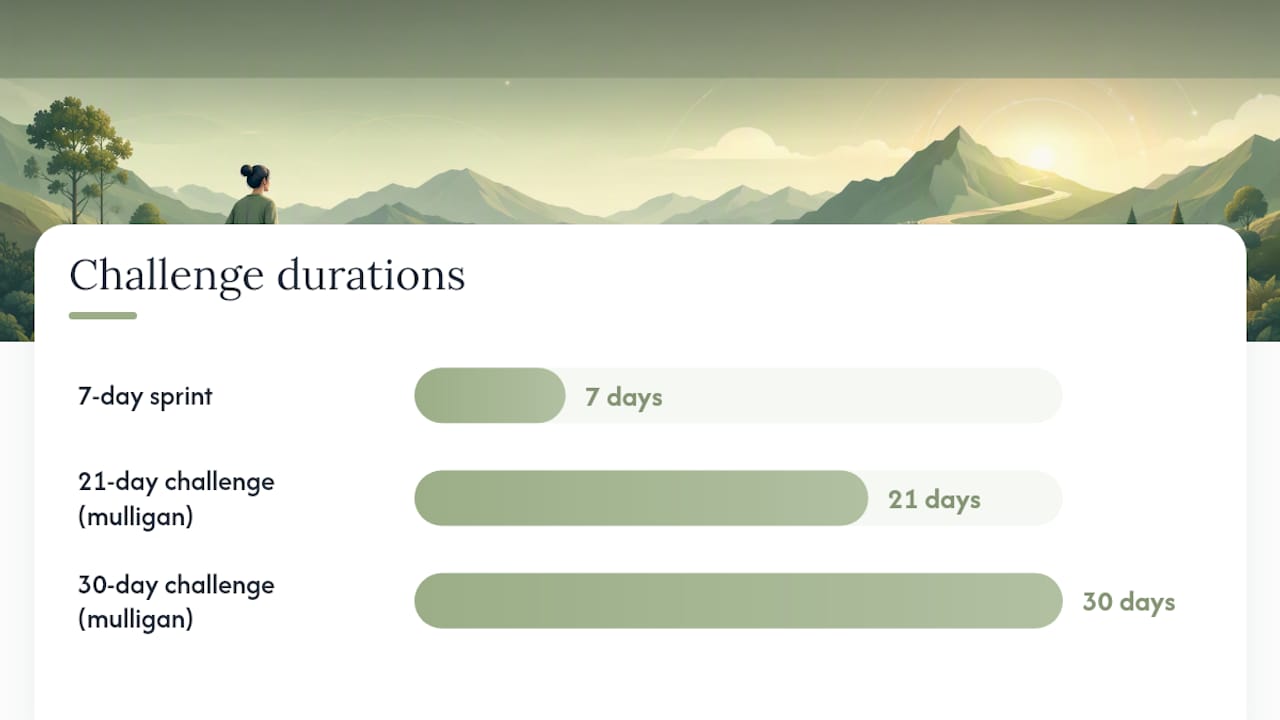
- Select a duration. Options are 7, 21, or 30 days. Each length has a different risk/reward profile (more on that below).
- Verify your identity. SMS verification confirms your account before the challenge starts.
- Submit your daily entry. Each day, you type five curated affirmations word-for-word into the platform. Typing (not just reading) is the verification mechanism.
- Track your streak. A dashboard shows your progress. On longer challenges, a mulligan lets you absorb one missed day without forfeiting.
- Collect your refund or forfeit. Complete every required day and your full stake is returned. Miss a day beyond your mulligan allowance and the stake is forfeited.
A few operational details matter here. The daily submission window is fixed, so submitting at 11:58 PM counts the same as 8:00 AM. The mulligan is available on 21-day and 30-day challenges, not the 7-day sprint. Forfeited funds stay with the platform, which is how Flourishorforfeit's revenue model works.
Why deposit contracts actually change behavior
The mechanism isn't willpower. It's math.
Present bias is the tendency to overvalue immediate comfort over future rewards. You know daily affirmations matter long-term, but skipping today feels costless in the moment. A deposit contract flips that: skipping today now has an immediate, concrete cost.
Loss aversion amplifies the effect. Research consistently shows people feel the pain of a loss roughly twice as strongly as the pleasure of an equivalent gain. One gamification trial found participants at risk of losing an earned level were ~18.4% more likely to meet daily step goals than those who had already secured it. The threat of losing something you already have is a stronger motivator than the prospect of earning something new.
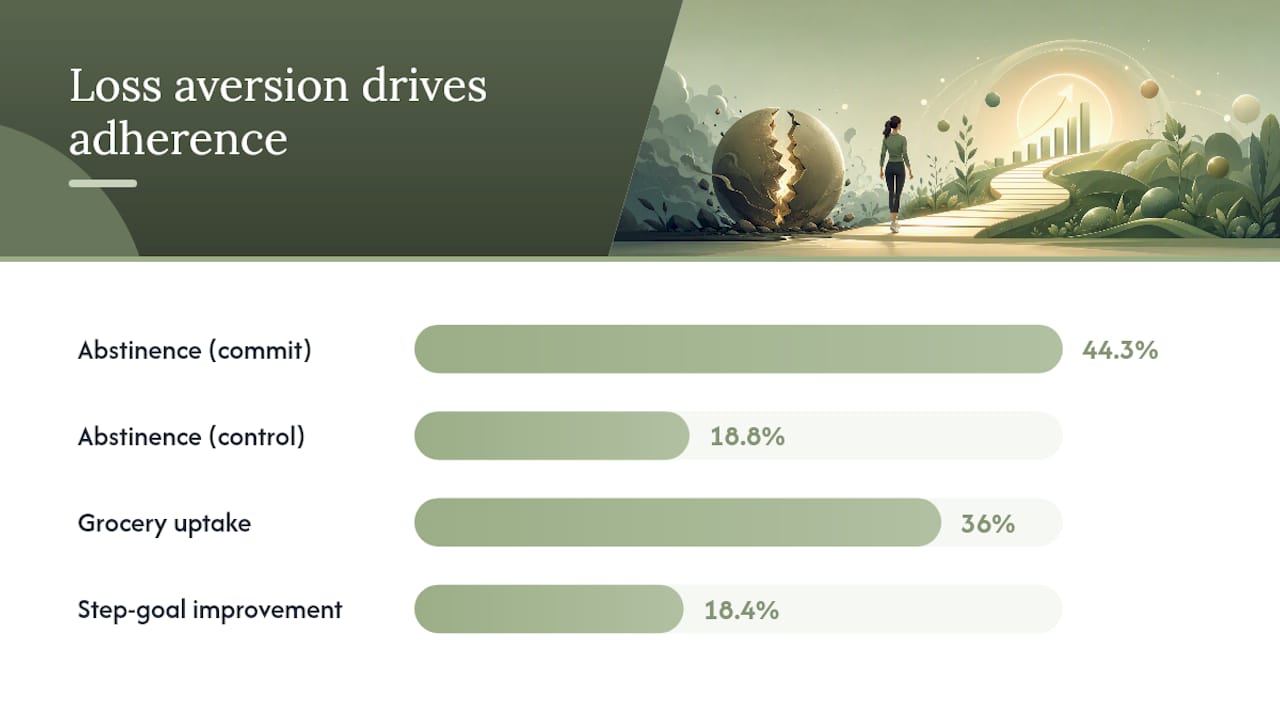
Field evidence backs this up across domains. A voluntary commitment contract for smoking cessation produced durable behavior change in a field experiment, showing self-funded contracts can improve long-term outcomes. An RCT combining monetary commitment contracts with team incentives found abstinence rates of 44.3% at 6 months versus 18.8% in the control group. A grocery-shopping field study found 36% of households accepted a binding commitment and measurably increased healthy purchases.
The honest caveat: most of this evidence comes from physical activity and smoking cessation, not affirmations specifically. The behavioral mechanisms transfer, but effect sizes in affirmation challenges haven't been studied at the same scale yet.
Who benefits most from paid affirmation challenges?
The NBER literature on commitment contract take-up identifies a key distinction: sophisticates (people who accurately recognize their own procrastination tendencies) tend to choose commitment devices and use them well. Naïfs (people who overestimate their future self-control) often skip commitment tools entirely, or take them on and fail because the stake wasn't calibrated to their actual risk.
Good fit:
- You've tried free habit apps and dropped them within two weeks.
- You can afford to lose the stake without financial stress.
- You want external accountability, not just internal motivation.
- You're willing to build a daily routine around a fixed submission window.
Poor fit:
- The stake amount would cause genuine financial hardship if lost.
- You have a history of anxiety around performance or financial loss.
- You're in a period of high unpredictability (travel, health issues, family emergencies) that makes daily completion unrealistic.
Pro Tip: Anchor your affirmation submission to an existing morning habit, like your first cup of coffee or brushing your teeth. Habit stacking reduces the cognitive load of remembering to complete the challenge and dramatically cuts mid-challenge dropout.
How to pick a stake size and challenge length
Stake size is personal, but there's a useful heuristic: the amount should feel meaningful enough that losing it would sting, but not so large that the fear of losing it becomes paralyzing. Flourishorforfeit's range of $5–$250 covers most profiles. The StepBet analysis found the modal deposit was $40 for a 6-week challenge, which suggests most real-world users land in the $30–$50 range as a starting point.
| Challenge length | Best for | Trade-off |
|---|---|---|
| 7 days | First-timers testing the model | Low risk, but too short to build a durable habit |
| 21 days | Habit formation (the commonly cited threshold) | Enough time to feel the routine take hold |
| 30 days | Deepening an established habit | Higher commitment; mulligan becomes more valuable |
A few decision rules:
- Start with a 7-day challenge at a lower stake if you've never used a deposit contract before.
- Move to 21 or 30 days once you've completed one cycle and know your daily routine can support it.
- The JMIR review notes that uptake of deposit contracts is often lower than reward programs, partly because the framing feels punitive. Reframe it mentally: you're making an investment in your future self, not paying a fine.
How to set up a Flourishorforfeit challenge
Getting started takes under five minutes.
- Go to Flourishorforfeit and create an account.
- Select your stake amount ($5–$250) and challenge length (7, 21, or 30 days).
- Complete SMS verification to confirm your phone number.
- Review the five curated affirmations assigned to your challenge.
- Each day, open the platform and type each affirmation word-for-word. Copy-paste doesn't count; active typing is the point.
- Check your dashboard to confirm the day is logged.
- On 21-day and 30-day challenges, your mulligan is available once. Use it deliberately, not as a default.
Pro Tip: Set a recurring phone alarm labeled "Affirmations" for the same time every morning. The mid-challenge slump typically hits around days 8–12 on a 21-day run. Having a locked-in time means the decision is already made before motivation dips.
Risks and limitations you should know before staking money
Deposit contracts are not a guaranteed fix, and the research is clear about where they fall short.
- Short-term focus: The systematic review evidence shows financial incentives work well while active, but long-term maintenance after the challenge ends is uncertain.
- Setback risk: Failing a challenge can trigger discouragement that makes it harder to restart. This is especially true for higher stakes.
- Low voluntary uptake: Some people simply won't choose a deposit contract even when it would help them. The JMIR review notes this is a consistent finding across programs.
- Financial risk: You can lose real money. Never stake an amount that would affect your ability to cover essential expenses.
- Emotional risk: If you miss a day and lose your stake, treat it as data, not failure. Adjust the stake or duration and try again.
"Framing the deposit as an investment in your future rather than a fine reduces abandonment and improves your long-term relationship with the habit-building process." This framing shift, supported by commitment contract research, is one of the most practical adjustments you can make before you start.
Mitigation tactics: use the mulligan strategically, start with a lower stake on your first challenge, and tell someone you trust that you've started. Public commitment adds a social layer that reinforces the financial one.
What results can you realistically expect?
During the challenge, the behavioral effect tends to be strong. The StepBet data showed large increases in target behavior while challenges were active. The smoking cessation RCT showed a 44.3% abstinence rate at 6 months with commitment contracts plus team incentives, compared to 18.8% with counseling alone.
For affirmations specifically, realistic expectations look like this:
- Days 1–5: High motivation, easy compliance.
- Days 6–12: The routine starts to feel like work. This is where most dropouts happen.
- Days 13–21: The habit begins to feel automatic for completers.
- Post-challenge: Maintenance is not guaranteed. Many users need a follow-up challenge or a different accountability structure to sustain the habit.
The systematic review is direct: financial commitment devices improve short-term outcomes, but evidence on long-term maintenance is limited. Plan for a second challenge before you finish the first one.
Trust and safety checks before you deposit money
Before staking any amount on a platform, verify these signals:
- Secure payment processing: Flourishorforfeit uses Stripe, a PCI-compliant payment processor. Your card data never touches the platform directly.
- Transparent refund policy: The terms should state clearly when and how your refund is issued upon completion.
- Defined verification rules: Know exactly what counts as a completed day and what the submission window is.
- Clear forfeit policy: Understand where forfeited funds go. Flourishorforfeit retains them as revenue, which is disclosed.
- Customer support: A reachable support channel matters if a technical issue causes a missed submission.
Red flags on any platform: vague refund timelines, no stated verification window, no contact information, and unclear language about what happens to your money if you dispute a result.
Pro Tip: Screenshot your completed daily submissions for the first week. If a technical glitch causes a missed log, having timestamped proof gives you a basis for a support dispute.
Why Flourishorforfeit built a paid-affirmation commitment option
Most affirmation tools ask you to trust your own motivation. Flourishorforfeit starts from a different premise: motivation is unreliable, but financial stakes are not. The platform was built around the behavioral science of commitment devices, specifically the insight that placing a real cost on failure aligns your immediate incentives with your long-term goals. Daily affirmations were chosen because they're short enough to complete in under two minutes but meaningful enough to shift how you approach the day. The combination of active typing, financial stakes, and a verified streak creates a level of engagement that passive reading or listening simply doesn't produce.
Flourishorforfeit: start your first paid-affirmation challenge
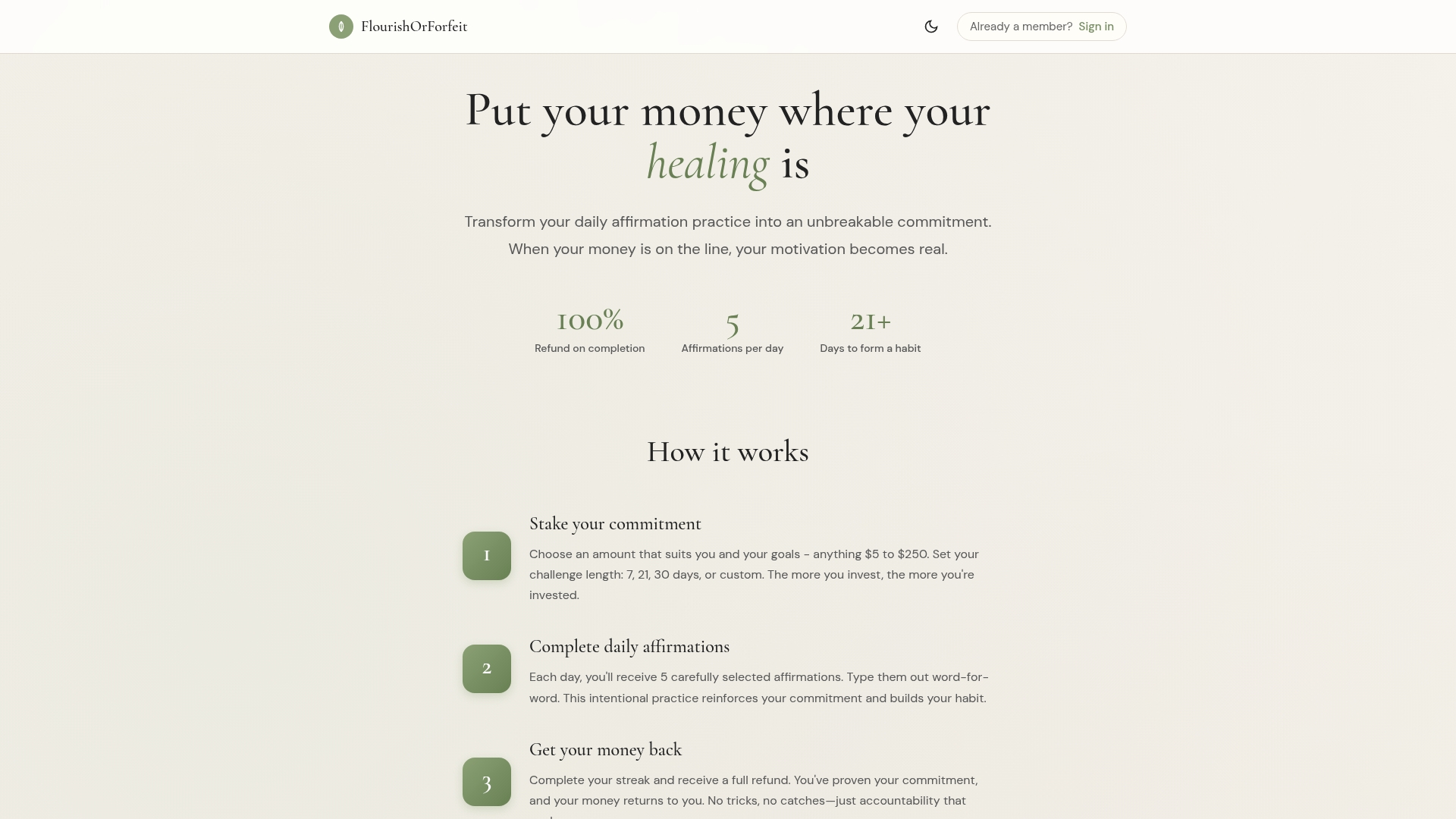
Flourishorforfeit gives you a stake range of $5–$250, three challenge lengths (7, 21, or 30 days), a mulligan for longer runs, Stripe-secured payments, and a full refund when you complete the challenge. The setup takes under five minutes, and the daily commitment is under two minutes.
If you've read this far and recognize yourself in the "tried free apps, didn't stick" profile, a low-stakes 7-day trial is the lowest-friction way to find out whether financial accountability works for you. Start your first challenge at Flourishorforfeit and set your stake at an amount that stings just enough to matter.
Sources
- Put your money where your feet are: The real-world effects of StepBet gamified deposit contracts for physical activity
- Loss aversion explains physical activity changes in a behavioral gamification trial
- Put Your Money Where Your Butt Is: A Commitment Contract for Smoking Cessation
- Commitment contracts and team incentives: randomized controlled trial for smoking cessation
- Deposit contracts for physical activity: mixed evidence and implementation considerations
- Systematic review of commitment devices and health behaviour
- Self-funded commitment contracts (NBER working paper w18580)