

The best goal accountability app depends entirely on what kind of pressure actually moves you. For financial stakes, Flourishorforfeit is the strongest pick. For live presence, Focusmate. For gamification, Habitica. For daily human coaching, GoalsWon. For schedule-based discipline, Lifestack or Todoist. Pick the mechanism first, then the app.
Here is the quick breakdown by reader type:
- If money on the line is what gets you moving: Flourishorforfeit's refundable-stake model ($5–$250, 7/21/30-day challenges) gives you a real financial consequence without permanent loss if you succeed. Ideal for people who have tried free habit trackers and quit anyway.
- If you stall at the moment of starting: Focusmate pairs you live with another person for a scheduled work block. The social presence alone removes the "I'll start in five minutes" loop.
- If you need a game to stay engaged: Habitica turns missed habits into RPG penalties that affect your whole party, making your failure someone else's problem too.
- If you want a human who checks on you daily: GoalsWon assigns a real coach who reviews your check-ins every day and sends personalized feedback, not automated nudges.
Pro Tip: Research on commitment devices shows deposit-based programs are more effective among people who accept them than reward-based programs, even though far fewer people opt in. If you are already reading this article, you are probably the kind of person who would follow through on a stake.
Key Takeaways
Financial-stake commitment devices are the most effective accountability mechanism for motivated users who opt in, and short refundable-stake challenges are the lowest-friction way to start.
| Point | Details |
|---|---|
| Match mechanism to failure point | Pick stakes for motivation gaps, body doubling for initiation gaps, coaching for long-term behavior change. |
| Deposit contracts outperform rewards for compliers | Research shows deposit programs had higher efficacy among those who accepted them, despite lower uptake. |
| Referees and weekly reporting raise success rates | StickK data from 742,000+ users links external referees and weekly check-ins to higher goal completion. |
| Iterative mindset beats perfectionism | Treating setbacks as experiments, not failures, correlates with habit automaticity and better long-term outcomes. |
| Flourishorforfeit for stakes-based challenges | Refundable $5–$250 stakes, 7/21/30-day formats, SMS verification, and a mulligan option make it the recommended financial-stakes pick. |
Table of Contents
- How the top goal accountability apps compare at a glance
- The best apps reviewed: what each one actually does
- How to choose the right accountability app for your goals
- How we evaluated these apps
- What the research says about commitment devices and why stakes often work
- What I would try first if I were starting today
- Flourishorforfeit is the recommended stakes option for this audience
- Useful sources and further reading
How the top goal accountability apps compare at a glance
| App | Best for | Primary mechanism | Pricing / free tier | Platforms | Integrations | Commitment length |
|---|---|---|---|---|---|---|
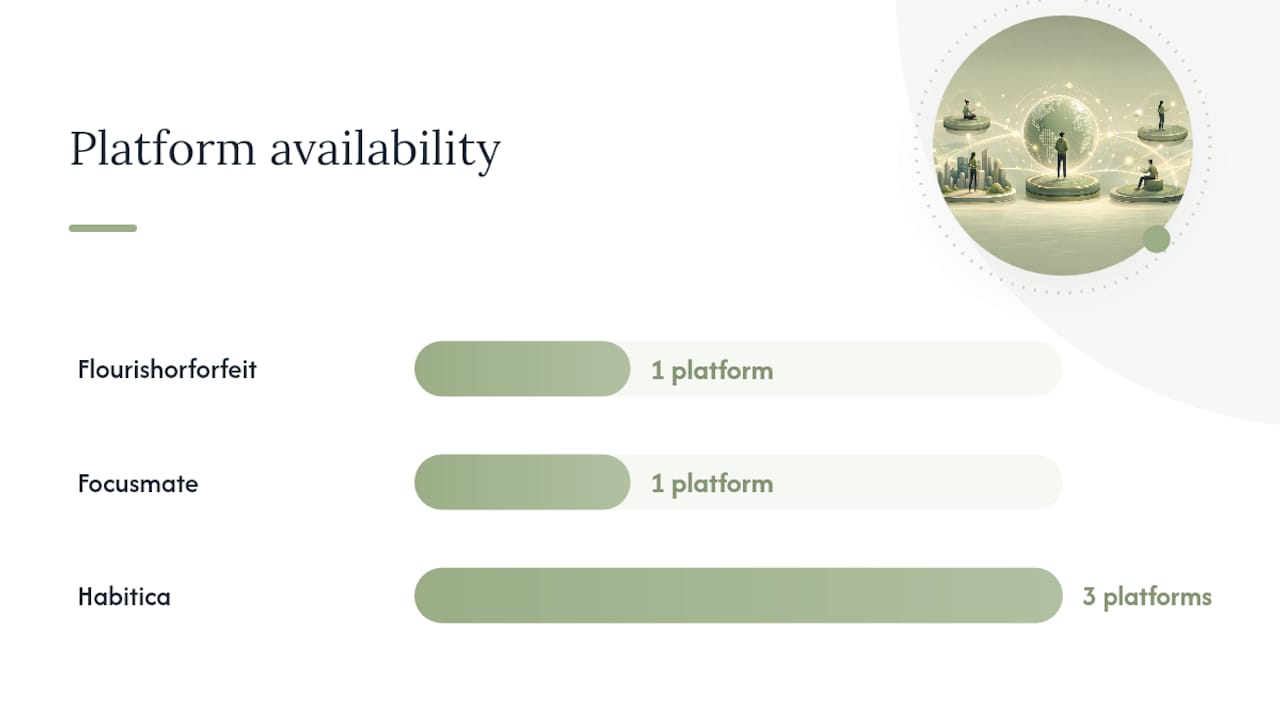
| Flourishorforfeit | Financial stakes + affirmation habits | Refundable financial stake | $5–$250 stake (refundable on success) | Web | Stripe, SMS | 7, 21, or 30 days |
| Focusmate | Live body doubling | Scheduled video coworking | Free (3 sessions/week); paid plans available | Web | Google Calendar | Per session / ongoing |
| Habitica | Gamification + social stakes | RPG mechanics + party consequences | Free; $9/month for premium | iOS, Android, Web | Zapier, Google Tasks | Ongoing |
| GoalsWon | Daily human coaching | Async human check-ins | Paid subscription | iOS, Android | — | Ongoing |
| Coach.me | Coaching marketplace + habit tracking | Community + paid coach | Free; coaching paid separately | iOS, Android, Web | — | Flexible |
| Todoist | Schedule-based task accountability | Recurring tasks + reminders | Free; Pro ~$4/month | iOS, Android, Web | 60+ integrations | Ongoing |
| Lifestack | Calendar + energy-aware scheduling | Schedule accountability | Free tier; paid plans | iOS, Web | Google Calendar, Notion | Weekly routines |
| Streaks | Solo streak-based habits | Streak visualization + Apple Health | — | iOS | Apple Health | Ongoing |
| Forest | Distraction-free focus blocks | Phone-blocking visual timer | Free; — | iOS, Android | — | Per session |
| Habitify | Cross-device habit analytics | Daily streaks + reports | Free; — | iOS, Android, Mac, Web | Apple Health | Ongoing |
| Loop Habit Tracker | Lightweight Android habit tracking | Streak + repeatability | Free (open source) | Android | — | Ongoing |
| Toggl Track | Time-tracking accountability | Billable-hour reports | Free; paid plans | iOS, Android, Web | over 60 integrations | Ongoing |
| SideCoach | AI-driven business nudges | AI check-ins + KPI reports | Paid | Web | Business tools | Weekly |
| Tability | Team OKR check-ins | Shared progress tracking | Free tier; paid plans | Web | Slack, Jira, Notion | Weekly check-ins |
| Flown | Deep-work flow sessions | Scheduled focus blocks | Paid subscription | Web | — | Per session / weekly |
| Beeminder | Data-driven financial stakes | Auto-charged commitment contract | Free; charges on failure | Web, iOS, Android | Fitbit, GitHub, Zapier | Ongoing |
| StickK | Referee-based commitment contracts | Referee + monetary stakes | Free | Web, iOS, Android | — | 6–8 weeks typical |
| Boss as a Service | Human boss accountability | Real human check-ins via email | Paid subscription | Web (email-based) | — | Ongoing |
| Forfeit | Photo-verified habit stakes | Photo proof + financial penalty | Paid | iOS, Android | — | Ongoing |
The best apps reviewed: what each one actually does
Flourishorforfeit: financial stakes with a safety net
Flourishorforfeit is built around one insight: free habit trackers fail because there is no real cost to quitting. You stake between $5 and $250, pick a 7, 21, or 30-day challenge, and type five curated affirmations word-for-word each day. Complete the challenge and your full stake comes back. Miss a day and you forfeit it. SMS verification and a dashboard track your progress, and longer challenges include a mulligan so one bad day does not end the run.
Pros: Refundable stake removes the "I'm just throwing money away" objection. Short challenge formats lower the barrier to starting. Mulligan option reflects how real habit formation works.
Cons: Affirmation-specific format means it is not a general task manager. Requires upfront payment commitment.
Typical workflow: Stake $25 on a 21-day challenge, receive a daily SMS prompt, type the affirmations in the dashboard, track your streak, collect your refund on day 21.
Beeminder: the data-driven commitment contract
Beeminder charges your credit card automatically the moment you fall off your yellow brick road, a visual graph of your goal trajectory. You set the goal, connect data sources (Fitbit, GitHub, Duolingo, and dozens more), and Beeminder monitors it. No human referee needed. The app is best for people who already track metrics and want a financial consequence wired directly to their data.
Pros: Deep integrations make proof automatic. Flexible goal types. Transparent charge schedule.
Cons: Setup is complex for non-technical users. The auto-charge model can feel punishing without a mulligan option.
StickK: referee-based commitment contracts with research behind them
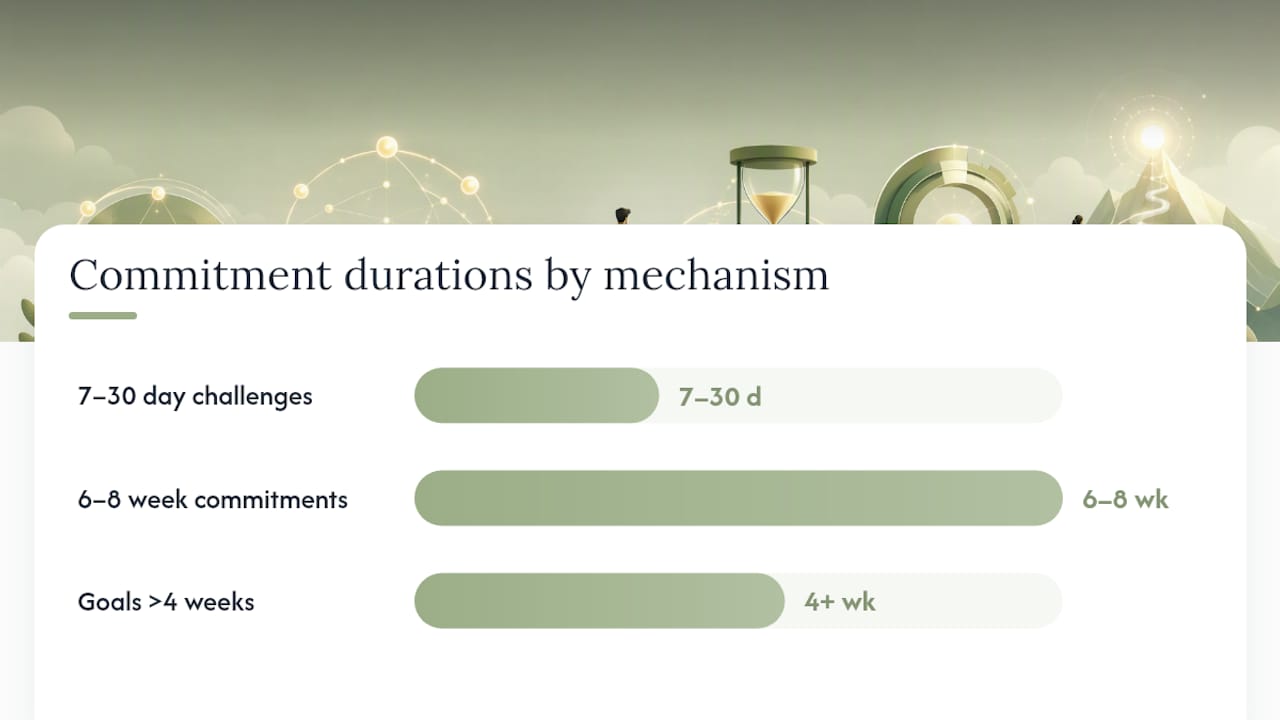
StickK is one of the most studied commitment platforms. Analysis of over 742,000 users found that adding an external referee, monetary stakes, and weekly reporting were each independently associated with higher success rates, with 6–8 week commitments showing strong outcomes. You set a goal, stake money, designate a referee, and report weekly.
Pros: Referee layer adds real social accountability. Free to use. Research-backed design.
Cons: Web-focused interface feels dated. Relies on honest self-reporting unless you add a referee.
Focusmate: body doubling for people who stall at starting
Focusmate pairs you with a stranger for a 25, 50, or 75-minute video session. You both state your task at the start, work silently, and check in at the end. The free tier allows three sessions per week. The mechanism is body doubling: the presence of another person watching (even silently) raises the cost of procrastinating.
Pros: Free tier is genuinely useful. Immediate accountability with no setup friction. Works for any task type.
Cons: Dependent on session availability. No long-term goal tracking.
Habitica: gamification that makes your teammates pay for your failures
Habitica converts your habits and daily tasks into an RPG character. Miss a habit and your character loses HP. Join a party and your missed tasks deal damage to your teammates' characters too. That social consequence is what separates Habitica from solo gamification apps.
Pros: Party mechanics create genuine social stakes. Huge community. Free tier is functional.
Cons: Game layer can feel juvenile for some users. Requires consistent engagement to maintain motivation.
GoalsWon: a real human who checks on you every single day
GoalsWon connects you with a human coach who reviews your daily check-ins and sends personalized feedback. Not automated. Not AI. A person reads what you wrote and responds. For users who have tried apps and found the lack of human judgment the missing piece, this is the closest thing to a personal accountability partner at scale.
Pros: Human review catches nuance automated tools miss. Daily cadence builds real momentum.
Cons: Paid subscription with no free tier. Coaching quality depends on coach match.
Boss as a Service: accountability through a real human "boss"
Boss as a Service assigns you a real human who emails you to check whether you completed your tasks, exactly like a manager would. You set goals, they follow up. Simple, slightly absurd, and surprisingly effective for people who respond to authority figures.
Pros: Human follow-up with no app to manage. Works for any goal type.
Cons: Email-based model limits real-time accountability. Paid only.
Forfeit: photo-verified stakes for habit accountability
Forfeit requires photo proof that you completed your habit before the deadline. Miss it and you pay a financial penalty. The photo verification layer is what distinguishes it from pure self-reporting apps, making it harder to rationalize skipping.
Pros: Photo proof reduces self-deception. Financial stakes create real motivation.
Cons: Photo verification can feel intrusive. Limited to habits that produce visible proof.
Focusmate, Forest, Flown: the focus-session trio
Forest gamifies phone avoidance by growing a virtual tree during your focus session. Open your phone and the tree dies. Flown takes a more structured approach with scheduled deep-work sessions and a community of focused workers. Both serve a narrower use case than full accountability apps: they enforce the work session itself, not the broader goal.
Pro Tip: Pair Forest or Focusmate with a stakes-based app like Flourishorforfeit. The focus tool handles execution; the stakes tool handles the commitment to show up at all.
Todoist and Lifestack: schedule-based accountability
Todoist is a full task manager with recurring tasks, reminders, and over 60 integrations. It does not enforce accountability through consequences, but its scheduling depth and automation make it the strongest option for people whose accountability failure is organizational rather than motivational. Lifestack adds energy-aware scheduling, syncing with your calendar to place tasks when you are most likely to complete them.
Habitify, Streaks, Loop Habit Tracker: the solo trackers
These three are habit trackers, not accountability apps in the strict sense. Habitify offers clean cross-platform analytics. Streaks is polished and integrates with Apple Health for sensor-verified habits on iOS. Loop Habit Tracker is open-source, lightweight, and Android-only. None of them enforce consequences for failure, which means they work best as maintenance tools after a behavior is already established.
Toggl Track: accountability through time visibility
Toggl Track does not set goals or enforce habits. It tracks where your time actually goes and generates reports. For freelancers and professionals whose accountability gap is billable-hour discipline or project time estimation, that visibility is the mechanism.
SideCoach and Tability: AI nudges and team OKRs
SideCoach uses AI to send daily nudges and progress reports tailored to business KPIs. Tability is built for small teams running OKR-style check-ins with shared progress dashboards. Both are narrower tools: SideCoach for solo business users, Tability for teams that need shared accountability rather than individual habit formation.
Coach.me: the coaching marketplace
Coach.me started as a habit tracker and evolved into a marketplace where you can hire a paid coach for specific skills. The community accountability layer is free; the coaching is not. It sits between a self-serve tracker and a full coaching service.
How to choose the right accountability app for your goals
The mechanism matters more than the feature list. Before comparing apps, answer these four questions:
- What failure cost actually motivates you? If losing $25 would genuinely sting, a stakes-based app will outperform a free tracker. If social embarrassment is your driver, a referee or party-based app fits better.
- Do you need live presence or asynchronous check-ins? Body doubling (Focusmate) requires scheduled sessions. Coaching apps (GoalsWon, Boss as a Service) work on your own schedule.
- How much friction will you tolerate for proof? Photo verification (Forfeit) is harder to fake but adds steps. SMS-verified affirmations (Flourishorforfeit) are low-friction. Self-reporting (StickK) requires honesty.
- Is this a short burst or a long-term behavior change? Short challenges (7–30 days) suit financial-stake apps. Ongoing habit formation suits trackers and coaching apps.
Feature checklist when evaluating any app:
- Accountability mechanism (stakes, referee, body doubling, gamification, coaching, schedule)
- Proof options: photo, sensor/Health integration, SMS, self-report
- Check-in frequency: daily, weekly, per session
- Referee or social layer: can someone else verify your progress?
- Payment and refund handling: are the rules transparent?
- Privacy and data policies: what happens to your check-in data?
- Exportability: can you pull your progress history?
Red flags to watch:
- No proof option for a high-stakes goal (pure self-reporting)
- Opaque forfeiture rules or unclear refund conditions
- No integrations with tools you already use
- Poor or infrequent reporting cadence
Research on accountability psychology confirms that self-monitoring alone is the lowest-friction mechanism but also the least effective for difficult goals. Adding a referee, a financial stake, or a live partner raises both friction and success rates. The right balance depends on how much accountability pressure you actually need.
For hybrid strategies: pair a body-doubling tool (Focusmate) with a habit tracker (Habitify or Streaks) for execution plus maintenance. Use a coaching app (GoalsWon) for long-term behavior change where nuance matters. Use a stakes app (Flourishorforfeit or Beeminder) for short, defined challenges where you need a hard commitment to start.
How we evaluated these apps
Every app on this list was assessed against five criteria: mechanism fit (does the accountability design match the stated use case?), real-world reliability (consistent uptime, active development, user-reported stability), pricing transparency (are the costs and refund/forfeiture rules clearly stated?), integrations (does it connect to tools users already rely on?), and evidence base (is the mechanism backed by behavioral research or large-scale usage data?).
Evaluation steps included:
- Hands-on trial of core features for each app
- Feature checklist review against the comparison dimensions above
- Privacy policy and data handling review
- Cross-referencing public user reviews on the App Store, Google Play, and independent review sites
- Verification of pricing tiers against each vendor's current published plans
Some apps were assessed primarily from vendor documentation and public reviews rather than full enterprise-scenario testing. Platform availability data reflects current vendor listings and may change.
This shortlist was compiled by Zack at Flourishorforfeit, drawing on behavioral research, hands-on app testing, and analysis of how each mechanism performs across different user profiles.
What the research says about commitment devices and why stakes often work
Commitment devices and accountability partners reliably increase short-term adherence. Sustained behavior change, though, depends on matching the mechanism to the user, iterating on failures, and building automaticity over time.
The clearest evidence on financial stakes comes from a large randomized trial on incentive programs: reward-based programs were accepted by most participants versus a much smaller fraction for deposit-based programs, but deposit programs showed higher efficacy among those who did accept them. The implication is direct: stakes work better for motivated users, but you have to opt in to feel the effect.
The StickK dataset analysis of over 742,000 users reinforces this. External referees, monetary stakes, weekly reporting, and 6–8 week commitments were each independently associated with higher success rates. That combination, a human who checks on you, money at risk, and a defined reporting cadence, is the design blueprint that the best accountability apps try to replicate.
A field trial of commitment-savings contracts found that deposit contracts can raise quit rates, but take-up is low and design details matter. Small stakes and clear refund conditions increase acceptance without sacrificing the motivational effect.
The Benefit Move trial on financial incentives for physical activity found that gain framing (you earn something back) outperformed loss framing in that sample, and deposit contracts had lower uptake than reward programs. Flourishorforfeit's refundable-stake model is essentially gain-framed: you get your money back if you succeed, which lowers the psychological barrier to starting.
On the habit-formation side, research on iterative mindset found that treating setbacks as experiments rather than failures correlates with habit automaticity and better outcomes in weight loss and workplace productivity. Apps that include a mulligan option or short challenge resets are not just being lenient; they are applying this principle directly.
Practical implications:
- Use financial stakes for short, defined challenges (7–30 days) where you need a hard start.
- Add a referee or human check-in layer for goals longer than four weeks.
- Prefer gain-framed stakes (refundable on success) if you are new to commitment devices.
- Use coaching or social mechanisms for long-term behavior change where nuance and iteration matter more than a single consequence.
- Pair any stakes app with an accountability partner model that fits your sticking point: friend, matched stranger, money referee, or professional coach.
What I would try first if I were starting today
Start with the mechanism that matches your actual failure pattern, not the app with the best reviews.
If you have tried free trackers and quit within two weeks, that is a motivation gap, not an organization gap. A 7-day Flourishorforfeit challenge at a stake that would genuinely sting ($25 is the sweet spot for most people) gives you a real consequence without a long commitment. Pair it with three Focusmate sessions per week for execution. Once the 7 days are done, review what worked and either extend to a 21-day challenge or switch mechanisms.
If you are already disciplined but scattered, Todoist or Lifestack handles the organizational layer. Add GoalsWon if you want a human who notices when you drift.
For teams, Tability's OKR check-ins create shared accountability without requiring everyone to use the same personal app.
The two-step starter plan:
- Pick one mechanism (stakes, body doubling, or coaching) and commit to a defined trial period, 7 days minimum.
- Schedule a 48-hour review after the first week. If the friction is too high, lower the stake or switch the mechanism. If it is too easy, raise the stake or shorten the check-in interval.
An iterative mindset, treating the first challenge as an experiment rather than a verdict on your willpower, is what the research on habit automaticity actually supports. The goal is not to pick the perfect app. The goal is to find the mechanism that sticks and iterate from there.
Flourishorforfeit is the recommended stakes option for this audience
Most accountability apps ask you to trust your own motivation. Flourishorforfeit puts something real on the line instead.
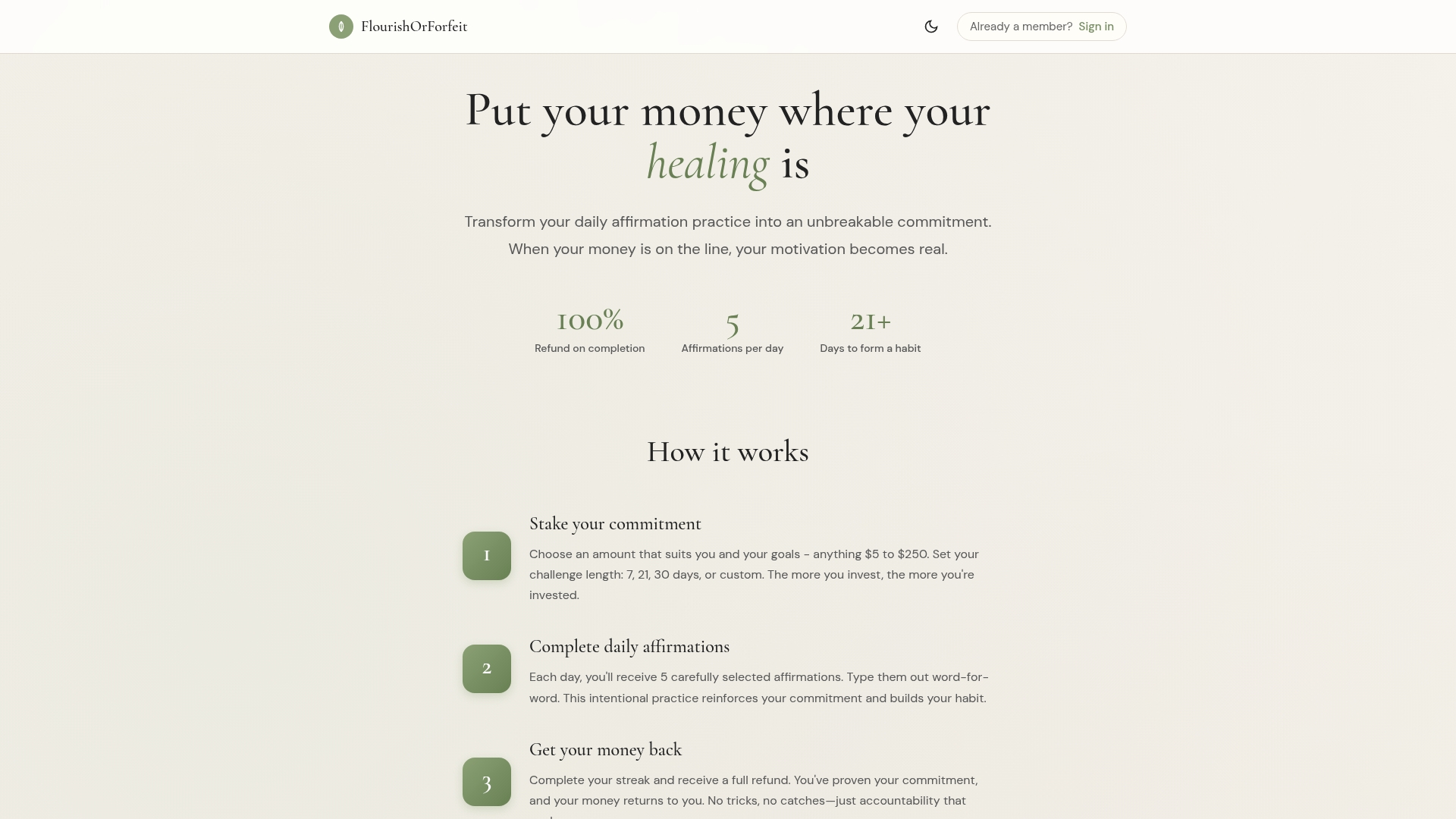
You stake between $5 and $250, choose a 7, 21, or 30-day challenge, and type five curated affirmations daily. Complete every day and your full stake comes back. Miss a day and you forfeit it. Payments run through Stripe, SMS verification confirms each check-in, and longer challenges include a mulligan so one rough day does not erase your progress. The refundable model is gain-framed by design: you are not gambling, you are making a recoverable commitment with a real cost for quitting.
For readers who have tried free habit trackers and found them too easy to ignore, this is the mechanism that changes the math. Start a challenge at Flourishorforfeit and pick a stake that would actually sting to lose.
Useful sources and further reading
- Motivation and successful goal pursuit: an iterative mindset predicts habits, weight loss, and work productivity | Current Psychology | Springer Nature Link
- https://pmc.ncbi.nlm.nih.gov/articles/PMC4471993/
- Put Your Money Where Your Mouth Is: Dataset and Analysis of Real World Habit Building Attempts | Proceedings of the International AAAI Conference on Web and Social Media
- CARES commitment-savings program field trial (Green Bank; Poverty Action Lab)
- Effectiveness of financial incentives for physical activity: Benefit Move (Journal of Medical Internet Research)
- Accountability psychology: Why it works for goals (GoalsAndProgress)
- Accountability Partner App: The 6 Best Options in 2026 (Habithuddle)