

The top gamified self-improvement apps for 2026 are Habitica, Forest, Beeminder, SuperBetter, BeeDone, and Flourishorforfeit. Each one takes a different approach to keeping you accountable, from RPG quests to financial stakes.
Here's the quick breakdown:
- Habitica — RPG-style habit tracker with avatars, quests, and guilds; free with optional $4.99/month subscription; iOS, Android, web
- Forest — Focus timer that grows virtual trees; one-time purchase around $1.99; iOS, Android, with a free Chrome extension
- Beeminder — Goal tracking with real monetary penalties for missing targets; free tier available, paid plans from $16/month; web, iOS, Android
- SuperBetter — Psychology-based resilience app using quests and power-ups; free with premium options; iOS, Android, web
- BeeDone — AI-powered task and habit manager with a one-week learning phase; free tier plus Pro paid plan; iOS, Android
- Flourishorforfeit — Financial stake platform where you stake $5–$250 on daily affirmation challenges and get a full refund on success; web-based
What are the best gamified self-improvement apps right now?
Six apps define the category in 2026. They differ sharply on mechanics, price, and who they actually work for.
| App | Core Gamification Mechanics | Best For | Pricing | Platforms | Unique Features |
|---|---|---|---|---|---|
| Habitica | Avatars, XP, quests, guilds | Community-oriented users | Free; $4.99/month | iOS, Android, web | Avatar customization, social challenges |
| Forest | Focus timer, virtual tree growth | Mindful focus, low distraction | ~$1.99 one-time | iOS, Android, Chrome | Real tree planting via earned coins |
| Beeminder | Monetary penalties, goal graphs | Disciplined, data-driven users | Free; from $16/month | Web, iOS, Android | Loss aversion via real financial stakes |
| SuperBetter | Quests, power-ups, allies | Mental health and resilience | Free; premium available | iOS, Android, web | Research-backed psychological resilience |
| BeeDone | AI personalization, habit streaks | Analytics-focused users | Free; Pro paid tier | iOS, Android | 1-week AI learning phase, advanced analytics |
| Flourishorforfeit | Financial stakes, daily affirmations | Accountability-driven users | $5–$250 stake (refundable) | Web | SMS verification, Stripe payments, full refund on success |
Habitica turns your to-do list into a full RPG. You build a character, join parties, and go on quests with other users. The Octalysis Framework identifies ownership and meaningful choice as Core Drive 4 in motivational design, and Habitica leans into that harder than any other app here. The avatar system creates a personal connection that basic streak counters never achieve.
Forest is the simplest app in this list, and that's its strength. You set a timer, a tree grows, and checking your phone kills it. The eco-friendly angle is real: users can spend earned in-app coins to plant actual trees through a partner program. It's a focus tool, not a full habit system.

Beeminder is blunt. Miss your goal, lose money. That's the whole model. It harnesses loss aversion to drive productivity, and it works well for people who respond to negative reinforcement rather than reward-based streaks. The data visualization is strong, with goal graphs that show your trajectory over time.
SuperBetter was built around academic research on resilience and post-traumatic growth. The app frames challenges as quests, setbacks as "bad guys," and support people as allies. It's the only app here specifically designed for mental health goals, including anxiety, depression recovery, and chronic illness management.
BeeDone personalizes its recommendations after a one-week learning phase, adapting to your behavior patterns before making suggestions. The Pro tier unlocks advanced analytics. Users who expect instant AI magic often drop off before the system has enough data to help them.
Flourishorforfeit takes a different angle entirely. You stake real money on a daily affirmation challenge, type each affirmation word-for-word to verify completion, and get every dollar back if you finish. Miss a day, and you forfeit. The 7, 21, and 30-day challenge lengths align with research on habit formation timelines.
How to choose the right gamified app for your goals
The app that works is the one that matches how you're actually motivated, not the one with the most features.
Start with your motivation style. If social pressure keeps you on track, Habitica's guild system or Flourishorforfeit's financial commitment will outperform a solo focus timer. If you're data-driven and want graphs of every variable, Beeminder's goal tracking is built for you. Forest suits users who need one simple cue to stay off their phone during work blocks.

Consider your goal type. SuperBetter is the clear choice for mental health and resilience work. BeeDone fits users juggling complex task lists who want AI to surface priorities. Flourishorforfeit works specifically for affirmation-based habit formation where the daily ritual matters as much as the outcome.
Budget matters too. Forest costs roughly $1.99 once. Beeminder's paid plans start at $16/month, and the financial stakes on top of that add up if you miss goals. Flourishorforfeit's model is different: your stake is refundable, so the cost is zero if you succeed.
Checklist before you commit:
- Does the app's core mechanic match your personality (social, competitive, financial, or visual)?
- Have you checked platform availability? BeeDone is mobile-only; Beeminder and Flourishorforfeit work on the web.
- Are you willing to give AI-driven apps like BeeDone a full week before judging them?
- Does the free tier give you enough to test the experience before paying?
Pro Tip: Gamified apps require 1–2 weeks before reward systems feel genuinely motivating. Don't quit during the first week when the novelty wears off but the intrinsic pull hasn't kicked in yet.
Why commitment contracts actually work for habit formation
Financial and social commitment contracts are among the most evidence-backed tools in behavioral economics for sustaining habits long-term.
A large-scale workplace field experiment found that self-funded commitment contracts generated lasting behavioral changes detectable even years after the original incentive program ended. A four-week incentive program alone produced only small lasting effects. Pairing it with a voluntary commitment contract changed the outcome entirely.
The mechanism is loss aversion. People feel the pain of losing something more acutely than the pleasure of gaining the same amount. Apps like Beeminder and Flourishorforfeit build this directly into their models, making the cost of failure immediate and concrete rather than abstract.
"Commitment contracts are low-cost, voluntary means of linking future behavior, which would be difficult to sustain otherwise, to present intentions. To the extent that longer contracts increase long-term exercise habit formation, carefully designed default values can lead users towards selecting commitment contracts with lengths optimal for addressing sedentary lifestyles." — NBER Working Paper, Committing to Exercise
Research also shows that public commitment combined with lifestyle interventions outperforms private tracking alone. Sharing your goal with a referee or support network adds a social layer that amplifies the financial one. Flourishorforfeit's SMS verification functions as a lightweight version of this, creating a daily confirmation ritual rather than passive logging.
Flourishorforfeit puts real money behind your habits
Most habit apps cost you nothing when you quit. Flourishorforfeit requires users to stake money that is refundable upon successful completion of the challenge.
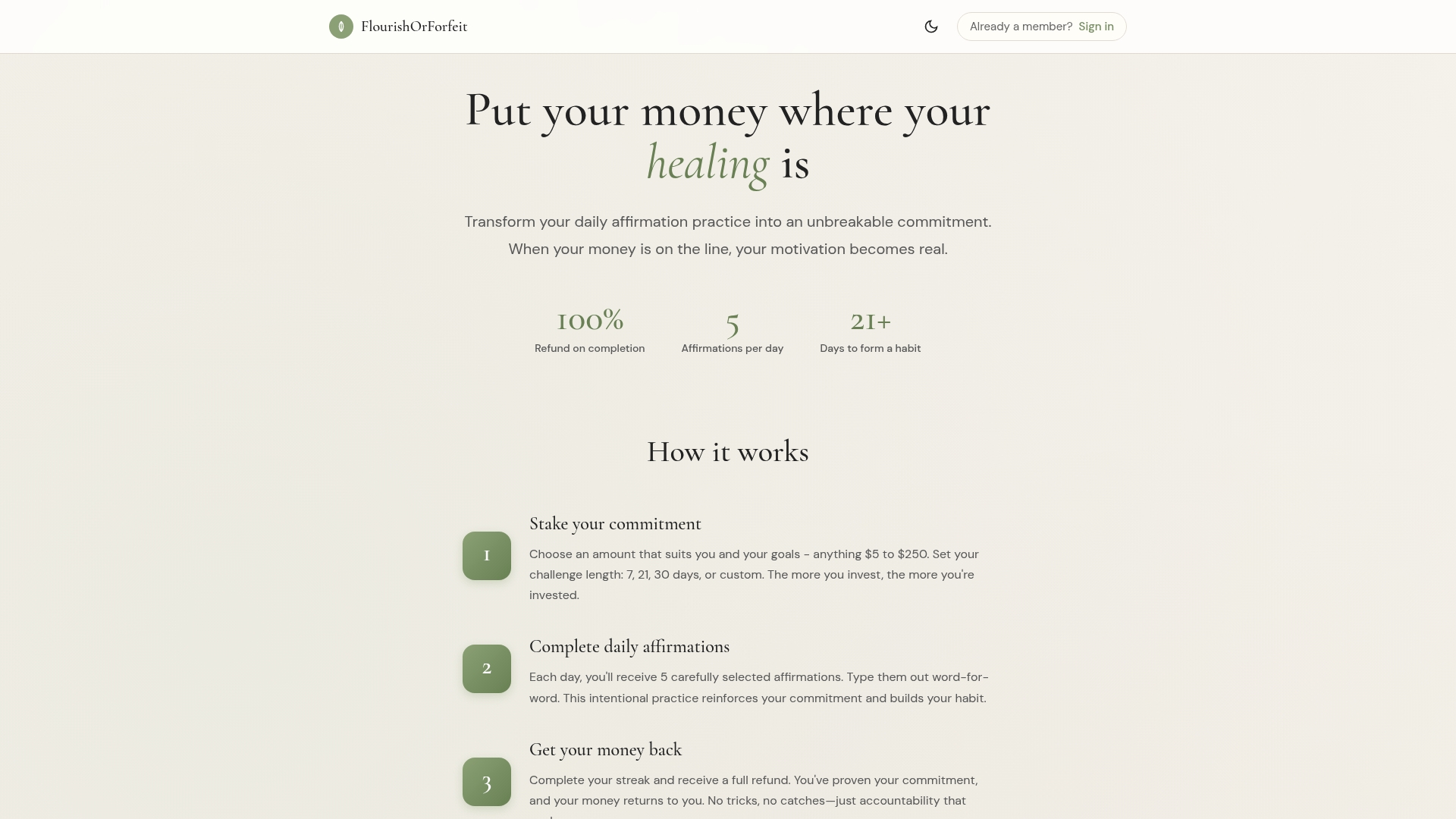
The model is straightforward: choose a monetary stake within a typical self-selected range, pick a 7, 21, or 30-day challenge, and type five curated affirmations word-for-word each day. Complete every day, and you get a full refund. Miss one, and you forfeit. Payments run through Stripe, and SMS verification confirms each session. Some challenge length options correspond to commonly cited habit formation timelines, and longer challenges include a mulligan for one missed day.
What separates Flourishorforfeit from Beeminder is the affirmation focus. This isn't about tracking gym visits or word counts. It's about daily mental reinforcement with a financial consequence attached. For users who've tried streaks and found them too easy to rationalize breaking, financial stakes add the friction that makes showing up non-negotiable.
Key Takeaways
The most effective gamified self-improvement apps combine financial or social accountability with consistent daily mechanics, not just streaks or badges alone.
| Point | Details |
|---|---|
| Match mechanics to motivation | Social users thrive with Habitica; financially motivated users do better with Beeminder or Flourishorforfeit. |
| Commitment contracts outlast incentives | Self-funded contracts produce behavioral changes lasting years after the original incentive ends. |
| AI apps need time | BeeDone requires a one-week learning phase before its personalization becomes genuinely useful. |
| Loss aversion drives compliance | Financial stakes create stronger follow-through than reward-only systems for most users. |
| Flourishorforfeit for affirmation habits | Users who want daily mental reinforcement backed by real financial stakes get a full refund on successful completion. |